A steelwork fabricator in Frankfurt, Germany supplying architectural metalwork holds 4 m lengths of 88.9 mm stainless pipe at 5 mm wall with a heavy mill seam and a transit scratch, and needs the metal cut back without thinning the wall past the buyer's own limit. SurfacePolish supplies finishing machines, media and compounds across borders and runs a free sample trial on parts shipped to Xiamen. This brief is written for a buyer in Frankfurt working on architectural metalwork; it describes equipment, media and a scoped sample review, not a local polishing service.
Will the finish be judged by a roughness number, by a physical reference panel, or by both, and who views the parts before they are accepted?
How much of the incoming mill seam, joint weld or transit scratch must be removed, and what minimum wall thickness has to remain after that removal?
Which faces of each profile are actually seen when installed, from what distance and under what light, and which faces can be finished to a coarser standard without it showing?
Not every face of a profile deserves the same effort. On a wall-mounted handrail the top and the outward face are read from standing height and from an angle, while the underside and the face against the wall are largely out of view. On a cladding mullion the sun-facing plane carries the reflection and the returns do not. Build a simple exposure map: which face, viewed from where, under what light, at what distance. That map settles where the tighter finish is specified and where a coarser one is honest. It also prevents over-finishing hidden faces, which costs cycle time and raises the risk of distortion on thin sections, and it tells the finishing supplier which face must be protected in every rack and stillage.
When an order repeats the same profile in volume, an arrangement that moves either the part or the working heads along the length can hold direction better than any batch chamber. A roller or belt conveyor carrying the length past fixed heads, or a carriage moving heads along a stationary length, produces a texture whose direction is set by the machine axis rather than by media motion. That is what makes the grain on adjacent lengths line up. The trade-offs are floor space, changeover when the profile or the length changes, and the need for reliable support of thin sections over the full travel. It is a line concept to be scoped against a real order book rather than a catalogue item.
| Machine route | Where it fits | What it will not do |
|---|---|---|
| Grinding finishing machine | Higher material removal where a mill seam, a joint weld or a deep scratch has to be cut back before surface refinement. | Removal is aggressive, so depth control and wall thickness limits have to be set before the cycle is run. |
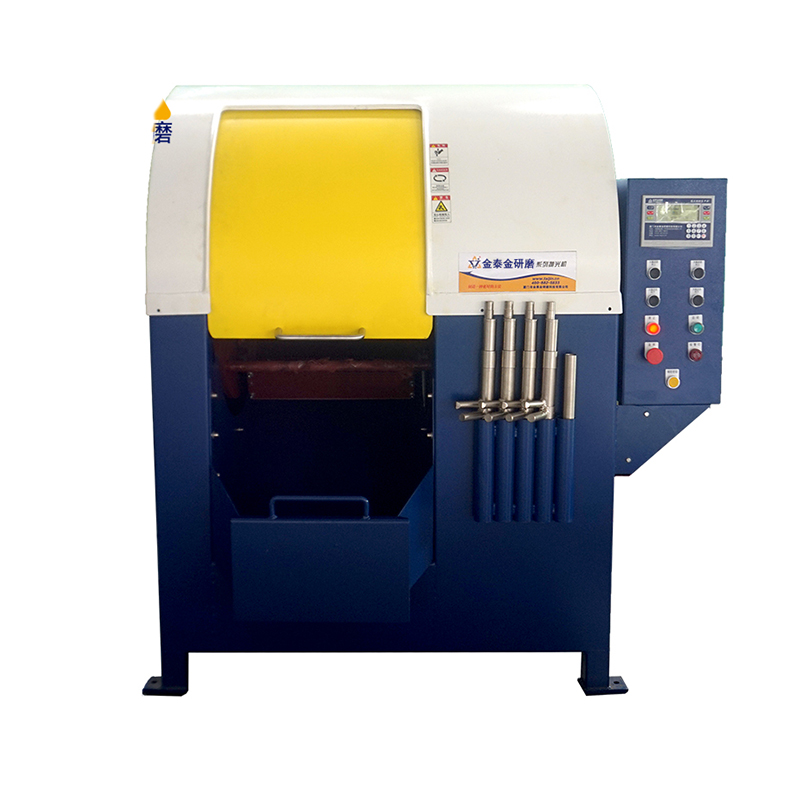
| Vibratory finishing machine, bowl type | General edge blending and surface refinement on brackets, base plates, cut spindles and other small fittings. | Chamber diameter caps the part length, and a long tube cannot be worked evenly in the circular bed. |
| Centrifugal barrel finishing machine | High-speed finishing of small precise parts, including where a bright appearance is required on a compact geometry. | Chamber geometry and high contact forces rule it out for long, thin-wall or easily marked sections. |
| Barrel finishing machine, rotary barrel tumbling | Gentle, precise batch processing of small parts, finials, sleeves and short connector pieces. | Part length and part-on-part contact restrict it to short fittings rather than long architectural runs. |
The compound carries cut debris away, keeps the media from loading, and buffers the chemistry against the metal. For stainless work the choice sits between mildly acidic, neutral and alkaline families, with the selection driven by the alloy, the incoming surface and the buyer's own residue limits rather than by a fixed rule. The behaviour that matters most on tube is rinsing. A compound that clings inside a six-metre bore will bleed out later onto a visible face and read as a stain or a patch. Pick a family that rinses cleanly, specify the rinse stages and the drying step, and agree how the interior of a sample length will be checked after the trial rather than assuming it is clean.
| Media | Best fit | Watch out for |
|---|---|---|
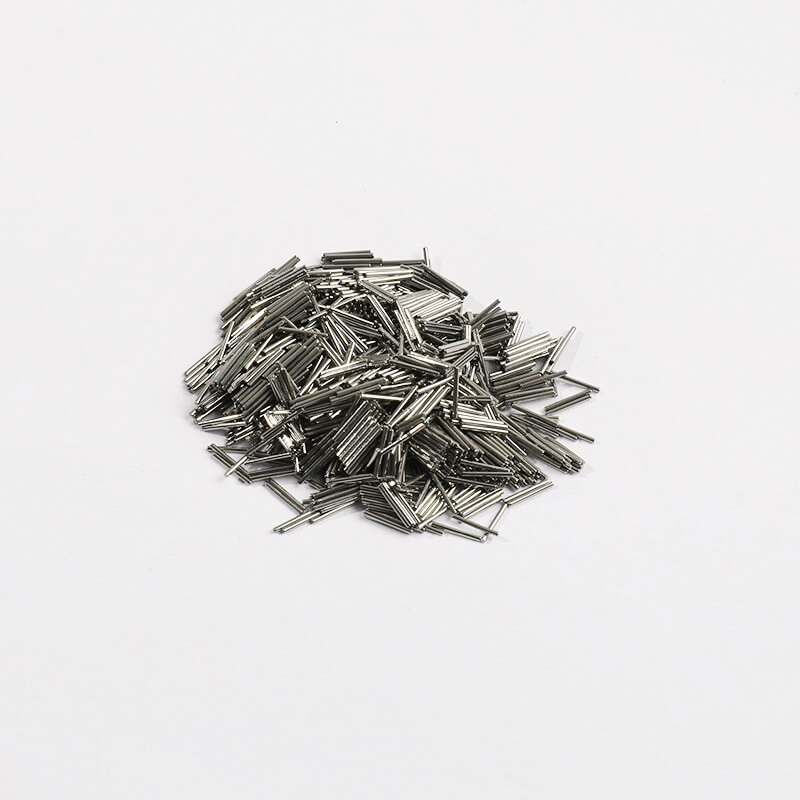
| Dry media, walnut shell and corn cob | Dry polishing and support for post-wet drying, particularly where a hollow section must not stay wet or carry residue inside. | Low cutting power, and dust generation and media separation need managing in the surrounding area. |
| Ceramic media, angle-cut triangles | Heavier cutting and seam removal on stainless tube and profiles, where a directional linear texture on the visible face is wanted. | Wears down and changes effective size class, generates sludge, and can over-round thin sections or chip on sharp edges. |
| Grinding media, alumina-based | Higher material removal where a mill seam, a joint weld or a deep transit scratch has to be cut back before refining. | Aggressive on thin wall, can over-round edges and change cross-section geometry, and needs tight depth control. |
| Plastic media, cylindrical | Light surface refinement on thin rectangular sections where holding the shape matters more than cutting power. | Little cut power, and the size class changes quickly as the media wears, which shifts the texture pitch over a run. |
Two welds matter on architectural tube: the longitudinal mill seam left by the tube maker, and the circumferential weld a fabricator makes when a length is joined to a fitting or to another length. Dressing either one means removing metal, and the risk is always the same. Too little leaves a visible band that reads as a line down the elevation; too much thins the wall and can leave a flat spot or a heat-affected zone that later shows as a different shade. The workable approach is to establish how much of the seam crown is to be removed, check it on a sectioned sample or with a depth gauge, and confirm that the wall at the dressed area still meets the buyer's requirement. Dressing is not a polishing step; it is a controlled removal step.
| Failure mode | Likely cause | How to catch it |
|---|---|---|
| Twist along the length | Differential working of opposite faces, or clamping and stacking that loads the section unevenly. | Rest the length on a reference surface and compare the angular orientation of the two end sections with a square. |
| Orange peel mottling on the visible face | Over-working with a coarse medium, or excessive pressure on a soft or thin section, which deforms the surface rather than cutting it. | Reflect a straight edge or a linear light source in the surface, and take a roughness reading at the same spot to show the divergence between number and appearance. |
| Shade change or discolouration at a welded area | The heat-affected zone responds differently to the same media and compound cycle than the parent metal. | Compare the area with adjacent metal under the agreed light and distance, and photograph it with a scale alongside the retained reference. |
| Bow along the length | Unsupported part in the bed, resting on hard supports, or lengths stacked while still wet. | Place on a surface plate or straight reference and measure the gap with a feeler gauge at several stations, against the incoming straightness record. |
Frankfurt am Main is the largest city in Hesse, a state whose industrial base the chemicals employers' association describes in terms of strong chemicals, pharmaceuticals, metal and electrical industries (s3). The city hosts Industriepark Höchst, where Infraserv provides infrastructure and services to customers in the chemical and pharmaceutical industries (s4). IHK Frankfurt am Main maintains an industry committee that brings industry and political decision-makers together to improve the framework conditions of the industrial location (s2), and describes the FrankfurtRheinMain region as one of the most important international business locations in Europe (s5). Air freight is anchored by Frankfurt Airport, which Fraport describes as handling more than 6,000 tonnes of cargo per day at FRA in 2019 (s1).
The nearest part of that base to this brief is medical: Chemical and pharmaceutical production is concentrated at Industriepark Höchst in Frankfurt, where Infraserv serves customers in the chemical and pharmaceutical industries (s4), and HessenChemie names chemicals and pharmaceuticals among Hesse's strong industrial branches (s3).
Frankfurt's industrial core is process-oriented chemical and pharmaceutical production plus the machinery and metal-working shops that serve it, where stainless-steel vessels, pipework, pump and valve components, and change parts are regularly reworked after welding, machining or laser cutting, and where burrs and residue are a contamination risk rather than a cosmetic matter. Plants of this type also tend to run mixed batches of small and large components, so equipment selection is usually driven by whether the same process can handle both without cross-contamination.
For a Frankfurt buyer the decisive question is usually the cleanliness specification rather than the finish alone: whether the part must be delivered free of burrs, loose particles and media residue for a chemical or pharmaceutical process, and which inspection method will be used to demonstrate that, because that determines both the process and the media chemistry.
Freight context: Frankfurt Airport (FRA), Fraport AG, Industriepark Höchst (chemical/pharma site with rail and road links). Frankfurt Airport handled more than 6,000 tonnes of cargo per day at FRA on Fraport's 2019 figures, alongside more than 1,400 daily aircraft movements (s1). For a Frankfurt plant the practical split is air freight for sample parts and urgent spares, and sea freight cleared through a container port with onward road or rail movement for a full machine.
German is the working language of drawings, contracts, test reports and conformity documentation, and German buyers normally expect English-language technical documentation to be supplied alongside it. Procurement is documentation-driven: the EU declaration of conformity, the technical file, and the identity of the EU-based importer or authorised representative are settled before the order, and the EORI registration and customs declaration are the importer's responsibility rather than the exporter's (c3, c4, c5). Germany is the world's leading machinery and equipment manufacturer, so quotations compete against established domestic builders on technical documentation and measurable process data rather than on price alone (c9). Payment, delivery and risk terms are normally fixed by written contract with a named Incoterm, and classification (commodity code) is commonly confirmed in writing before shipment because it drives the duty and the import declaration.
Germany sits inside the EU customs union, so Chinese-origin industrial machinery enters against the EU's common commercial tariff rather than a German national tariff, and the duty that applies is determined by the commodity code declared on the import declaration. China is one of the EU's largest goods trading partners and the EU has long run a goods deficit with it, while the Commission characterises the relationship as simultaneously partnership, competition and systemic rivalry (c1, c2). The Commission publishes the EU's trade agreements; no agreement with China appears in that overview, so Chinese-origin goods cannot claim a preferential origin rate and are assessed under the standard tariff (c8). German customs is administered by the Zoll under the Generalzolldirektion, and the importer must hold an EORI number - valid throughout the European Union and replacing the former German customs number - before goods can be cleared (c5, c6).
SurfacePolish supplies from Xiamen, China. The buyer's own destination rules, conformity marking, tariff classification and documentation responsibilities stay with the buyer; confirm them against the authorities named above before ordering.
A six-metre length cannot be examined in every square millimetre, so the acceptance plan has to say where the checked zones are and how often they are checked. Define stations along the length, for example near each end and at one or two intermediate points, decide whether the visible face of every length is checked or only a percentage of the batch, and set the reaction when a station fails: quarantine the lot, measure the rest of the lot, and record the finding. Keep the first accepted length as a physical reference and re-photograph it under the agreed light whenever the lighting setup changes. Photographs taken on different days with different cameras are a poor substitute for the retained part, though they are useful supporting evidence when the setup is fixed.
The trial result is only meaningful against a documented starting point. Photograph each sample under fixed lighting with a scale in frame, note the direction of the incoming texture, and take roughness readings at marked stations with the traverse direction recorded. Note the incoming straightness with the sample on a reference surface, the edge condition at cut ends, and any existing weld, scratch or discolouration. Keep one piece unprocessed as the baseline. When the trial parts come back, the comparison is between the returned parts and these records, not against memory. This is also how a buyer distinguishes a change made by the process from a feature that was present in the material when it arrived.
It depends on the order book rather than on the profile alone. A tub suits mixed work and shorter runs, because the set-up changes with the part and the chamber can take several profiles. A dedicated arrangement that carries the length past fixed heads, or moves heads along a stationary length, sets the texture direction by machine axis and holds it better over repeated runs, at the cost of floor space and changeover when the profile or length changes. Bring the profile mix, the typical and maximum lengths and the annual volume into the line-concept discussion; we can scope it, though the choice is yours.
Directional satin textures usually come from elongated or angular media rather than spheres. Angle-cut triangles and cylinders strike along their axis and leave a linear pattern, while rounded shapes produce overlapping craters that read soft and slightly dimpled. The size class then has to reach the root of a mill seam or the cove of a rectangular profile without lodging in the bore or a fixing hole. Media selection is confirmed against the actual part in a trial, because the incoming grain, the wall thickness and the visible face all shift the answer. Send sections from the production delivery and say which face must carry the grain.
No. SurfacePolish is a cross-border supplier of finishing machines, media and compounds, and runs a free sample trial on parts the buyer sends. The tube, pipe and profiles remain the buyer's own material from their own mill or stockholder, and we do not verify its grade, mill certificate or corrosion performance. Keeping those roles separate matters, because the appearance a finishing line can reach is limited by the incoming material: its alloy, its hardness, its existing grain and the condition it arrives in. Send material from the actual delivery rather than a hand-picked offcut.
Use Frankfurt, Germany as the destination on the enquiry and state whether the deliverable is equipment, media and compound, a representative sample review or a line concept. A destination does not imply local stock, a local service point or a local delivery time.
Frankfurt buyers specify surface, edge and cleanliness requirements through DIN/EN/ISO standards, and machinery must carry CE marking with an EU declaration of conformity before it is placed on the German market (c3, c7). Chemical and pharmaceutical customers add their own materials, documentation and cleaning requirements, and the VDA framework applies where the same parts feed automotive programmes (c10).
Sources were retrieved on 2026-09-29 and describe the local industrial and trade context only. They do not evidence any SurfacePolish project, shipment, installation or service in Frankfurt.
The seam and scratch have to be cut back to an even grain without reducing the wall below the buyer's own minimum.
Send the material, dimensions, approximate weight, batch quantity, the incoming condition and photographs of the difficult features. Mark which features must not be contacted by media and state how the result will be inspected. This form carries source reference PSEO-0327; quote it if you prefer an additional manual reference.
Open the SurfacePolish enquiry form Email a prepared enquiry
No price, lead time, certification or result is promised here. Confirm whether a sample trial is available for the specific part and what the trial can and cannot show.
Page PSEO-0327 · revised 2026-09-29 · cross-border equipment, media and scoped sample review. City context is sourced and cited above.
Use this local checker to identify missing part and inspection information. It prepares a technical-review brief; it does not approve a machine, process recipe or production result.
Complete the part details to prepare a review brief.
Email : info@surface-polish.com


 IPv6 network supported


 +86-592-2381506
