A refurbishment contractor in Hamilton, Canada adding to an architectural metalwork installation has new stainless handrail lengths that must sit beside tube already in service, where the original grain has weathered and dulled unevenly. SurfacePolish supplies finishing machines, media and compounds across borders and runs a free sample trial on removed sample sections shipped to Xiamen. This brief is written for a buyer in Hamilton working on architectural metalwork; it describes equipment, media and a scoped sample review, not a local polishing service.
Which faces of each profile are actually seen when installed, from what distance and under what light, and which faces can be finished to a coarser standard without it showing?
What texture direction is required, and how will that direction be preserved and compared across lengths that are finished in different lots?
Will the finish be judged by a roughness number, by a physical reference panel, or by both, and who views the parts before they are accepted?
For architectural tube the first screening number is the ratio of wall thickness to outside diameter or to width across the flat. A 60 mm round tube at 1.5 mm wall and the same tube at 3 mm wall are not the same finishing problem: the thin one will show ovality, bow and dents long before the finish is acceptable, and the media that works on the heavy wall will mark the light one. Ask for the mill's nominal wall plus the tolerance band, confirm the actual wall at three places with an ultrasonic gauge or a sectioned offcut, and note any thinning at bends or swaged ends. Record the as-received straightness as well, because a bowed length will read as a finish fault when it is really a handling fault.
Media must be small enough to reach the root of a seam or into the concave corner of a rectangular profile, and large enough not to lodge in the bore, in a drilled fixing hole or in a slotted channel. On small sections those two conditions conflict, and the resolution is usually to plug or cap the openings rather than to compromise the media. Where the visible face has a shallow cove, a smaller media class gives better access but wears faster and produces a shorter texture pitch. Where the profile is open, a larger class cuts more evenly and separates more easily. Decide the size against the tightest feature that must be finished and the smallest opening that must stay clear, and state both in the trial request.
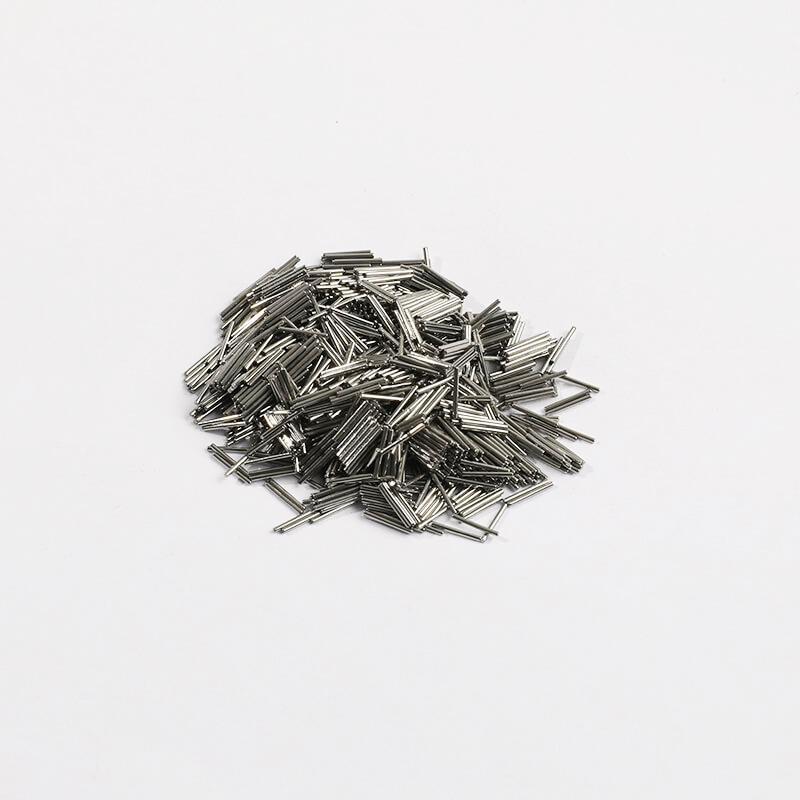
| Media | Best fit | Watch out for |
|---|---|---|
| Ceramic media, spheres and balls | General deburring and edge work on cut ends, brackets and small fittings in the same order as the long runs. | Produces overlapping crater-like marks that work against a linear brushed appearance and can peen a thin wall. |
| Dry media, walnut shell and corn cob | Dry polishing and support for post-wet drying, particularly where a hollow section must not stay wet or carry residue inside. | Low cutting power, and dust generation and media separation need managing in the surrounding area. |
| Plastic media, cylindrical | Light surface refinement on thin rectangular sections where holding the shape matters more than cutting power. | Little cut power, and the size class changes quickly as the media wears, which shifts the texture pitch over a run. |
| Plastic media, cones and triangles | Gentle work on thin-wall sections and softer alloys, and where marking or distortion is the main risk to be managed. | Slower cut and shorter media life, with limited effect on a deep scratch or a heavy seam. |
When an order repeats the same profile in volume, an arrangement that moves either the part or the working heads along the length can hold direction better than any batch chamber. A roller or belt conveyor carrying the length past fixed heads, or a carriage moving heads along a stationary length, produces a texture whose direction is set by the machine axis rather than by media motion. That is what makes the grain on adjacent lengths line up. The trade-offs are floor space, changeover when the profile or the length changes, and the need for reliable support of thin sections over the full travel. It is a line concept to be scoped against a real order book rather than a catalogue item.
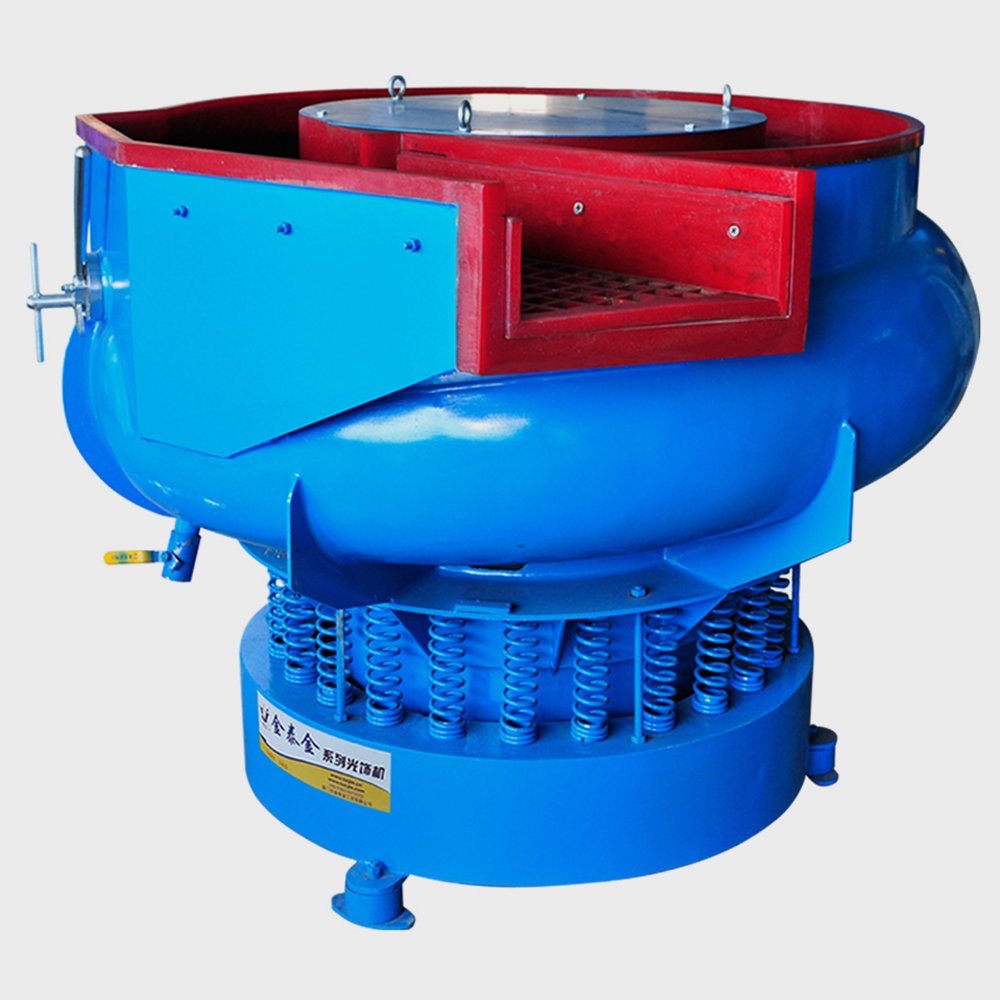
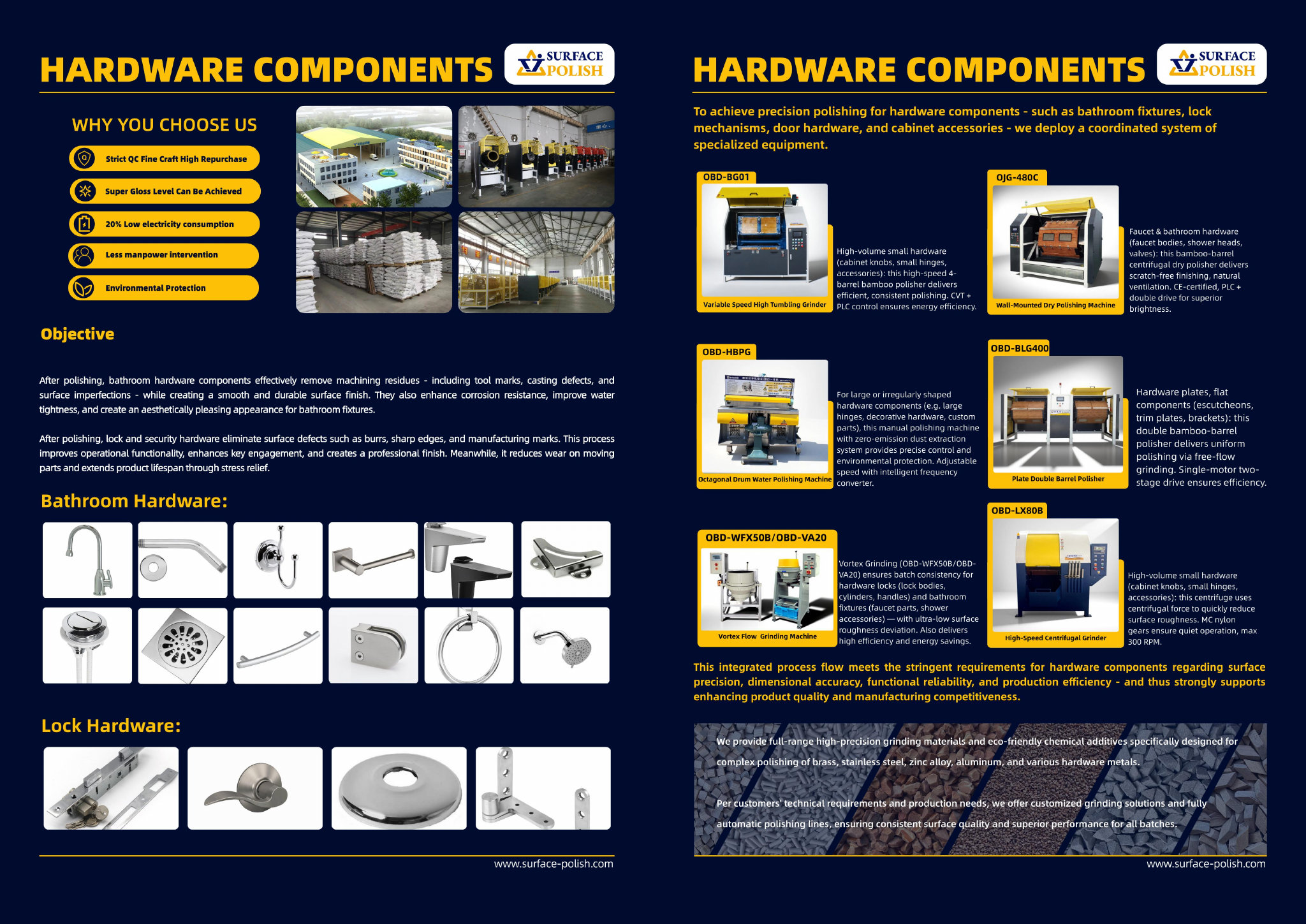
| Machine route | Where it fits | What it will not do |
|---|---|---|
| Dry polishing machine and dryer | Post-wet drying and dry luster work, particularly where a hollow section must come out clean and dry inside. | Dry routes cut less than wet media, and dust control and media separation need planning. |
| Centrifugal barrel finishing machine | High-speed finishing of small precise parts, including where a bright appearance is required on a compact geometry. | Chamber geometry and high contact forces rule it out for long, thin-wall or easily marked sections. |
| Tub vibrator | Long and large parts such as architectural tube and profiles, where the process length has to extend along the part. | Bed depth and fixture design decide whether thin sections survive, and fluid flow has to be checked at the far end of the chamber. |
| Magnetic finishing machine | Small precise parts and localised areas that are difficult to reach with loose media in a conventional chamber. | Size and mass limits keep it away from architectural lengths and large diameter profiles. |
Straight scratches running along the length are the signature defect of tube finishing. They come from three places: the incoming coil or straightener, media or swarf dragged along the surface during the cycle, and the handling between operations, when a finished length slides over a steel support. The first cannot be removed without cutting back real wall, so it has to be identified before the cycle is set. The second is controlled by media cleanliness, compound filtration and keeping the bed free of tramp metal. The third is controlled by padded cradles and a rule that nothing finished ever touches bare metal. Detection is by raking light along the axis at a low angle; a scratch invisible under diffuse light can be the first thing an occupier sees on a sunlit elevation.
| Failure mode | Likely cause | How to catch it |
|---|---|---|
| Hazy or milky patch with a dull reflection | Uneven cut, worn media in part of the chamber, or weak compound flow at the far end of a long tub. | Compare the near end and the far end of the same length, and check compound concentration and fluid flow at both ends of the chamber. |
| Longitudinal scratch running along the part axis | Incoming coil or straightener marks, media or swarf dragged along the surface during the cycle, or a finished length sliding over a bare support between operations. | View the surface under raking light at a low angle along the axis, compare the same station on several parts, and compare against the retained reference panel. |
| Orange peel mottling on the visible face | Over-working with a coarse medium, or excessive pressure on a soft or thin section, which deforms the surface rather than cutting it. | Reflect a straight edge or a linear light source in the surface, and take a roughness reading at the same spot to show the divergence between number and appearance. |
| Media or swarf trapped in a bore or channel | Open ends left unplugged, a media class smaller than the opening, or no defined retrieval step at the end of the cycle. | Endoscope or internally swab every sample length, and count media into and out of the batch as a routine check. |
Hamilton is Ontario's steel city, and the federal government describes its industrial base in those terms: the region plays a critical role in Ontario's economy, "supported by a diverse industrial base that includes advanced manufacturing, automation technologies, steel production, packaging solutions, and specialized industrial equipment". In August 2026, FedDev Ontario announced a combined investment of over CAD 12.5 million for nine Hamilton-area businesses responding to tariff-related pressures, and the backgrounder names the actual mix: custom robotic welding systems and CNC machining, steel fabrication of pressure equipment, hot-rolled steel bar production, prefabricated steel buildings, grease cartridges and industrial packaging, high-performance technical textiles for aviation, rail, defence and medical markets, and high-efficiency heating equipment. The national steel industry association frames the wider context, reporting over 40 producing facilities across Canada and a CAD 4.2 billion contribution to GDP from Canadian steel producers, and listing ArcelorMittal among its members. Automation is not incidental here — one of the funded Hamilton-area firms, Automation Design and Installation Inc., designs and manufactures custom robotic welding systems and automation solutions and is expanding into the mining and nuclear sectors.
The nearest part of that base to this brief is automation: FedDev Ontario funded Stoney Creek-based Automation Design and Installation Inc. with CAD 675,000 toward a CAD 1.8 million project to expand manufacturing capabilities and grow into the mining and nuclear sectors; the company designs and manufactures custom robotic welding systems and automation solutions and custom CNC machining.
Hamilton's steel and heavy-fabrication base produces rolled bar, pressure equipment, welded structures and machined components where scale, edge condition and coating preparation are recurring production issues: mill scale and oxide on hot-rolled product, weld spatter and heat-tint on fabricated stainless, and burrs on cut and machined edges. Pressure-equipment fabrication adds a code-driven requirement, because a ground or dressed weld and a clean base metal surface are part of what the fabricator's quality system has to demonstrate. The robotics and automation cluster is a second, distinct driver: custom welding and machining cells are built to run unattended, which raises the value of a deburring or finishing step that is equally repeatable and not dependent on an operator standing at the machine.
A Hamilton buyer should settle whether the finishing step exists to meet a code or customer surface requirement or simply to prepare a surface for coating, because the first case requires documented, inspectable results and the second is a cost-and-throughput decision; conflating the two usually produces either an over-specified machine or an audit finding. The second question is how the finishing step will be loaded and unloaded inside a fabrication shop that is already organised around heavy lifts and long cycle times, since material handling, not the finishing process itself, is where most of the labour and the safety risk sits in heavy fabrication.
Freight context: Port of Hamilton (Hamilton-Oshawa Port Authority), John C. Munro Hamilton International Airport, CN and CPKC rail corridors, Great Lakes / St. Lawrence Seaway marine corridor. Hamilton combines a Great Lakes seaport with an international airport and direct Class 1 rail service, which is what allows heavy steel and fabricated industrial equipment to move in and out by water and rail rather than only by road. The Hamilton Chamber of Commerce, one of the oldest in Canada, also issues certificates of origin and maintains a tariff and trade resource hub, reflecting how much of the local manufacturing base is export-facing.
Canada's national standards system is coordinated by the Standards Council of Canada (SCC), which accredits standards-development organizations, certification bodies and testing laboratories; the SCC and CSA Group websites could not be retrieved for citation during this research, so this entry rests on the accessible Government of Canada and CCOHS material below. The Canadian Centre for Occupational Health and Safety describes standards as documents that "establish specifications and procedures to ensure the reliability of the products, methods, and services people use every day on the job", and Innovation, Science and Economic Development Canada (ISED) maintains the federal entry point for "[t]he different types of standards and certifying bodies that can be used by your business". In practice a Canadian buyer of finishing equipment references (a) the Canadian electrical safety certification of the machine and its control panel, (b) provincial occupational health and safety regulation for machine guarding, lockout and dust/ventilation control, which in Canada is enforced by the provinces rather than by a single federal inspectorate, and (c) the buyer's own customer-specific surface finish, edge-condition and cleanliness specifications, which are contractual rather than national standards. Finishing-process standards in the ISO 25.080 machine-tool and ISO 8500-series surface-preparation families are the usual technical reference points, but product-level standards sold by CSA Group were not retrievable for verification here.
The customs authority is the Canada Border Services Agency (CBSA), and importers of commercial goods must work through the CBSA Assessment and Revenue Management (CARM) system, which is where registration, the duties-and-taxes calculator, advance rulings and national customs rulings, and the commercial accounting declaration (CAD) are handled. Documentation expectations are explicit: "You must provide proof of country of origin when you import goods into Canada and, in some cases, your goods must also be clearly marked", the invoice or sales receipt must carry "a complete description of the goods", "the selling price" and "any conditions and terms of the sale", and the value for duty must be declared in Canadian currency only. Duties and taxes are layered rather than single: customs duty on the tariff item, the Goods and Services Tax calculated on the duty-paid value, and potentially excise duty, excise tax, surtax or safeguard measures. Importers must also clear non-tariff gates: goods must be admissible, some goods need permits, certificates or inspections from other federal departments that the CBSA applies on their behalf, controlled goods under the Defence Production Act require consultation with the CBSA and Global Affairs Canada before import, and "Goods manufactured or produced wholly or in part by forced or prison labour are prohibited from entering Canada", with due diligence resting on the importer. For electrical machinery, the practical conformity route in Canada is certification of the product to Canadian electrical safety standards by an accredited certification body rather than a self-declared CE-style mark; buyers should confirm the specific certification body and mark required before shipment. For a first shipment of a finishing machine or a media/compound sample lot, the fastest way to remove classification and valuation uncertainty is to use the CARM portal to request an advance ruling for tariff classification and origin.
SurfacePolish supplies from Xiamen, China. The buyer's own destination rules, conformity marking, tariff classification and documentation responsibilities stay with the buyer; confirm them against the authorities named above before ordering.
Brushed stainless is not a specification, and a finish described only in words cannot be accepted or rejected consistently. The callout on the drawing or the purchase order should say what the texture direction is, which faces carry it, the roughness limit and the measurement conditions if a number is used, the reference panel and the viewing distance, and which faces are exempt. It should also say what is protected: threads, fixing holes, cut ends, machined lands. Where the buyer cannot express the finish numerically, a physical reference sample with a written description of its texture direction and appearance is still far better than an adjective. Sorting this out before a trial is what allows the trial result to be compared against a real requirement.
If two media classes or two cycle settings are being compared, run them on adjacent cut sections from the same original length so the only difference is the variable under test. Keep the position in the load and the cycle length the same where possible, label the pieces before they are run, and have the returned parts judged together in one session under the agreed light rather than one at a time as they arrive. Where several people are judging, ask each to rank the pieces before discussing them, so the strongest opinion does not set the answer. A handful of sections can compare two settings; what cannot be compared is one section from a trial run one week against another run later under different conditions.
No. SurfacePolish is a cross-border supplier of finishing machines, media and compounds, and runs a free sample trial on parts the buyer sends. The tube, pipe and profiles remain the buyer's own material from their own mill or stockholder, and we do not verify its grade, mill certificate or corrosion performance. Keeping those roles separate matters, because the appearance a finishing line can reach is limited by the incoming material: its alloy, its hardness, its existing grain and the condition it arrives in. Send material from the actual delivery rather than a hand-picked offcut.
No. A sample trial produces observations on the parts that were tested under the settings used; it is not a guarantee of a roughness value, a surface class, an appearance or a repeatable production result. Media wear, compound concentration and the condition of incoming material all move the finish over a run. What we can do is show what a given media, compound and cycle direction did to your part, and describe what would need to be controlled to hold that result. Acceptance criteria and any promise made to a client or specifier remain your own.
It should name the texture direction, the faces that carry it, the roughness limit and its measurement conditions if a number is used, the reference panel and the viewing distance, and the faces that are exempt. Add what must be protected: threads, fixing holes, cut ends and machined lands. Where the finish cannot be expressed numerically, a numbered physical reference sample with a written description of its texture direction and appearance is far more useful than an adjective such as brushed or satin. Settling this before a trial is what allows the trial result to be measured against a real requirement.
Use Hamilton, Canada as the destination on the enquiry and state whether the deliverable is equipment, media and compound, a representative sample review or a line concept. A destination does not imply local stock, a local service point or a local delivery time.
A Hamilton fabricator normally works to the material and fabrication standards named on the customer's drawing, the welding and pressure-equipment code applicable to the vessel or structure being built, and the customer's coating or surface-preparation specification. Plant-side requirements come from Ontario occupational health and safety regulation, including guarding, lockout and welding fume control, and equipment must carry Canadian electrical safety certification.
Sources were retrieved on 2026-09-29 and describe the local industrial and trade context only. They do not evidence any SurfacePolish project, shipment, installation or service in Hamilton.
The new lengths have to sit acceptably beside existing tube whose grain has weathered and dulled unevenly over time.
Send the material, dimensions, approximate weight, batch quantity, the incoming condition and photographs of the difficult features. Mark which features must not be contacted by media and state how the result will be inspected. This form carries source reference PSEO-0167; quote it if you prefer an additional manual reference.
Open the SurfacePolish enquiry form Email a prepared enquiry
No price, lead time, certification or result is promised here. Confirm whether a sample trial is available for the specific part and what the trial can and cannot show.
Page PSEO-0167 · revised 2026-09-29 · cross-border equipment, media and scoped sample review. City context is sourced and cited above.
Use this local checker to identify missing part and inspection information. It prepares a technical-review brief; it does not approve a machine, process recipe or production result.
Complete the part details to prepare a review brief.
Email : info@surface-polish.com


 IPv6 network supported


 +86-592-2381506