A decorative screen manufacturer in Ottawa, Canada supplying architectural metalwork uses 2.5 m lengths of 25 x 25 x 0.9 mm stainless tube, and the flat faces dent and the lengths twist whenever the parts are run loose in a batch. SurfacePolish supplies finishing machines, media and compounds across borders and runs a free sample trial on sections shipped to Xiamen. This brief is written for a buyer in Ottawa working on architectural metalwork; it describes equipment, media and a scoped sample review, not a local polishing service.
Which faces of each profile are actually seen when installed, from what distance and under what light, and which faces can be finished to a coarser standard without it showing?
What texture direction is required, and how will that direction be preserved and compared across lengths that are finished in different lots?
Will the finish be judged by a roughness number, by a physical reference panel, or by both, and who views the parts before they are accepted?
For architectural tube the first screening number is the ratio of wall thickness to outside diameter or to width across the flat. A 60 mm round tube at 1.5 mm wall and the same tube at 3 mm wall are not the same finishing problem: the thin one will show ovality, bow and dents long before the finish is acceptable, and the media that works on the heavy wall will mark the light one. Ask for the mill's nominal wall plus the tolerance band, confirm the actual wall at three places with an ultrasonic gauge or a sectioned offcut, and note any thinning at bends or swaged ends. Record the as-received straightness as well, because a bowed length will read as a finish fault when it is really a handling fault.
Compound concentration, flow rate and water quality need managing along the whole chamber, not just at the inlet. In a long tub the fluid front can arrive weaker at the far end, so media there cuts differently and the finish drifts from one end of a part to the other. Hard water leaves scale and spotting; very soft water may foam differently with the same compound. Foam is a real constraint in a tub because it cushions the media and reduces cut, and it overflows into the surrounding area. Set concentration by measurement rather than by appearance, check flow at both ends of the chamber, and plan drag-out and rinse-water handling before the first production run.
| Media | Best fit | Watch out for |
|---|---|---|
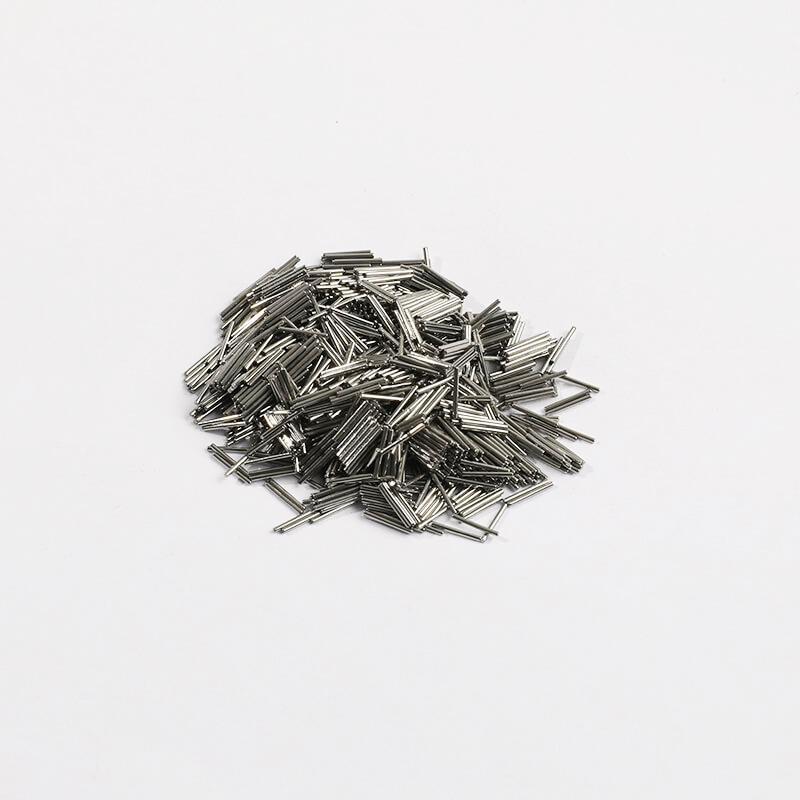
| Plastic media, cylindrical | Light surface refinement on thin rectangular sections where holding the shape matters more than cutting power. | Little cut power, and the size class changes quickly as the media wears, which shifts the texture pitch over a run. |
| Ceramic media, spheres and balls | General deburring and edge work on cut ends, brackets and small fittings in the same order as the long runs. | Produces overlapping crater-like marks that work against a linear brushed appearance and can peen a thin wall. |
| Ceramic media, angle-cut triangles | Heavier cutting and seam removal on stainless tube and profiles, where a directional linear texture on the visible face is wanted. | Wears down and changes effective size class, generates sludge, and can over-round thin sections or chip on sharp edges. |
| Plastic media, cones and triangles | Gentle work on thin-wall sections and softer alloys, and where marking or distortion is the main risk to be managed. | Slower cut and shorter media life, with limited effect on a deep scratch or a heavy seam. |
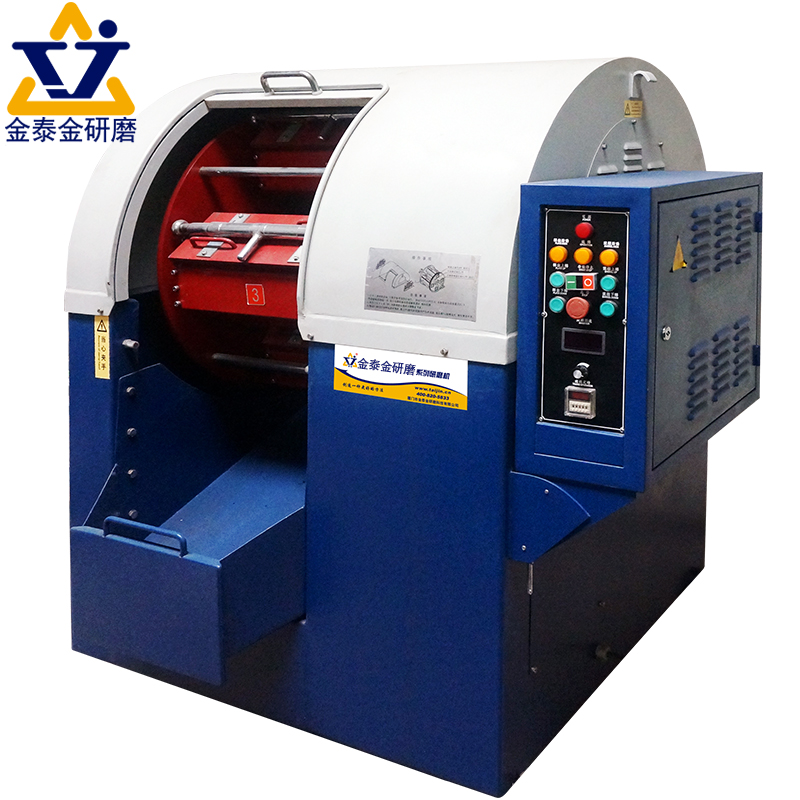
A tub vibrator uses a long rectangular chamber, so the process length can be extended along one axis while the bed depth stays modest. That allows a length to be carried through a media bed deep enough to work the visible face and shallow enough to keep the load moving. Decisions to settle with the equipment supplier are the usable chamber length against the longest part, whether lengths run one at a time or several end to end, how the part is supported so it does not ride on top of the media, and how the open ends are kept clear of media. A tub also tolerates the mid-length supports that thin rectangular sections need, which a circular chamber cannot accommodate without a purpose-built fixture.
| Machine route | Where it fits | What it will not do |
|---|---|---|
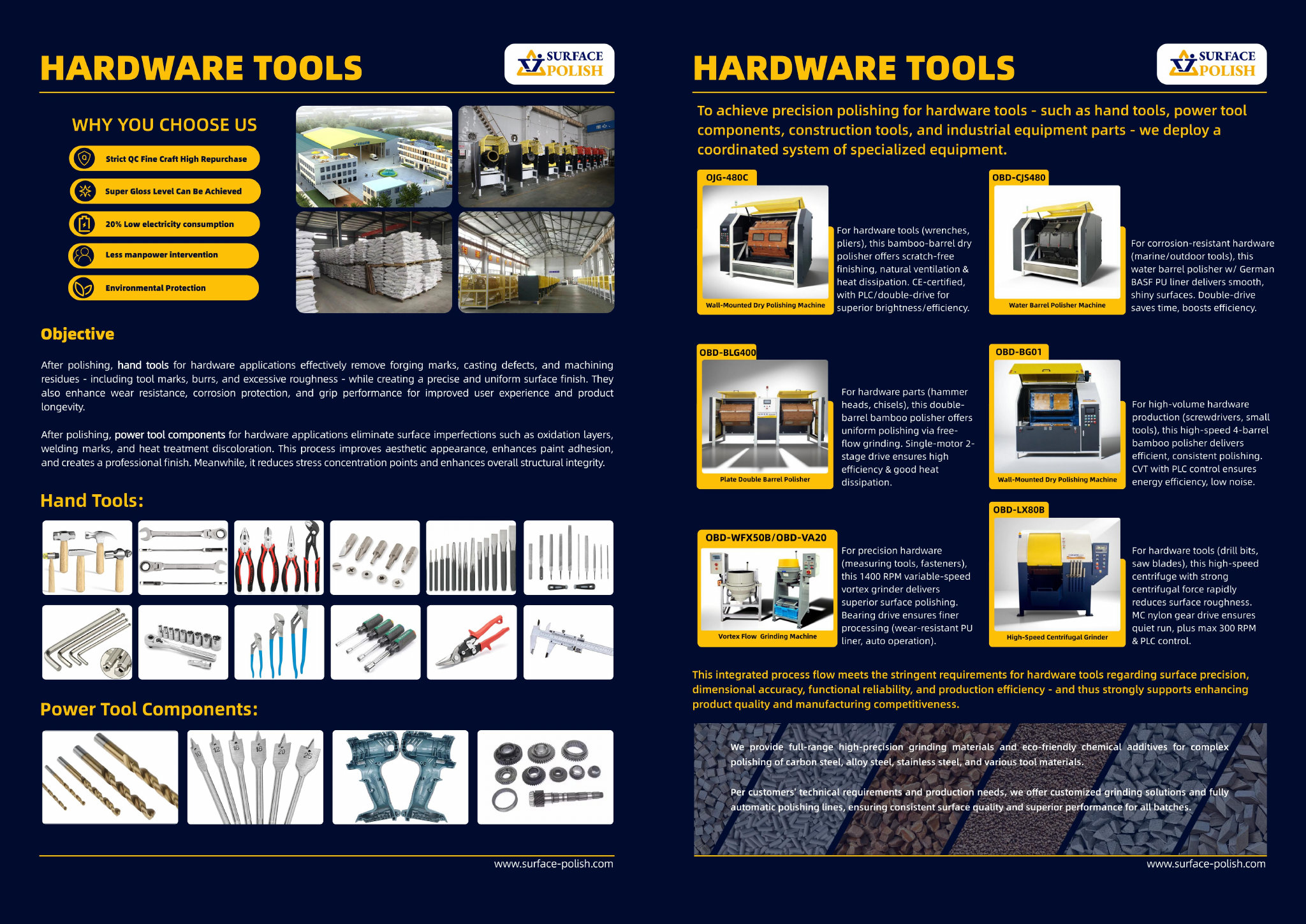
| Barrel finishing machine, rotary barrel tumbling | Gentle, precise batch processing of small parts, finials, sleeves and short connector pieces. | Part length and part-on-part contact restrict it to short fittings rather than long architectural runs. |
| Magnetic finishing machine | Small precise parts and localised areas that are difficult to reach with loose media in a conventional chamber. | Size and mass limits keep it away from architectural lengths and large diameter profiles. |
| Grinding finishing machine | Higher material removal where a mill seam, a joint weld or a deep scratch has to be cut back before surface refinement. | Removal is aggressive, so depth control and wall thickness limits have to be set before the cycle is run. |
| Dry polishing machine and dryer | Post-wet drying and dry luster work, particularly where a hollow section must come out clean and dry inside. | Dry routes cut less than wet media, and dust control and media separation need planning. |
Open tube ends, slotted channels and drilled fixings all collect media, swarf and compound. The failure is rarely visible at the end of the cycle; it shows up after the part is installed, when compound weeps from a bore onto a visible face or when a trapped particle works loose during handling and scratches an adjacent length. Treat removal as a designed step rather than a rinse: plug or cap what should never see media, count media in and out of each batch, and agree how the interior of a sample length will be checked, using an endoscope or an internal swab where the bore matters. Ask what the drying step after a wet process does for a closed section, because a hollow part that stays wet inside is a delayed defect.
| Failure mode | Likely cause | How to catch it |
|---|---|---|
| Shade change or discolouration at a welded area | The heat-affected zone responds differently to the same media and compound cycle than the parent metal. | Compare the area with adjacent metal under the agreed light and distance, and photograph it with a scale alongside the retained reference. |
| Media or swarf trapped in a bore or channel | Open ends left unplugged, a media class smaller than the opening, or no defined retrieval step at the end of the cycle. | Endoscope or internally swab every sample length, and count media into and out of the batch as a routine check. |
| Visible band or line along the mill seam | The seam crown was not cut back evenly, or the media class was too small to reach the seam root without over-working the surrounding surface. | Look along the seam line under raking light from both sides, and measure the remaining crown with a depth gauge on a sectioned sample. |
| Flat spot or thinning at a dressed weld | Too much material removed in one place while chasing the weld toe, usually with too coarse a medium or too much pressure. | Measure wall thickness with an ultrasonic gauge across the dressed area, and lay a straightedge over the joint to reveal a flat. |
Ottawa's economy is built on technology and on the federal government, and its manufacturing base is concentrated in aerospace and defence, telecommunications, cybersecurity and semiconductors. Ottawa Economic Development (Invest Ottawa) states its position directly: "Canada's Capital Region Mobilizes to Lead as a Global Defence Innovation Hub", and the national defence industry association that head offices in Ottawa reports that Canada's defence and security sector generated close to CAD 17.3 billion in revenues in 2024, contributed CAD 11.1 billion in GDP and supported 81,800 jobs, with 538-plus enterprises operating across every region. Ontario accounts for 35 per cent of that national defence industry footprint, with aircraft mission systems and simulation systems, combat vehicle manufacturing, and aircraft and aircraft parts manufacturing among the key Ontario activities. Ottawa's public research and testing infrastructure is part of the industrial story, including Bayview Yards and Area X.O, which the city's economic development agency describes as a secure R&D complex for next-generation smart mobility, autonomy and connectivity technologies built for all-weather experimentation.
The nearest part of that base to this brief is medical: Canada's defence and security industry, whose national association is headquartered in Ottawa, contributes CAD 11.1 billion to GDP and supports 81,800 jobs, with the sector's capabilities spanning mission systems, sensors, electronics and platform systems, the electronics and sensor supply base that medical device manufacturers also draw on.
Ottawa's aerospace, defence and photonics manufacturing is characterised by small, high-value machined and optical parts where burrs are functionally unacceptable: a burr on a waveguide, a sensor housing, a connector face or a machined mounting surface changes electrical or optical performance rather than just appearance. Defence and space work also imposes cleanliness and contamination control, which makes the choice of finishing media and the completeness of media separation a quality-control question rather than a housekeeping one. Because volumes are low and part values are high, the practical requirement is a process that can be set up and documented for a small lot without risking damage to the part.
An Ottawa buyer should settle the contamination and media-residue question before selecting equipment, because in this market a part that is dimensionally correct but carries embedded media or a smear of compound is a defect, and the media-separation and rinse stages therefore need to be specified as carefully as the finishing machine itself. The second question is documentation and traceability: if the part serves a defence or space programme, the finishing process needs a controlled specification and records that the customer's quality system will accept, and that has to be designed in rather than retrofitted.
Freight context: Ottawa Macdonald-Cartier International Airport, Via Rail and freight rail corridors, Highway 417 corridor to Toronto and Montreal, Ottawa River / St. Lawrence corridor connections to Montreal. Ottawa has no seaport, so equipment arrives by air or through a coastal or St. Lawrence container port with onward truck or rail movement, and the city's position on the Highway 417 corridor between Toronto and Montreal gives it practical access to both of Canada's central freight networks. For high-value, low-volume components the airport and the Montreal and Toronto air-cargo gateways are the relevant nodes, while sample parts and media can move by courier.
China is one of Canada's ten principal merchandise trading partners and the second-largest single-country source of Canadian imports after the United States: Statistics Canada reported CAD 5,369 million of balance-of-payments imports from China in January 2025, against a CAD 2,299 million bilateral merchandise deficit that month. Canada has no free trade agreement with China, so Chinese-origin industrial machinery enters under the Most-Favoured-Nation (MFN) tariff column of the Canadian Customs Tariff; the preferential treatments listed in the tariff (CUSMA/UST and MXT, CETA/CEUT, CPTPP/CPTPT, UKT, KRT and others) do not include China, and preferential rates require proof of origin plus the applicable shipping rules, so a China-origin machine cannot claim them. Tariff classification is mandatory work, not a formality: vibratory, barrel, centrifugal and disc finishing machines are classified in Chapter 84 ("Nuclear reactors, boilers, machinery and mechanical appliances; parts thereof") according to the function of the machine, and the ten-digit Canadian tariff item drives both the duty rate and the statistics. A further landed-cost risk sits outside the tariff schedule: under the Special Import Measures Act (SIMA), the CBSA and the Canadian International Trade Tribunal may apply anti-dumping and countervailing duties to named goods, so a buyer should check the measures-in-force list for the specific product before assuming the MFN rate is the final duty.
Canada is a bilingual market for selling purposes: English is the working language of procurement outside Quebec, while Quebec buyers (Montreal, Quebec City) normally expect French-language quotations, technical documentation and after-sales support, and Quebec's Charter of the French Language makes French the default for commercial documentation in the province. Procurement expectations are formal and auditable: a Canadian industrial buyer will typically ask for the tariff classification and country of origin up front, expect a commercial invoice that satisfies the CBSA invoice requirements, and expect the seller to provide proof of origin for any preferential claim. Payment norms are bank-to-bank, with wire transfer or letter of credit rather than platform payment, and Canadian buyers commonly net-30 to net-60 from invoice, so a cross-border seller should price the working-capital gap into the offer. Certificates of origin for export documentation are issued through chambers of commerce, which is why chambers such as the Hamilton Chamber of Commerce and the Winnipeg Chamber of Commerce offer document certification. The current trade environment adds policy risk to landed cost: Canadian federal programs are explicitly framed around responding to U.S. tariffs, with the FedDev Ontario Regional Tariff Response Initiative described as supporting "businesses to respond to tariff pressures" in southern Ontario, and tariff and surtax measures can change by Order in Council, so quotations should state the tariff basis and the date on which the landed-cost calculation was made.
SurfacePolish supplies from Xiamen, China. The buyer's own destination rules, conformity marking, tariff classification and documentation responsibilities stay with the buyer; confirm them against the authorities named above before ordering.
An architectural finish is graded by what an observer sees, so the acceptance standard has to name the viewing distance and the light. A panel that looks uniform from three metres can show every mark from half a metre, and a finish assessed under direct sun reads differently from one assessed under diffuse daylight or a linear light source. Agree the distance for the closest inspection the installed part will receive, the lighting condition, and the viewing angle, then write them into the finish callout. A practical arrangement is a physical reference panel accepted once by the buyer, kept in controlled storage, and used as the comparison standard. Numerical limits can sit beside it, but the panel is what a dispute is actually settled against.
The first production batch is usually the best one, because the media charge is fresh and the fluid is at its set point. What changes over a run is media wear, which reduces cut and shifts the surface toward a finer and dimmer appearance; the build-up of swarf and fines in the fluid; and the arrival of material from a different heat or mill finish. Plan for it: a media top-up and screening routine with a defined interval, a fluid change criterion based on measurement rather than appearance, and a check length kept from each lot for comparison. Agree in advance what will be done if a later lot does not match the retained reference, so the decision is procedural rather than improvised.
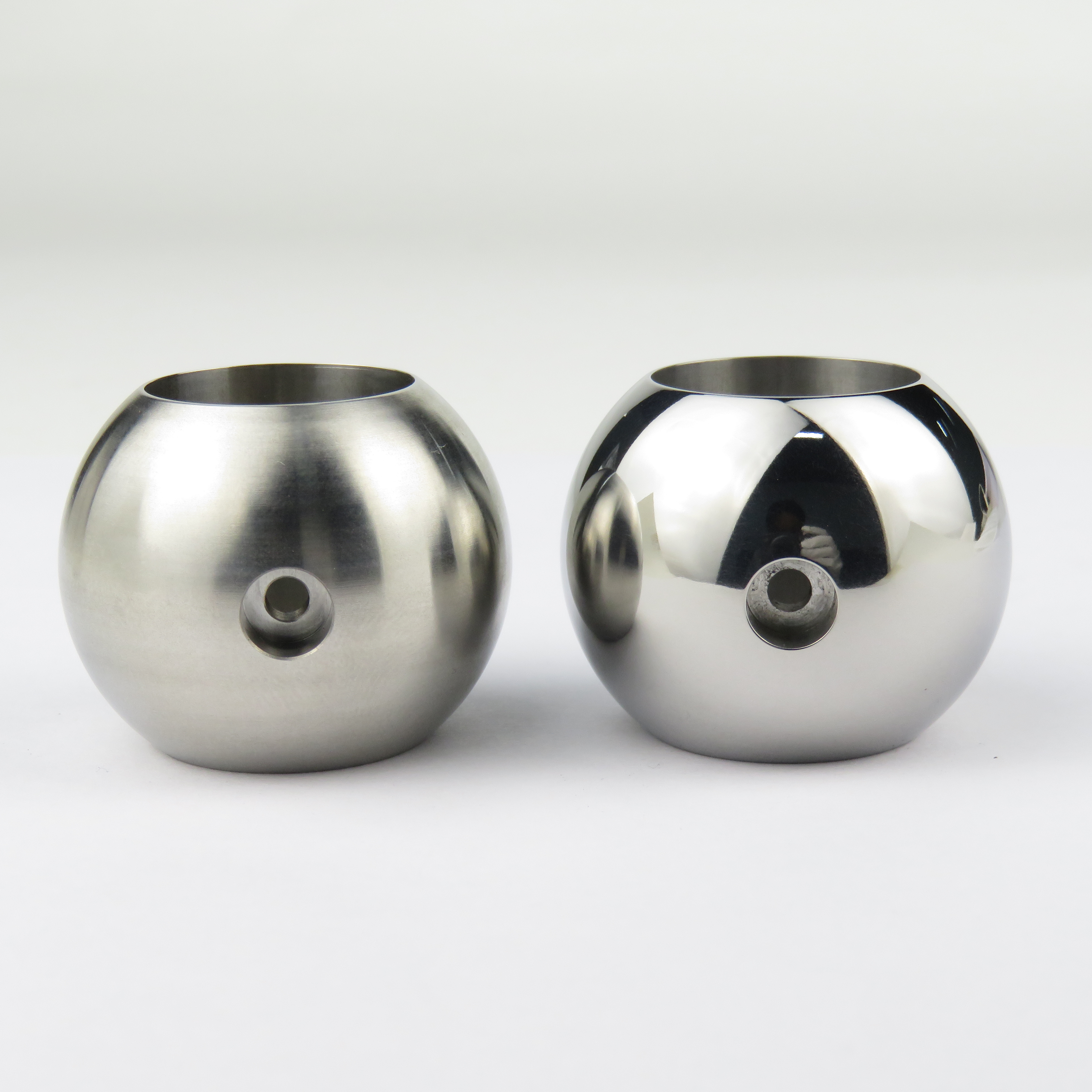
Ra is a two-dimensional amplitude average taken along one traverse, and it says nothing about the pitch of the texture, its direction, or whether the surface reflects light evenly. Two surfaces with the same Ra can look quite different: one can carry a directional brushed grain and the other a mottled, hazy appearance with a broken reflection. That is why an architectural callout normally needs both a numeric limit with its measurement conditions and a physical reference viewed at an agreed distance under agreed light. The number controls the process, and the panel settles the argument.
No. A sample trial produces observations on the parts that were tested under the settings used; it is not a guarantee of a roughness value, a surface class, an appearance or a repeatable production result. Media wear, compound concentration and the condition of incoming material all move the finish over a run. What we can do is show what a given media, compound and cycle direction did to your part, and describe what would need to be controlled to hold that result. Acceptance criteria and any promise made to a client or specifier remain your own.
A round bowl moves its load on a circular path in a chamber whose diameter caps the part length, and extending that chamber to take a six-metre length stops being practical. The deeper issue is the bed: a long tube occupies too much of the load for the media to circulate around it, so the part is dragged and struck instead of worked evenly. Long sections are better run in a tub, where the process length can be extended along one axis, or on a dedicated arrangement that moves the part or the heads along the length.
Use Ottawa, Canada as the destination on the enquiry and state whether the deliverable is equipment, media and compound, a representative sample review or a line concept. A destination does not imply local stock, a local service point or a local delivery time.
An Ottawa buyer in aerospace, defence or space supply chains works to the prime contractor's or programme's process specification, contamination-control and traceability requirements, plus controlled-goods obligations where the item is defence-controlled under the Defence Production Act. On the plant floor, Ontario occupational health and safety rules and Canadian electrical certification apply as elsewhere in the province.
Sources were retrieved on 2026-09-29 and describe the local industrial and trade context only. They do not evidence any SurfacePolish project, shipment, installation or service in Ottawa.
The flat faces dent and the lengths twist whenever they are run loose together, and the buyer cannot accept that geometry loss.
Send the material, dimensions, approximate weight, batch quantity, the incoming condition and photographs of the difficult features. Mark which features must not be contacted by media and state how the result will be inspected. This form carries source reference PSEO-0177; quote it if you prefer an additional manual reference.
Open the SurfacePolish enquiry form Email a prepared enquiry
No price, lead time, certification or result is promised here. Confirm whether a sample trial is available for the specific part and what the trial can and cannot show.
Page PSEO-0177 · revised 2026-09-29 · cross-border equipment, media and scoped sample review. City context is sourced and cited above.
Use this local checker to identify missing part and inspection information. It prepares a technical-review brief; it does not approve a machine, process recipe or production result.
Complete the part details to prepare a review brief.
Email : info@surface-polish.com


 IPv6 network supported


 +86-592-2381506