A decorative screen manufacturer in Hiroshima, Japan supplying architectural metalwork uses 2.5 m lengths of 25 x 25 x 0.9 mm stainless tube, and the flat faces dent and the lengths twist whenever the parts are run loose in a batch. SurfacePolish supplies finishing machines, media and compounds across borders and runs a free sample trial on sections shipped to Xiamen. This brief is written for a buyer in Hiroshima working on architectural metalwork; it describes equipment, media and a scoped sample review, not a local polishing service.
Will the finish be judged by a roughness number, by a physical reference panel, or by both, and who views the parts before they are accepted?
How much of the incoming mill seam, joint weld or transit scratch must be removed, and what minimum wall thickness has to remain after that removal?
Which faces of each profile are actually seen when installed, from what distance and under what light, and which faces can be finished to a coarser standard without it showing?
An elevation is normally assembled from lengths made and finished at different times, so the lot definition matters as much as the finish itself. Decide how parts are grouped into finishing lots: by profile, by wall thickness, by alloy heat, by incoming mill finish, or by the date the material arrived. Then decide how lot identity is preserved through finishing, fabrication and despatch, because a length that cannot be traced back to a lot cannot be compared with another length in a dispute. Where an order will be produced over several weeks, keep an unprocessed reference length from the first delivery in store, and keep a finished reference panel from the first accepted lot. Both are needed before anyone can argue about whether a later length matches.
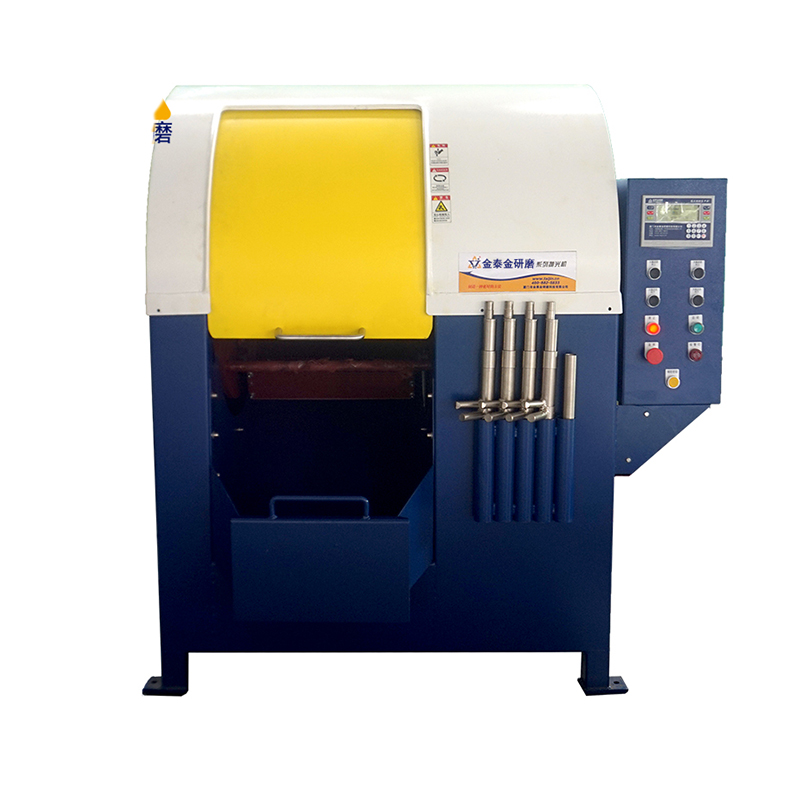
A conventional vibratory bowl moves its load around a circular path in a chamber whose diameter sets the maximum part length. Extending that chamber to take a six-metre length stops being practical, because the volume grows far faster than the usable length. The deeper problem is the bed. A long tube lying in a bowl is either too large a fraction of the load, in which case the media cannot circulate around it, or it is dragged and struck by the rest of the load in a way that produces local marking rather than an even longitudinal texture. The geometry, not the power, is the limitation. This is the practical reason long architectural sections are run in a tub or on a dedicated longitudinal arrangement rather than in a general-purpose bowl.
| Machine route | Where it fits | What it will not do |
|---|---|---|
| Grinding finishing machine | Higher material removal where a mill seam, a joint weld or a deep scratch has to be cut back before surface refinement. | Removal is aggressive, so depth control and wall thickness limits have to be set before the cycle is run. |
| Disc finishing machine | Fast, high-energy cycles for small to medium fittings and hardware where a short cycle is the priority. | The high energy that makes it fast will distort, mark or bend thin and long parts. |
| Dry polishing machine and dryer | Post-wet drying and dry luster work, particularly where a hollow section must come out clean and dry inside. | Dry routes cut less than wet media, and dust control and media separation need planning. |
| Centrifugal barrel finishing machine | High-speed finishing of small precise parts, including where a bright appearance is required on a compact geometry. | Chamber geometry and high contact forces rule it out for long, thin-wall or easily marked sections. |
Compound concentration, flow rate and water quality need managing along the whole chamber, not just at the inlet. In a long tub the fluid front can arrive weaker at the far end, so media there cuts differently and the finish drifts from one end of a part to the other. Hard water leaves scale and spotting; very soft water may foam differently with the same compound. Foam is a real constraint in a tub because it cushions the media and reduces cut, and it overflows into the surrounding area. Set concentration by measurement rather than by appearance, check flow at both ends of the chamber, and plan drag-out and rinse-water handling before the first production run.
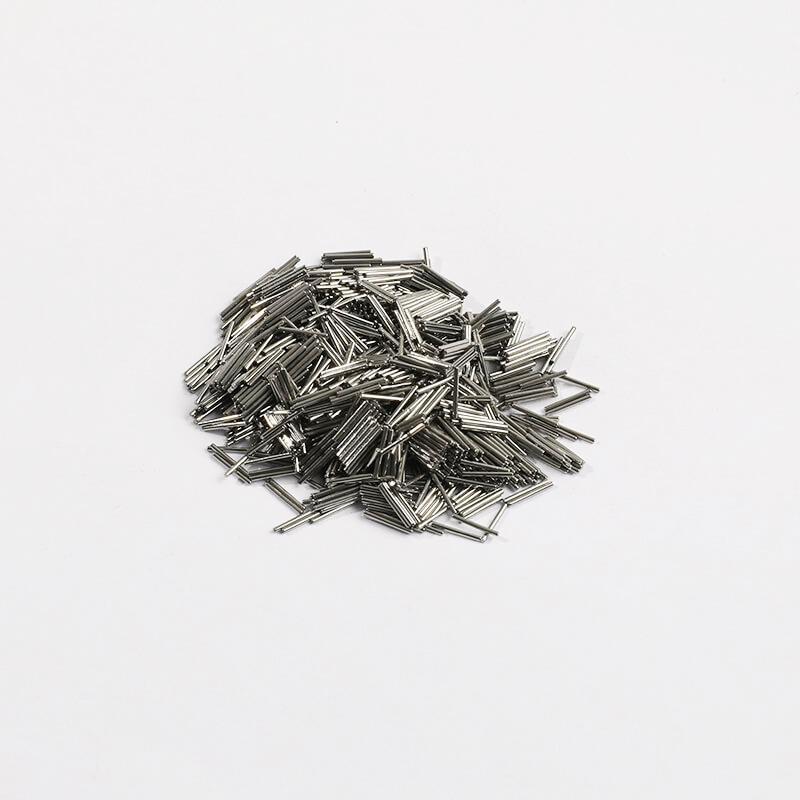
| Media | Best fit | Watch out for |
|---|---|---|
| Plastic media, cones and triangles | Gentle work on thin-wall sections and softer alloys, and where marking or distortion is the main risk to be managed. | Slower cut and shorter media life, with limited effect on a deep scratch or a heavy seam. |
| Dry media, walnut shell and corn cob | Dry polishing and support for post-wet drying, particularly where a hollow section must not stay wet or carry residue inside. | Low cutting power, and dust generation and media separation need managing in the surrounding area. |
| Plastic media, cylindrical | Light surface refinement on thin rectangular sections where holding the shape matters more than cutting power. | Little cut power, and the size class changes quickly as the media wears, which shifts the texture pitch over a run. |
| Steel media, pins and balls | Bright, strongly linear appearance on stainless where a higher-lustre finish is wanted on accessible faces. | Heavy, needs tight compound control to stay clean and separated, and any iron-bearing debris is a contamination question the buyer has to define and verify. |
Straight scratches running along the length are the signature defect of tube finishing. They come from three places: the incoming coil or straightener, media or swarf dragged along the surface during the cycle, and the handling between operations, when a finished length slides over a steel support. The first cannot be removed without cutting back real wall, so it has to be identified before the cycle is set. The second is controlled by media cleanliness, compound filtration and keeping the bed free of tramp metal. The third is controlled by padded cradles and a rule that nothing finished ever touches bare metal. Detection is by raking light along the axis at a low angle; a scratch invisible under diffuse light can be the first thing an occupier sees on a sunlit elevation.
| Failure mode | Likely cause | How to catch it |
|---|---|---|
| Hazy or milky patch with a dull reflection | Uneven cut, worn media in part of the chamber, or weak compound flow at the far end of a long tub. | Compare the near end and the far end of the same length, and check compound concentration and fluid flow at both ends of the chamber. |
| Loss of ovality or out-of-round section | A load applied across the wall during the cycle or while the part sits in a rack. | Measure the diameter across two axes at several stations along the length with a caliper or micrometer. |
| Media or swarf trapped in a bore or channel | Open ends left unplugged, a media class smaller than the opening, or no defined retrieval step at the end of the cycle. | Endoscope or internally swab every sample length, and count media into and out of the batch as a routine check. |
| Compound residue weeping from a hollow section | Incomplete rinsing of the interior, or a drying step that does not reach inside a closed section. | Stand the length on end over a clean cloth for a set period, then inspect the bore interior for residue after drying. |
Hiroshima Prefecture's industrial base is organised around automobiles and their supply chain: the prefecture's industry department describes a Hiroshima automotive industry-academia-government collaboration council founded in 2015 by six organisations with a 2030 vision, together with a car-technology innovation centre that supports automotive suppliers, and a separate division for automotive industry promotion and for advanced manufacturing and new technology development. Aircraft is a second organised cluster: the prefecture's Hiroshima Aircraft Industry Promotion Association (エアクラフトひろしま) builds an aircraft supply chain with more than 150 member companies and organisations, mainly manufacturers in the prefecture, and the prefecture also runs a carbon-neutral manufacturing business programme. Hiroshima Port is designated an international hub port (国際拠点港湾) serving the Hiroshima Bay industrial zone.
The nearest part of that base to this brief is automotive: The prefecture's industry department states that a Hiroshima automotive industry-academia-government collaboration council was founded by six organisations in 2015 with a 2030 vision, and that it operates programmes to activate the Hiroshima area's automotive industry.
Automotive parts produced around Hiroshima - machined, stamped and cast components - are deburred and edge-conditioned before assembly, painting or inspection, and the prefecture's supplier-development programmes put supplier process capability under review. Aircraft supply-chain work adds documented process control and cleanliness expectations, so surface condition and edge quality have to be repeatable and recordable rather than merely visually acceptable.
A Hiroshima buyer should first settle which customer regime governs the part - automotive drawing tolerances for edge break and burrs, or an aircraft flow-down requiring documented process control and cleanliness - because that determines how much of the finishing process has to be specified, recorded and verified rather than judged by eye.
Freight context: 広島港 (Hiroshima Port), 国際拠点港湾. The prefecture's port authority office states that it manages and promotes the international hub port Hiroshima Port together with the ports in Etajima City, serving the Hiroshima Bay industrial zone; that makes Hiroshima Port the natural route for incoming finishing machines and for outbound sample parts.
Chinese industrial machinery entering Japan is classified under the Customs Tariff Law, whose harmonised schedule sets the classification and the General Rate; the Temporary Tariff Measures Law sets a Temporary Rate for certain products, and where the WTO rate or an EPA rate for the goods is lower, that lower rate is applied. The applied rate therefore depends on the exact commodity code, and on whether an economic partnership agreement covers the goods and their origin, so a landed-cost figure has to be confirmed against the specific machine before it is quoted. Japan Customs' monthly country table for August 2026 records exports to China of 1,809,133 million yen and imports from China of 2,361,239 million yen, the largest single-country line in the Asian table, with imports from China up 22.5 per cent year on year.
The national standards body is the Japanese Industrial Standards Committee (JISC), which states that JIS covers industrial and mineral products, data, services and management systems under the Industrial Standardization Act. Its technical divisions include mechanical engineering, ferrous materials and metallurgy, nonferrous materials and metallurgy, ceramics, medical equipment and safety appliances, and aircraft and aviation, which are the divisions a finishing or deburring requirement is normally read against. Product certification runs through the JIS Mark Certification Scheme, operated by accredited certification bodies compliant with ISO/IEC 17065; as of March 2019 there were 24 JIS-accredited bodies, three of them outside Japan, with about 8,700 certifications issued, and the scheme explicitly covers foreign manufacturers, processors and exporters.
SurfacePolish supplies from Xiamen, China. The buyer's own destination rules, conformity marking, tariff classification and documentation responsibilities stay with the buyer; confirm them against the authorities named above before ordering.
Grain direction is the most common reason a set of individually acceptable lengths is rejected as an assembly. Where two lengths butt at a joint, their texture direction has to run the same way, and the pitch and brightness have to be close enough that the joint does not read as a line. That is a planning decision made before the lengths are run, not a sorting decision made afterwards: define the grain direction on the drawing, mark the direction on every length, and keep the orientation through fabrication and despatch. Then inspect the lengths laid end to end as they will be installed, under the agreed light, rather than one at a time on a bench. A direction reversal that is obvious in an assembly can be invisible in a single part.
The first production batch is usually the best one, because the media charge is fresh and the fluid is at its set point. What changes over a run is media wear, which reduces cut and shifts the surface toward a finer and dimmer appearance; the build-up of swarf and fines in the fluid; and the arrival of material from a different heat or mill finish. Plan for it: a media top-up and screening routine with a defined interval, a fluid change criterion based on measurement rather than appearance, and a check length kept from each lot for comparison. Agree in advance what will be done if a later lot does not match the retained reference, so the decision is procedural rather than improvised.

Directional satin textures usually come from elongated or angular media rather than spheres. Angle-cut triangles and cylinders strike along their axis and leave a linear pattern, while rounded shapes produce overlapping craters that read soft and slightly dimpled. The size class then has to reach the root of a mill seam or the cove of a rectangular profile without lodging in the bore or a fixing hole. Media selection is confirmed against the actual part in a trial, because the incoming grain, the wall thickness and the visible face all shift the answer. Send sections from the production delivery and say which face must carry the grain.
Length is a handling question before it is a finishing question. Long architectural sections are run in a tub or on a dedicated longitudinal arrangement rather than a round bowl, and the practical limit depends on the chamber length, the supports available and how the length is packed for shipping. For a trial, send cut sections from the production material and one full-length piece where bend or end effects could matter, so the arrangement is chosen against the real part rather than an average. Parts travel to our factory in Xiamen, and we do not process anything in Japan or Hiroshima.
No. A sample trial produces observations on the parts that were tested under the settings used; it is not a guarantee of a roughness value, a surface class, an appearance or a repeatable production result. Media wear, compound concentration and the condition of incoming material all move the finish over a run. What we can do is show what a given media, compound and cycle direction did to your part, and describe what would need to be controlled to hold that result. Acceptance criteria and any promise made to a client or specifier remain your own.
Use Hiroshima, Japan as the destination on the enquiry and state whether the deliverable is equipment, media and compound, a representative sample review or a line concept. A destination does not imply local stock, a local service point or a local delivery time.
Japanese buyers work to JIS (Japanese Industrial Standards) administered through the Japanese Industrial Standards Committee (JISC); the official JIS database allows standards to be read but not printed, so buyers normally work from purchased or licensed copies and from the JIS number cited on drawings. Management-system certification to ISO 9001 is commonly required as general industry practice, and aerospace customers flow down their own additional process and documentation requirements.
Sources were retrieved on 2026-09-29 and describe the local industrial and trade context only. They do not evidence any SurfacePolish project, shipment, installation or service in Hiroshima.
The flat faces dent and the lengths twist whenever they are run loose together, and the buyer cannot accept that geometry loss.
Send the material, dimensions, approximate weight, batch quantity, the incoming condition and photographs of the difficult features. Mark which features must not be contacted by media and state how the result will be inspected. This form carries source reference PSEO-0867; quote it if you prefer an additional manual reference.
Open the SurfacePolish enquiry form Email a prepared enquiry
No price, lead time, certification or result is promised here. Confirm whether a sample trial is available for the specific part and what the trial can and cannot show.
Page PSEO-0867 · revised 2026-09-29 · cross-border equipment, media and scoped sample review. City context is sourced and cited above.
Use this local checker to identify missing part and inspection information. It prepares a technical-review brief; it does not approve a machine, process recipe or production result.
Complete the part details to prepare a review brief.
Email : info@surface-polish.com


 IPv6 network supported


 +86-592-2381506