An interior fit-out contractor in London, United Kingdom is working on architectural metalwork with 3 m flat oval stainless tube, 60 x 20 mm, and the buyer's own inspector is rejecting the brightness under raking light rather than by roughness number. SurfacePolish supplies finishing machines, media and compounds across borders and runs a free sample trial on cut sections shipped to Xiamen. This brief is written for a buyer in London working on architectural metalwork; it describes equipment, media and a scoped sample review, not a local polishing service.
How much of the incoming mill seam, joint weld or transit scratch must be removed, and what minimum wall thickness has to remain after that removal?
Which wall thickness and section shape in the order is most likely to distort, and what fixture, cradle or support will protect it?
What is the longest length in the order, and how will it be supported, carried and packed at every stage between finishing, fabrication and installation?
For architectural tube the first screening number is the ratio of wall thickness to outside diameter or to width across the flat. A 60 mm round tube at 1.5 mm wall and the same tube at 3 mm wall are not the same finishing problem: the thin one will show ovality, bow and dents long before the finish is acceptable, and the media that works on the heavy wall will mark the light one. Ask for the mill's nominal wall plus the tolerance band, confirm the actual wall at three places with an ultrasonic gauge or a sectioned offcut, and note any thinning at bends or swaged ends. Record the as-received straightness as well, because a bowed length will read as a finish fault when it is really a handling fault.
When an order repeats the same profile in volume, an arrangement that moves either the part or the working heads along the length can hold direction better than any batch chamber. A roller or belt conveyor carrying the length past fixed heads, or a carriage moving heads along a stationary length, produces a texture whose direction is set by the machine axis rather than by media motion. That is what makes the grain on adjacent lengths line up. The trade-offs are floor space, changeover when the profile or the length changes, and the need for reliable support of thin sections over the full travel. It is a line concept to be scoped against a real order book rather than a catalogue item.
| Machine route | Where it fits | What it will not do |
|---|---|---|
| Dry polishing machine and dryer | Post-wet drying and dry luster work, particularly where a hollow section must come out clean and dry inside. | Dry routes cut less than wet media, and dust control and media separation need planning. |
| Grinding finishing machine | Higher material removal where a mill seam, a joint weld or a deep scratch has to be cut back before surface refinement. | Removal is aggressive, so depth control and wall thickness limits have to be set before the cycle is run. |
| Tub vibrator | Long and large parts such as architectural tube and profiles, where the process length has to extend along the part. | Bed depth and fixture design decide whether thin sections survive, and fluid flow has to be checked at the far end of the chamber. |
| Vibratory finishing machine, bowl type | General edge blending and surface refinement on brackets, base plates, cut spindles and other small fittings. | Chamber diameter caps the part length, and a long tube cannot be worked evenly in the circular bed. |
The compound carries cut debris away, keeps the media from loading, and buffers the chemistry against the metal. For stainless work the choice sits between mildly acidic, neutral and alkaline families, with the selection driven by the alloy, the incoming surface and the buyer's own residue limits rather than by a fixed rule. The behaviour that matters most on tube is rinsing. A compound that clings inside a six-metre bore will bleed out later onto a visible face and read as a stain or a patch. Pick a family that rinses cleanly, specify the rinse stages and the drying step, and agree how the interior of a sample length will be checked after the trial rather than assuming it is clean.
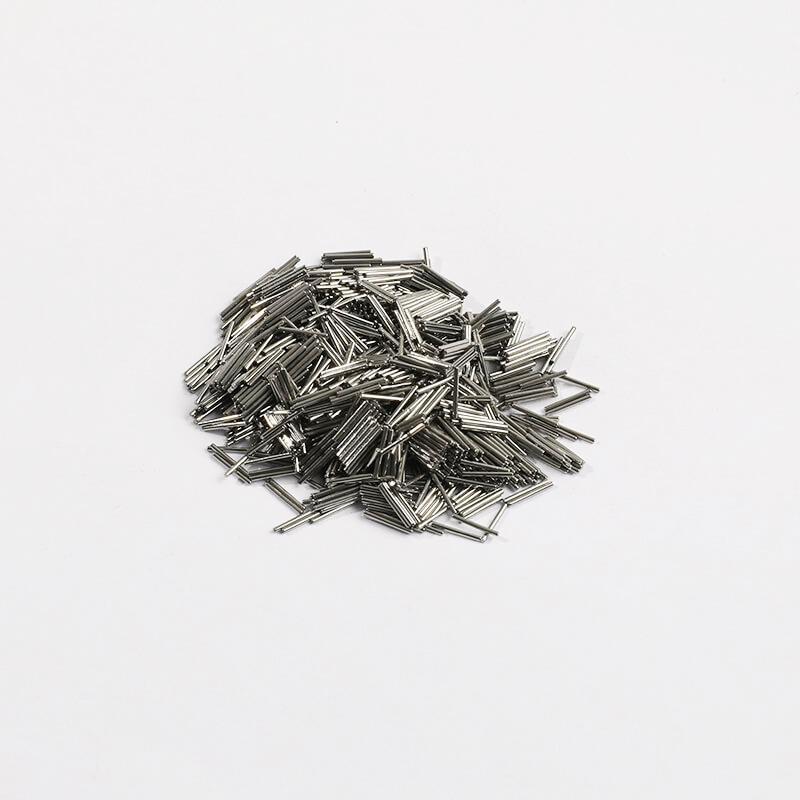
| Media | Best fit | Watch out for |
|---|---|---|
| Grinding media, alumina-based | Higher material removal where a mill seam, a joint weld or a deep transit scratch has to be cut back before refining. | Aggressive on thin wall, can over-round edges and change cross-section geometry, and needs tight depth control. |
| Steel media, pins and balls | Bright, strongly linear appearance on stainless where a higher-lustre finish is wanted on accessible faces. | Heavy, needs tight compound control to stay clean and separated, and any iron-bearing debris is a contamination question the buyer has to define and verify. |
| Plastic media, cylindrical | Light surface refinement on thin rectangular sections where holding the shape matters more than cutting power. | Little cut power, and the size class changes quickly as the media wears, which shifts the texture pitch over a run. |
| Ceramic media, cylinders and other elongated shapes | Linear, directional refinement of the visible faces of round and rectangular profiles after the seam has been cut back. | Flat sides and ends mark differently, and the length-to-diameter ratio limits how far the media reaches into a shallow cove. |
Thin-wall and rectangular profiles change shape during finishing more often than they change appearance. A length can bow along its axis, twist, lose its ovality, or take a local dent where it rested on a hard support or struck another part. Rectangular sections are the more vulnerable because the flat faces have no hoop stiffness to resist a load applied across the width. Check geometry the same way on every sample: place the length on a surface plate or a straight reference and measure the gap with a feeler gauge, measure the width across the flat at several stations, and compare the ends with a square. Record the incoming straightness first, otherwise a pre-existing bow is attributed to the finishing line and the argument cannot be settled.
| Failure mode | Likely cause | How to catch it |
|---|---|---|
| Orange peel mottling on the visible face | Over-working with a coarse medium, or excessive pressure on a soft or thin section, which deforms the surface rather than cutting it. | Reflect a straight edge or a linear light source in the surface, and take a roughness reading at the same spot to show the divergence between number and appearance. |
| Twist along the length | Differential working of opposite faces, or clamping and stacking that loads the section unevenly. | Rest the length on a reference surface and compare the angular orientation of the two end sections with a square. |
| Shade change or discolouration at a welded area | The heat-affected zone responds differently to the same media and compound cycle than the parent metal. | Compare the area with adjacent metal under the agreed light and distance, and photograph it with a scale alongside the retained reference. |
| Dents and part-on-part nibbling | Parts running loose together in the load, or a finished part contacting a bare support or another length. | Inspect the contact line between parts with side lighting, and run a straightedge over the damaged area to judge depth. |
London's published trade profile is services-led rather than goods-led: ONS estimates place London's total trade surplus at £59.4 billion in 2023, with services exports of £213.1 billion, while ONS also records the capital as having the value of services exports higher than any UK region in 2023. The Greater London Authority publishes the city's data through the London Datastore, which holds over a thousand datasets on the capital. Deep-sea container freight for the capital region is handled by Thames-side terminals such as DP World's London Gateway rather than by inner-London wharves.
The nearest part of that base to this brief is machinery: DP World operates London Gateway as a deep-sea container terminal on the Thames serving the capital region, which is the route by which imported machinery and equipment reach London buyers.
London's published trade profile is dominated by services rather than by goods production, so finishing capacity serving the capital is generally not located in the capital. Deburring, edge and cleanliness requirements for London-specified work therefore have to be written into the purchase specification and the technical file, with an acceptance test agreed in advance, rather than settled against an assumed local plant practice.
A London-based buyer should decide up front whether the finishing step will run in-house or at a supplier, and write the edge or cleanliness acceptance test into the purchase order, because the equipment is imported and the technical file and Declaration of Conformity must be held by a manufacturer or a UK-established economic operator.
Freight context: London Gateway (DP World), deep-sea container terminal on the Thames, Thames-side port estate controlled under the Port of London Authority regime. ONS records London as the UK region with the highest total trade surplus in 2023 (£59.4 billion) and shows the capital importing £89.8 billion of goods against £41.8 billion of goods exports, so incoming machinery and media for London buyers are landed and cleared outside the capital, principally at Thames-side deep-sea terminals.
BSI is the UK's National Standards Body, and British Standards (BS, including adopted BS EN ISO texts) are the documents a UK buyer's surface-finish, edge and cleanliness specifications are normally written against and purchased through. On the plant side, HSE maintains the work equipment and machinery topic covering the safe supply and use of machinery, and the COSHH regime, which requires employers to identify, assess and control risks from hazardous substances - the regime that applies to finishing compounds, abrasive media and the dust and effluent they generate.
China does not appear in the alphabetical list of trade agreements in effect published by the Department for Business and Trade, so Chinese-origin machinery imported into the UK cannot claim a preferential agreement rate. Duty is instead determined by the commodity code declared on the import declaration, and the UK's customs authority is HM Revenue and Customs (HMRC), which ONS also names as the largest single data source behind UK trade-in-goods statistics. Because a GB-prefixed EORI number is a precondition for importing into England, Scotland or Wales, a Chinese seller's UK buyer must already hold that registration before any machine ships.
SurfacePolish supplies from Xiamen, China. The buyer's own destination rules, conformity marking, tariff classification and documentation responsibilities stay with the buyer; confirm them against the authorities named above before ordering.
Brushed stainless is not a specification, and a finish described only in words cannot be accepted or rejected consistently. The callout on the drawing or the purchase order should say what the texture direction is, which faces carry it, the roughness limit and the measurement conditions if a number is used, the reference panel and the viewing distance, and which faces are exempt. It should also say what is protected: threads, fixing holes, cut ends, machined lands. Where the buyer cannot express the finish numerically, a physical reference sample with a written description of its texture direction and appearance is still far better than an adjective. Sorting this out before a trial is what allows the trial result to be compared against a real requirement.
If two media classes or two cycle settings are being compared, run them on adjacent cut sections from the same original length so the only difference is the variable under test. Keep the position in the load and the cycle length the same where possible, label the pieces before they are run, and have the returned parts judged together in one session under the agreed light rather than one at a time as they arrive. Where several people are judging, ask each to rank the pieces before discussing them, so the strongest opinion does not set the answer. A handful of sections can compare two settings; what cannot be compared is one section from a trial run one week against another run later under different conditions.



It depends on the order book rather than on the profile alone. A tub suits mixed work and shorter runs, because the set-up changes with the part and the chamber can take several profiles. A dedicated arrangement that carries the length past fixed heads, or moves heads along a stationary length, sets the texture direction by machine axis and holds it better over repeated runs, at the cost of floor space and changeover when the profile or length changes. Bring the profile mix, the typical and maximum lengths and the annual volume into the line-concept discussion; we can scope it, though the choice is yours.
No. SurfacePolish does not supply or carry out electropolishing. Where electrochemical treatment is part of the buyer's requirement, we treat it as a comparison point and as a reason to look at what a mechanical route can achieve on the same part, and we can discuss media, compound and machine options for that mechanical route. A mechanical finish should not be presented as equivalent to an electropolished surface, and the choice between the two, together with any specification that depends on it, belongs to the buyer's own engineering decision.
Length is a handling question before it is a finishing question. Long architectural sections are run in a tub or on a dedicated longitudinal arrangement rather than a round bowl, and the practical limit depends on the chamber length, the supports available and how the length is packed for shipping. For a trial, send cut sections from the production material and one full-length piece where bend or end effects could matter, so the arrangement is chosen against the real part rather than an average. Parts travel to our factory in Xiamen, and we do not process anything in United Kingdom or London.
Use London, United Kingdom as the destination on the enquiry and state whether the deliverable is equipment, media and compound, a representative sample review or a line concept. A destination does not imply local stock, a local service point or a local delivery time.
London buyers work to the same Great Britain regime as the rest of England: UKCA or CE marking with a Declaration of Conformity, HSE duties on work equipment and machinery, and COSHH for the compounds, media and dust arising from finishing.
Sources were retrieved on 2026-09-29 and describe the local industrial and trade context only. They do not evidence any SurfacePolish project, shipment, installation or service in London.
An inspector is rejecting the delivered appearance under raking light even though roughness readings sit inside the stated band.
Send the material, dimensions, approximate weight, batch quantity, the incoming condition and photographs of the difficult features. Mark which features must not be contacted by media and state how the result will be inspected. This form carries source reference PSEO-0227; quote it if you prefer an additional manual reference.
Open the SurfacePolish enquiry form Email a prepared enquiry
No price, lead time, certification or result is promised here. Confirm whether a sample trial is available for the specific part and what the trial can and cannot show.
Page PSEO-0227 · revised 2026-09-29 · cross-border equipment, media and scoped sample review. City context is sourced and cited above.
Use this local checker to identify missing part and inspection information. It prepares a technical-review brief; it does not approve a machine, process recipe or production result.
Complete the part details to prepare a review brief.
Email : info@surface-polish.com


 IPv6 network supported


 +86-592-2381506