A balustrade maker in Maastricht, Netherlands sends architectural metalwork work in the form of 40 x 40 x 1.5 mm stainless posts, 1.1 m long and welded to base plates, and needs those welds blended into the brushed grain without a flat spot on the corner. SurfacePolish supplies finishing machines, media and compounds across borders and runs a free sample trial on parts shipped to Xiamen. This brief is written for a buyer in Maastricht working on architectural metalwork; it describes equipment, media and a scoped sample review, not a local polishing service.
Which faces of each profile are actually seen when installed, from what distance and under what light, and which faces can be finished to a coarser standard without it showing?
What is the longest length in the order, and how will it be supported, carried and packed at every stage between finishing, fabrication and installation?
Which wall thickness and section shape in the order is most likely to distort, and what fixture, cradle or support will protect it?
The surface you receive already carries a direction of texture from the mill, from a prior brush line or from a fabricator's earlier pass. Finishing can change the amplitude and the scale of that texture and can impose a new direction, but erasing a deep existing grain means removing real wall thickness, which is rarely acceptable on a visible architectural profile. Note the direction of the incoming texture along the length, its pitch, and whether the tube is bright annealed, pickled or mill finish. A pickled or matte mill surface hides small process variation that a bright surface reveals immediately. Send the worst-looking incoming length rather than the best one, because the finish a line has to hold is set by the roughest material that regularly arrives, not by the sample kept aside as a reference.
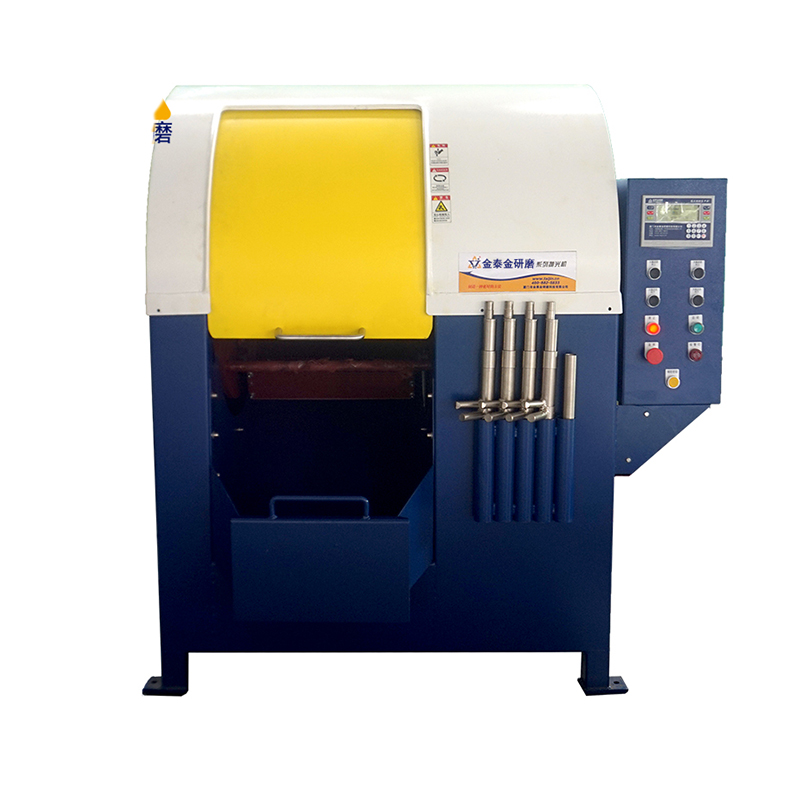
A tub vibrator uses a long rectangular chamber, so the process length can be extended along one axis while the bed depth stays modest. That allows a length to be carried through a media bed deep enough to work the visible face and shallow enough to keep the load moving. Decisions to settle with the equipment supplier are the usable chamber length against the longest part, whether lengths run one at a time or several end to end, how the part is supported so it does not ride on top of the media, and how the open ends are kept clear of media. A tub also tolerates the mid-length supports that thin rectangular sections need, which a circular chamber cannot accommodate without a purpose-built fixture.
| Machine route | Where it fits | What it will not do |
|---|---|---|
| Disc finishing machine | Fast, high-energy cycles for small to medium fittings and hardware where a short cycle is the priority. | The high energy that makes it fast will distort, mark or bend thin and long parts. |
| Barrel finishing machine, rotary barrel tumbling | Gentle, precise batch processing of small parts, finials, sleeves and short connector pieces. | Part length and part-on-part contact restrict it to short fittings rather than long architectural runs. |
| Tub vibrator | Long and large parts such as architectural tube and profiles, where the process length has to extend along the part. | Bed depth and fixture design decide whether thin sections survive, and fluid flow has to be checked at the far end of the chamber. |
| Grinding finishing machine | Higher material removal where a mill seam, a joint weld or a deep scratch has to be cut back before surface refinement. | Removal is aggressive, so depth control and wall thickness limits have to be set before the cycle is run. |
Compound concentration, flow rate and water quality need managing along the whole chamber, not just at the inlet. In a long tub the fluid front can arrive weaker at the far end, so media there cuts differently and the finish drifts from one end of a part to the other. Hard water leaves scale and spotting; very soft water may foam differently with the same compound. Foam is a real constraint in a tub because it cushions the media and reduces cut, and it overflows into the surrounding area. Set concentration by measurement rather than by appearance, check flow at both ends of the chamber, and plan drag-out and rinse-water handling before the first production run.
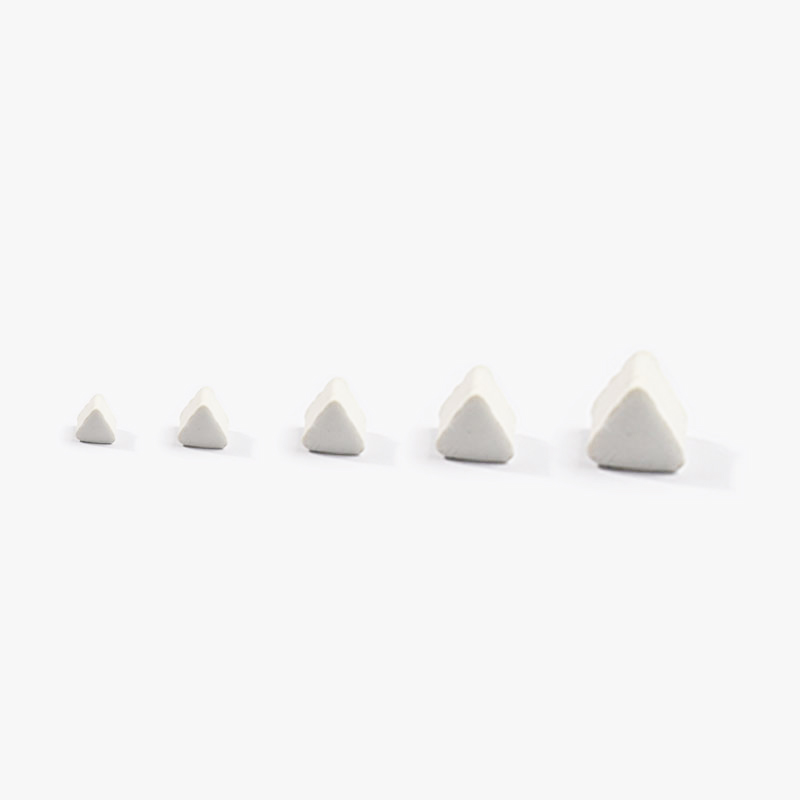
| Media | Best fit | Watch out for |
|---|---|---|
| Plastic media, cones and triangles | Gentle work on thin-wall sections and softer alloys, and where marking or distortion is the main risk to be managed. | Slower cut and shorter media life, with limited effect on a deep scratch or a heavy seam. |
| Dry media, walnut shell and corn cob | Dry polishing and support for post-wet drying, particularly where a hollow section must not stay wet or carry residue inside. | Low cutting power, and dust generation and media separation need managing in the surrounding area. |
| Plastic media, cylindrical | Light surface refinement on thin rectangular sections where holding the shape matters more than cutting power. | Little cut power, and the size class changes quickly as the media wears, which shifts the texture pitch over a run. |
| Steel media, pins and balls | Bright, strongly linear appearance on stainless where a higher-lustre finish is wanted on accessible faces. | Heavy, needs tight compound control to stay clean and separated, and any iron-bearing debris is a contamination question the buyer has to define and verify. |
Thin-wall and rectangular profiles change shape during finishing more often than they change appearance. A length can bow along its axis, twist, lose its ovality, or take a local dent where it rested on a hard support or struck another part. Rectangular sections are the more vulnerable because the flat faces have no hoop stiffness to resist a load applied across the width. Check geometry the same way on every sample: place the length on a surface plate or a straight reference and measure the gap with a feeler gauge, measure the width across the flat at several stations, and compare the ends with a square. Record the incoming straightness first, otherwise a pre-existing bow is attributed to the finishing line and the argument cannot be settled.
| Failure mode | Likely cause | How to catch it |
|---|---|---|
| Visible band or line along the mill seam | The seam crown was not cut back evenly, or the media class was too small to reach the seam root without over-working the surrounding surface. | Look along the seam line under raking light from both sides, and measure the remaining crown with a depth gauge on a sectioned sample. |
| Dents and part-on-part nibbling | Parts running loose together in the load, or a finished part contacting a bare support or another length. | Inspect the contact line between parts with side lighting, and run a straightedge over the damaged area to judge depth. |
| Media or swarf trapped in a bore or channel | Open ends left unplugged, a media class smaller than the opening, or no defined retrieval step at the end of the cycle. | Endoscope or internally swab every sample length, and count media into and out of the batch as a routine check. |
| Longitudinal scratch running along the part axis | Incoming coil or straightener marks, media or swarf dragged along the surface during the cycle, or a finished length sliding over a bare support between operations. | View the surface under raking light at a low angle along the axis, compare the same station on several parts, and compare against the retained reference panel. |
Maastricht's economy combines a life-sciences campus with an established production base in the city and its surrounding region. The Brightlands Maastricht Health Campus is part of the Brightlands open-innovation community in Limburg, which reports over 32,000 innovative entrepreneurs, researchers and students working on sustainability, health and digitisation, and the campus concentrates researchers, entrepreneurs and students on healthcare, medicine and life sciences with imaging and analytical facilities used by medical start-ups. Alongside that, the Maastricht Maakt industry platform represents 16 production companies in the city, with employers including Tata Steel, Sappi, the Regout Group, SteelSolutions, Mosa, FENZI AGT and SunChemical, and says its operators, technicians and logistics staff work in sectors such as chemistry, food and production. Sappi's Maastricht mill employs nearly 500 people and produces around 260,000 tons of coated woodfree paper and paperboard a year. Maastricht Aachen Airport is part of the national aviation infrastructure and, after Schiphol, the only Dutch airport with a cargo function; the province of Limburg is a shareholder and funds the airport.
The nearest part of that base to this brief is medical: The campus describes first-class imaging facilities and analytical technology as the basis of medical innovation at the site, and positions itself as a location for medical start-ups.
Maastricht and the surrounding Limburg region combine medical-technology work, steel and metal processing, paper production and glass and food manufacturing. Medical-technology and life-sciences activity on the Brightlands Maastricht Health Campus involves stainless and titanium instruments, implants, device housings and precision components, where deburring, edge rounding, passivation and residue-free cleaning are quality requirements, while the city's steel, metal and equipment producers need burr and edge control on machined and cut parts before assembly, coating or further processing. Limburg's wider Brightlands network also includes the Chemelot chemical campus, which adds stainless process and laboratory equipment with comparable cleanliness and corrosion expectations.
A buyer here should settle the documentation and cleanliness standard first, because medical and life-sciences supply chains normally require validated, repeatable processes with defined residue limits, whereas general metal parts usually need no more than a specified burr height and Ra.
Freight context: Maastricht Aachen Airport (cargo function). Maastricht Aachen Airport is the only Dutch airport other than Schiphol with a cargo function and is part of the national aviation infrastructure, which gives the region an air-freight option for urgent parts or samples; the province of Limburg is a shareholder and has funded infrastructure and route development. Machinery arriving by sea is declared to Dutch Customs at its EU point of entry, and the importer needs an EORI number.
The Dutch standards body is NEN (Nederlands Normalisatie-instituut), which publishes and maintains the NEN and NEN-EN-ISO standards; the content of a standard is set by a NEN standards committee made up of the organisations concerned, not by NEN itself. For surface finishing NEN publishes NEN-EN-ISO 2080, which defines the terms for the general types of surface-finishing processes with emphasis on practical use in metal finishing, under the standards committee for metallic coatings and corrosion of metals and alloys. Machinery safety, EMC, low-voltage, ATEX, RoHS and ecodesign requirements reach Dutch buyers through the CE directives and regulations referenced by KVK, with the Machinery Regulation applying from 20 January 2027.
Business is conducted in Dutch, but engineering and procurement communication in these sectors is routinely handled in English. Buyers are KVK-registered legal entities and expect a clear commercial entity to contract with, an EORI number for customs, correct HS/TARIC classification, and a full CE technical file including the EC Declaration of Conformity and a manual in the correct language; a technical construction file held by the manufacturer is normally part of the qualification pack. For EU-internal supply the invoice carries 0% VAT with the customer's VAT identification number and the customer accounts for 21% Dutch VAT in its own return, so a Chinese seller shipping directly from outside the EU must be clear about who is importer of record and who carries the duty and import VAT. Trade and investment support is organised through bodies such as KVK, RVO, the regional development agencies and the Trade and Innovate NL network, and the Dutch technology industry is represented by FME.
SurfacePolish supplies from Xiamen, China. The buyer's own destination rules, conformity marking, tariff classification and documentation responsibilities stay with the buyer; confirm them against the authorities named above before ordering.
Grain direction is the most common reason a set of individually acceptable lengths is rejected as an assembly. Where two lengths butt at a joint, their texture direction has to run the same way, and the pitch and brightness have to be close enough that the joint does not read as a line. That is a planning decision made before the lengths are run, not a sorting decision made afterwards: define the grain direction on the drawing, mark the direction on every length, and keep the orientation through fabrication and despatch. Then inspect the lengths laid end to end as they will be installed, under the agreed light, rather than one at a time on a bench. A direction reversal that is obvious in an assembly can be invisible in a single part.
If two media classes or two cycle settings are being compared, run them on adjacent cut sections from the same original length so the only difference is the variable under test. Keep the position in the load and the cycle length the same where possible, label the pieces before they are run, and have the returned parts judged together in one session under the agreed light rather than one at a time as they arrive. Where several people are judging, ask each to rank the pieces before discussing them, so the strongest opinion does not set the answer. A handful of sections can compare two settings; what cannot be compared is one section from a trial run one week against another run later under different conditions.
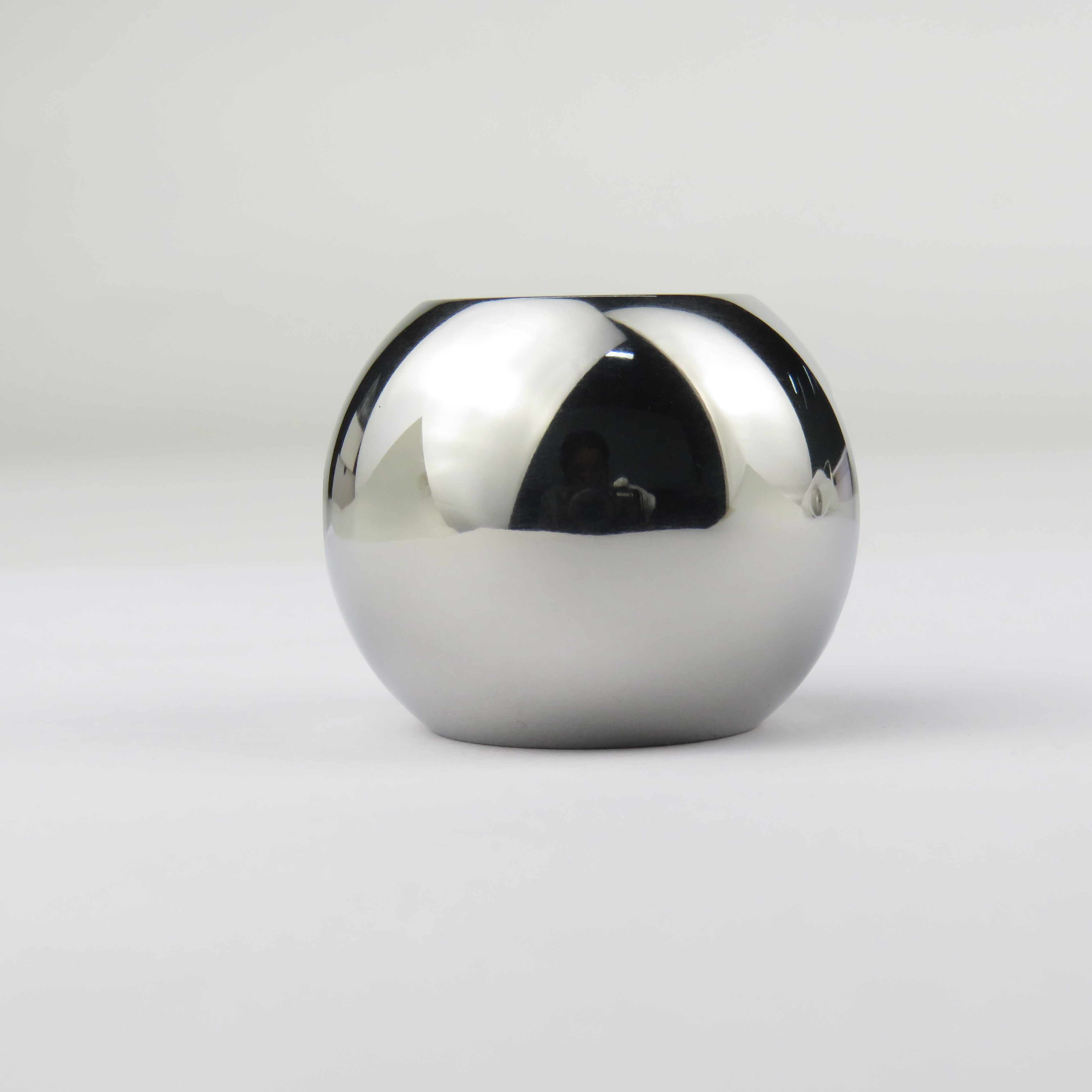
Ra is a two-dimensional amplitude average taken along one traverse, and it says nothing about the pitch of the texture, its direction, or whether the surface reflects light evenly. Two surfaces with the same Ra can look quite different: one can carry a directional brushed grain and the other a mottled, hazy appearance with a broken reflection. That is why an architectural callout normally needs both a numeric limit with its measurement conditions and a physical reference viewed at an agreed distance under agreed light. The number controls the process, and the panel settles the argument.
It depends on the order book rather than on the profile alone. A tub suits mixed work and shorter runs, because the set-up changes with the part and the chamber can take several profiles. A dedicated arrangement that carries the length past fixed heads, or moves heads along a stationary length, sets the texture direction by machine axis and holds it better over repeated runs, at the cost of floor space and changeover when the profile or length changes. Bring the profile mix, the typical and maximum lengths and the annual volume into the line-concept discussion; we can scope it, though the choice is yours.
Directional satin textures usually come from elongated or angular media rather than spheres. Angle-cut triangles and cylinders strike along their axis and leave a linear pattern, while rounded shapes produce overlapping craters that read soft and slightly dimpled. The size class then has to reach the root of a mill seam or the cove of a rectangular profile without lodging in the bore or a fixing hole. Media selection is confirmed against the actual part in a trial, because the incoming grain, the wall thickness and the visible face all shift the answer. Send sections from the production delivery and say which face must carry the grain.
Use Maastricht, Netherlands as the destination on the enquiry and state whether the deliverable is equipment, media and compound, a representative sample review or a line concept. A destination does not imply local stock, a local service point or a local delivery time.
Buyers here would reference the CE machinery regime (Machinery Regulation from 20 January 2027) and the Dutch/EN-ISO surface-finishing standards published by NEN, such as NEN-EN-ISO 2080. For medical and life-sciences customers the binding requirements are normally the customer's own cleanliness and validation specification, with ISO 13485 as the customary quality-system reference for medical devices.
Sources were retrieved on 2026-09-29 and describe the local industrial and trade context only. They do not evidence any SurfacePolish project, shipment, installation or service in Maastricht.
The circumferential weld at the base and the mill seam have to be blended without leaving a flat spot on the corner or a colour change.
Send the material, dimensions, approximate weight, batch quantity, the incoming condition and photographs of the difficult features. Mark which features must not be contacted by media and state how the result will be inspected. This form carries source reference PSEO-0697; quote it if you prefer an additional manual reference.
Open the SurfacePolish enquiry form Email a prepared enquiry
No price, lead time, certification or result is promised here. Confirm whether a sample trial is available for the specific part and what the trial can and cannot show.
Page PSEO-0697 · revised 2026-09-29 · cross-border equipment, media and scoped sample review. City context is sourced and cited above.
Use this local checker to identify missing part and inspection information. It prepares a technical-review brief; it does not approve a machine, process recipe or production result.
Complete the part details to prepare a review brief.
Email : info@surface-polish.com


 IPv6 network supported


 +86-592-2381506