A column-cover fabricator in Winnipeg, Canada for architectural metalwork handles 6 m lengths of 168 mm stainless tube at 3 mm wall and needs an even finish on the visible half without losing roundness or denting the wall in handling. SurfacePolish supplies finishing machines, media and compounds across borders and runs a free sample trial on cut sections and one full length shipped to Xiamen. This brief is written for a buyer in Winnipeg working on architectural metalwork; it describes equipment, media and a scoped sample review, not a local polishing service.
Will the finish be judged by a roughness number, by a physical reference panel, or by both, and who views the parts before they are accepted?
Which wall thickness and section shape in the order is most likely to distort, and what fixture, cradle or support will protect it?
What is the longest length in the order, and how will it be supported, carried and packed at every stage between finishing, fabrication and installation?
An elevation is normally assembled from lengths made and finished at different times, so the lot definition matters as much as the finish itself. Decide how parts are grouped into finishing lots: by profile, by wall thickness, by alloy heat, by incoming mill finish, or by the date the material arrived. Then decide how lot identity is preserved through finishing, fabrication and despatch, because a length that cannot be traced back to a lot cannot be compared with another length in a dispute. Where an order will be produced over several weeks, keep an unprocessed reference length from the first delivery in store, and keep a finished reference panel from the first accepted lot. Both are needed before anyone can argue about whether a later length matches.
A balustrade or handrail job is never only long runs. It also contains cut-to-length spindles, elbows, brackets, base plates, ball finials and short connector sleeves, often in the same alloy and finish. Those parts are a poor fit for a longitudinal arrangement and a good fit for batch equipment, where a large number of small identical parts can be processed together with controlled part-on-part contact. Treating the two populations as one route is a common planning error: the runs are under-processed because the settings were chosen for the fittings, or the fittings are over-worked and lose their edges. Screen the order into long runs and small fittings, then specify the media class separately for each, even where the final appearance has to read the same.
| Machine route | Where it fits | What it will not do |
|---|---|---|
| Disc finishing machine | Fast, high-energy cycles for small to medium fittings and hardware where a short cycle is the priority. | The high energy that makes it fast will distort, mark or bend thin and long parts. |
| Centrifugal barrel finishing machine | High-speed finishing of small precise parts, including where a bright appearance is required on a compact geometry. | Chamber geometry and high contact forces rule it out for long, thin-wall or easily marked sections. |
| Grinding finishing machine | Higher material removal where a mill seam, a joint weld or a deep scratch has to be cut back before surface refinement. | Removal is aggressive, so depth control and wall thickness limits have to be set before the cycle is run. |
| Magnetic finishing machine | Small precise parts and localised areas that are difficult to reach with loose media in a conventional chamber. | Size and mass limits keep it away from architectural lengths and large diameter profiles. |
Ceramic media cuts harder, holds its shape longer and is the usual choice when a previous scratch or a weld seam has to be removed from stainless. Plastic media is gentler, lighter and less likely to mark a thin or soft section, at the cost of a slower cut and a shorter texture. Steel media produces a bright appearance and strongly linear marks, but it is heavy, it needs well-controlled compound to keep it clean and separated, and it raises a question about whether any iron-bearing debris is acceptable in the buyer's own cleanliness or contamination control. That last point is a requirement for the buyer to define and verify, and it is not something a supplier can decide on their behalf.
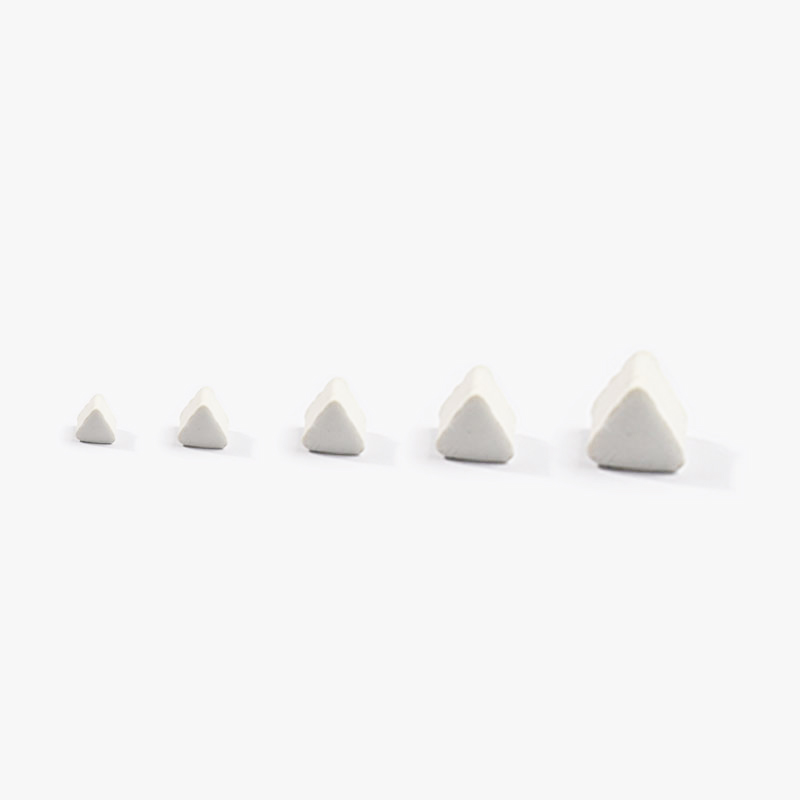
| Media | Best fit | Watch out for |
|---|---|---|
| Ceramic media, spheres and balls | General deburring and edge work on cut ends, brackets and small fittings in the same order as the long runs. | Produces overlapping crater-like marks that work against a linear brushed appearance and can peen a thin wall. |
| Ceramic media, angle-cut triangles | Heavier cutting and seam removal on stainless tube and profiles, where a directional linear texture on the visible face is wanted. | Wears down and changes effective size class, generates sludge, and can over-round thin sections or chip on sharp edges. |
| Ceramic media, cylinders and other elongated shapes | Linear, directional refinement of the visible faces of round and rectangular profiles after the seam has been cut back. | Flat sides and ends mark differently, and the length-to-diameter ratio limits how far the media reaches into a shallow cove. |
| Dry media, walnut shell and corn cob | Dry polishing and support for post-wet drying, particularly where a hollow section must not stay wet or carry residue inside. | Low cutting power, and dust generation and media separation need managing in the surrounding area. |
Open tube ends, slotted channels and drilled fixings all collect media, swarf and compound. The failure is rarely visible at the end of the cycle; it shows up after the part is installed, when compound weeps from a bore onto a visible face or when a trapped particle works loose during handling and scratches an adjacent length. Treat removal as a designed step rather than a rinse: plug or cap what should never see media, count media in and out of each batch, and agree how the interior of a sample length will be checked, using an endoscope or an internal swab where the bore matters. Ask what the drying step after a wet process does for a closed section, because a hollow part that stays wet inside is a delayed defect.
| Failure mode | Likely cause | How to catch it |
|---|---|---|
| Hazy or milky patch with a dull reflection | Uneven cut, worn media in part of the chamber, or weak compound flow at the far end of a long tub. | Compare the near end and the far end of the same length, and check compound concentration and fluid flow at both ends of the chamber. |
| Loss of ovality or out-of-round section | A load applied across the wall during the cycle or while the part sits in a rack. | Measure the diameter across two axes at several stations along the length with a caliper or micrometer. |
| Bow along the length | Unsupported part in the bed, resting on hard supports, or lengths stacked while still wet. | Place on a surface plate or straight reference and measure the gap with a feeler gauge at several stations, against the incoming straightness record. |
| Shade change or discolouration at a welded area | The heat-affected zone responds differently to the same media and compound cycle than the parent metal. | Compare the area with adjacent metal under the agreed light and distance, and photograph it with a scale alongside the retained reference. |
Winnipeg's manufacturing base is aerospace and defence plus food processing and packaging, and federal investment is actively expanding it. Prairies Economic Development Canada announced CAD 19.5 million through the Regional Defence Investment Initiative for three Winnipeg-based projects: Magellan Aerospace's establishment of an advanced machining centre in Winnipeg for aircraft components used in military aircraft, StandardAero's expansion of its Winnipeg campus for dual-use aerospace maintenance, repair and overhaul capacity including new equipment and advanced digital technologies, and Win-Shield Devices' establishment of a manufacturing facility for personal protective equipment. The city is also a defence geography in its own right: it is home to the operational headquarters of the Royal Canadian Air Force and the Canadian NORAD region, and Manitoba hosts CFB Winnipeg (17 Wing) and CFB Shilo. Investment in the airside industrial base continues, with CAD 10 million federal and CAD 5 million provincial funding announced in February 2026 toward the Winnipeg Airports Authority's development of 127 acres of direct-access runway lands at Winnipeg Richardson International Airport, intended to support growth in aerospace, defence and advanced manufacturing including aircraft maintenance and repair operations.
The nearest part of that base to this brief is machinery: The federal programme frames the funded projects as strengthening Manitoba's aerospace and manufacturing sectors and growing industrial capacity in Winnipeg, with StandardAero's expansion described as a 70,000 sq. ft. addition to its Winnipeg facility.
Winnipeg's aerospace machining and MRO base is the dominant finishing driver: engine components and aircraft structures produced or repaired in the city carry edge-condition, surface-integrity and cleanliness requirements that trace back to airworthiness, and MRO work on in-service hardware often requires re-finishing parts whose original surface condition has degraded. Magellan's new advanced machining centre and StandardAero's expanded engine MRO campus both increase the volume of machined and reworked parts flowing through the city, and both sit inside quality systems that require the finishing process to be specified, controlled and recorded. Personal protective equipment manufacturing at Win-Shield adds a different requirement set, where moulded and formed components need clean, burr-free edges that will not damage the sealing surfaces of respirators.
A Winnipeg buyer should settle whether the finishing operation is inside a quality system that requires approved process specifications and records, because in aerospace MRO and component manufacturing it usually is, and a machine that cannot be tied to a controlled specification will not be usable on flight hardware. The second question is how reworked and in-service parts differ from new parts in their finishing requirement, since MRO work brings in parts with unknown prior surface history that may need inspection and re-finishing rather than a standard pass through the same process.
Freight context: Winnipeg Richardson International Airport (YWG), CentrePort Canada inland port, CN and CPKC rail corridors, Arctic Gateway Group trade alliance routes. Winnipeg is a rail and air hub rather than a seaport. The federal and provincial governments are funding preparation of 127 acres of direct-access runway lands at YWG to create space for businesses that need immediate runway access, in support of aerospace, defence and advanced manufacturing including aircraft maintenance and repair operations. Separately, the Winnipeg Airports Authority, CentrePort Canada and Arctic Gateway Group announced a trade alliance in January 2026 to diversify trade routes and improve access to global markets, which matters for a manufacturer importing equipment and exporting finished parts.
Canada is a bilingual market for selling purposes: English is the working language of procurement outside Quebec, while Quebec buyers (Montreal, Quebec City) normally expect French-language quotations, technical documentation and after-sales support, and Quebec's Charter of the French Language makes French the default for commercial documentation in the province. Procurement expectations are formal and auditable: a Canadian industrial buyer will typically ask for the tariff classification and country of origin up front, expect a commercial invoice that satisfies the CBSA invoice requirements, and expect the seller to provide proof of origin for any preferential claim. Payment norms are bank-to-bank, with wire transfer or letter of credit rather than platform payment, and Canadian buyers commonly net-30 to net-60 from invoice, so a cross-border seller should price the working-capital gap into the offer. Certificates of origin for export documentation are issued through chambers of commerce, which is why chambers such as the Hamilton Chamber of Commerce and the Winnipeg Chamber of Commerce offer document certification. The current trade environment adds policy risk to landed cost: Canadian federal programs are explicitly framed around responding to U.S. tariffs, with the FedDev Ontario Regional Tariff Response Initiative described as supporting "businesses to respond to tariff pressures" in southern Ontario, and tariff and surtax measures can change by Order in Council, so quotations should state the tariff basis and the date on which the landed-cost calculation was made.
The customs authority is the Canada Border Services Agency (CBSA), and importers of commercial goods must work through the CBSA Assessment and Revenue Management (CARM) system, which is where registration, the duties-and-taxes calculator, advance rulings and national customs rulings, and the commercial accounting declaration (CAD) are handled. Documentation expectations are explicit: "You must provide proof of country of origin when you import goods into Canada and, in some cases, your goods must also be clearly marked", the invoice or sales receipt must carry "a complete description of the goods", "the selling price" and "any conditions and terms of the sale", and the value for duty must be declared in Canadian currency only. Duties and taxes are layered rather than single: customs duty on the tariff item, the Goods and Services Tax calculated on the duty-paid value, and potentially excise duty, excise tax, surtax or safeguard measures. Importers must also clear non-tariff gates: goods must be admissible, some goods need permits, certificates or inspections from other federal departments that the CBSA applies on their behalf, controlled goods under the Defence Production Act require consultation with the CBSA and Global Affairs Canada before import, and "Goods manufactured or produced wholly or in part by forced or prison labour are prohibited from entering Canada", with due diligence resting on the importer. For electrical machinery, the practical conformity route in Canada is certification of the product to Canadian electrical safety standards by an accredited certification body rather than a self-declared CE-style mark; buyers should confirm the specific certification body and mark required before shipment. For a first shipment of a finishing machine or a media/compound sample lot, the fastest way to remove classification and valuation uncertainty is to use the CARM portal to request an advance ruling for tariff classification and origin.
SurfacePolish supplies from Xiamen, China. The buyer's own destination rules, conformity marking, tariff classification and documentation responsibilities stay with the buyer; confirm them against the authorities named above before ordering.
Grain direction is the most common reason a set of individually acceptable lengths is rejected as an assembly. Where two lengths butt at a joint, their texture direction has to run the same way, and the pitch and brightness have to be close enough that the joint does not read as a line. That is a planning decision made before the lengths are run, not a sorting decision made afterwards: define the grain direction on the drawing, mark the direction on every length, and keep the orientation through fabrication and despatch. Then inspect the lengths laid end to end as they will be installed, under the agreed light, rather than one at a time on a bench. A direction reversal that is obvious in an assembly can be invisible in a single part.
If two media classes or two cycle settings are being compared, run them on adjacent cut sections from the same original length so the only difference is the variable under test. Keep the position in the load and the cycle length the same where possible, label the pieces before they are run, and have the returned parts judged together in one session under the agreed light rather than one at a time as they arrive. Where several people are judging, ask each to rank the pieces before discussing them, so the strongest opinion does not set the answer. A handful of sections can compare two settings; what cannot be compared is one section from a trial run one week against another run later under different conditions.


It depends on the order book rather than on the profile alone. A tub suits mixed work and shorter runs, because the set-up changes with the part and the chamber can take several profiles. A dedicated arrangement that carries the length past fixed heads, or moves heads along a stationary length, sets the texture direction by machine axis and holds it better over repeated runs, at the cost of floor space and changeover when the profile or length changes. Bring the profile mix, the typical and maximum lengths and the annual volume into the line-concept discussion; we can scope it, though the choice is yours.
Lay the lengths end to end as they will be installed, under the light and at the distance agreed for acceptance, and look along the run rather than at each piece separately. A direction reversal or a change in texture pitch that is invisible on a single length usually shows immediately at the joint. The planning side matters more than the inspection: mark the grain direction on every length and keep the orientation through fabrication, packing and despatch. Where the finished parts come from different batches, compare each against the retained reference panel under the same conditions.
Length is a handling question before it is a finishing question. Long architectural sections are run in a tub or on a dedicated longitudinal arrangement rather than a round bowl, and the practical limit depends on the chamber length, the supports available and how the length is packed for shipping. For a trial, send cut sections from the production material and one full-length piece where bend or end effects could matter, so the arrangement is chosen against the real part rather than an average. Parts travel to our factory in Xiamen, and we do not process anything in Canada or Winnipeg.
Use Winnipeg, Canada as the destination on the enquiry and state whether the deliverable is equipment, media and compound, a representative sample review or a line concept. A destination does not imply local stock, a local service point or a local delivery time.
A Winnipeg buyer in aerospace works to the applicable transport-aircraft maintenance and manufacturing requirements and the customer's approved process specifications, with the finished part's edge condition and cleanliness treated as part of airworthiness rather than appearance. On the plant side, Manitoba occupational health and safety regulation and Canadian electrical certification of the equipment apply. Where the product is protective equipment, the relevant product standard and certification regime for that device governs.
Sources were retrieved on 2026-09-29 and describe the local industrial and trade context only. They do not evidence any SurfacePolish project, shipment, installation or service in Winnipeg.
The visible half needs an even finish while the roundness and the wall are held through every handling step.
Send the material, dimensions, approximate weight, batch quantity, the incoming condition and photographs of the difficult features. Mark which features must not be contacted by media and state how the result will be inspected. This form carries source reference PSEO-0187; quote it if you prefer an additional manual reference.
Open the SurfacePolish enquiry form Email a prepared enquiry
No price, lead time, certification or result is promised here. Confirm whether a sample trial is available for the specific part and what the trial can and cannot show.
Page PSEO-0187 · revised 2026-09-29 · cross-border equipment, media and scoped sample review. City context is sourced and cited above.
Use this local checker to identify missing part and inspection information. It prepares a technical-review brief; it does not approve a machine, process recipe or production result.
Complete the part details to prepare a review brief.
Email : info@surface-polish.com


 IPv6 network supported


 +86-592-2381506