A fabricator in Toronto, Canada working on architectural metalwork needs an even satin grain along 5.8 m of 316 stainless handrail tube, 42.4 mm diameter at 2.0 mm wall, without bowing the thin wall or marking the face seen from above. SurfacePolish supplies finishing machines, media and compounds across borders and runs a free sample trial on parts shipped to Xiamen. This brief is written for a buyer in Toronto working on architectural metalwork; it describes equipment, media and a scoped sample review, not a local polishing service.
What is the longest length in the order, and how will it be supported, carried and packed at every stage between finishing, fabrication and installation?
Which wall thickness and section shape in the order is most likely to distort, and what fixture, cradle or support will protect it?
Which faces of each profile are actually seen when installed, from what distance and under what light, and which faces can be finished to a coarser standard without it showing?
Not every face of a profile deserves the same effort. On a wall-mounted handrail the top and the outward face are read from standing height and from an angle, while the underside and the face against the wall are largely out of view. On a cladding mullion the sun-facing plane carries the reflection and the returns do not. Build a simple exposure map: which face, viewed from where, under what light, at what distance. That map settles where the tighter finish is specified and where a coarser one is honest. It also prevents over-finishing hidden faces, which costs cycle time and raises the risk of distortion on thin sections, and it tells the finishing supplier which face must be protected in every rack and stillage.
Inside whichever machine is chosen, the fixture or the load arrangement decides whether thin sections survive. A thin-wall rectangular profile will flatten under its own weight in a deep bed, and two loose lengths finished together will nibble each other along the contact line. Practical measures are cradles that follow the profile, dividers or compartments that keep parts apart, end caps or plugs for open tube ends, and clip-on carriers that present the visible face to the media evenly. The fixture also fixes the finish: a part that rotates freely receives an inconsistent texture, while a part held at a controlled orientation receives a directional one. Build the fixture around the longest and thinnest part in the order, not the average one.
| Machine route | Where it fits | What it will not do |
|---|---|---|
| Disc finishing machine | Fast, high-energy cycles for small to medium fittings and hardware where a short cycle is the priority. | The high energy that makes it fast will distort, mark or bend thin and long parts. |
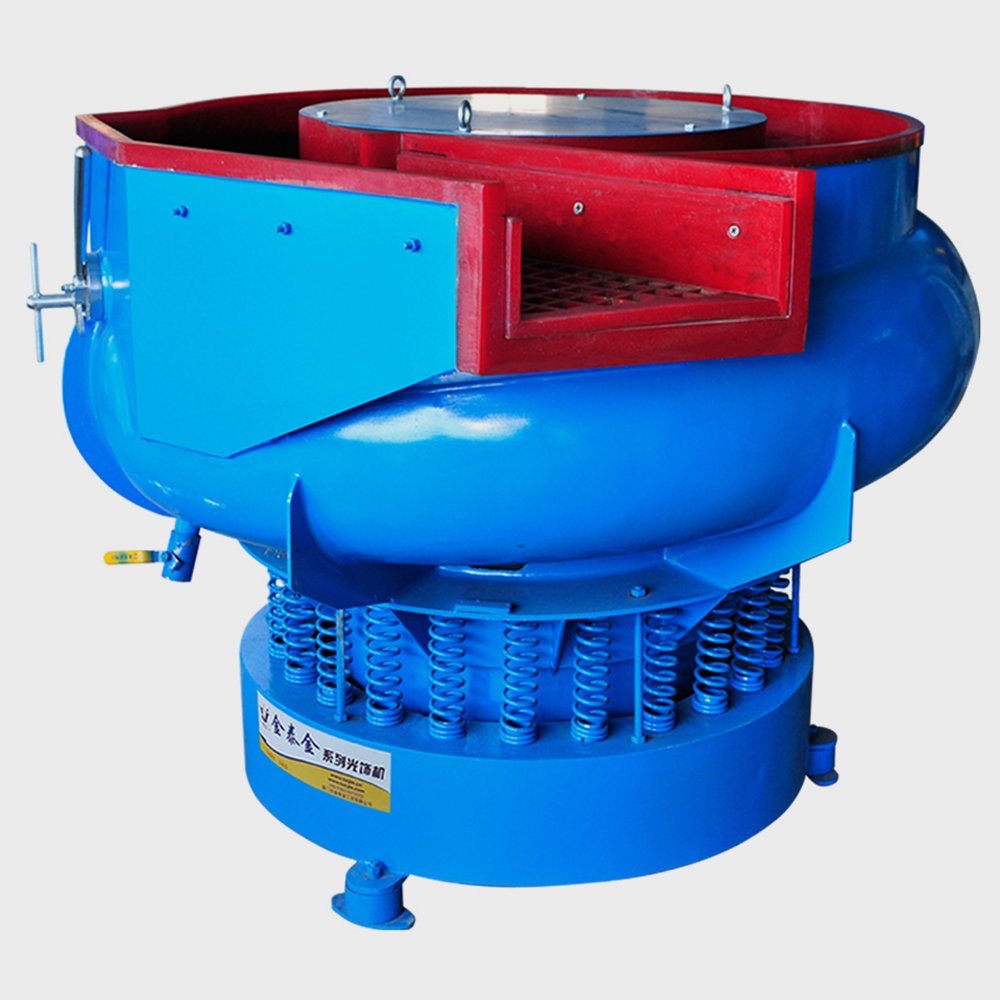
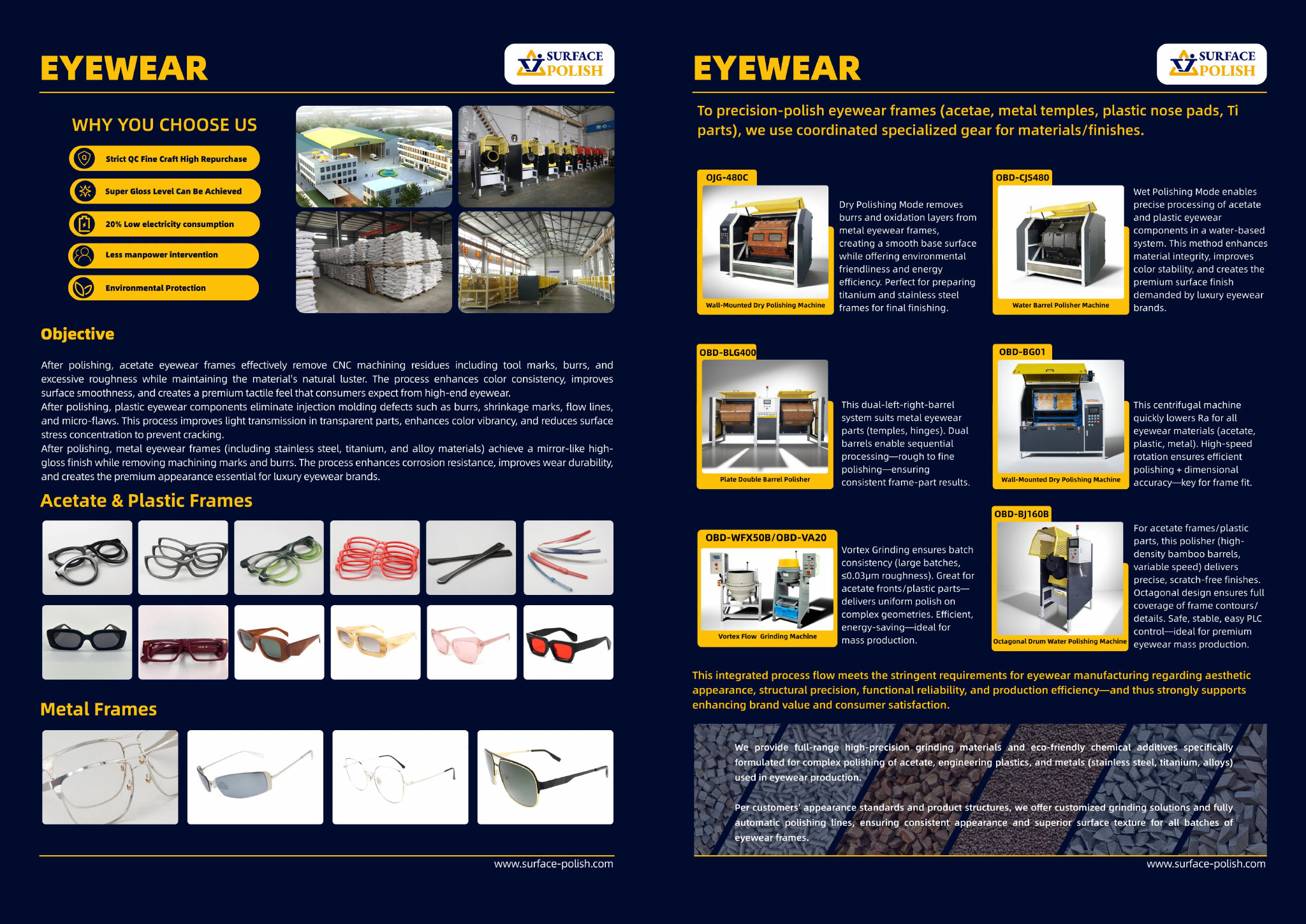
| Tub vibrator | Long and large parts such as architectural tube and profiles, where the process length has to extend along the part. | Bed depth and fixture design decide whether thin sections survive, and fluid flow has to be checked at the far end of the chamber. |
| Vibratory finishing machine, bowl type | General edge blending and surface refinement on brackets, base plates, cut spindles and other small fittings. | Chamber diameter caps the part length, and a long tube cannot be worked evenly in the circular bed. |
| Dry polishing machine and dryer | Post-wet drying and dry luster work, particularly where a hollow section must come out clean and dry inside. | Dry routes cut less than wet media, and dust control and media separation need planning. |
The compound carries cut debris away, keeps the media from loading, and buffers the chemistry against the metal. For stainless work the choice sits between mildly acidic, neutral and alkaline families, with the selection driven by the alloy, the incoming surface and the buyer's own residue limits rather than by a fixed rule. The behaviour that matters most on tube is rinsing. A compound that clings inside a six-metre bore will bleed out later onto a visible face and read as a stain or a patch. Pick a family that rinses cleanly, specify the rinse stages and the drying step, and agree how the interior of a sample length will be checked after the trial rather than assuming it is clean.
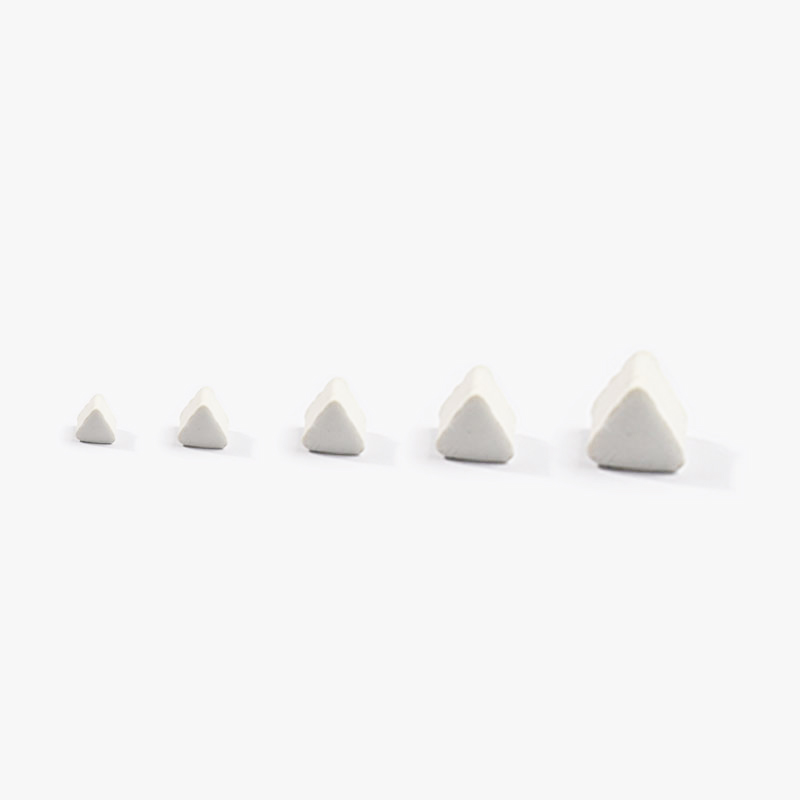
| Media | Best fit | Watch out for |
|---|---|---|
| Plastic media, cylindrical | Light surface refinement on thin rectangular sections where holding the shape matters more than cutting power. | Little cut power, and the size class changes quickly as the media wears, which shifts the texture pitch over a run. |
| Grinding media, alumina-based | Higher material removal where a mill seam, a joint weld or a deep transit scratch has to be cut back before refining. | Aggressive on thin wall, can over-round edges and change cross-section geometry, and needs tight depth control. |
| Plastic media, cones and triangles | Gentle work on thin-wall sections and softer alloys, and where marking or distortion is the main risk to be managed. | Slower cut and shorter media life, with limited effect on a deep scratch or a heavy seam. |
| Dry media, walnut shell and corn cob | Dry polishing and support for post-wet drying, particularly where a hollow section must not stay wet or carry residue inside. | Low cutting power, and dust generation and media separation need managing in the surrounding area. |
Two welds matter on architectural tube: the longitudinal mill seam left by the tube maker, and the circumferential weld a fabricator makes when a length is joined to a fitting or to another length. Dressing either one means removing metal, and the risk is always the same. Too little leaves a visible band that reads as a line down the elevation; too much thins the wall and can leave a flat spot or a heat-affected zone that later shows as a different shade. The workable approach is to establish how much of the seam crown is to be removed, check it on a sectioned sample or with a depth gauge, and confirm that the wall at the dressed area still meets the buyer's requirement. Dressing is not a polishing step; it is a controlled removal step.
| Failure mode | Likely cause | How to catch it |
|---|---|---|
| Bow along the length | Unsupported part in the bed, resting on hard supports, or lengths stacked while still wet. | Place on a surface plate or straight reference and measure the gap with a feeler gauge at several stations, against the incoming straightness record. |
| Compound residue weeping from a hollow section | Incomplete rinsing of the interior, or a drying step that does not reach inside a closed section. | Stand the length on end over a clean cloth for a set period, then inspect the bore interior for residue after drying. |
| Hazy or milky patch with a dull reflection | Uneven cut, worn media in part of the chamber, or weak compound flow at the far end of a long tub. | Compare the near end and the far end of the same length, and check compound concentration and fluid flow at both ends of the chamber. |
| Flat spot or thinning at a dressed weld | Too much material removed in one place while chasing the weld toe, usually with too coarse a medium or too much pressure. | Measure wall thickness with an ultrasonic gauge across the dressed area, and lay a straightedge over the joint to reveal a flat. |
Toronto is Canada's largest city economy and its industrial base is concentrated in food and beverage manufacturing, life sciences and medical manufacturing, and a very large technology sector, with municipal industrial land policy actively directed at keeping manufacturing in the city. The Toronto region houses what the City describes as the greatest concentration of food and beverage manufacturers in Canada, employing more than 64,000 workers, and the city itself accounts for more than half of that workforce. The life sciences base is research- and hospital-anchored: the sector employed 30,490 people in Toronto in 2023 and contributed CAD 3.6 billion to GDP, with pharmaceuticals and medical instrument and equipment manufacturing making up a substantial share of the jobs. The City supports industrial investment through the Economic Development and Growth in Employment (EDGE) Incentive program, whose first recipient was a beverage manufacturer expanding by 62,000 square feet with CAD 18.1 million of construction investment, and it also maintains a discounted Industrial Water Rate program for manufacturers. Technology is the other pillar, with the City citing 289,000 technology workers and describing Toronto as the largest technology hub in Canada and third largest in North America.
The nearest part of that base to this brief is automation: The City of Toronto is funding manufacturing automation and expansion directly, including a repayable-style incentive package supporting 24/7 automated operation of new aluminium and glass beverage lines and a separate industrial water rate discount for manufacturers.
Food and beverage manufacturing in the Toronto region runs stainless steel filling, mixing, conveying and packaging lines where surface finish and cleanability are functional requirements, not cosmetic ones, and where weld dressing and edge break on fabricated stainless are recurring production steps. The life sciences base includes medical instrument, equipment and supplies manufacturing and implant-adjacent device work, which drives burr-free edges, controlled surface roughness and documented cleaning of parts. Add the automotive-tier and machine-building suppliers that sit in the same industrial land base, and Toronto's deburring demand is concentrated in stainless process equipment, device components and machined parts rather than in heavy capital-intensive finishing lines.
Before buying, a Toronto buyer should settle who carries the equipment certification for Canadian electrical safety and who verifies that the machine's guarding and dust or fume control meet Ontario requirements, because a machine that is compliant in its country of manufacture is not automatically acceptable on an Ontario plant floor. The second question is whether a wet process is even appropriate: if the plant holds a discounted Industrial Water Rate or is inside a food-grade environment, the choice between wet and dry finishing media, and the associated effluent and drying steps, should be decided against the utility and sanitation constraints, not only against cycle time.
Freight context: Port of Toronto (Toronto Port Authority), Billy Bishop Toronto City Airport, Toronto Pearson International Airport, CN and CPKC rail corridors. The Port of Toronto is a working inland port directly adjacent to downtown, running 50 acres of bonded, 24-hour-secured paved terminal space with about 1,800 metres of berthing and Seaway-depth berths, and it handled more than 2.16 million metric tonnes of cargo on 167 vessels in 2025. Its 2025 inbound bulk mix included 751,353 tonnes of road salt, 575,898 tonnes of sugar, 714,843 tonnes of cement and 79,079 tonnes of steel products, which shows the port is a bulk gateway rather than a container gateway; a finishing machine arriving from Asia would more plausibly be containerised through a coastal port and moved inland by rail or truck, while sample parts and media can move by air.
China is one of Canada's ten principal merchandise trading partners and the second-largest single-country source of Canadian imports after the United States: Statistics Canada reported CAD 5,369 million of balance-of-payments imports from China in January 2025, against a CAD 2,299 million bilateral merchandise deficit that month. Canada has no free trade agreement with China, so Chinese-origin industrial machinery enters under the Most-Favoured-Nation (MFN) tariff column of the Canadian Customs Tariff; the preferential treatments listed in the tariff (CUSMA/UST and MXT, CETA/CEUT, CPTPP/CPTPT, UKT, KRT and others) do not include China, and preferential rates require proof of origin plus the applicable shipping rules, so a China-origin machine cannot claim them. Tariff classification is mandatory work, not a formality: vibratory, barrel, centrifugal and disc finishing machines are classified in Chapter 84 ("Nuclear reactors, boilers, machinery and mechanical appliances; parts thereof") according to the function of the machine, and the ten-digit Canadian tariff item drives both the duty rate and the statistics. A further landed-cost risk sits outside the tariff schedule: under the Special Import Measures Act (SIMA), the CBSA and the Canadian International Trade Tribunal may apply anti-dumping and countervailing duties to named goods, so a buyer should check the measures-in-force list for the specific product before assuming the MFN rate is the final duty.
The customs authority is the Canada Border Services Agency (CBSA), and importers of commercial goods must work through the CBSA Assessment and Revenue Management (CARM) system, which is where registration, the duties-and-taxes calculator, advance rulings and national customs rulings, and the commercial accounting declaration (CAD) are handled. Documentation expectations are explicit: "You must provide proof of country of origin when you import goods into Canada and, in some cases, your goods must also be clearly marked", the invoice or sales receipt must carry "a complete description of the goods", "the selling price" and "any conditions and terms of the sale", and the value for duty must be declared in Canadian currency only. Duties and taxes are layered rather than single: customs duty on the tariff item, the Goods and Services Tax calculated on the duty-paid value, and potentially excise duty, excise tax, surtax or safeguard measures. Importers must also clear non-tariff gates: goods must be admissible, some goods need permits, certificates or inspections from other federal departments that the CBSA applies on their behalf, controlled goods under the Defence Production Act require consultation with the CBSA and Global Affairs Canada before import, and "Goods manufactured or produced wholly or in part by forced or prison labour are prohibited from entering Canada", with due diligence resting on the importer. For electrical machinery, the practical conformity route in Canada is certification of the product to Canadian electrical safety standards by an accredited certification body rather than a self-declared CE-style mark; buyers should confirm the specific certification body and mark required before shipment. For a first shipment of a finishing machine or a media/compound sample lot, the fastest way to remove classification and valuation uncertainty is to use the CARM portal to request an advance ruling for tariff classification and origin.
SurfacePolish supplies from Xiamen, China. The buyer's own destination rules, conformity marking, tariff classification and documentation responsibilities stay with the buyer; confirm them against the authorities named above before ordering.
An architectural finish is graded by what an observer sees, so the acceptance standard has to name the viewing distance and the light. A panel that looks uniform from three metres can show every mark from half a metre, and a finish assessed under direct sun reads differently from one assessed under diffuse daylight or a linear light source. Agree the distance for the closest inspection the installed part will receive, the lighting condition, and the viewing angle, then write them into the finish callout. A practical arrangement is a physical reference panel accepted once by the buyer, kept in controlled storage, and used as the comparison standard. Numerical limits can sit beside it, but the panel is what a dispute is actually settled against.
The trial result is only meaningful against a documented starting point. Photograph each sample under fixed lighting with a scale in frame, note the direction of the incoming texture, and take roughness readings at marked stations with the traverse direction recorded. Note the incoming straightness with the sample on a reference surface, the edge condition at cut ends, and any existing weld, scratch or discolouration. Keep one piece unprocessed as the baseline. When the trial parts come back, the comparison is between the returned parts and these records, not against memory. This is also how a buyer distinguishes a change made by the process from a feature that was present in the material when it arrived.
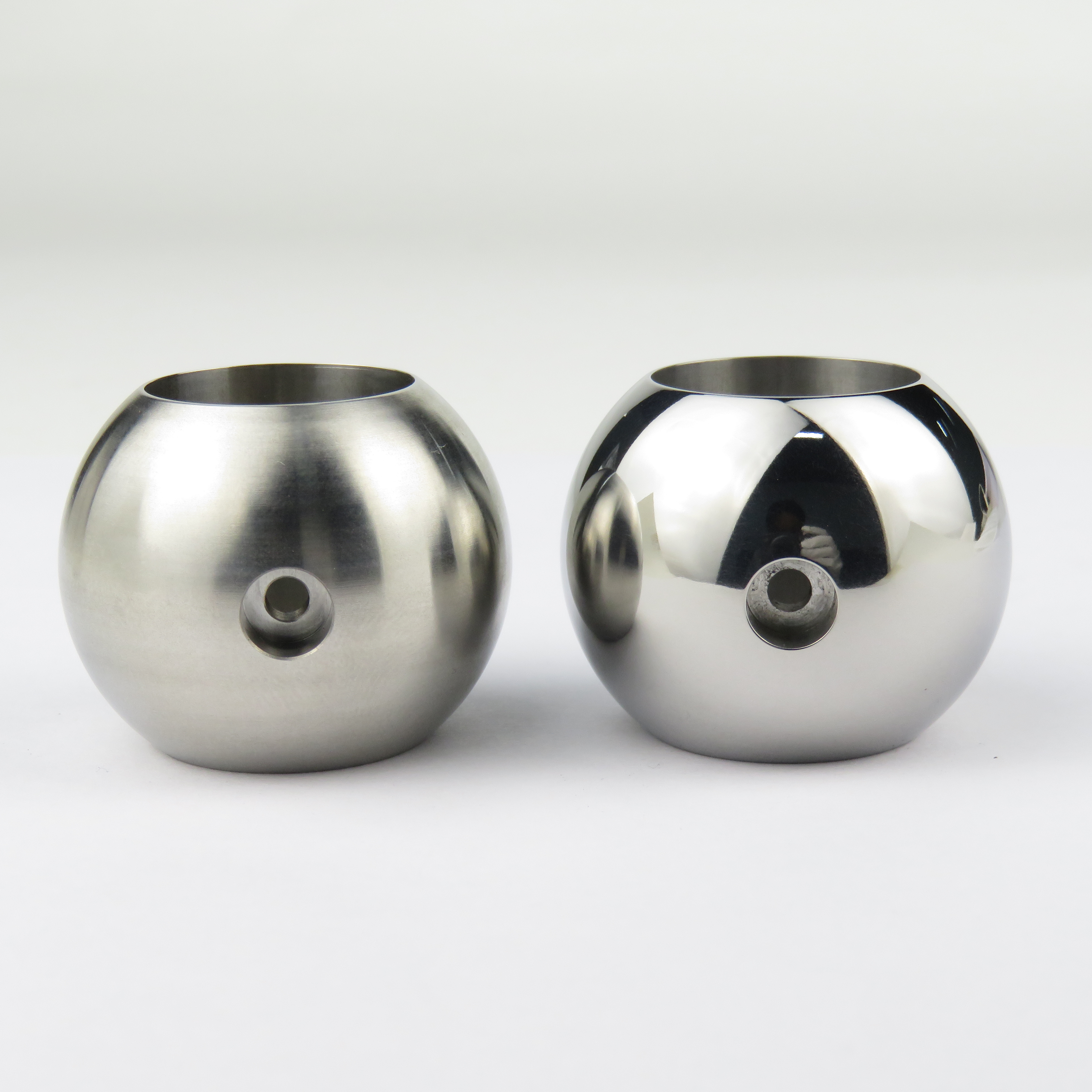
Start with a physical sample: if a short section can be removed without damage, send it, together with the retained reference panel from the original order if one exists. An installed surface has aged, been cleaned and possibly scratched, so a new length will not reproduce it exactly, and the visible difference is usually easier to manage by finishing a group of adjacent lengths than by matching one piece in isolation. A trial reports what the tested settings produced on the sample you sent; deciding how close is close enough remains with your own acceptance process and the people who will look at it daily.
A round bowl moves its load on a circular path in a chamber whose diameter caps the part length, and extending that chamber to take a six-metre length stops being practical. The deeper issue is the bed: a long tube occupies too much of the load for the media to circulate around it, so the part is dragged and struck instead of worked evenly. Long sections are better run in a tub, where the process length can be extended along one axis, or on a dedicated arrangement that moves the part or the heads along the length.
Lay the lengths end to end as they will be installed, under the light and at the distance agreed for acceptance, and look along the run rather than at each piece separately. A direction reversal or a change in texture pitch that is invisible on a single length usually shows immediately at the joint. The planning side matters more than the inspection: mark the grain direction on every length and keep the orientation through fabrication, packing and despatch. Where the finished parts come from different batches, compare each against the retained reference panel under the same conditions.
Use Toronto, Canada as the destination on the enquiry and state whether the deliverable is equipment, media and compound, a representative sample review or a line concept. A destination does not imply local stock, a local service point or a local delivery time.
A Toronto buyer will normally anchor on Canadian electrical safety certification of the machine and control panel, Ontario's Occupational Health and Safety Act and its industrial regulations for guarding and lockout, and the buyer's own customer specifications for surface roughness and cleanliness. The City of Toronto's own industrial water rate and incentive programs also show that process utility and environmental constraints feature in local manufacturing decisions.
Sources were retrieved on 2026-09-29 and describe the local industrial and trade context only. They do not evidence any SurfacePolish project, shipment, installation or service in Toronto.
The buyer needs an even satin grain along the whole length without bowing the thin wall or marking the face that will be seen from above.
Send the material, dimensions, approximate weight, batch quantity, the incoming condition and photographs of the difficult features. Mark which features must not be contacted by media and state how the result will be inspected. This form carries source reference PSEO-0107; quote it if you prefer an additional manual reference.
Open the SurfacePolish enquiry form Email a prepared enquiry
No price, lead time, certification or result is promised here. Confirm whether a sample trial is available for the specific part and what the trial can and cannot show.
Page PSEO-0107 · revised 2026-09-29 · cross-border equipment, media and scoped sample review. City context is sourced and cited above.
Use this local checker to identify missing part and inspection information. It prepares a technical-review brief; it does not approve a machine, process recipe or production result.
Complete the part details to prepare a review brief.
Email : info@surface-polish.com


 IPv6 network supported


 +86-592-2381506