A buyer in Ahmedabad, India working on semiconductor equipment has a slotted stainless distribution plate where edge burrs must go and the sealing face must stay flat and media-free. SurfacePolish supplies finishing machines, media and compounds across borders and runs a free sample trial: the plate travels to Xiamen and comes back with observed results and a proposed media, compound and cycle direction for the buyer's own checks. This brief is written for a buyer in Ahmedabad working on semiconductor equipment; it describes equipment, media and a scoped sample review, not a local polishing service.
Which surfaces on this part are functional, such as seal lands, gas passage walls and locating bores, and which are only cosmetic?
Which cleanliness method and limit does the buyer own, and is it applied before or after the buyer's own cleaning step?
How will a production batch be identified, segregated by material family and documented so a result can be traced to its settings?
Batch composition is a process variable, not a logistics detail. Mixing a 4 kg chamber lid with a handful of small stainless fittings changes media circulation, the cycle energy per part and the contact pattern between parts. Delicate electrode plates and thin-wall liners can be dented by heavier neighbours, and aluminium fines released in one batch can transfer onto stainless parts in the next unless the charge and the machine are cleaned between material families. Decide the part mix, the maximum mass per batch and whether fragile parts need racking or compartmentalisation. Decide also how batches are identified, with a traveller that carries material, media charge, compound, cycle time and operator, so a finishing result can be traced back to the settings that produced it. Batch identity is the basis for any later comparison.
Media wears, and worn media changes the process. Ceramic shrinks, plastic deforms and floats differently, steel can fracture into slivers, and all of them eventually reach a size or shape that lodges where a fresh charge would not. A working charge therefore needs a defined maintenance cycle: screen for undersize and debris, top up to a target mass, remove broken pieces, and record the change. Separation at unload deserves the same attention. Screens over the discharge, magnetic recovery for steel, tilting and draining stations, pin gauges and borescope checks on agreed features all reduce the chance that a medium travels with the part into the next operation. Where aluminium and stainless batches share a machine, purging media and compound between material families avoids cross-contamination that is difficult to see and easy to attribute to the wrong cause later.
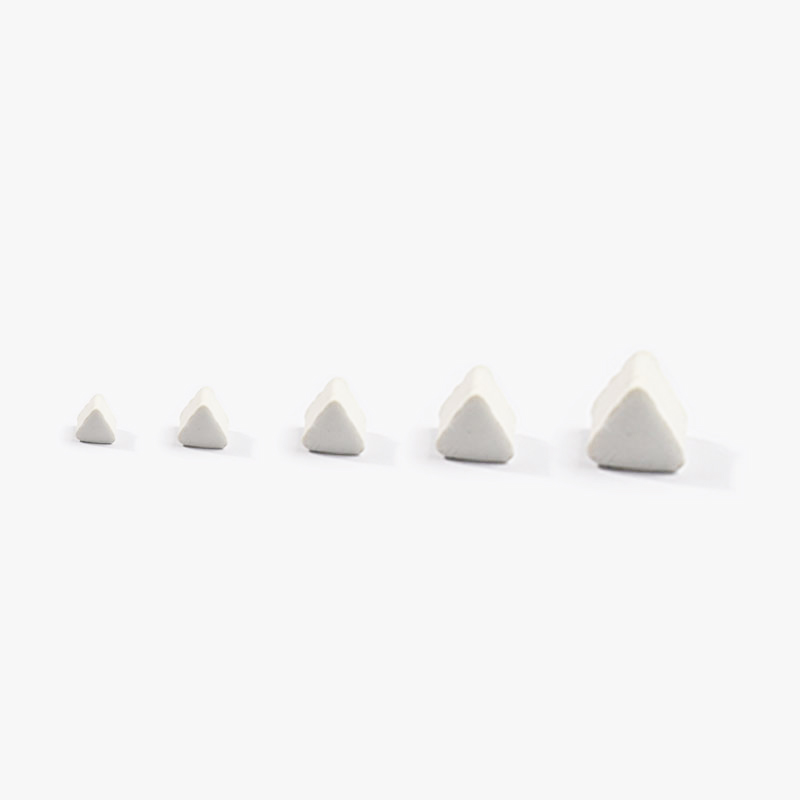
| Media | Best fit | Watch out for |
|---|---|---|
| Fine ceramic or porcelain spheres in a small size class | Refinement and light edge blending after a cutting stage, and reaching tighter external geometry on chamber bodies and plates | Small sizes enter and retain in gas passages and fine slots; media wear shrinks the charge and changes the finish over its life |
| Dry media such as walnut shell and corn cob | Drying assistance, light surface drying polish and removal of superficial soil after a wet cycle | Does not deburr or refine metal significantly, generates dust, and must not be treated as a cleanliness step |
| Heavy-cut ceramic, angle-cut triangles in a coarse size class | Removing a substantial machining burr from open external edges and pockets on aluminium and stainless housings before a refinement stage | Cuts edges and corners aggressively, leaves a coarse surface, and lodges in slots whose width approaches the media section |
| Plastic triangles and pyramids in a soft to medium grade | Deburring aluminium and other soft alloys where surface marking and edge rounding must be kept to a minimum | Slow cut rate, media deforms and wears, and a worn charge behaves noticeably differently from a fresh one |
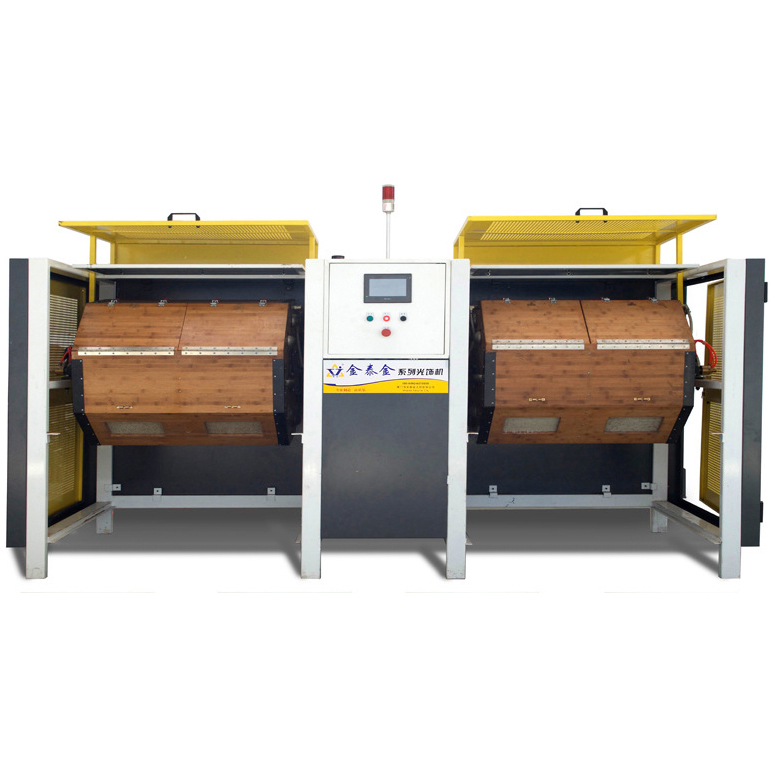
Rotary barrel finishing is the gentle end of the mechanical range: parts tumble in a closed drum, usually with plastic or light ceramic media and a generous compound flow, which limits direct impact and suits small fragile components and mixed batches of fittings. Cycles are long, the drum hides the parts while they run, and internal passages can collect media and compound, so unloading and retrieval discipline matters. On the dry side, dry polishing machines and dryers follow a wet process to remove residual moisture and reduce water spotting on aluminium and stainless surfaces. Drying is a finishing step, not a cleanliness release: a dry part can still carry a compound film, fine particulate or media dust, and the buyer's own cleanliness method is what decides whether the part may move forward.
| Machine route | Where it fits | What it will not do |
|---|---|---|
| Dry polishing machine and dryer | Removing residual moisture after a wet cycle and reducing water spotting on aluminium and stainless surfaces | A finishing step only; a dry part can still carry compound film, fines and media dust, so it is not a cleanliness release |
| Grinding finishing machine | Taking off a heavy machining burr or a defined stock layer before a refinement pass on robust stainless work | High removal energy cuts functional edges fast and demands a tighter geometry assessment and shorter cycles |
| Centrifugal barrel finishing machine | Small precise parts and short cycles with high contact pressure, such as inserts, small valve bodies and distribution components | Rounds edges and can distort thin unsupported sections quickly; results are sensitive to charge weight, speed and stop time |
| Vibratory finishing machine (bowl) | General deburring and refinement of chamber bodies, plates and housings that fit and can tumble without racking, with easy mid-cycle inspection | Continuous part-on-part contact and no access to deep internal passages; thin plates and finished mating faces need separation |
Edge rounding beyond limit shows up first on knife-edge seal faces, sharp bore lips and fine slot edges, where a fractionally generous radius can change how a gasket seats or how a flow path behaves. High-energy routes, long cycles, dense media and coarse ceramic all accelerate it, and aluminium rounds faster than stainless under the same conditions. The damage is easy to miss on a finished part because the edge looks uniform and polished. Checking means measuring a defined edge feature before and after, using an optical comparator, a radius gauge or a moulded replica of the corner, and comparing against the limit the buyer placed on the drawing. Where a knife edge cannot be protected, masking, a fixture that shields the face, or a gentler medium and shorter cycle are the usual mitigations to test.
| Failure mode | Likely cause | How to catch it |
|---|---|---|
| Uneven finish with unrefined pockets, corners or the shielded side of a flange | Media cannot reach the feature at the chosen size or orientation, charge flow is blocked, or the part was not repositioned during the cycle | Inspect at defined locations rather than judging the whole part, photograph the same feature before and after, and measure roughness only at the surfaces the drawing controls |
| A ceramic or plastic medium lodged in a blind tapped hole, slot or gas passage | Media size class too close to the opening, a worn charge that has broken down into smaller pieces, or a retention feature that was never mapped | Count the charge in and out where practical, borescope the smallest passages at an agreed angle, pin gauge every hole, and rinse through a filter for a visual residue check |
| Water spotting or mineral residue left after wet processing and drying | Hard or high-chloride rinse water, slow or uneven drying, or parts stacked wet so moisture is trapped in pockets and grooves | Inspect dried parts under angled light for rings and haze, check the rinse water source and drying method, and verify that pockets and grooves drain before the part is packed |
| Burr remaining in a cross-drilled intersection or an internal corner | Media too large to enter the intersection, part orientation that shields the feature, or a cycle stopped before that feature was reached | Borescope the intersection at a fixed angle, compare against a first-article reference, and use a pin or probe to feel for a lip on sampled parts |
Ahmedabad is the largest city and commercial centre of Gujarat, a state that accounts for 29.88% of India's total exports in FY 2024-25 and 62% of the country's petrochemical production (s2). The state's industrial base is organised through more than 200 industrial estates covering 33,000+ hectares of industrial land, with sector-specific parks including PM-MITRA Park, a Ceramics Park and a Bulk Drug Park, plus GIFT City, India's first operational smart city and its only International Financial Services Centre (s2). Ahmedabad-specific infrastructure includes the country's first bullet train, connecting Ahmedabad and Mumbai over 508 km, and the state's largest waste-to-energy plant, established at Piplaj on a public-private basis (s1).
For this brief the relevant part of that base is semiconductor: Invest India's semiconductor sector page reports Micron Technology's semiconductor assembly plant in Gujarat, one of the country's approved ATMP/OSAT facilities (s3).
Ahmedabad's pharmaceutical, chemical and electronics/semiconductor supply base needs deburring and cleanliness on machined stainless parts, dies, tooling and precision components, where contamination and burr retention are functional risks rather than appearance issues. The broader engineering and automotive-component work in the Sanand-Changodar-Vatva belt adds conventional deburring, edge radiusing and surface preparation before coating or assembly, and pharma equipment fabrication adds passivation and product-contact cleanliness requirements.
An Ahmedabad buyer should settle whether the parts are pharmaceutical, chemical or food-contact components requiring documented cleanliness and passivation, or general engineering components needing edge control and finish, because that distinction decides the media chemistry, the rinse and drying regime, and what evidence of the process the customer's quality team will accept.
Freight context: Gujarat's major port (Kandla/Deendayal) and 48 non-major ports, Sardar Vallabhbhai Patel International Airport, Ahmedabad, GIFT City / DMIC corridor. Gujarat has 1 major port and 48 non-major ports and 19 operational airports, four of which are international, with 38% of the Delhi-Mumbai Industrial Corridor lying in the state (s4). Sea-borne machinery and media therefore land through the state's port system, while Ahmedabad's international airport handles air freight and sample parts, and the DMIC road and rail corridor links the metro to the northern and western hinterland.
The Bureau of Indian Standards (BIS) describes itself as the National Standards Body of India and runs the country's product certification system, including products under compulsory certification, a foreign manufacturers certification scheme with nomination of an authorised Indian representative, and a registration scheme for manufacturers (c8, c9). Indian Standards (IS) issued by BIS are the reference texts Indian buyers write surface, coating and material specifications against, and BIS-recognised or BIS-empanelled laboratories are the test facilities used for certification work. Where a machine, media or compound falls under a BIS quality-control order, the licence or registration duty attaches to the product placed on the Indian market, so an overseas supplier should settle the applicable IS standard and the certification route before quoting.
India classifies every imported item in the ITC(HS) schedule, a compilation of codes for all merchandise for export and import whose Schedule I lays down the import policy regime for each item, maintained at 8-digit level under the First Schedule of the Customs Tariff Act, 1975 and aligned at 6 digits with the WCO Harmonized System (c1, c3). Importability is judged by the policy in force on the date of import, and when a policy moves from free to restricted, goods already committed through an irrevocable commercial letter of credit opened before the change can still be imported up to the balance quantity, value and period in that ICLC (c4). Preferential customs treatment is available only through the preferential trade agreements, free trade agreements, CECAs and CEPAs that India notifies and that are in operation (c5), so Chinese-origin industrial machinery is assessed at the applicable rate of the customs tariff rather than under any India-China preferential rate; India's commerce leadership has separately pointed to exports under free trade pacts growing faster than imports (c12). For capital goods specifically, DGFT operates the Export Promotion Capital Goods (EPCG) scheme, whose stated objective is to facilitate import of capital goods for producing quality goods and services (c7), which Indian firms use when they want duty relief on imported plant against an export obligation.
SurfacePolish supplies from Xiamen, China. The buyer's own destination rules, conformity marking, tariff classification and documentation responsibilities stay with the buyer; confirm them against the authorities named above before ordering.
Cleanliness acceptance belongs to the buyer, because only the buyer knows what the part will see downstream and which residue matters. A practical specification names the method, the surface or extract volume it applies to, and the limit. Common approaches include a solvent or water wipe over a defined area with a visual or gravimetric assessment, a rinse-and-filter collection on internal passages, magnification or borescope inspection of sealing faces and slot edges, and the buyer's own leak or functional test on the assembled part. State whether inspection happens on the finished part, after the buyer's own cleaning step, or both. SurfacePolish can report what was observed on tested parts and keep them separated and documented, but it cannot certify a cleanliness level or guarantee a particle result.
A sample trial answers a narrow question: what happened to these parts under these settings on this equipment. It does not prove that a production lot will be uniform, because bowl size, load ratio, media age and operator practice all shift the outcome. It does not establish a particle count, a cleanliness level or fitness for a cleanroom or any regulated process environment, and it does not transfer a roughness value from a coupon to a complex geometry. It cannot guarantee a cycle time, a cost per part, a capacity or a delivery schedule, and it does not qualify a machine, medium or compound for a semiconductor application. Treat the returned parts and the settings record as evidence for the buyer's own engineering decision, and plan the production route with its own first-article and sampling discipline.

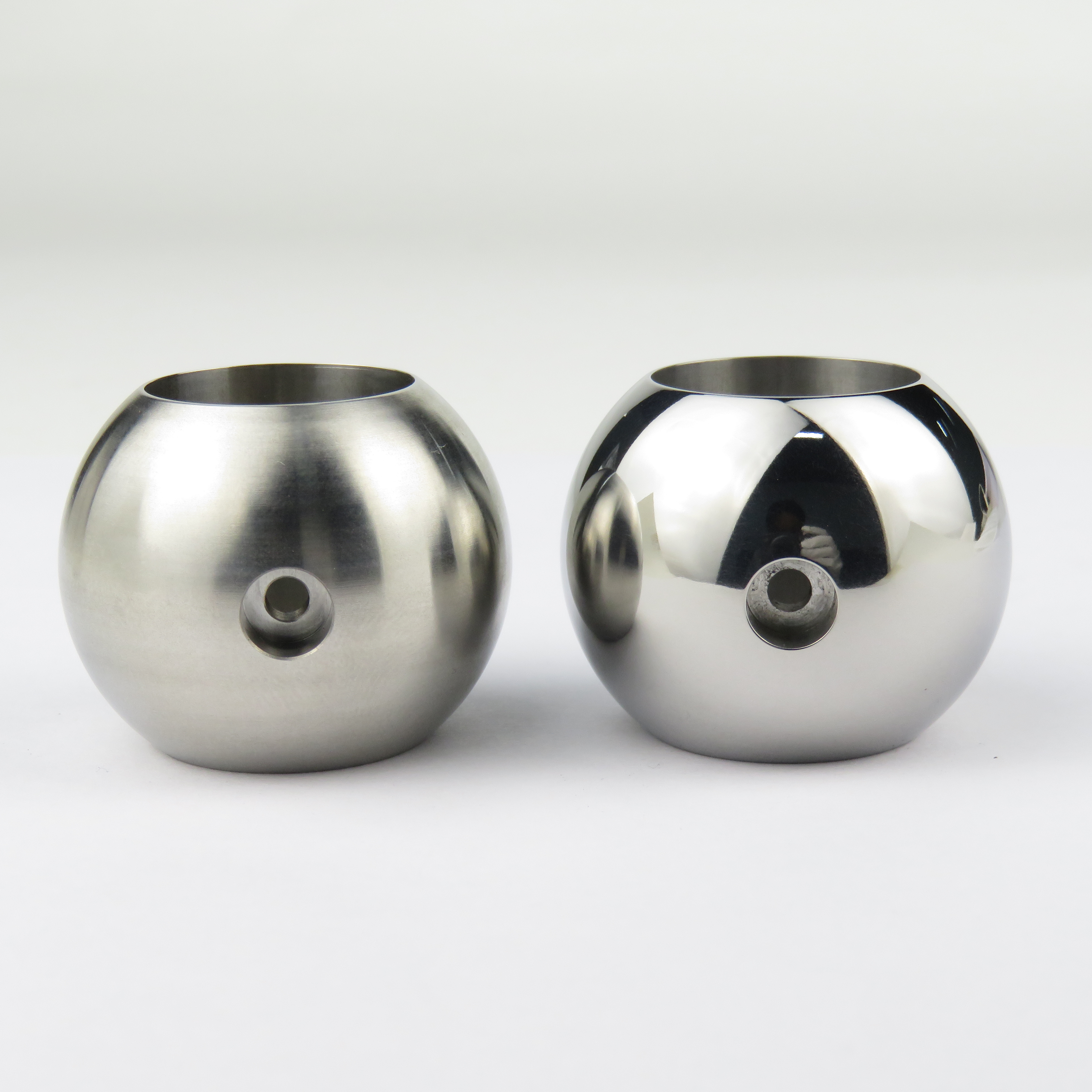
A pump housing is usually assessed on external edges, bore condition and appearance, and a slightly rounded edge is often acceptable. A chamber component is assessed on small functional surfaces: a seal land that must not round, a gas passage that must stay clear, a locating bore that sets position. That shifts the whole process toward smaller media, gentler energy, more masking and fixturing, and a defined cleanliness step. It also shifts acceptance from a visual judgement to measurements at named features. If a shop quotes both parts the same way, the finishing route is probably being chosen by part size rather than by what the surfaces actually do.
Size the medium well below the smallest opening the charge could enter, and treat every passage as a retrieval point rather than assuming it stays clear. Map the tightest hole, slot or cross-drilling first, then choose a size class against that geometry instead of an average part. Add a defined check such as a borescope at an agreed angle, a pin gauge on holes, and a rinse collected through a filter. For India buyers preparing a trial, send the part with the smallest passage so the media choice is tested on the real feature. SurfacePolish reports what was observed on tested parts; the cleanliness release remains the buyer's decision.
Mechanical mass finishing and electropolishing are different processes with different effects, and SurfacePolish does not supply or perform electropolishing. A mechanical route can deburr and refine a surface, and it may reduce the reason to consider an electrochemical step, but it does not reproduce what electropolishing does to a surface. The honest comparison is to define what the gas line actually requires, then test whether a mechanical route can observe those requirements on representative parts. Where an electrochemical finish is mandatory in your specification, that requirement stays with your own supply chain. This page treats electropolishing only as a comparison point and as a reason to evaluate a mechanical alternative.
Use Ahmedabad, India as the destination on the enquiry and state whether the deliverable is equipment, media and compound, a representative sample review or a line concept. A destination does not imply local stock, a local service point or a local delivery time.
Ahmedabad buyers specify finish, cleanliness and material conformity against Indian Standards (IS) published by the Bureau of Indian Standards, the National Standards Body of India (s5). Pharmaceutical and food-contact work additionally carries the customer's own cleaning, passivation and validation requirements, and where the machine or finishing consumable falls under a BIS quality-control order the licence or registration duty applies to the product on the Indian market (s5).
Sources were retrieved on 2026-09-29 and describe the local industrial and trade context only. They do not evidence any SurfacePolish project, shipment, installation or service in Ahmedabad.
The buyer needs the slot edges deburred and the sealing face kept flat, with no media left in the slot array.
Send the material, dimensions, approximate weight, batch quantity, the incoming condition and photographs of the difficult features. Mark which features must not be contacted by media and state how the result will be inspected. This form carries source reference PSEO-0965; quote it if you prefer an additional manual reference.
Open the SurfacePolish enquiry form Email a prepared enquiry
No price, lead time, certification or result is promised here. Confirm whether a sample trial is available for the specific part and what the trial can and cannot show.
Page PSEO-0965 · revised 2026-09-29 · cross-border equipment, media and scoped sample review. City context is sourced and cited above.
Use this local checker to identify missing part and inspection information. It prepares a technical-review brief; it does not approve a machine, process recipe or production result.
Complete the part details to prepare a review brief.
Email : info@surface-polish.com


 IPv6 network supported


 +86-592-2381506