A buyer in Surat, India in semiconductor equipment has a machined showerhead housing with fine gas passages that must be deburred without plugging a passage or contaminating the seal face. SurfacePolish supplies finishing machines, media and compounds across borders and offers a free sample trial, returning tested parts to the buyer with observations and a proposed media, compound and cycle direction. This brief is written for a buyer in Surat working on semiconductor equipment; it describes equipment, media and a scoped sample review, not a local polishing service.
Which surfaces on this part are functional, such as seal lands, gas passage walls and locating bores, and which are only cosmetic?
How will a production batch be identified, segregated by material family and documented so a result can be traced to its settings?
Which cleanliness method and limit does the buyer own, and is it applied before or after the buyer's own cleaning step?
Material state decides more about the route than the drawing tolerance does. A 6061-T6 machined plate, a 5083 weldment and a 316L casting behave differently under the same media load: aluminium work-hardens and smears, cast material can open porosity, and stainless can pick up iron from tooling or from steel media. Establish whether the part has been heat treated, whether weld zones will be finished in the same pass as the parent metal, and whether an anodise, passivation or coating step follows, because that downstream step can be the real reason a surface must be smut-free and free of embedded debris. Record the starting condition honestly: machining marks, EDM recast layer, heat tint, glass-bead residue from an earlier operation and any oil or handling soil all change what one mass-finishing cycle can achieve.
Compound choice controls residue as much as it controls cutting. Alkaline and neutral families are common for general deburring and cleaning, acidic families may be used where a descale or brightening effect is wanted, and silicate-bearing products can leave a tenacious film that is difficult to remove from a sealing face or a gas passage. For aluminium, a compound with an effective corrosion inhibitor is usually necessary to avoid darkening and surface attack during and after the cycle. Concentration, flow rate and temperature all shift the result, so dosing should be metered rather than guessed. Water quality matters too: hardness, chloride content and suspended solids affect foaming, rinsing and the residue left behind. The question to put to a supplier is what the compound leaves on the part, how it is removed, and what evidence a buyer can collect to confirm removal.
| Media | Best fit | Watch out for |
|---|---|---|
| Steel media, including balls and shaped pins | Bright finishing and edge blending on stainless components where appearance and a burnished surface matter | Transfers iron to aluminium and carbon steel, needs a corrosion-inhibiting compound, and must be separated magnetically or by screen at unload |
| Dry media such as walnut shell and corn cob | Drying assistance, light surface drying polish and removal of superficial soil after a wet cycle | Does not deburr or refine metal significantly, generates dust, and must not be treated as a cleanliness step |
| Magnetic finishing pins and fine magnetic media | Small precise items such as nozzles, orifice plates and fine slot arrays where tumbling media cannot reach the feature | Limited working envelope, pins lodge in the same fine features they are chosen to reach, and the surface signature differs from tumbling |
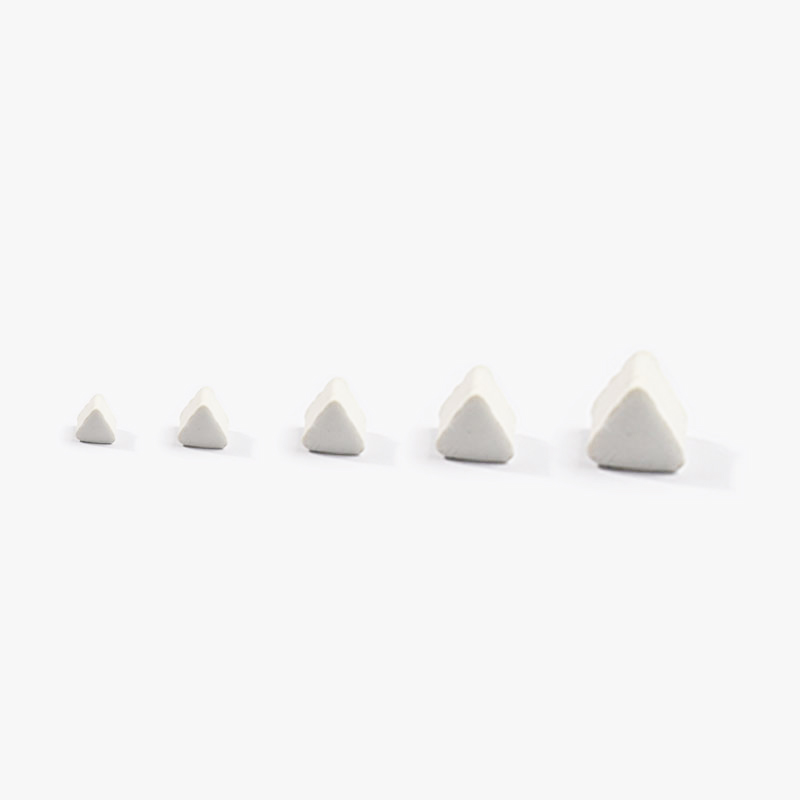
| Plastic triangles and pyramids in a soft to medium grade | Deburring aluminium and other soft alloys where surface marking and edge rounding must be kept to a minimum | Slow cut rate, media deforms and wears, and a worn charge behaves noticeably differently from a fresh one |
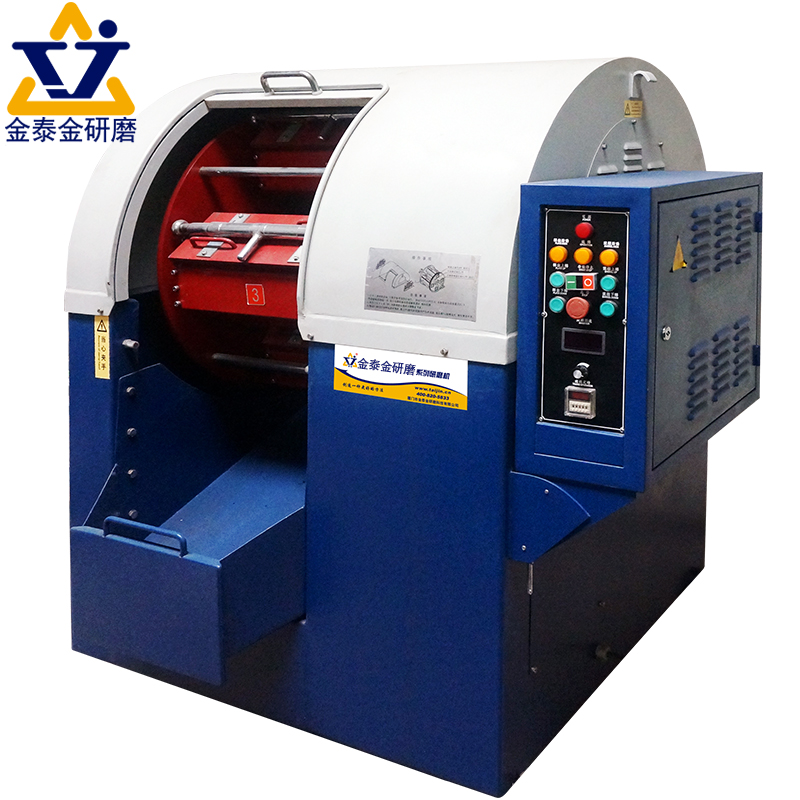
Rotary barrel finishing is the gentle end of the mechanical range: parts tumble in a closed drum, usually with plastic or light ceramic media and a generous compound flow, which limits direct impact and suits small fragile components and mixed batches of fittings. Cycles are long, the drum hides the parts while they run, and internal passages can collect media and compound, so unloading and retrieval discipline matters. On the dry side, dry polishing machines and dryers follow a wet process to remove residual moisture and reduce water spotting on aluminium and stainless surfaces. Drying is a finishing step, not a cleanliness release: a dry part can still carry a compound film, fine particulate or media dust, and the buyer's own cleanliness method is what decides whether the part may move forward.
| Machine route | Where it fits | What it will not do |
|---|---|---|
| Centrifugal barrel finishing machine | Small precise parts and short cycles with high contact pressure, such as inserts, small valve bodies and distribution components | Rounds edges and can distort thin unsupported sections quickly; results are sensitive to charge weight, speed and stop time |
| Grinding finishing machine | Taking off a heavy machining burr or a defined stock layer before a refinement pass on robust stainless work | High removal energy cuts functional edges fast and demands a tighter geometry assessment and shorter cycles |
| Tub vibrator | Long gas rails, tubular manifolds, weldments and linear electrode assemblies that cannot rotate in a bowl | Lower energy per unit area so heavy burrs take longer, and large tubs need floor space and a suitable part support method |
| Disc finishing machine | Fast, high-energy edge breaking and surface refinement on small robust parts and uniform batches of fittings | High impingement and edge-loss risk on thin or soft parts, and geometry must suit the disc working gap |
Compound film, media dust and embedded particles on a sealing face are the failure mode that most often forces a semiconductor equipment part back through cleaning or into scrap. The face may look acceptable under shop light while carrying a tenacious silicate film, a smear of aluminium, or fine ceramic debris forced into a soft surface. Impingement can also peen media fragments into aluminium, which is difficult to detect without magnification or a wipe test. Likely causes include too little rinse, a compound that forms a film, insufficient separation after the cycle, and drying a part before it is genuinely clean. Inspection should combine magnification of the sealing land, a solvent wipe over a defined area, and the buyer's own cleanliness method. Surface finish alone is not evidence that a face is free of residue.
| Failure mode | Likely cause | How to catch it |
|---|---|---|
| Burr remaining in a cross-drilled intersection or an internal corner | Media too large to enter the intersection, part orientation that shields the feature, or a cycle stopped before that feature was reached | Borescope the intersection at a fixed angle, compare against a first-article reference, and use a pin or probe to feel for a lip on sampled parts |
| Thin plate or liner distorted, bowed or dimensionally drifted after the cycle | Tumbling load on an unsupported thin section, part-on-part contact, or heat and pressure from a high-energy route | Measure flatness, wall thickness and critical dimensions at the same marked points as the pre-process baseline, using a CMM or surface plate and gauge |
| A ceramic or plastic medium lodged in a blind tapped hole, slot or gas passage | Media size class too close to the opening, a worn charge that has broken down into smaller pieces, or a retention feature that was never mapped | Count the charge in and out where practical, borescope the smallest passages at an agreed angle, pin gauge every hole, and rinse through a filter for a visual residue check |
| Tapped threads rounded, galled or opened out by edge finishing | Media working the thread crest during a long or high-energy cycle, with no plugging or masking on the hole | Run a go and no-go thread gauge on every sampled hole, inspect crest condition at magnification, and confirm that plugs or masks were used and removed |
Surat is a processing and port-industrial city. The district administration states that Surat is the world's largest diamond manufacturing centre with over 5,000 diamond manufacturing units and that three-quarters of the world's diamonds are cut and polished there, while the Southern Gujarat Chamber of Commerce and Industry (SGCCI) records a diamond-cutting workforce of more than 1.5 million people. SGCCI describes Surat as India's most prominent man-made textile centre and notes a strong MSME manufacturing base in South Gujarat. The district's heaviest industry sits in the Hazira belt about 15 km from the city, which SGCCI says has attracted investment from Reliance, ONGC, Essar, L & T, KRIBHCO, GAIL, Shell, Niko, NTPC, ABG Shipyard, IOCL, HPCL and BPCL, and Reliance confirms a carbon fibre facility at Hazira.
The nearest part of that base to this brief is marine: ABG Shipyard is among the units SGCCI lists in the Hazira belt about 15 km from Surat, and the district administration states that Hazira port is connected by NH8 to Ahmedabad and Mumbai.
Surat's metal-finishing demand is concentrated around diamond and textile processing and the Hazira process belt: machine parts, dies, jigs and stainless components that need burr removal and edge control before use, plus tooling and hardware where surface condition matters. Fabrication and maintenance workshops in the belt also finish replacement parts and stainless components, where the practical question is whether a vibratory or barrel process can reach the required edge condition without altering dimensions or leaving compound residue. Because much of the supporting industry is MSME-scale, batches are often small and mixed-material, which affects media choice.
A Surat buyer should first decide whether finishing is needed for edge control and deburring of machined components or for surface preparation of cast, formed or welded parts, then confirm on sample parts that the media and compound suit the specific alloy and geometry — a step that matters when parts come from mixed small-batch production.
Freight context: Hazira port, Surat, Surat International Airport (Airports Authority of India), NH8 / NH6 road corridors. The district administration states that Hazira port is connected by NH8 to Ahmedabad and Mumbai, with NH6 linking the Maharashtra border-Surat-Hazira, and AAI material refers to Surat International Airport. Sea freight for the Hazira belt enters through Hazira; imported machines and sample parts are cleared under the standard Indian customs procedure at the port or airport of entry.
An Importer-Exporter Code (IEC) issued by DGFT is a key business identification number which is mandatory for exports or imports, and since the introduction of GST the IEC number is the same as the PAN of the firm (c6). The post-incorporation clearance list published by Invest India includes the IEC, a Customs- Special Valuation Branch reference and the grant of a Bureau of Indian Standards (BIS) licence, and it names the Central Board of Excise and Customs among the agencies in the framework (c10). The Foreign Trade Policy fixes the mandatory import documents as a bill of lading / airway bill / lorry receipt / railway receipt, a commercial invoice cum packing list and a bill of entry, with additional documents or NOCs possible for goods subject to product-specific compliance (c3); it also states that domestic laws, rules, orders, technical specifications and environmental, safety and health norms applicable to domestically produced goods apply mutatis mutandis to imports unless specifically exempted (c2), which is the basis on which a BIS quality-control order can bite on imported machinery. A landed-cost plan therefore needs the correct ITC(HS) classification and the basic customs duty and IGST that follow from it, plus the IEC, the bill of entry documentation and any BIS licence or registration obligation, and a related-party import can additionally be pulled into special customs valuation.
The Bureau of Indian Standards (BIS) describes itself as the National Standards Body of India and runs the country's product certification system, including products under compulsory certification, a foreign manufacturers certification scheme with nomination of an authorised Indian representative, and a registration scheme for manufacturers (c8, c9). Indian Standards (IS) issued by BIS are the reference texts Indian buyers write surface, coating and material specifications against, and BIS-recognised or BIS-empanelled laboratories are the test facilities used for certification work. Where a machine, media or compound falls under a BIS quality-control order, the licence or registration duty attaches to the product placed on the Indian market, so an overseas supplier should settle the applicable IS standard and the certification route before quoting.
SurfacePolish supplies from Xiamen, China. The buyer's own destination rules, conformity marking, tariff classification and documentation responsibilities stay with the buyer; confirm them against the authorities named above before ordering.
Acceptance has to be written before the trial, on the drawing and in the purchase specification, not agreed verbally afterwards. Name the controlled surfaces individually, for example a seal land, a gas passage wall or a mating flange face, and state the parameter, the cut-off length, the direction of measurement and the number of readings. A single global roughness call-out on a chamber body is not enough, because the sealing face, the outer wall and the bore will not respond the same way to one media charge. Where an edge limit applies, express it as a maximum radius or a required chamfer at a named feature. Add the cleanliness requirements the part must meet and the method by which they will be judged. Settling these points early prevents the common dispute in which a supplier reports a finish and a buyer rejects on cleanliness.
Send parts that represent the real range, not a single convenient sample. The set should include the part with the tightest internal passage, the thinnest unsupported section, the surface that must not be touched, and at least one part in the true as-received condition with its normal burr and soil. Add a coupon of the same material, ideally with a known starting roughness, so a measurement can be compared before and after. Supply a marked-up drawing identifying critical surfaces, edge limits and any cleanliness requirement, plus a short statement of what the part does in service. Quantity matters: several pieces allow a stop-and-look at more than one cycle time. Pack them so they arrive undamaged, label each one, and state the material and heat treatment, since an unlabelled mixed lot cannot be assessed.
Change one variable at a time. Hold the machine, load, compound, cycle time and part mix constant, and change only the medium; if the question is cycle time, hold the charge constant and stop at two or three defined intervals. Evaluate the returned parts at the same marked measurement points, and if several people judge appearance, use coded labels so the assessment is blind. Where a cut stage is followed by a refinement stage, score the stages separately, because a good final figure can hide a coarse first stage. A clear comparison needs the returned parts, the record and your own inspectors.
A batch record should identify what was done rather than simply assert a result. Ask for part numbers and quantities, the machine used, the media type and size class, charge mass and age since the last screen, the compound and dose, the rinse water source, cycle time, inspection results and the lot disposition. Request the media and compound data sheets offered by the supplier. Where aluminium and stainless are processed on the same site, ask for the changeover note covering media purge, machine cleaning and compound replacement. This is finishing process documentation, not a certificate of compliance, and it supports your own traceability in India.
Mechanical mass finishing and electropolishing are different processes with different effects, and SurfacePolish does not supply or perform electropolishing. A mechanical route can deburr and refine a surface, and it may reduce the reason to consider an electrochemical step, but it does not reproduce what electropolishing does to a surface. The honest comparison is to define what the gas line actually requires, then test whether a mechanical route can observe those requirements on representative parts. Where an electrochemical finish is mandatory in your specification, that requirement stays with your own supply chain. This page treats electropolishing only as a comparison point and as a reason to evaluate a mechanical alternative.
Use Surat, India as the destination on the enquiry and state whether the deliverable is equipment, media and compound, a representative sample review or a line concept. A destination does not imply local stock, a local service point or a local delivery time.
The Bureau of Indian Standards (BIS) is the national standards body, and BIS describes its certification scheme as basically voluntary in nature, with compliance made compulsory for a number of products by the Central Government. Process and chemical units in Gujarat additionally work to their customers' material and inspection specifications as general industry practice.
Sources were retrieved on 2026-09-29 and describe the local industrial and trade context only. They do not evidence any SurfacePolish project, shipment, installation or service in Surat.
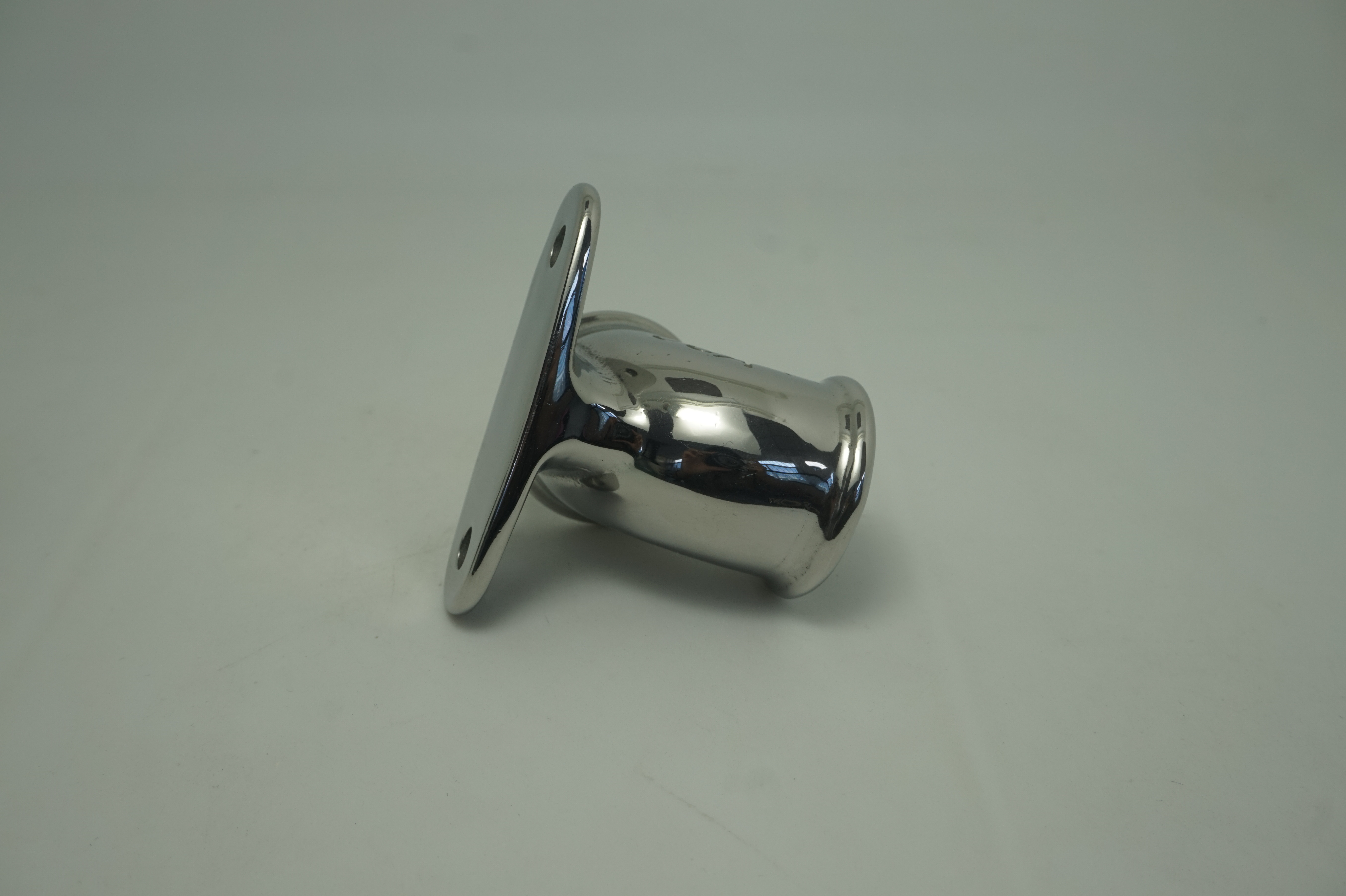
The buyer must deburr the rib edges and passage entries without blocking a passage or leaving compound film on the sealing face.
Send the material, dimensions, approximate weight, batch quantity, the incoming condition and photographs of the difficult features. Mark which features must not be contacted by media and state how the result will be inspected. This form carries source reference PSEO-0975; quote it if you prefer an additional manual reference.
Open the SurfacePolish enquiry form Email a prepared enquiry
No price, lead time, certification or result is promised here. Confirm whether a sample trial is available for the specific part and what the trial can and cannot show.
Page PSEO-0975 · revised 2026-09-29 · cross-border equipment, media and scoped sample review. City context is sourced and cited above.
Use this local checker to identify missing part and inspection information. It prepares a technical-review brief; it does not approve a machine, process recipe or production result.
Complete the part details to prepare a review brief.
Email : info@surface-polish.com


 IPv6 network supported


 +86-592-2381506