A buyer in Birmingham, United Kingdom working on semiconductor equipment has an aluminium chamber lid whose seal land and 24 blind tapped holes must survive deburring without rounding or lodging. SurfacePolish supplies vibratory finishing machines, media and compounds across borders and runs a free sample trial: the part travels to Xiamen, and the returned part comes with a proposed media, compound and cycle direction for the buyer's own review. This brief is written for a buyer in Birmingham working on semiconductor equipment; it describes equipment, media and a scoped sample review, not a local polishing service.
Which surfaces on this part are functional, such as seal lands, gas passage walls and locating bores, and which are only cosmetic?
Can the required finish be reached in one mechanical route, or does the part need a cut stage followed by a refinement stage?
What is the smallest internal passage, slot or hole the charge must not plug, and how will a lodged medium be detected and removed?
Before discussing media, establish what the burr actually is and where it sits. Milling leaves a rolled edge on a machined flange, turning leaves a feather on a bore lip, and EDM leaves a recast layer that behaves differently under impact media. Note the edge condition on seal lands and knife edges specifically, because those are the features where rounding is least tolerated and where a specification usually names a maximum radius or a required chamfer. Ask which burrs are functional rather than cosmetic: a burr inside a gas passage affects flow and can shed particles, while one on an external bracket face may not matter at all. Equally, record the cleanliness baseline the part arrives with, since oil, coolant and earlier blasting residue will load the compound and influence the outcome of a first cycle.
Steel media produces a bright, burnished appearance and high contact pressure, and it is usually paired with a corrosion-inhibiting compound. On semiconductor equipment parts it belongs mainly on stainless items where appearance and edge blending matter, and it should be treated with caution on aluminium, where steel can transfer iron and leave rust spotting or embedded fragments that later appear as particles or staining. Separation at unload is critical: steel media is dense, is easily retained in blind holes and slots, and can be recovered magnetically only if the equipment is set up for that. Steel charges also need their own containment and cleaning discipline to keep ferrous contamination out of aluminium work. A bright result from a steel charge is an observation about a surface, not evidence about cleanliness or suitability for a process environment.
| Media | Best fit | Watch out for |
|---|---|---|
| Fine ceramic or porcelain spheres in a small size class | Refinement and light edge blending after a cutting stage, and reaching tighter external geometry on chamber bodies and plates | Small sizes enter and retain in gas passages and fine slots; media wear shrinks the charge and changes the finish over its life |
| Dry media such as walnut shell and corn cob | Drying assistance, light surface drying polish and removal of superficial soil after a wet cycle | Does not deburr or refine metal significantly, generates dust, and must not be treated as a cleanliness step |
| Plastic cylinders and cones in a harder, denser grade | Longer cycles on mixed batches of small fittings where a repeatable light edge break is wanted without ceramic impact | Can float or segregate by shape in a bowl, and cylindrical forms can wedge in slots and cross-drillings |
| Aluminium oxide grinding media in a dense ceramic bond | Where a heavier stock removal or a more consistent cut is needed on robust stainless parts with thick edges | High removal energy rounds functional edges quickly and is a poor match for thin aluminium plates or knife-edge seal lands |
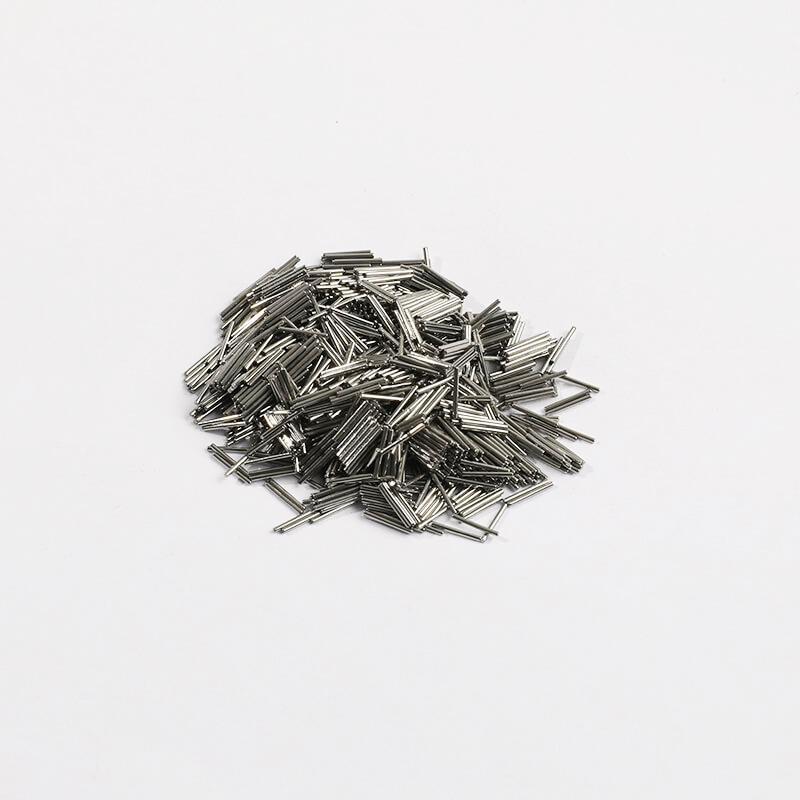
Magnetic finishing uses a small charge of pin-shaped or fine media driven by a moving magnetic field, which lets it reach narrow gaps, small bores and fine internal radii that tumbling media cannot enter. For semiconductor equipment parts it is most relevant on small precise items: gas nozzles, orifice plates, small machined inserts and fine slot arrays where the requirement is deburring and light refinement rather than bulk stock removal. The working envelope is small, so chamber bodies and long gas lines are out of scope. The media pins themselves are a lodging risk in the same features they are chosen to reach, and they are difficult to see inside a closed passage. Magnetic finishing also leaves a different surface signature from tumbling, so a roughness figure obtained on one route cannot be assumed to transfer to another.
| Machine route | Where it fits | What it will not do |
|---|---|---|
| Disc finishing machine | Fast, high-energy edge breaking and surface refinement on small robust parts and uniform batches of fittings | High impingement and edge-loss risk on thin or soft parts, and geometry must suit the disc working gap |
| Dry polishing machine and dryer | Removing residual moisture after a wet cycle and reducing water spotting on aluminium and stainless surfaces | A finishing step only; a dry part can still carry compound film, fines and media dust, so it is not a cleanliness release |
| Grinding finishing machine | Taking off a heavy machining burr or a defined stock layer before a refinement pass on robust stainless work | High removal energy cuts functional edges fast and demands a tighter geometry assessment and shorter cycles |
| Tub vibrator | Long gas rails, tubular manifolds, weldments and linear electrode assemblies that cannot rotate in a bowl | Lower energy per unit area so heavy burrs take longer, and large tubs need floor space and a suitable part support method |
Edge rounding beyond limit shows up first on knife-edge seal faces, sharp bore lips and fine slot edges, where a fractionally generous radius can change how a gasket seats or how a flow path behaves. High-energy routes, long cycles, dense media and coarse ceramic all accelerate it, and aluminium rounds faster than stainless under the same conditions. The damage is easy to miss on a finished part because the edge looks uniform and polished. Checking means measuring a defined edge feature before and after, using an optical comparator, a radius gauge or a moulded replica of the corner, and comparing against the limit the buyer placed on the drawing. Where a knife edge cannot be protected, masking, a fixture that shields the face, or a gentler medium and shorter cycle are the usual mitigations to test.
| Failure mode | Likely cause | How to catch it |
|---|---|---|
| Knife-edge seal face or bore lip rounded past the drawing limit | High-energy route, over-long cycle, dense or coarse media, or a soft aluminium edge run without masking or shielding | Measure a defined edge feature before and after with an optical comparator, radius gauge or moulded replica, and compare with the maximum radius on the drawing |
| A ceramic or plastic medium lodged in a blind tapped hole, slot or gas passage | Media size class too close to the opening, a worn charge that has broken down into smaller pieces, or a retention feature that was never mapped | Count the charge in and out where practical, borescope the smallest passages at an agreed angle, pin gauge every hole, and rinse through a filter for a visual residue check |
| Rust spotting on stainless parts appearing hours or days after finishing | Ferrous transfer from steel media, a machine or tooling that has held carbon steel, or insufficient corrosion inhibition and drying | Inspect after a defined dwell time rather than immediately, look for pinpoint spots on and near edges, and trace media and machine history for the lot |
| Tapped threads rounded, galled or opened out by edge finishing | Media working the thread crest during a long or high-energy cycle, with no plugging or masking on the hole | Run a go and no-go thread gauge on every sampled hole, inspect crest condition at magnification, and confirm that plugs or masks were used and removed |
Birmingham sits inside the West Midlands production region whose robotics and autonomous systems adoption Make UK studied jointly with the West Midlands Combined Authority and the West Midlands RAS Cluster, based on survey responses from over 100 manufacturers of all sizes. The West Midlands Combined Authority is the region's statutory economic body, and the city is the base of the Greater Birmingham Chambers of Commerce. Freight is anchored by ABP's Hams Hall Rail Freight Terminal, 13 km from Birmingham, which handles deep-sea and short-sea traffic to and from Southampton, Tilbury and Felixstowe as well as Channel Tunnel traffic. Make UK's regional outlook records that all English regions have now exceeded their 2019 manufacturing output levels, with aerospace and defence investment fuelling growth in the strongest-performing areas.
The nearest part of that base to this brief is machinery: Make UK's West Midlands study addresses the region's production industry and its RAS adoption, drawing on a literature review and survey responses from over 100 manufacturers of all sizes.
Deburring and edge control sit between machining and assembly in a production base that is being pushed towards automation: Make UK and WMCA commissioned the West Midlands RAS study specifically because adoption is uneven across the region's manufacturers. Because incoming machines and media move through an inland rail terminal rather than a local seaport, the practical issues for a Birmingham plant are inland container booking, offloading and media handling rather than port-side clearance.
Before choosing a machine or media, the Birmingham buyer should define which edge or surface condition is actually acceptance-critical on the part, and confirm who will hold the UKCA/CE technical file and Declaration of Conformity once the equipment is installed in the West Midlands.
Freight context: Hams Hall Rail Freight Terminal (ABP-owned, Edison Road, Coleshill, Birmingham; operated by Maritime Transport), Birmingham Airport. ABP describes Hams Hall as 'one of the country's busiest inland rail freight terminal' and states that the 11ha site handles deep-sea and short-sea traffic to and from ports such as Southampton, Tilbury and Felixstowe, plus traffic via the Channel Tunnel and domestic traffic from Scotland. Machines or sample parts consigned to Birmingham can therefore be cleared through a southern container port and moved inland by rail.
China does not appear in the alphabetical list of trade agreements in effect published by the Department for Business and Trade, so Chinese-origin machinery imported into the UK cannot claim a preferential agreement rate. Duty is instead determined by the commodity code declared on the import declaration, and the UK's customs authority is HM Revenue and Customs (HMRC), which ONS also names as the largest single data source behind UK trade-in-goods statistics. Because a GB-prefixed EORI number is a precondition for importing into England, Scotland or Wales, a Chinese seller's UK buyer must already hold that registration before any machine ships.
English is the working language of contracts, drawings and conformity paperwork, so quotations, technical files and Declarations of Conformity should be supplied in English. UK manufacturers have now recovered above 2019 output levels in every English region and devolved nation except Northern Ireland, and the sector is concentrated in food and drink and transport equipment, with the North West the largest manufacturing region by total output. Buyers typically expect the UKCA/CE route, a Declaration of Conformity and a UK-established economic operator to be identified before order, and they need commercial invoices, customs declarations and the C79 retained in a form their finance team can use for import VAT recovery. No source verified in this research establishes a mandated payment instrument, so payment structure should be treated as commercial negotiation rather than a regulatory requirement.
SurfacePolish supplies from Xiamen, China. The buyer's own destination rules, conformity marking, tariff classification and documentation responsibilities stay with the buyer; confirm them against the authorities named above before ordering.
Cleanliness acceptance belongs to the buyer, because only the buyer knows what the part will see downstream and which residue matters. A practical specification names the method, the surface or extract volume it applies to, and the limit. Common approaches include a solvent or water wipe over a defined area with a visual or gravimetric assessment, a rinse-and-filter collection on internal passages, magnification or borescope inspection of sealing faces and slot edges, and the buyer's own leak or functional test on the assembled part. State whether inspection happens on the finished part, after the buyer's own cleaning step, or both. SurfacePolish can report what was observed on tested parts and keep them separated and documented, but it cannot certify a cleanliness level or guarantee a particle result.
Send parts that represent the real range, not a single convenient sample. The set should include the part with the tightest internal passage, the thinnest unsupported section, the surface that must not be touched, and at least one part in the true as-received condition with its normal burr and soil. Add a coupon of the same material, ideally with a known starting roughness, so a measurement can be compared before and after. Supply a marked-up drawing identifying critical surfaces, edge limits and any cleanliness requirement, plus a short statement of what the part does in service. Quantity matters: several pieces allow a stop-and-look at more than one cycle time. Pack them so they arrive undamaged, label each one, and state the material and heat treatment, since an unlabelled mixed lot cannot be assessed.



A pump housing is usually assessed on external edges, bore condition and appearance, and a slightly rounded edge is often acceptable. A chamber component is assessed on small functional surfaces: a seal land that must not round, a gas passage that must stay clear, a locating bore that sets position. That shifts the whole process toward smaller media, gentler energy, more masking and fixturing, and a defined cleanliness step. It also shifts acceptance from a visual judgement to measurements at named features. If a shop quotes both parts the same way, the finishing route is probably being chosen by part size rather than by what the surfaces actually do.
No cleanliness level or cleanroom readiness is certified or guaranteed here. The offer is cross-border supply of finishing machines, media and compounds, plus a sample trial that reports what was observed on the parts tested under the settings used. Cleanroom and process-environment requirements are defined by the buyer and verified by the buyer's own methods, which may include wipes, rinse collection, magnification, leak testing and functional checks. SurfacePolish can keep tested parts separated, documented and returned with a settings record, and that record can support your verification work in Birmingham, but the acceptance decision and any compliance statement remain with your quality function.
Thin plates are governed by distortion and media lodging as much as by finish, so plastic media is often the conservative first choice because it is lighter and imposes less impact. A fine ceramic may cut the hole exits faster, but it also increases edge rounding and part-on-part damage unless the plates are separated. Either way, the plate needs support and separation in the charge, and the hole exits need an inspection that can see inside them. Send several plates so more than one cycle time can be examined, and state the flatness requirement you will verify afterwards.
Use Birmingham, United Kingdom as the destination on the enquiry and state whether the deliverable is equipment, media and compound, a representative sample review or a line concept. A destination does not imply local stock, a local service point or a local delivery time.
Equipment placed on the Great Britain market must carry UKCA or CE marking with a Declaration of Conformity held by the manufacturer or a UK-established authorised representative, and HSE's work equipment and machinery regime governs guarding and safe operation on site. COSHH applies to ceramic, plastic or steel media, to finishing compounds and to the dust and effluent the process produces.
Sources were retrieved on 2026-09-29 and describe the local industrial and trade context only. They do not evidence any SurfacePolish project, shipment, installation or service in Birmingham.
The buyer needs the machined burrs removed and the groove cleaned without rounding the seal land or leaving media in the blind holes.
Send the material, dimensions, approximate weight, batch quantity, the incoming condition and photographs of the difficult features. Mark which features must not be contacted by media and state how the result will be inspected. This form carries source reference PSEO-0205; quote it if you prefer an additional manual reference.
Open the SurfacePolish enquiry form Email a prepared enquiry
No price, lead time, certification or result is promised here. Confirm whether a sample trial is available for the specific part and what the trial can and cannot show.
Page PSEO-0205 · revised 2026-09-29 · cross-border equipment, media and scoped sample review. City context is sourced and cited above.
Use this local checker to identify missing part and inspection information. It prepares a technical-review brief; it does not approve a machine, process recipe or production result.
Complete the part details to prepare a review brief.
Email : info@surface-polish.com


 IPv6 network supported


 +86-592-2381506