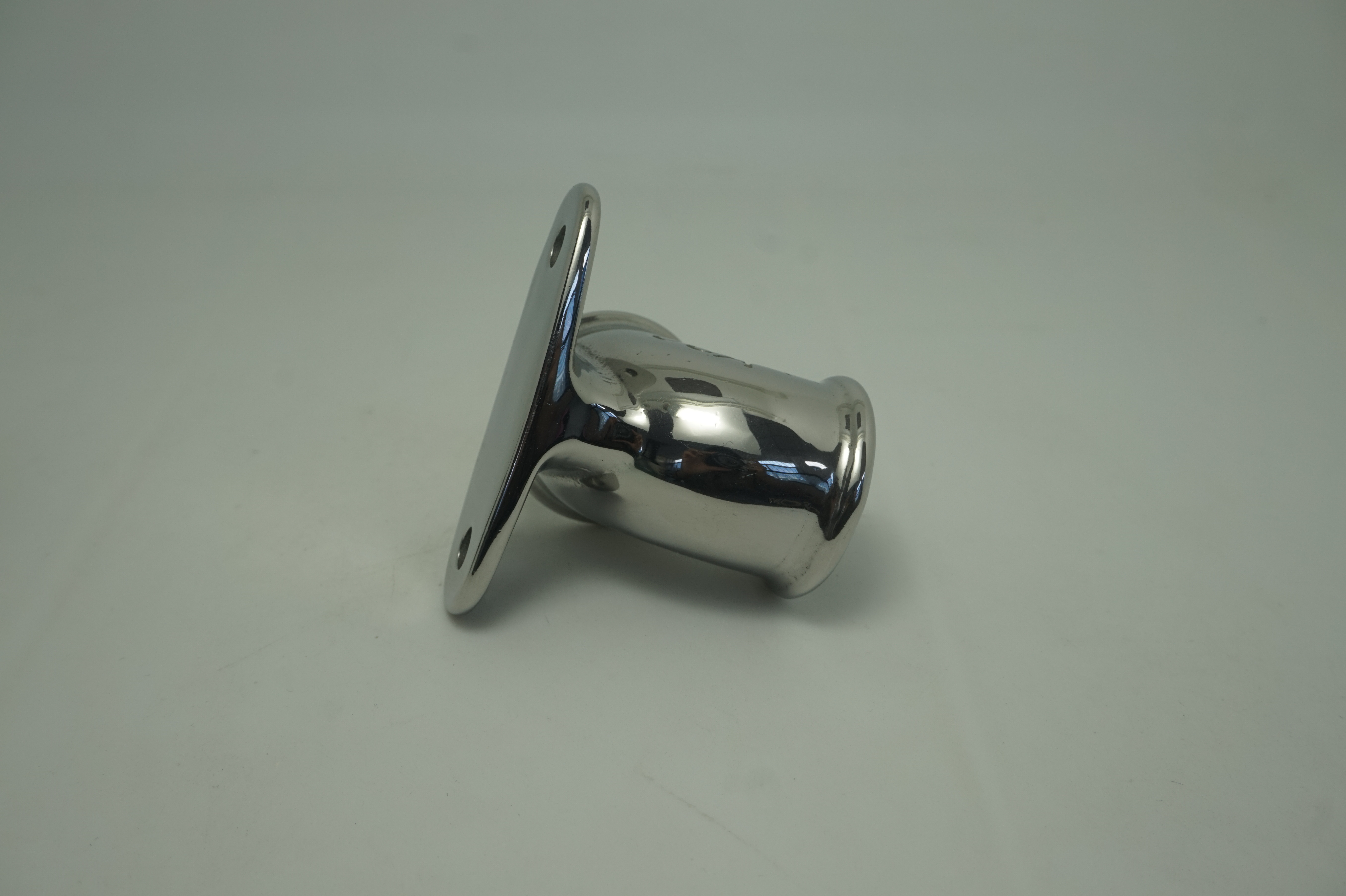
A buyer in Manchester, United Kingdom in semiconductor equipment is dealing with a welded stainless gas line whose internal bead affects flow and cleanliness. SurfacePolish supplies finishing machines, media and compounds across borders and offers a free sample trial: the elbow is shipped to Xiamen, processed under recorded settings, and returned with observations and a proposed media, compound and cycle direction for the buyer to verify. This brief is written for a buyer in Manchester working on semiconductor equipment; it describes equipment, media and a scoped sample review, not a local polishing service.
Can the required finish be reached in one mechanical route, or does the part need a cut stage followed by a refinement stage?
What is the smallest internal passage, slot or hole the charge must not plug, and how will a lodged medium be detected and removed?
Which cleanliness method and limit does the buyer own, and is it applied before or after the buyer's own cleaning step?
Before discussing media, establish what the burr actually is and where it sits. Milling leaves a rolled edge on a machined flange, turning leaves a feather on a bore lip, and EDM leaves a recast layer that behaves differently under impact media. Note the edge condition on seal lands and knife edges specifically, because those are the features where rounding is least tolerated and where a specification usually names a maximum radius or a required chamfer. Ask which burrs are functional rather than cosmetic: a burr inside a gas passage affects flow and can shed particles, while one on an external bracket face may not matter at all. Equally, record the cleanliness baseline the part arrives with, since oil, coolant and earlier blasting residue will load the compound and influence the outcome of a first cycle.
Compound choice controls residue as much as it controls cutting. Alkaline and neutral families are common for general deburring and cleaning, acidic families may be used where a descale or brightening effect is wanted, and silicate-bearing products can leave a tenacious film that is difficult to remove from a sealing face or a gas passage. For aluminium, a compound with an effective corrosion inhibitor is usually necessary to avoid darkening and surface attack during and after the cycle. Concentration, flow rate and temperature all shift the result, so dosing should be metered rather than guessed. Water quality matters too: hardness, chloride content and suspended solids affect foaming, rinsing and the residue left behind. The question to put to a supplier is what the compound leaves on the part, how it is removed, and what evidence a buyer can collect to confirm removal.
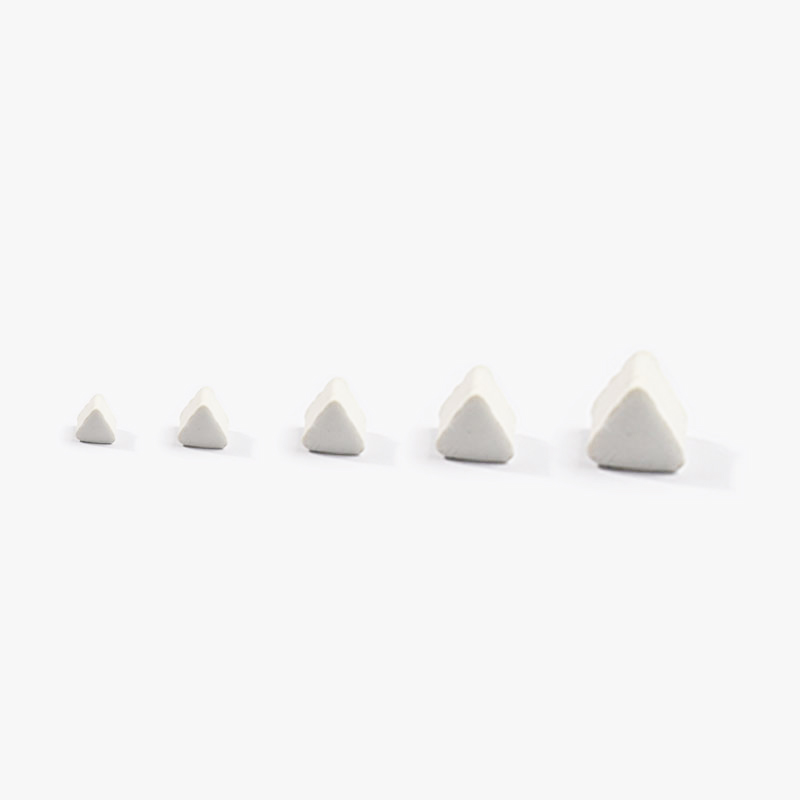
| Media | Best fit | Watch out for |
|---|---|---|
| Steel media, including balls and shaped pins | Bright finishing and edge blending on stainless components where appearance and a burnished surface matter | Transfers iron to aluminium and carbon steel, needs a corrosion-inhibiting compound, and must be separated magnetically or by screen at unload |
| Aluminium oxide grinding media in a dense ceramic bond | Where a heavier stock removal or a more consistent cut is needed on robust stainless parts with thick edges | High removal energy rounds functional edges quickly and is a poor match for thin aluminium plates or knife-edge seal lands |
| Plastic cylinders and cones in a harder, denser grade | Longer cycles on mixed batches of small fittings where a repeatable light edge break is wanted without ceramic impact | Can float or segregate by shape in a bowl, and cylindrical forms can wedge in slots and cross-drillings |
| Plastic triangles and pyramids in a soft to medium grade | Deburring aluminium and other soft alloys where surface marking and edge rounding must be kept to a minimum | Slow cut rate, media deforms and wears, and a worn charge behaves noticeably differently from a fresh one |
Magnetic finishing uses a small charge of pin-shaped or fine media driven by a moving magnetic field, which lets it reach narrow gaps, small bores and fine internal radii that tumbling media cannot enter. For semiconductor equipment parts it is most relevant on small precise items: gas nozzles, orifice plates, small machined inserts and fine slot arrays where the requirement is deburring and light refinement rather than bulk stock removal. The working envelope is small, so chamber bodies and long gas lines are out of scope. The media pins themselves are a lodging risk in the same features they are chosen to reach, and they are difficult to see inside a closed passage. Magnetic finishing also leaves a different surface signature from tumbling, so a roughness figure obtained on one route cannot be assumed to transfer to another.
| Machine route | Where it fits | What it will not do |
|---|---|---|
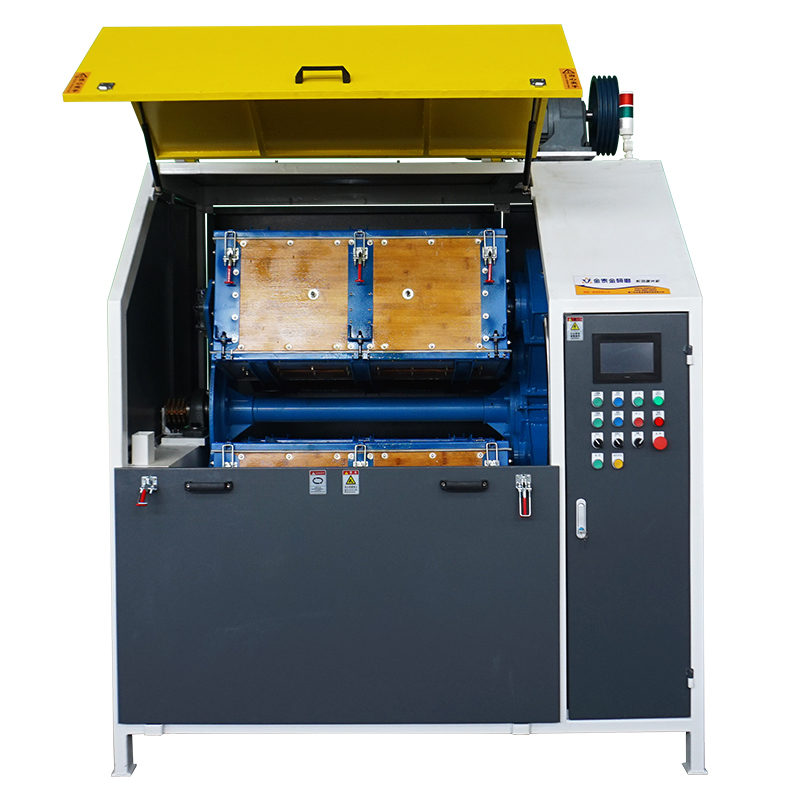
| Magnetic finishing machine | Fine deburring and light refinement of small precise features such as nozzles, orifice plates and narrow slots | Small working envelope that excludes chamber bodies and long gas lines, with pin media that can lodge in fine passages |
| Vibratory finishing machine (bowl) | General deburring and refinement of chamber bodies, plates and housings that fit and can tumble without racking, with easy mid-cycle inspection | Continuous part-on-part contact and no access to deep internal passages; thin plates and finished mating faces need separation |
| Rotary barrel finishing machine | Gentle deburring of small fragile components and mixed fitting batches with a generous compound flow | Long cycles, no visibility while running, and internal passages can collect media and compound that must be retrieved at unload |
| Dry polishing machine and dryer | Removing residual moisture after a wet cycle and reducing water spotting on aluminium and stainless surfaces | A finishing step only; a dry part can still carry compound film, fines and media dust, so it is not a cleanliness release |
Edge rounding beyond limit shows up first on knife-edge seal faces, sharp bore lips and fine slot edges, where a fractionally generous radius can change how a gasket seats or how a flow path behaves. High-energy routes, long cycles, dense media and coarse ceramic all accelerate it, and aluminium rounds faster than stainless under the same conditions. The damage is easy to miss on a finished part because the edge looks uniform and polished. Checking means measuring a defined edge feature before and after, using an optical comparator, a radius gauge or a moulded replica of the corner, and comparing against the limit the buyer placed on the drawing. Where a knife edge cannot be protected, masking, a fixture that shields the face, or a gentler medium and shorter cycle are the usual mitigations to test.
| Failure mode | Likely cause | How to catch it |
|---|---|---|
| Fine media fragments or aluminium smear embedded in a soft surface | Impingement from too much energy or charge mass, media that has fractured, or cross-contamination from a previous material family | Inspect at magnification under angled light, use a wipe or tape lift on the suspect area, and check the charge for broken media and fines |
| Bright impact marks, dents or flattened corners from part-on-part contact | Dense charge, high load ratio, thin or light parts left loose among heavy neighbours, or a cycle run longer than the edge condition required | Look for repeating mark patterns on exposed faces and edges, compare an unsupported part with a racked or compartmentalised one, and review the batch mix and load recorded for the lot |
| Grey aluminium smear transferred onto stainless parts in a shared batch | Aluminium fines retained in media, compound or the machine after an aluminium lot, with no purge before the stainless lot | Check stainless surfaces under angled light for a dull grey film, review the changeover record, and inspect the charge and machine sump for retained fines |
| Tapped threads rounded, galled or opened out by edge finishing | Media working the thread crest during a long or high-energy cycle, with no plugging or masking on the hole | Run a go and no-go thread gauge on every sampled hole, inspect crest condition at magnification, and confirm that plugs or masks were used and removed |
Greater Manchester is the largest city-region economy outside London, generating £100 billion in GVA according to Invest Manchester, the city region's inward investment service, whose sector offer leads on advanced materials and manufacturing, life sciences and health innovation, and low carbon. The Manchester Ship Canal runs from the Mersey estuary into the heart of Manchester as a 36-mile inland seaway whose five terminals handle 7.5 million tonnes of cargo a year. Make UK classes the North West as the strongest-performing English region and the UK region with the highest total manufacturing output, and describes the North West as the industrial heartland of Britain.
The nearest part of that base to this brief is medical: Invest Manchester lists 'Life sciences & health innovation' as one of the Greater Manchester sectors it promotes.
A city region combining precision manufacturing, life-sciences hardware and low-carbon equipment produces parts that often carry both a surface-finish specification and a cleanliness requirement, and the cleaning step after mass finishing is usually where those two specifications interact. Because media and machines can be routed to Port Salford, Runcorn Docks or Ellesmere Port through the same inland waterway that carries the region's bulk and project cargo, inbound equipment and outbound sample parts can be planned on one freight chain rather than a coastal port.
A Manchester buyer should settle the required cleanliness level first - for example whether a life-sciences or low-carbon component needs a validated post-finishing cleaning step - because that decision drives both the media choice and the effluent and waste handling the plant must provide for.
Freight context: Manchester Ship Canal terminals: QEII Dock, Ellesmere Port, Runcorn Docks, Port Warrington and Port Salford, Port of Liverpool (Royal Seaforth Container Terminal and Liverpool2), linked to the canal. Peel Ports states that the five Manchester Ship Canal terminals handle 7.5 million tonnes of cargo and that the canal runs 36 miles from the Mersey estuary into the heart of Manchester; Port Salford sits next to the M60 and M62 and provides direct vessel access from the Liverpool2 deep-water terminal, while Ellesmere Port is described as fully multimodal with road, rail and sea connectivity.
Importers need a GB-prefixed Economic Operators Registration and Identification (EORI) number, an import declaration carrying the correct commodity code, and retained commercial invoices plus the Import VAT Certificate (C79) so import VAT can be reclaimed. Machinery placed on the Great Britain market must be marked UKCA or CE: the manufacturer must draw up and retain technical documentation including a Declaration of Conformity, apply the correct marking with identification details, and cooperate with market surveillance; an authorised representative must be established in the UK. Under the Product Safety and Metrology (Amendment) Regulations 2024 the UK continues to recognise CE marking alongside or in place of UKCA for the Great Britain market, so either route can be used for most product types. Duty and import VAT are calculated from the customs value declared, and the commodity code also determines whether an import licence is needed.
BSI is the UK's National Standards Body, and British Standards (BS, including adopted BS EN ISO texts) are the documents a UK buyer's surface-finish, edge and cleanliness specifications are normally written against and purchased through. On the plant side, HSE maintains the work equipment and machinery topic covering the safe supply and use of machinery, and the COSHH regime, which requires employers to identify, assess and control risks from hazardous substances - the regime that applies to finishing compounds, abrasive media and the dust and effluent they generate.
SurfacePolish supplies from Xiamen, China. The buyer's own destination rules, conformity marking, tariff classification and documentation responsibilities stay with the buyer; confirm them against the authorities named above before ordering.
Functional checks catch the failures that visual inspection and roughness measurement miss. On a vacuum part that means the buyer's own leak test on the assembled component, which is the only way to see a seal land that has been rounded or a residue film that opens a virtual leak path. On a gas line it means a flow check against a reference part, since an internal burr or a lodged medium changes conductance. Dimensional verification belongs on a CMM or with hand gauges at the features that can move: slot widths, bore diameters, flange flatness, position of dowel holes and wall thickness on thin parts. Thread gauges confirm that a tapped hole was not rounded out by edge finishing. These checks are performed by the buyer's quality function against the buyer's limits; a finishing report is supporting evidence, not a qualification.
Record the starting condition before the parts leave, because a trial can only be read against a baseline. Photograph each burr and each controlled surface at a fixed scale, measure roughness at the same marked locations with the same instrument and cut-off, note edge condition with a comparator or radius gauge, and record mass and critical dimensions. Then ask for the same measurements on the returned parts at the same marked points. Without that pairing, a result is an opinion. Ask also for the settings used: machine, media type and size class, charge mass, compound and dose, cycle time, and the number of parts in the batch. Note any behaviour observed during the run, such as part-on-part impact, media lodging or compound foaming. That record is what allows two routes to be compared rather than merely described.

Size the medium well below the smallest opening the charge could enter, and treat every passage as a retrieval point rather than assuming it stays clear. Map the tightest hole, slot or cross-drilling first, then choose a size class against that geometry instead of an average part. Add a defined check such as a borescope at an agreed angle, a pin gauge on holes, and a rinse collected through a filter. For United Kingdom buyers preparing a trial, send the part with the smallest passage so the media choice is tested on the real feature. SurfacePolish reports what was observed on tested parts; the cleanliness release remains the buyer's decision.
It can change a surface, but whether it lands inside a specified band is something to measure rather than assume. The parameter, the cut-off length, the measurement direction and the reading locations all have to be fixed first, because a seal land, a bore and an outer wall respond differently to the same charge. A trial result applies to the geometry and settings tested, not to every part in the family. SurfacePolish does not guarantee a roughness value. Send parts with a marked measurement plan, ask for readings at those points, and set your own acceptance band from data you can verify in Manchester.
A batch record should identify what was done rather than simply assert a result. Ask for part numbers and quantities, the machine used, the media type and size class, charge mass and age since the last screen, the compound and dose, the rinse water source, cycle time, inspection results and the lot disposition. Request the media and compound data sheets offered by the supplier. Where aluminium and stainless are processed on the same site, ask for the changeover note covering media purge, machine cleaning and compound replacement. This is finishing process documentation, not a certificate of compliance, and it supports your own traceability in United Kingdom.
Use Manchester, United Kingdom as the destination on the enquiry and state whether the deliverable is equipment, media and compound, a representative sample review or a line concept. A destination does not imply local stock, a local service point or a local delivery time.
UKCA or CE marking with a Declaration of Conformity is required for equipment placed on the Great Britain market, HSE's work equipment and machinery topic covers guarding and safe use, and COSHH governs the media, compounds and dust from vibratory, centrifugal or barrel finishing.
Sources were retrieved on 2026-09-29 and describe the local industrial and trade context only. They do not evidence any SurfacePolish project, shipment, installation or service in Manchester.
The buyer needs the internal bead smoothed for conductance and cleanliness but cannot accept a lodged medium or a thinned wall.
Send the material, dimensions, approximate weight, batch quantity, the incoming condition and photographs of the difficult features. Mark which features must not be contacted by media and state how the result will be inspected. This form carries source reference PSEO-0215; quote it if you prefer an additional manual reference.
Open the SurfacePolish enquiry form Email a prepared enquiry
No price, lead time, certification or result is promised here. Confirm whether a sample trial is available for the specific part and what the trial can and cannot show.
Page PSEO-0215 · revised 2026-09-29 · cross-border equipment, media and scoped sample review. City context is sourced and cited above.
Use this local checker to identify missing part and inspection information. It prepares a technical-review brief; it does not approve a machine, process recipe or production result.
Complete the part details to prepare a review brief.
Email : info@surface-polish.com


 IPv6 network supported


 +86-592-2381506