A buyer in Brescia, Italy in semiconductor equipment is dealing with a welded stainless gas line whose internal bead affects flow and cleanliness. SurfacePolish supplies finishing machines, media and compounds across borders and offers a free sample trial: the elbow is shipped to Xiamen, processed under recorded settings, and returned with observations and a proposed media, compound and cycle direction for the buyer to verify. This brief is written for a buyer in Brescia working on semiconductor equipment; it describes equipment, media and a scoped sample review, not a local polishing service.
Which cleanliness method and limit does the buyer own, and is it applied before or after the buyer's own cleaning step?
Which surfaces on this part are functional, such as seal lands, gas passage walls and locating bores, and which are only cosmetic?
Is edge rounding tolerable on a knife edge or bore lip, and what maximum radius belongs on the drawing?
Before discussing media, establish what the burr actually is and where it sits. Milling leaves a rolled edge on a machined flange, turning leaves a feather on a bore lip, and EDM leaves a recast layer that behaves differently under impact media. Note the edge condition on seal lands and knife edges specifically, because those are the features where rounding is least tolerated and where a specification usually names a maximum radius or a required chamfer. Ask which burrs are functional rather than cosmetic: a burr inside a gas passage affects flow and can shed particles, while one on an external bracket face may not matter at all. Equally, record the cleanliness baseline the part arrives with, since oil, coolant and earlier blasting residue will load the compound and influence the outcome of a first cycle.
A vibratory bowl is the general-purpose starting point for chamber bodies, plates and housings that fit comfortably and can tumble without racking. Media circulates in a toroidal path and reaches external faces, edges and open pockets at moderate energy, and the open bowl allows an operator to pull a part mid-cycle for a look, which matters when a feature is sensitive. Part-on-part contact is continuous, so thin plates and finished mating faces need separation or protection within the charge. Where a heavy machining burr has to come off before refinement, a grinding finishing machine with higher removal energy can take the bulk of it, but it cuts edges faster as well and needs a tighter geometry assessment. A bowl will not reach deep internal passages on its own; those depend on media size, compound flow and how the part sits in the charge.
| Machine route | Where it fits | What it will not do |
|---|---|---|
| Disc finishing machine | Fast, high-energy edge breaking and surface refinement on small robust parts and uniform batches of fittings | High impingement and edge-loss risk on thin or soft parts, and geometry must suit the disc working gap |
| Dry polishing machine and dryer | Removing residual moisture after a wet cycle and reducing water spotting on aluminium and stainless surfaces | A finishing step only; a dry part can still carry compound film, fines and media dust, so it is not a cleanliness release |
| Rotary barrel finishing machine | Gentle deburring of small fragile components and mixed fitting batches with a generous compound flow | Long cycles, no visibility while running, and internal passages can collect media and compound that must be retrieved at unload |
| Vibratory finishing machine (bowl) | General deburring and refinement of chamber bodies, plates and housings that fit and can tumble without racking, with easy mid-cycle inspection | Continuous part-on-part contact and no access to deep internal passages; thin plates and finished mating faces need separation |
Media wears, and worn media changes the process. Ceramic shrinks, plastic deforms and floats differently, steel can fracture into slivers, and all of them eventually reach a size or shape that lodges where a fresh charge would not. A working charge therefore needs a defined maintenance cycle: screen for undersize and debris, top up to a target mass, remove broken pieces, and record the change. Separation at unload deserves the same attention. Screens over the discharge, magnetic recovery for steel, tilting and draining stations, pin gauges and borescope checks on agreed features all reduce the chance that a medium travels with the part into the next operation. Where aluminium and stainless batches share a machine, purging media and compound between material families avoids cross-contamination that is difficult to see and easy to attribute to the wrong cause later.
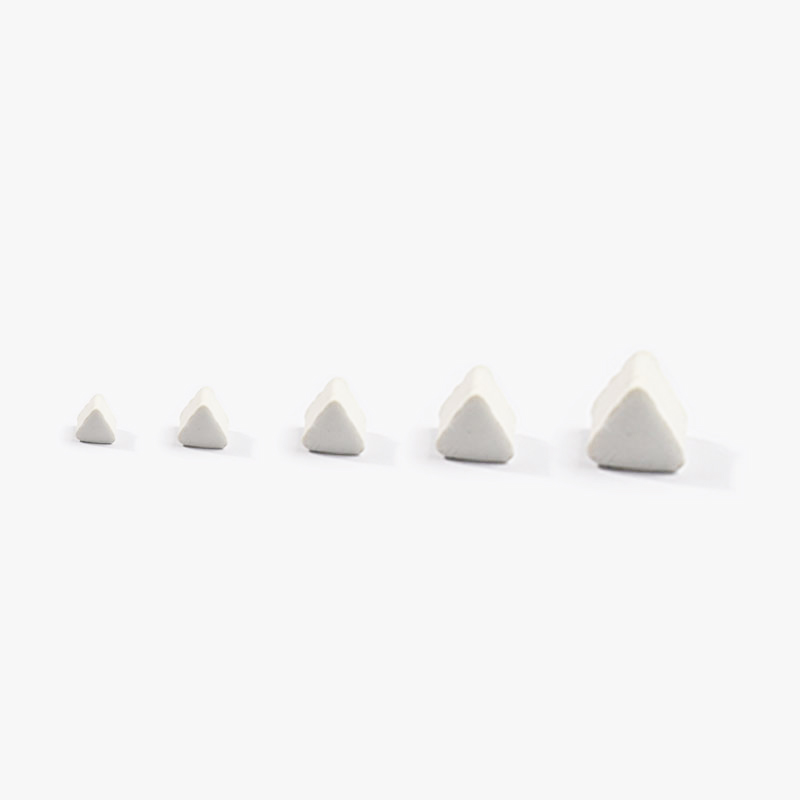
| Media | Best fit | Watch out for |
|---|---|---|
| Plastic triangles and pyramids in a soft to medium grade | Deburring aluminium and other soft alloys where surface marking and edge rounding must be kept to a minimum | Slow cut rate, media deforms and wears, and a worn charge behaves noticeably differently from a fresh one |
| Plastic cylinders and cones in a harder, denser grade | Longer cycles on mixed batches of small fittings where a repeatable light edge break is wanted without ceramic impact | Can float or segregate by shape in a bowl, and cylindrical forms can wedge in slots and cross-drillings |
| Heavy-cut ceramic, angle-cut triangles in a coarse size class | Removing a substantial machining burr from open external edges and pockets on aluminium and stainless housings before a refinement stage | Cuts edges and corners aggressively, leaves a coarse surface, and lodges in slots whose width approaches the media section |
| Magnetic finishing pins and fine magnetic media | Small precise items such as nozzles, orifice plates and fine slot arrays where tumbling media cannot reach the feature | Limited working envelope, pins lodge in the same fine features they are chosen to reach, and the surface signature differs from tumbling |
A medium lodged in a blind hole, slot or gas passage is the classic semiconductor finishing failure, and it often escapes the finishing shop and is found at the buyer's leak or particle check. It happens when the media size class is too close to the feature opening, when the charge has worn into smaller pieces, or when a passage was never mapped as a retention risk. Slots with a width close to the media section are the worst case, followed by cross-drilled intersections and deep tapped holes. Checking relies on controlled unloading and an agreed inspection: count the media charge in and out where practical, borescope the smallest passages at a defined angle, use a pin gauge on holes, and rinse into a filter for a visual residue check. Any medium found is a reportable non-conformance, not a wipe-and-release.
| Failure mode | Likely cause | How to catch it |
|---|---|---|
| Rust spotting on stainless parts appearing hours or days after finishing | Ferrous transfer from steel media, a machine or tooling that has held carbon steel, or insufficient corrosion inhibition and drying | Inspect after a defined dwell time rather than immediately, look for pinpoint spots on and near edges, and trace media and machine history for the lot |
| Burr remaining in a cross-drilled intersection or an internal corner | Media too large to enter the intersection, part orientation that shields the feature, or a cycle stopped before that feature was reached | Borescope the intersection at a fixed angle, compare against a first-article reference, and use a pin or probe to feel for a lip on sampled parts |
| Fine media fragments or aluminium smear embedded in a soft surface | Impingement from too much energy or charge mass, media that has fractured, or cross-contamination from a previous material family | Inspect at magnification under angled light, use a wipe or tape lift on the suspect area, and check the charge for broken media and fines |
| Knife-edge seal face or bore lip rounded past the drawing limit | High-energy route, over-long cycle, dense or coarse media, or a soft aluminium edge run without masking or shielding | Measure a defined edge feature before and after with an optical comparator, radius gauge or moulded replica, and compare with the maximum radius on the drawing |
Brescia is one of Lombardy's most industrial provinces. The Camera di Commercio di Brescia reports that industrial production in the province grew 2.6% year on year in the second quarter of 2026, above the Lombardy average of 2.1%, with industry turnover up 5.7% on the year and export orders up 8.9%. Foreign sales carry the local economy: the chamber's economy report estimates that 45.2% of the province's value added derives from exports and that exports cover 173.8% of imports. The chamber's manufacturing surveys break the local industrial fabric into steel (siderurgia), mechanical engineering (meccanica), food (alimentari), chemicals and rubber-plastics, and its 2026 investment survey shows food, transport equipment and steel among the branches that invested most in 2025.
The nearest part of that base to this brief is food: Food (alimentari) is one of the merceological sectors used to stratify Brescia manufacturing in the chamber's survey, and the chamber's investment survey reports that 90% of food firms invested in 2025.
A production mix built on steel, metalworking, mechanical engineering and food processing generates a continuous flow of parts that need deburring, edge rounding, descaling or a controlled surface before assembly, coating or sale. In that kind of metalworking supply chain, metal treatment and surface finishing sit upstream of assembly, so cycle time, media wear and the ability to reproduce the same finish from batch to batch are the practical qualification issues - which is why consumable cost per part, rather than machine price alone, is normally the deciding number for a steel-working buyer.
The first question is whether the requirement is metallurgical and functional (removing scale and burrs, establishing an edge radius on a forged or machined steel part) or visual, and how the works will verify it on incoming inspection - because a steel-working buyer needs a process window that holds across changing part geometry and batch size, not a single demonstration part.
Freight context: Aeroporto di Brescia (airport of national interest per ENAC), Road and rail freight (no commercial seaport in the province). Brescia has no commercial seaport in the province; the national civil aviation authority ENAC lists Brescia among Italy's airports of national interest, and the province's heavy export orientation (45.2% of value added, exports covering 173.8% of imports) means freight moves mainly by road and rail to EU gateways. Non-EU machinery or sample parts therefore clear customs at their EU point of entry and are then trucked to Brescia.
The customs authority is the Agenzia delle Dogane e dei Monopoli (ADM), which is the regulatory, supervisory and control authority for customs and collects the duties. Goods arriving from China are cleared by customs before they can enter the single market and are released into free circulation by means of a customs declaration; the date of acceptance of that declaration is the date used to calculate and apply the import duty and any VAT or excise duty. Importers should settle in advance who lodges the declaration and under which VAT and EORI arrangements, and must ensure the machine carries CE marking and is supported by the EU declaration of conformity and technical file. Because the CE mark is compulsory for machinery covered by the EU machinery legislation and forbidden for products outside it, the conformity route must be settled before shipment rather than at the border.
The national standards body is UNI - Ente Italiano di Normazione, a private non-profit association founded over a century ago, which develops, publishes and disseminates voluntary technical standards and adopts the European and international standards as Italian editions. For finishing work the operative references are the surface-texture series UNI EN ISO 21920-1:2022, which fixes how the surface state (roughness, waviness, primary profile) is indicated on technical product documentation, and UNI EN ISO 21920-2:2022, which defines the terms, definitions and parameters used with profile methods. Machinery safety requirements come from the EU machinery legislation rather than from UNI alone: Machinery Directive 2006/42/EC applies to machinery placed on the EU market before 20 January 2027, after which Machinery Regulation (EU) 2023/1230 takes over.
SurfacePolish supplies from Xiamen, China. The buyer's own destination rules, conformity marking, tariff classification and documentation responsibilities stay with the buyer; confirm them against the authorities named above before ordering.
Functional checks catch the failures that visual inspection and roughness measurement miss. On a vacuum part that means the buyer's own leak test on the assembled component, which is the only way to see a seal land that has been rounded or a residue film that opens a virtual leak path. On a gas line it means a flow check against a reference part, since an internal burr or a lodged medium changes conductance. Dimensional verification belongs on a CMM or with hand gauges at the features that can move: slot widths, bore diameters, flange flatness, position of dowel holes and wall thickness on thin parts. Thread gauges confirm that a tapped hole was not rounded out by edge finishing. These checks are performed by the buyer's quality function against the buyer's limits; a finishing report is supporting evidence, not a qualification.
Compare one variable at a time. If the question is media shape, hold the compound, the cycle time, the machine and the load constant and change only the medium; if the question is cycle time, hold the charge constant and stop at two or three defined intervals. Running two changes at once produces a result that cannot be attributed. Where a trial includes a refinement stage after a cutting stage, evaluate the stages separately, since a final figure can hide a coarse first stage or an unremoved burr. Blind evaluation helps when several people judge appearance: label the returned parts with codes and have the buyer's inspectors score edge condition, coverage and cleanliness without knowing the settings. Keep the parts and the record. A trial showing both routes failing on one controlled feature is as useful as one showing a difference.



Size the medium well below the smallest opening the charge could enter, and treat every passage as a retrieval point rather than assuming it stays clear. Map the tightest hole, slot or cross-drilling first, then choose a size class against that geometry instead of an average part. Add a defined check such as a borescope at an agreed angle, a pin gauge on holes, and a rinse collected through a filter. For Italy buyers preparing a trial, send the part with the smallest passage so the media choice is tested on the real feature. SurfacePolish reports what was observed on tested parts; the cleanliness release remains the buyer's decision.
It can change a surface, but whether it lands inside a specified band is something to measure rather than assume. The parameter, the cut-off length, the measurement direction and the reading locations all have to be fixed first, because a seal land, a bore and an outer wall respond differently to the same charge. A trial result applies to the geometry and settings tested, not to every part in the family. SurfacePolish does not guarantee a roughness value. Send parts with a marked measurement plan, ask for readings at those points, and set your own acceptance band from data you can verify in Brescia.
Send a set that covers the real range rather than one convenient piece. Include the part with the tightest passage or smallest hole, the thinnest unsupported section, the surface that must not be touched, and one part in its normal as-received condition with its usual burr and soil. Add a coupon of the same material with a known starting roughness, and a marked-up drawing naming the controlled surfaces, edge limits and any cleanliness requirement. Several pieces let more than one cycle time be examined. Parts are shipped to Xiamen and returned with a settings record.
Use Brescia, Italy as the destination on the enquiry and state whether the deliverable is equipment, media and compound, a representative sample review or a line concept. A destination does not imply local stock, a local service point or a local delivery time.
Finish is specified through UNI, the Italian standards body, whose Italian editions of the EN/ISO surface-texture series (UNI EN ISO 21920-1 and -2:2022) govern drawing indications and measurement parameters, and the Camera di Commercio di Brescia is the local body that issues the certificates of origin, export visas and free-sale attestations companies need for foreign trade. Machinery supplied into the province must also satisfy the EU machinery legislation.
Sources were retrieved on 2026-09-29 and describe the local industrial and trade context only. They do not evidence any SurfacePolish project, shipment, installation or service in Brescia.
The buyer needs the internal bead smoothed for conductance and cleanliness but cannot accept a lodged medium or a thinned wall.
Send the material, dimensions, approximate weight, batch quantity, the incoming condition and photographs of the difficult features. Mark which features must not be contacted by media and state how the result will be inspected. This form carries source reference PSEO-0435; quote it if you prefer an additional manual reference.
Open the SurfacePolish enquiry form Email a prepared enquiry
No price, lead time, certification or result is promised here. Confirm whether a sample trial is available for the specific part and what the trial can and cannot show.
Page PSEO-0435 · revised 2026-09-29 · cross-border equipment, media and scoped sample review. City context is sourced and cited above.
Use this local checker to identify missing part and inspection information. It prepares a technical-review brief; it does not approve a machine, process recipe or production result.
Complete the part details to prepare a review brief.
Email : info@surface-polish.com


 IPv6 network supported


 +86-592-2381506