A buyer in Naples, Italy in semiconductor equipment needs a stainless vacuum tee cleaned up without losing its knife-edge seal geometry. SurfacePolish supplies finishing machines, media and compounds across borders and offers a free sample trial, in which representative parts are shipped to the factory in Xiamen and returned with an observed condition and a proposed media, compound and cycle direction for the buyer to assess. This brief is written for a buyer in Naples working on semiconductor equipment; it describes equipment, media and a scoped sample review, not a local polishing service.
Is edge rounding tolerable on a knife edge or bore lip, and what maximum radius belongs on the drawing?
Can the required finish be reached in one mechanical route, or does the part need a cut stage followed by a refinement stage?
Which cleanliness method and limit does the buyer own, and is it applied before or after the buyer's own cleaning step?
Before discussing media, establish what the burr actually is and where it sits. Milling leaves a rolled edge on a machined flange, turning leaves a feather on a bore lip, and EDM leaves a recast layer that behaves differently under impact media. Note the edge condition on seal lands and knife edges specifically, because those are the features where rounding is least tolerated and where a specification usually names a maximum radius or a required chamfer. Ask which burrs are functional rather than cosmetic: a burr inside a gas passage affects flow and can shed particles, while one on an external bracket face may not matter at all. Equally, record the cleanliness baseline the part arrives with, since oil, coolant and earlier blasting residue will load the compound and influence the outcome of a first cycle.
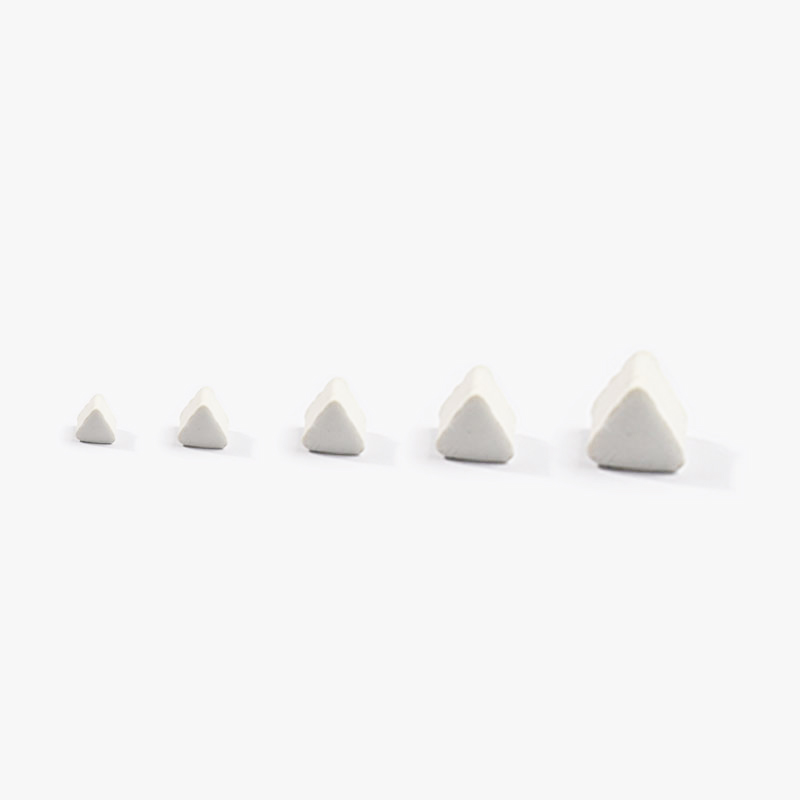
Plastic media is chosen for aluminium and other soft materials where a ceramic charge would peen, smear or mark the surface. It is lighter, so contact pressure is lower and edges survive longer, at the cost of a slower cut and a longer cycle for the same burr. Shapes range from triangles and cones to cylinders, and the harder, denser grades remove more material than the softer ones. Because plastic media wear and deform, a charge that has run for many hours behaves differently from a fresh one, and part-to-part consistency can drift within a batch if the charge is not monitored. For a chamber component with a sealing face, plastic is often the safer starting point, and the trade-off to be tested is whether the achievable surface and the cycle time are acceptable once the burr is genuinely gone.
| Media | Best fit | Watch out for |
|---|---|---|
| Magnetic finishing pins and fine magnetic media | Small precise items such as nozzles, orifice plates and fine slot arrays where tumbling media cannot reach the feature | Limited working envelope, pins lodge in the same fine features they are chosen to reach, and the surface signature differs from tumbling |
| Dry media such as walnut shell and corn cob | Drying assistance, light surface drying polish and removal of superficial soil after a wet cycle | Does not deburr or refine metal significantly, generates dust, and must not be treated as a cleanliness step |
| Fine ceramic or porcelain spheres in a small size class | Refinement and light edge blending after a cutting stage, and reaching tighter external geometry on chamber bodies and plates | Small sizes enter and retain in gas passages and fine slots; media wear shrinks the charge and changes the finish over its life |
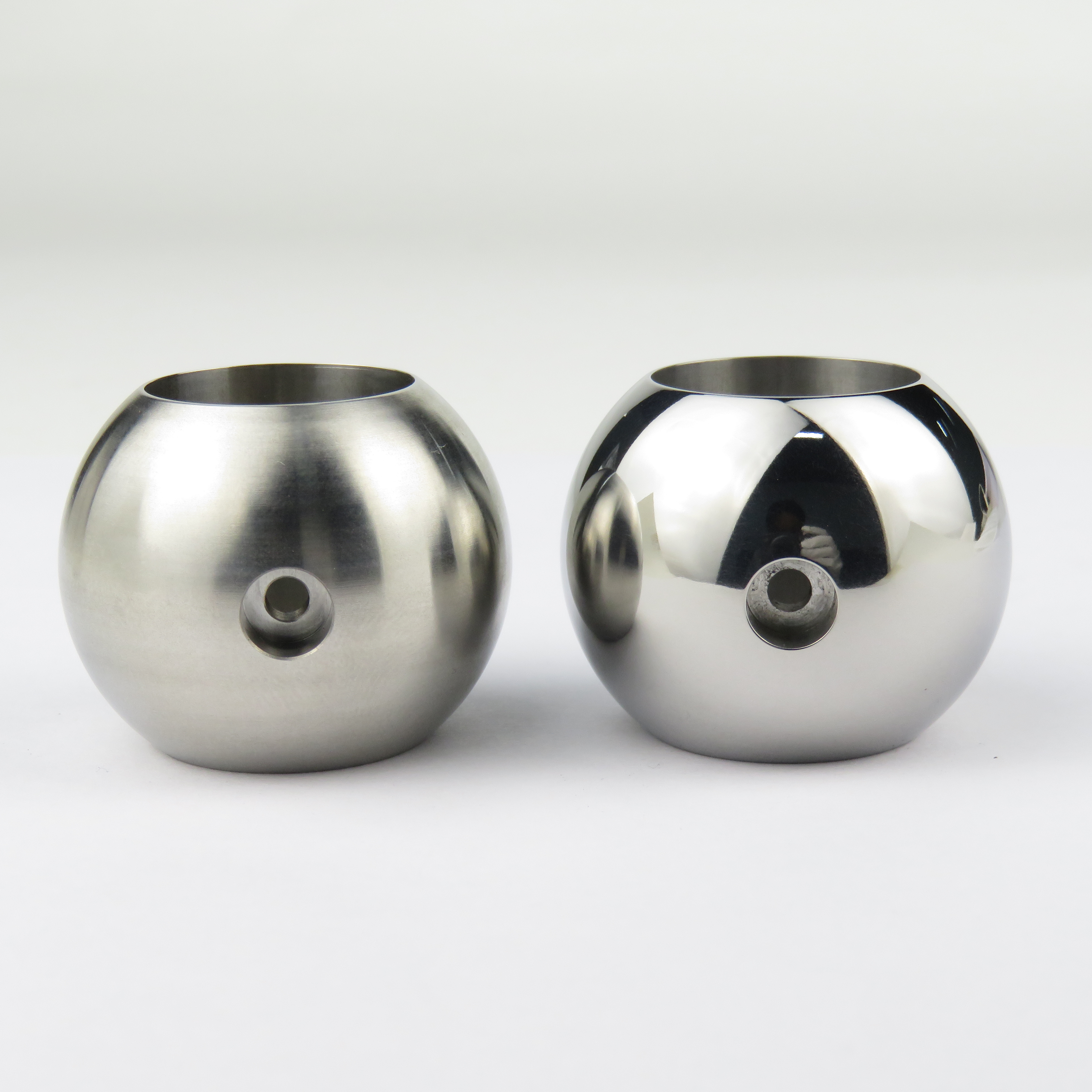
| Steel media, including balls and shaped pins | Bright finishing and edge blending on stainless components where appearance and a burnished surface matter | Transfers iron to aluminium and carbon steel, needs a corrosion-inhibiting compound, and must be separated magnetically or by screen at unload |
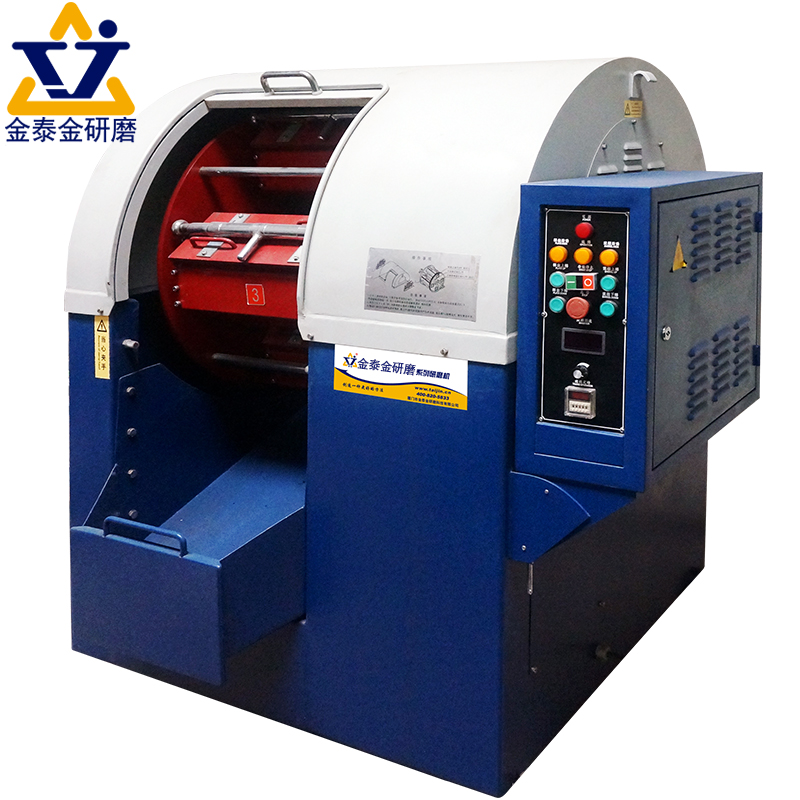
Centrifugal barrel finishing multiplies the effective gravity acting on the media charge, so cycle times shorten and contact pressure rises sharply. That combination can deburr and refine small precise parts such as fitted inserts, small valve bodies and gas distribution components efficiently, and it can also round an edge or distort a thin plate within a minute of over-running. Parts usually sit in compartments or barrels, which limits part-on-part damage but concentrates media at the compartment walls. Process control matters more than on a bowl: charge weight, barrel speed, fill level, compound dose and stop time all change the outcome, and a short trial cycle is easier to overshoot than to under-run. Ask whether the geometry has thin unsupported spans, a knife edge or a soft aluminium section, because those features decide whether this route is usable.
| Machine route | Where it fits | What it will not do |
|---|---|---|
| Vibratory finishing machine (bowl) | General deburring and refinement of chamber bodies, plates and housings that fit and can tumble without racking, with easy mid-cycle inspection | Continuous part-on-part contact and no access to deep internal passages; thin plates and finished mating faces need separation |
| Rotary barrel finishing machine | Gentle deburring of small fragile components and mixed fitting batches with a generous compound flow | Long cycles, no visibility while running, and internal passages can collect media and compound that must be retrieved at unload |
| Centrifugal barrel finishing machine | Small precise parts and short cycles with high contact pressure, such as inserts, small valve bodies and distribution components | Rounds edges and can distort thin unsupported sections quickly; results are sensitive to charge weight, speed and stop time |
| Dry polishing machine and dryer | Removing residual moisture after a wet cycle and reducing water spotting on aluminium and stainless surfaces | A finishing step only; a dry part can still carry compound film, fines and media dust, so it is not a cleanliness release |
Cross-contamination and staining are quiet failures. Aluminium worked in a charge previously used on stainless can leave a grey smear; stainless run with steel media, or in a machine that has held carbon steel, can show rust spots that appear days later; hard water and slow drying leave mineral spotting; and a compound that is too aggressive darkens aluminium. Dimensional drift is the other quiet failure, where thin plates, long tubes and unsupported walls relax or distort under tumbling loads, so a part that passed the edge check fails a flatness or position check afterwards. Both categories are caught by discipline rather than by looking harder at the finish: segregate material families and dedicate or purge media, control rinse water and drying, measure defined dimensions and flatness at the same points before and after, and keep that data with the batch record.
| Failure mode | Likely cause | How to catch it |
|---|---|---|
| Burr remaining in a cross-drilled intersection or an internal corner | Media too large to enter the intersection, part orientation that shields the feature, or a cycle stopped before that feature was reached | Borescope the intersection at a fixed angle, compare against a first-article reference, and use a pin or probe to feel for a lip on sampled parts |
| Water spotting or mineral residue left after wet processing and drying | Hard or high-chloride rinse water, slow or uneven drying, or parts stacked wet so moisture is trapped in pockets and grooves | Inspect dried parts under angled light for rings and haze, check the rinse water source and drying method, and verify that pockets and grooves drain before the part is packed |
| A ceramic or plastic medium lodged in a blind tapped hole, slot or gas passage | Media size class too close to the opening, a worn charge that has broken down into smaller pieces, or a retention feature that was never mapped | Count the charge in and out where practical, borescope the smallest passages at an agreed angle, pin gauge every hole, and rinse through a filter for a visual residue check |
| Rust spotting on stainless parts appearing hours or days after finishing | Ferrous transfer from steel media, a machine or tooling that has held carbon steel, or insufficient corrosion inhibition and drying | Inspect after a defined dwell time rather than immediately, look for pinpoint spots on and near edges, and trace media and machine history for the lot |
The Chamber of Commerce's provincial economic profile records a broad manufacturing base alongside services: manufacturing accounts for 18% of provincial employment, behind public services and administration at 30.7% but ahead of commerce (14%), construction (9.5%) and transport (8.2%) (s2). The profile singles out mechanical, electromechanical and transport-equipment manufacturing as particularly significant, and records that the automotive and aeronautical industries are present through large plants that have generated a tier of specialised small and medium subcontracting firms (s1). The fishing and marine sector has an official support track: the chamber approved state-aid vouchers for modernising machinery and equipment for fishing firms in the Phlegraean communes (s5), and the wine sector of the province is promoted through chamber-organised export meetings with foreign buyers (s3). These chamber data are the provincial economic profile published by the Camera di Commercio di Napoli and its census base is historical, so the structural description should be read as the chamber's own profile rather than as current-year statistics.
The nearest part of that base to this brief is food: The chamber organised an incoming programme of B2B meetings with foreign buyers reserved for wine companies of the province of Naples, and the provincial profile lists horticulture, citrus, olive and vine cultivation among the most profitable coastal crops.
Naples has an automotive and aeronautical plant base supplied by a local subcontracting tier, which is the part of the local market where deburring and edge control matter most: transmission and engine components, hydraulic fittings, structural brackets and machined castings, all of which reach a finishing operation before inspection. The port's shipbuilding and ship-repair activity adds a large-fabrication case where weld dressing and surface preparation, not fine deburring, set the requirement. Burr and residue control is the acceptance issue for both, and for the aerospace-supplying shops it is written into the customer's drawing.
The first question is whether the shop supplies the automotive or the aeronautical chain, because that decides which quality regime governs and whether a special-process approval is needed at all. Having settled that, the acceptance criterion for burr height or cleanliness should be taken from the customer's drawing rather than agreed bilaterally, since both chains audit against the prime's specification.
Freight context: Porto di Napoli, Aeroporto internazionale di Napoli (Capodichino). The chamber's profile of the provincial transport system records more than 370 firms operating port services with more than 5,200 employees, and lists ship repairs, port warehousing, container services, freight forwarding and ship's agency among the main services, alongside bulk trades in mineral oils, cereals and machinery and vehicles (s6). It describes the international airport at Naples as the most important in southern Italy for traffic volume and close to the city centre (s6). Machines can therefore be landed by sea and cleared in the port area, while sample parts normally move by air, which makes the airport the practical route for a small consignment.
Italy applies the EU's common commercial policy to imports from China, so Chinese industrial machinery enters under the EU Common Customs Tariff, where the duty rate depends on the type and origin of the goods and the working tariff is TARIC. Istat's August 2026 extra-EU trade release records a 16.0% year-on-year increase in Italian purchases from China, alongside strong growth from India, OPEC and Mercosur, so China remains one of the fastest-growing sources of Italian imports. Anti-dumping and other trade-defence measures apply case by case to specific product categories rather than to finishing machinery in general, so the applicable rate must be checked against the specific commodity code before a quotation is finalised.
Business is conducted in Italian; quotations, drawings, technical dossiers and declarations of conformity are normally expected in Italian, and correspondence in English is workable but rarely sufficient for a purchase order or for a conformity file. Italian industrial buyers qualify suppliers through a documented process: a part drawing with surface-texture indications, a sample or trial batch, and written acceptance criteria are the usual gate before a machine or media is specified into production. Payment and documentation norms follow Italian/EU practice - the importing entity's VAT and EORI details, invoice data matching the customs declaration, and standard EU commercial terms - so a cross-border seller should expect the conformity documentation (declaration of conformity, technical file, material certificates) to be requested before, not after, delivery.
SurfacePolish supplies from Xiamen, China. The buyer's own destination rules, conformity marking, tariff classification and documentation responsibilities stay with the buyer; confirm them against the authorities named above before ordering.
Acceptance has to be written before the trial, on the drawing and in the purchase specification, not agreed verbally afterwards. Name the controlled surfaces individually, for example a seal land, a gas passage wall or a mating flange face, and state the parameter, the cut-off length, the direction of measurement and the number of readings. A single global roughness call-out on a chamber body is not enough, because the sealing face, the outer wall and the bore will not respond the same way to one media charge. Where an edge limit applies, express it as a maximum radius or a required chamfer at a named feature. Add the cleanliness requirements the part must meet and the method by which they will be judged. Settling these points early prevents the common dispute in which a supplier reports a finish and a buyer rejects on cleanliness.
Scale-up is mostly about holding the conditions that produced the trial result. In production that means a defined media charge kept at a target mass, screened on a schedule, with undersize and broken pieces removed and fresh media added to a recorded level. Compound should be metered to a concentration rather than poured by eye, and rinse water quality should be known and stable. Every lot needs an identity: part numbers, quantity, machine, settings, operator, inspection result and disposition. Where the same machine handles aluminium and stainless, define the changeover, including media purge, machine cleaning and compound replacement, and record when it happened. Cycle counting is a simple control that is often skipped: a charge that has run a known number of hours can be scheduled for replacement before wear starts producing lodged media or a drifting finish.
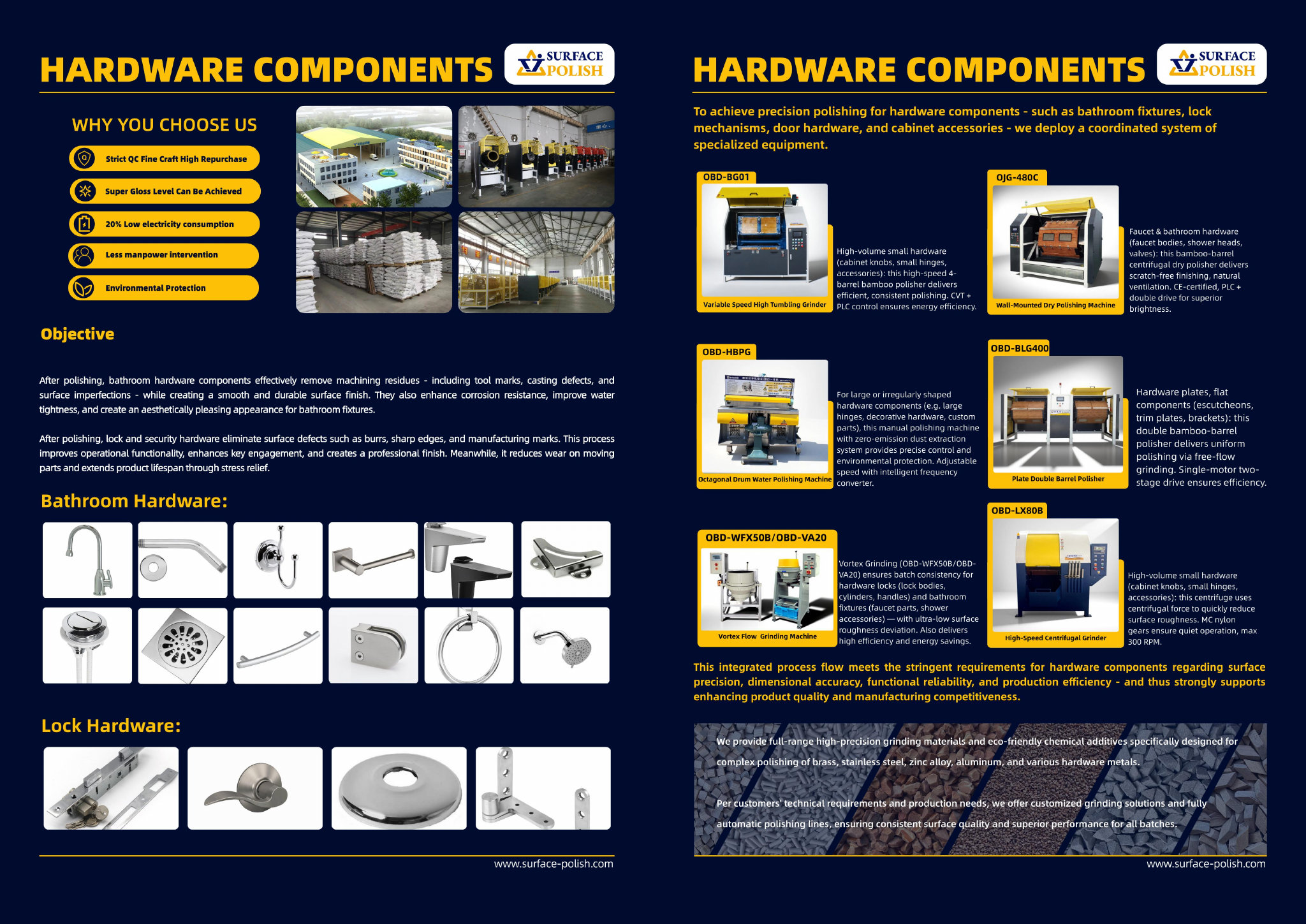
No cleanliness level or cleanroom readiness is certified or guaranteed here. The offer is cross-border supply of finishing machines, media and compounds, plus a sample trial that reports what was observed on the parts tested under the settings used. Cleanroom and process-environment requirements are defined by the buyer and verified by the buyer's own methods, which may include wipes, rinse collection, magnification, leak testing and functional checks. SurfacePolish can keep tested parts separated, documented and returned with a settings record, and that record can support your verification work in Naples, but the acceptance decision and any compliance statement remain with your quality function.
Thin plates are governed by distortion and media lodging as much as by finish, so plastic media is often the conservative first choice because it is lighter and imposes less impact. A fine ceramic may cut the hole exits faster, but it also increases edge rounding and part-on-part damage unless the plates are separated. Either way, the plate needs support and separation in the charge, and the hole exits need an inspection that can see inside them. Send several plates so more than one cycle time can be examined, and state the flatness requirement you will verify afterwards.
A batch record should identify what was done rather than simply assert a result. Ask for part numbers and quantities, the machine used, the media type and size class, charge mass and age since the last screen, the compound and dose, the rinse water source, cycle time, inspection results and the lot disposition. Request the media and compound data sheets offered by the supplier. Where aluminium and stainless are processed on the same site, ask for the changeover note covering media purge, machine cleaning and compound replacement. This is finishing process documentation, not a certificate of compliance, and it supports your own traceability in Italy.
Use Naples, Italy as the destination on the enquiry and state whether the deliverable is equipment, media and compound, a representative sample review or a line concept. A destination does not imply local stock, a local service point or a local delivery time.
Naples-area buyers reference UNI and ISO standards for surface texture and cleanliness, and in the automotive and aerospace supply chains the qualification regimes their primes impose: IATF 16949 for automotive and AS/EN 9100 for aerospace, frequently with NADCAP special-process approval where surface treatment is involved. Because the province's automotive and aeronautical work runs through a subcontracting tier, the finish and cleanliness callouts usually reach a machine shop inside the customer's drawing and inspection plan rather than as a standalone finishing specification.
Sources were retrieved on 2026-09-29 and describe the local industrial and trade context only. They do not evidence any SurfacePolish project, shipment, installation or service in Naples.
The buyer wants weld discolouration and machining burrs reduced on the outside while the knife edges stay within their radius limit.
Send the material, dimensions, approximate weight, batch quantity, the incoming condition and photographs of the difficult features. Mark which features must not be contacted by media and state how the result will be inspected. This form carries source reference PSEO-0495; quote it if you prefer an additional manual reference.
Open the SurfacePolish enquiry form Email a prepared enquiry
No price, lead time, certification or result is promised here. Confirm whether a sample trial is available for the specific part and what the trial can and cannot show.
Page PSEO-0495 · revised 2026-09-29 · cross-border equipment, media and scoped sample review. City context is sourced and cited above.
Use this local checker to identify missing part and inspection information. It prepares a technical-review brief; it does not approve a machine, process recipe or production result.
Complete the part details to prepare a review brief.
Email : info@surface-polish.com


 IPv6 network supported


 +86-592-2381506