A buyer in Utrecht, Netherlands working on semiconductor equipment has a thin stainless liner whose slot edges must be blended without distortion or lodged media. SurfacePolish supplies finishing machines, media and compounds across borders and runs a free sample trial, in which the liner is shipped to Xiamen and returned with an observed condition plus a proposed media, compound and cycle direction that the buyer can assess against its own requirements. This brief is written for a buyer in Utrecht working on semiconductor equipment; it describes equipment, media and a scoped sample review, not a local polishing service.
Is edge rounding tolerable on a knife edge or bore lip, and what maximum radius belongs on the drawing?
Which cleanliness method and limit does the buyer own, and is it applied before or after the buyer's own cleaning step?
How will a production batch be identified, segregated by material family and documented so a result can be traced to its settings?
Treat every internal feature as a potential media trap and map it before selecting a media size class. Slot widths, blind tapped holes, cross-drilled intersections, tapered gas passages, O-ring groove corners and the annular gap behind a flange are the usual retention points. A useful first pass is to measure the narrowest opening a medium could enter and the depth behind it, then compare that with the smallest medium in the proposed charge. Sharp internal corners and stepped bores hold media differently from through-hole patterns that drain freely. Where a passage cannot be avoided, the process needs a defined retrieval step such as a controlled rinse, an ultrasonic bath, a borescope inspection at an agreed angle or a pin gauge, rather than an assumption that parts come out clean. The exit of the smallest gas passage is often the hardest place to inspect.
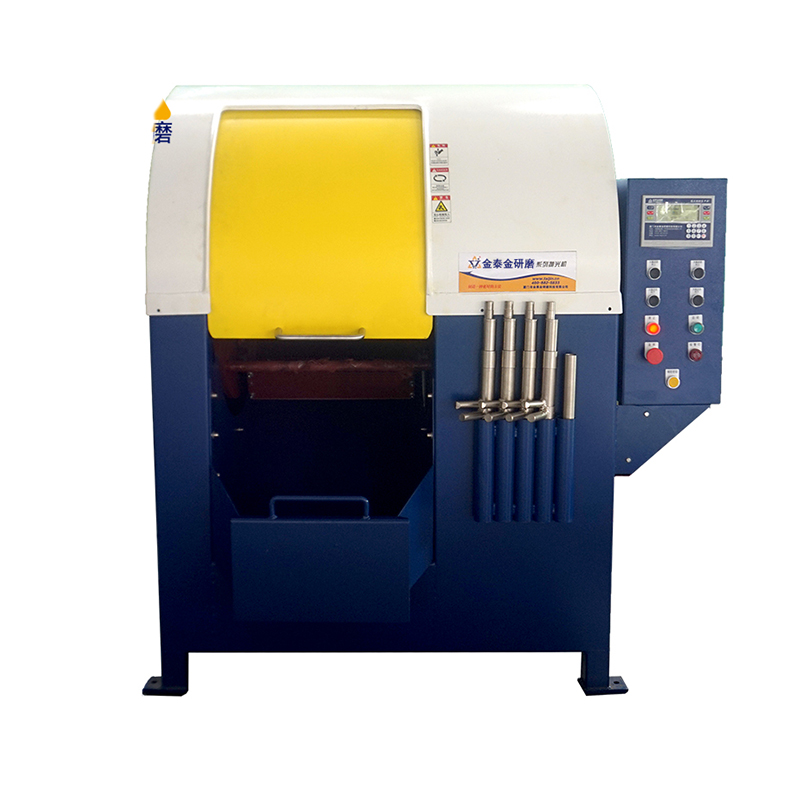
Centrifugal barrel finishing multiplies the effective gravity acting on the media charge, so cycle times shorten and contact pressure rises sharply. That combination can deburr and refine small precise parts such as fitted inserts, small valve bodies and gas distribution components efficiently, and it can also round an edge or distort a thin plate within a minute of over-running. Parts usually sit in compartments or barrels, which limits part-on-part damage but concentrates media at the compartment walls. Process control matters more than on a bowl: charge weight, barrel speed, fill level, compound dose and stop time all change the outcome, and a short trial cycle is easier to overshoot than to under-run. Ask whether the geometry has thin unsupported spans, a knife edge or a soft aluminium section, because those features decide whether this route is usable.
| Machine route | Where it fits | What it will not do |
|---|---|---|
| Vibratory finishing machine (bowl) | General deburring and refinement of chamber bodies, plates and housings that fit and can tumble without racking, with easy mid-cycle inspection | Continuous part-on-part contact and no access to deep internal passages; thin plates and finished mating faces need separation |
| Magnetic finishing machine | Fine deburring and light refinement of small precise features such as nozzles, orifice plates and narrow slots | Small working envelope that excludes chamber bodies and long gas lines, with pin media that can lodge in fine passages |
| Rotary barrel finishing machine | Gentle deburring of small fragile components and mixed fitting batches with a generous compound flow | Long cycles, no visibility while running, and internal passages can collect media and compound that must be retrieved at unload |
| Disc finishing machine | Fast, high-energy edge breaking and surface refinement on small robust parts and uniform batches of fittings | High impingement and edge-loss risk on thin or soft parts, and geometry must suit the disc working gap |
Ceramic media is the workhorse for deburring machined aluminium and stainless, and its shape and size class matter more than the broad material label. Angle-cut triangles and cylinders in a coarse size class cut quickly and reach open pockets, while smaller sizes follow tighter geometry but lodge more easily and can load passages with chips. A heavy-cut ceramic leaves a coarser surface than a fine ceramic or a plastic medium, so a route that starts coarse has to plan a refinement stage and a compound change rather than simply a longer cycle. Size selection should be driven by the smallest opening a medium can enter and by the smallest radius that must not be rounded. Wear is continuous: ceramic media break down and shrink, so the charge changes character over its life unless it is screened and topped up on a defined schedule.
| Media | Best fit | Watch out for |
|---|---|---|
| Aluminium oxide grinding media in a dense ceramic bond | Where a heavier stock removal or a more consistent cut is needed on robust stainless parts with thick edges | High removal energy rounds functional edges quickly and is a poor match for thin aluminium plates or knife-edge seal lands |
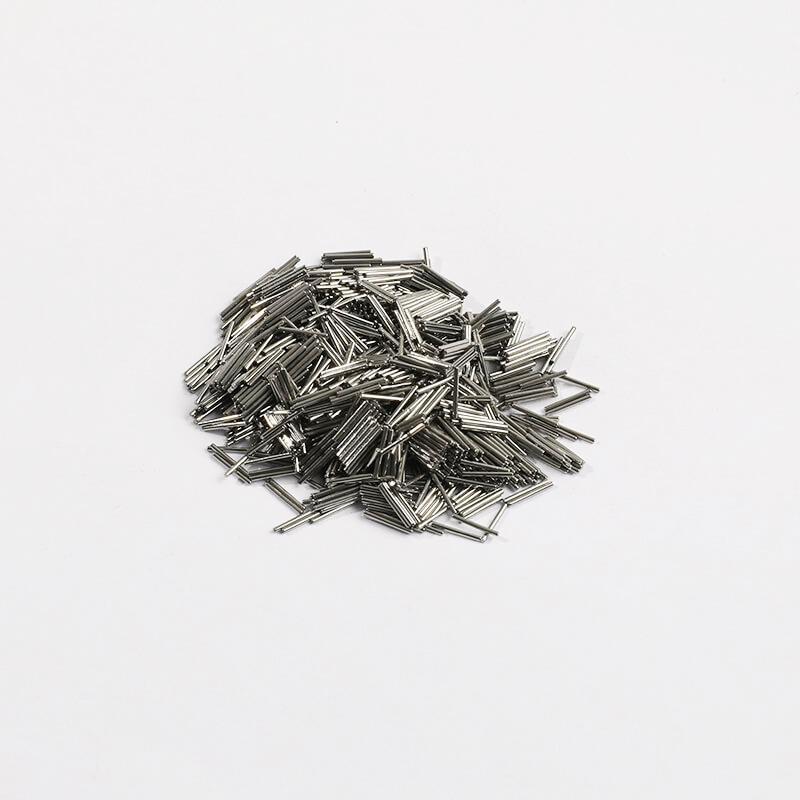
| Steel media, including balls and shaped pins | Bright finishing and edge blending on stainless components where appearance and a burnished surface matter | Transfers iron to aluminium and carbon steel, needs a corrosion-inhibiting compound, and must be separated magnetically or by screen at unload |
| Heavy-cut ceramic, angle-cut triangles in a coarse size class | Removing a substantial machining burr from open external edges and pockets on aluminium and stainless housings before a refinement stage | Cuts edges and corners aggressively, leaves a coarse surface, and lodges in slots whose width approaches the media section |
| Fine ceramic or porcelain spheres in a small size class | Refinement and light edge blending after a cutting stage, and reaching tighter external geometry on chamber bodies and plates | Small sizes enter and retain in gas passages and fine slots; media wear shrinks the charge and changes the finish over its life |
A medium lodged in a blind hole, slot or gas passage is the classic semiconductor finishing failure, and it often escapes the finishing shop and is found at the buyer's leak or particle check. It happens when the media size class is too close to the feature opening, when the charge has worn into smaller pieces, or when a passage was never mapped as a retention risk. Slots with a width close to the media section are the worst case, followed by cross-drilled intersections and deep tapped holes. Checking relies on controlled unloading and an agreed inspection: count the media charge in and out where practical, borescope the smallest passages at a defined angle, use a pin gauge on holes, and rinse into a filter for a visual residue check. Any medium found is a reportable non-conformance, not a wipe-and-release.
| Failure mode | Likely cause | How to catch it |
|---|---|---|
| Burr remaining in a cross-drilled intersection or an internal corner | Media too large to enter the intersection, part orientation that shields the feature, or a cycle stopped before that feature was reached | Borescope the intersection at a fixed angle, compare against a first-article reference, and use a pin or probe to feel for a lip on sampled parts |
| Compound film or tenacious residue left on a sealing face | A film-forming or silicate-bearing compound, insufficient rinse volume, or drying the part before it is genuinely clean | Magnify the sealing land and wipe a defined area with solvent, comparing the wipe against a clean reference; confirm with the buyer's own cleanliness method |
| Fine media fragments or aluminium smear embedded in a soft surface | Impingement from too much energy or charge mass, media that has fractured, or cross-contamination from a previous material family | Inspect at magnification under angled light, use a wipe or tape lift on the suspect area, and check the charge for broken media and fines |
| Bright impact marks, dents or flattened corners from part-on-part contact | Dense charge, high load ratio, thin or light parts left loose among heavy neighbours, or a cycle run longer than the edge condition required | Look for repeating mark patterns on exposed faces and edges, compare an unsupported part with a racked or compartmentalised one, and review the batch mix and load recorded for the lot |
Utrecht's industrial identity is knowledge- and health-driven rather than heavy-manufacturing driven. Utrecht Science Park is the largest science park in the Netherlands, with over 31,000 employees and 55,000 students and the highest density of knowledge institutions in the country; it is anchored by Utrecht University, UMC Utrecht, the Princess Maxima Center, the Hubrecht and Westerdijk institutes, RIVM and TNO, and its organisation list includes Danone Nutricia and the high-tech systems developer Demcon. The municipality and Utrecht University signed a cooperation agreement for the park covering the period to 2040, targeting about 4,000 additional homes and a comparable number of new jobs.
The nearest part of that base to this brief is medical: Utrecht Science Park combines Utrecht University, UMC Utrecht, the Princess Maxima Center (described as Europe's largest centre for pediatric oncology), the Hubrecht Institute, RIVM and TNO, with R&D companies growing employment by 76% since 2018.
Life-sciences and medical-technology manufacturing at Utrecht Science Park involves stainless and titanium instruments, implants, laboratory hardware and device housings where deburring, edge rounding, passivation and residue-free cleaning are quality-critical. Food production and high-tech systems engineering in the same ecosystem add stainless process parts and precision machined components with comparable cleanliness expectations.
A buyer should establish whether the surface requirement is a cleanliness and passivation specification (residues, iron contamination, documented process validation) or a dimensional specification (edge radius, burr height, Ra), because those two routes call for different media, compounds and evidence.
Freight context: No seaport or cargo airport in the city; freight arrives by road and rail. Utrecht is an inland node and its science park is a workplace location rather than a freight gateway, so machines and media normally arrive by road or rail from a sea or air port of entry. Imported equipment is declared to Dutch Customs at that point of entry, so the landlocked location does not change the customs or CE documentation obligations.
The Dutch standards body is NEN (Nederlands Normalisatie-instituut), which publishes and maintains the NEN and NEN-EN-ISO standards; the content of a standard is set by a NEN standards committee made up of the organisations concerned, not by NEN itself. For surface finishing NEN publishes NEN-EN-ISO 2080, which defines the terms for the general types of surface-finishing processes with emphasis on practical use in metal finishing, under the standards committee for metallic coatings and corrosion of metals and alloys. Machinery safety, EMC, low-voltage, ATEX, RoHS and ecodesign requirements reach Dutch buyers through the CE directives and regulations referenced by KVK, with the Machinery Regulation applying from 20 January 2027.
Business is conducted in Dutch, but engineering and procurement communication in these sectors is routinely handled in English. Buyers are KVK-registered legal entities and expect a clear commercial entity to contract with, an EORI number for customs, correct HS/TARIC classification, and a full CE technical file including the EC Declaration of Conformity and a manual in the correct language; a technical construction file held by the manufacturer is normally part of the qualification pack. For EU-internal supply the invoice carries 0% VAT with the customer's VAT identification number and the customer accounts for 21% Dutch VAT in its own return, so a Chinese seller shipping directly from outside the EU must be clear about who is importer of record and who carries the duty and import VAT. Trade and investment support is organised through bodies such as KVK, RVO, the regional development agencies and the Trade and Innovate NL network, and the Dutch technology industry is represented by FME.
SurfacePolish supplies from Xiamen, China. The buyer's own destination rules, conformity marking, tariff classification and documentation responsibilities stay with the buyer; confirm them against the authorities named above before ordering.
A first-article part, finished under the intended production settings, is the reference every later batch is compared against. Keep it identified, protected and available, together with the measurement record and the settings that produced it. Production acceptance then relies on a sampling plan rather than on inspecting every part: define the sample size, the sampling frequency, which features are measured and which are only visually checked. For a low-volume semiconductor equipment build, sampling by part may be workable; for a batch of small fittings, sampling by position in the charge is more useful, because the media path means parts at different points in the bowl see different conditions. Record where each sampled part sat in the charge. If a sample fails, the batch disposition rule has to be agreed in advance, including whether rework is allowed.
A sample trial answers a narrow question: what happened to these parts under these settings on this equipment. It does not prove that a production lot will be uniform, because bowl size, load ratio, media age and operator practice all shift the outcome. It does not establish a particle count, a cleanliness level or fitness for a cleanroom or any regulated process environment, and it does not transfer a roughness value from a coupon to a complex geometry. It cannot guarantee a cycle time, a cost per part, a capacity or a delivery schedule, and it does not qualify a machine, medium or compound for a semiconductor application. Treat the returned parts and the settings record as evidence for the buyer's own engineering decision, and plan the production route with its own first-article and sampling discipline.
Mechanical mass finishing and electropolishing are different processes with different effects, and SurfacePolish does not supply or perform electropolishing. A mechanical route can deburr and refine a surface, and it may reduce the reason to consider an electrochemical step, but it does not reproduce what electropolishing does to a surface. The honest comparison is to define what the gas line actually requires, then test whether a mechanical route can observe those requirements on representative parts. Where an electrochemical finish is mandatory in your specification, that requirement stays with your own supply chain. This page treats electropolishing only as a comparison point and as a reason to evaluate a mechanical alternative.
No cleanliness level or cleanroom readiness is certified or guaranteed here. The offer is cross-border supply of finishing machines, media and compounds, plus a sample trial that reports what was observed on the parts tested under the settings used. Cleanroom and process-environment requirements are defined by the buyer and verified by the buyer's own methods, which may include wipes, rinse collection, magnification, leak testing and functional checks. SurfacePolish can keep tested parts separated, documented and returned with a settings record, and that record can support your verification work in Utrecht, but the acceptance decision and any compliance statement remain with your quality function.
Thin plates are governed by distortion and media lodging as much as by finish, so plastic media is often the conservative first choice because it is lighter and imposes less impact. A fine ceramic may cut the hole exits faster, but it also increases edge rounding and part-on-part damage unless the plates are separated. Either way, the plate needs support and separation in the charge, and the hole exits need an inspection that can see inside them. Send several plates so more than one cycle time can be examined, and state the flatness requirement you will verify afterwards.
Use Utrecht, Netherlands as the destination on the enquiry and state whether the deliverable is equipment, media and compound, a representative sample review or a line concept. A destination does not imply local stock, a local service point or a local delivery time.
A local buyer would reference the CE machinery regime (Machinery Regulation from 20 January 2027) and the Dutch/EN-ISO surface-finishing standards published by NEN, such as NEN-EN-ISO 2080 for metal-finishing terminology. In the medical and life-sciences supply chains that dominate the park, cleanliness, residue limits and process validation are usually imposed through the customer's own quality system, and ISO 13485 is the customary quality-system reference for medical devices.
Sources were retrieved on 2026-09-29 and describe the local industrial and trade context only. They do not evidence any SurfacePolish project, shipment, installation or service in Utrecht.
The buyer needs the slot edges blended and the surface refined while keeping the liner flat and free of trapped media.
Send the material, dimensions, approximate weight, batch quantity, the incoming condition and photographs of the difficult features. Mark which features must not be contacted by media and state how the result will be inspected. This form carries source reference PSEO-0635; quote it if you prefer an additional manual reference.
Open the SurfacePolish enquiry form Email a prepared enquiry
No price, lead time, certification or result is promised here. Confirm whether a sample trial is available for the specific part and what the trial can and cannot show.
Page PSEO-0635 · revised 2026-09-29 · cross-border equipment, media and scoped sample review. City context is sourced and cited above.
Use this local checker to identify missing part and inspection information. It prepares a technical-review brief; it does not approve a machine, process recipe or production result.
Complete the part details to prepare a review brief.
Email : info@surface-polish.com


 IPv6 network supported


 +86-592-2381506