A part can leave a wet finishing machine looking clean and then come out of the dryer covered in marks. When that happens the dryer is often blamed first, but the dryer is only one step in the chain that decides the result. This guide is written for the buyer who has to specify the step after rinsing — and who would rather define it once than rework it after the machine is installed.
Nothing here is a guarantee about any particular machine or result. Drying is a part-specific process, and the only reliable evidence is a trial on your own parts under your own acceptance method.
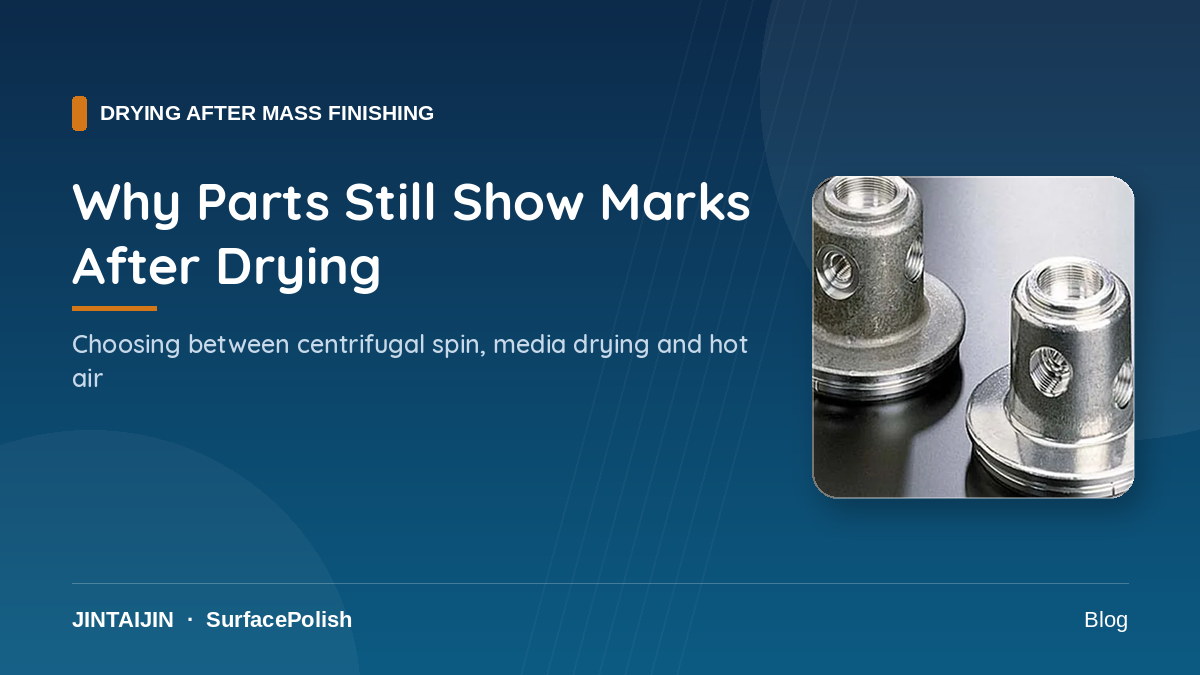
Before anyone changes a dryer setting, compare an as-rinsed part with a dried part from the same batch, under the same lighting.
This is a diagnostic sequence, not a universal diagnosis. Record the part material and coating, the finishing media and compound, the rinse method, the time between rinsing and drying, the part orientation, and exactly where the mark appears. Photograph the same location in both conditions. Avoid attributing a mark to mineral deposits, corrosion, abrasive dust or oil without a suitable residue check — the guess can cost more than the test.
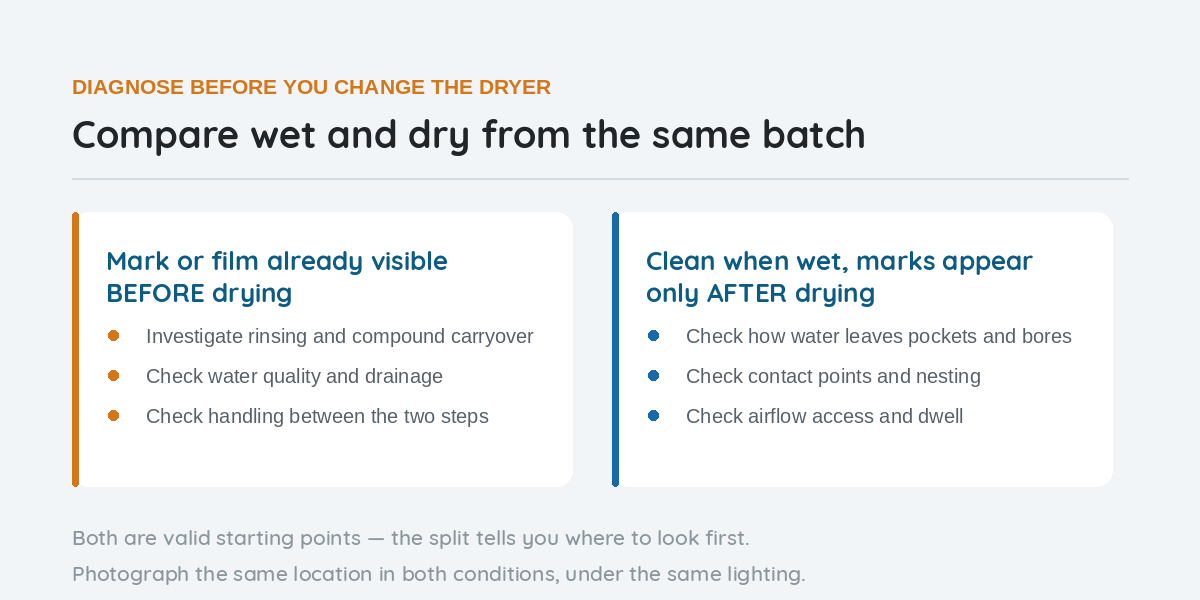
Most finishing lines end up comparing three families. They differ in how they touch the part, which is what usually decides the answer.
| Route | How it removes water | The part-specific question |
|---|---|---|
| Heated centrifugal spin | Rotation throws free water off the part inside a heated basket. | Can the batch tolerate the motion and the heat, and can liquid drain from the geometry? |
| Media-assisted drying | Parts contact heated absorbent granules in a vibratory or drum chamber. | Can granules lodge in holes or threads, or mark a protected surface? |
| Hot-air or belt drying | Airflow and dwell remove moisture without a drying medium. | Can the airflow actually reach the least accessible feature at production throughput? |
In a media-assisted route the part touches heated granules, which may be unsuitable where small openings can retain them or where contact could change a cosmetic face. A hot-air route removes that contact, but airflow access, part orientation, drain paths and dwell still need a part-specific trial. Neither route guarantees a mark-free finish, and a machine that works on one sample may not match production flow.
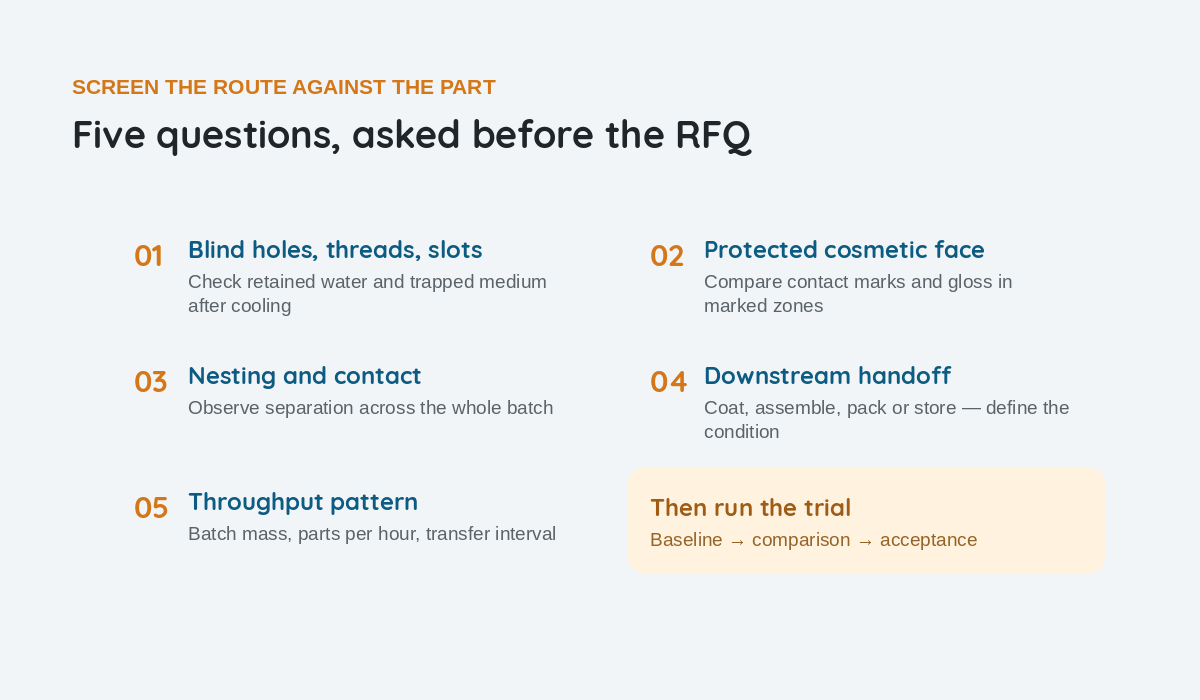
Work through these five questions before requesting equipment or a sample trial. They are the ones that most often change the answer.
| Part question | What to inspect in a trial | Why it matters |
|---|---|---|
| Are there blind holes, threads, narrow slots or cavities? | Retained water and trapped drying medium after cooling and handling. | A dry external face can conceal moisture or granules inside a feature. |
| Is there a protected cosmetic face or a tight finish requirement? | Contact marks and gloss in the same marked inspection zones. | A drying route can change appearance even while it removes water. |
| Do parts nest, stack or touch during transfer? | Separation and contact points across the whole batch. | Sheltered surfaces dry differently from freely exposed ones. |
| Is the next step coating, assembly, packing or storage? | The required condition at that handoff, including any delayed recheck. | “Dry at machine exit” may not be the only acceptance point. |
| Is throughput continuous or batch-based? | Batch mass, parts per hour and transfer interval. | A dryer that suits one sample may not match the line. |
Baseline after rinse. Label a representative set of parts, including the worst-case recesses and the visible faces. Photograph and note water or film before drying, and keep comparison parts from the same lot and the same finishing cycle.
Controlled drying comparison. Trial only routes that are technically suitable. Record the dryer type, any drying medium, the load, the orientation, the dwell and the settings actually used. Note contact marks, retained medium, and moisture in hidden features. Do not compare one route against a different incoming rinse condition — that measures the rinse, not the dryer.
Acceptance on the agreed check. Re-inspect after cooling and again at the downstream handoff if your process has a delay. State who inspects, under what lighting, and what counts as a reject. A successful trial applies only to the part, the configuration and the acceptance method that were actually tested.
A request that arrives without these facts usually comes back as a price for a box, not for a solution.
Ask the supplier for the exact model and revision, the usable load rather than merely the nominal chamber volume, the working ranges, and the operating and safety limits of the maker. Where a line is not quoted, it stays not quoted rather than becoming an implied zero.
Only if drying is the actual cause. If the mark is present before drying, or if it comes from compound carryover or water quality, changing the dryer moves the problem rather than solving it. Separate the two conditions first.
Not in general. Media-assisted drying avoids airflow dependence but introduces contact with heated granules, which can lodge in features or affect a cosmetic face. Which is gentler depends on the part — that is exactly what the trial is for.
Long enough to include the worst-case recesses, the full batch and the transfer between steps, and to repeat the check after cooling. A single part dried in isolation answers a question you are not asking.
If the part has any protected feature, blind hole or cosmetic requirement, yes. A trial on your parts is the only way to know whether a route retains medium or changes appearance. It is evidence about the parts tested — not a production approval.
Define the incoming condition, the protected features and the acceptance check before comparing machines. That order turns a vague requirement into a request a supplier can answer precisely — and gives you a record of what was actually observed on your parts.
SurfacePolish supplies finishing machines, media and compounds across borders and reviews sample parts to report what was observed on the parts tested. It is not a local contract finishing shop, and a sample review is not a production approval, a certification, or a promise about finish, cycle time, price or delivery. For the wider picture you can review the application notes, the machine families and the media and compound ranges.
Email : info@surface-polish.com


 IPv6 network supported


 +86-592-2381506