
Centrifugal Dryer: Drying Is the Last Process Step, Not an Accessory
A centrifugal dryer is usually bought as an afterthought — a line item added after the machine and the media have been chosen, often after the first batch has already shown a problem. That ordering is backwards.
Drying is the step that decides whether the finish survives the trip from the machine to the next operation. A part that comes out of a wet process bright and goes into a basket wet does not stay bright. On steel it rusts; on aluminium it spots; on any part with a blind feature it holds water exactly where the corrosion or the stain will appear first.
This page is about the decision: what drying has to remove, what a centrifugal dryer can and cannot do, and how to size it against the part rather than against the machine it sits next to.
What drying actually has to remove
Water sits in three places after a wet finishing process, and they behave differently:
| Where the water is | How it leaves | What happens if it stays |
|---|---|---|
| On open faces | Evaporates or is flung off | Nothing, usually — a spot at worst |
| In blind holes, counterbores, thread roots | Only by force or by heat; it will not drain | Rust, staining, a residue that shows up days later |
| Inside the charge itself (media, and parts nested together) | Slower than the parts, so it keeps re-wetting them | Parts that look dry and are not |
The second row is the one that costs money, and it is the reason a centrifugal dryer exists rather than a rack and time.
A part with a blind hole cannot be dried by air movement alone in any reasonable time — the air passes over the hole, not into it. What removes that water is force (the part is spun so the water is thrown out) or heat (the water is evaporated). A centrifugal dryer does both, and the combination is why it works on a part that a fan cannot dry.
What a centrifugal dryer does, mechanically
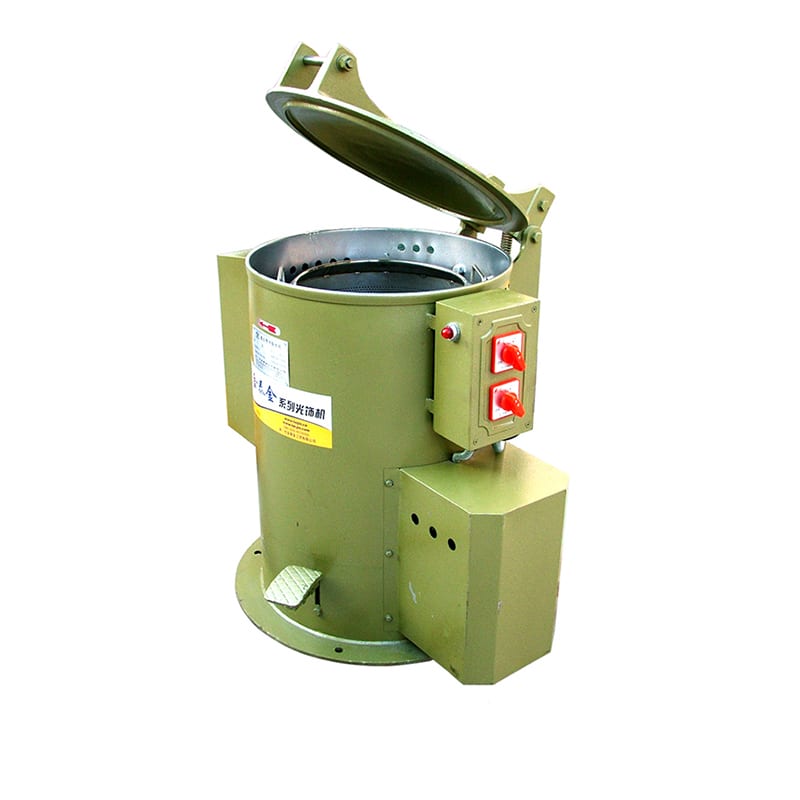
The part sits in a basket inside a drum. The drum spins at speed, and the water is thrown off the part by centrifugal force — out of the blind holes, out of the thread roots, out of the gaps between nested parts. Hot air is passed through at the same time, which takes the surface from wet to dry rather than merely from wet to damp.
Five things follow from that mechanism, and each one is a specification question:
1. The spin has to exceed the force holding the water in. A shallow recess drains at low speed; a deep blind hole needs more. This is why capacity alone does not describe a dryer — the same basket size at a different speed behaves differently on a part with deep features.
2. The heat has to reach the part, not just the chamber. Hot air that short-circuits across the top of the drum warms the cabinet and not the parts. The useful question is where the air enters and whether it passes through the basket.
3. The load has to be balanced. An unbalanced basket at speed is a maintenance item at best. Parts should be distributed, and mixed part sizes in one load are the usual cause of a vibration that gets blamed on the bearings.
4. The basket has to suit the part. A basket with large apertures drops small parts; a fine mesh blinds with swarf and stops passing water. On small parts this is the constraint that decides whether the dryer can be used at all.
5. It is a batch device. A centrifugal dryer dries what is in the basket. Very long parts, or parts that cannot be tumbled into a basket without marking, are a different problem — the same limitation that decides machine families elsewhere.
The four configurations we build, with the numbers
These are the four models in our range. The figures are catalogue ratings — confirm them against your own part and load before planning output, because the usable load depends on part shape and on how the basket is filled.
| Model | Load (kg) | Dimensions L×W×H (mm) | Basket φ×H (mm) | Spin motor (kW) | Heat (kW) | Voltage (V) | Net weight (kg) |
|---|---|---|---|---|---|---|---|
| 35 | 30 | 650×800×800 | 400×300 | 0.75 | 3 | 380 | 80 |
| 35A | 35 | 750×700×710 | 400×285 | 0.75 | 1.8 | 380 | 150 |
| 70 | 50 | 800×1000×850 | 500×400 | 1.1 | 3 | 380 | 100 |
| 70A | 60 | 900×580×730 | 480×290 | 1.1 | 3 | 380 | 170 |
How to read that table. The two 35-series models share a 400 mm basket; the two 70-series share a 500 mm basket. Within each pair the difference is not capacity but basket height and heat: the 35A carries 5 kg more than the 35 with a shallower basket (300 → 285 mm) and less heat (3 → 1.8 kW), while the 70A carries 10 kg more than the 70 with a shallower basket (400 → 290 mm) at the same heat.
The pattern worth noticing: the higher-capacity model in each pair has the shallower basket. That is not a quirk — it is the trade. A deeper basket holds more per cycle but the air has further to travel to reach the bottom of it. A shallower basket dries more reliably and is the safer choice for a part with deep blind features, even though its nominal load is achieved differently.
And the footprint matters commercially. The 70A is the tallest and heaviest of the four (170 kg against the 70's 100 kg) while occupying a smaller floor area — a difference that decides where it can be installed, and one that a floor plan has to accommodate before the order rather than after.
Where a centrifugal dryer will not help
Being specific about this is more useful than any capacity table:
A part that cannot be tumbled into a basket. Long shafts, or parts whose finished face must not touch anything, need a different handling approach. The dryer is not the problem; the loading method is.
A part with a feature that traps the charge rather than the water. If media lodges in a recess, spinning throws the water out and leaves the media in. The separation step comes before the dryer, not after it.
A production rate that exceeds a batch device. A dryer processes a basket at a time. If the finishing machine runs continuously, the dryer has to be sized against the finishing cycle, not against the machine's hourly rate — and two dryers are usually cheaper than one oversized one that runs half empty.
A process where the part must stay wet. Some routes go straight from finishing into a wet downstream step. Drying in the middle adds a cycle and a handling step for nothing.
A part where heat is the risk. Thin sections, some plastics and some assemblies distort or degrade at drying temperature. On those, the answer is a lower heat setting or a different drying method — not a bigger machine.
Why this belongs in the process, not the purchase order
The reason drying gets bought late is that it looks like a convenience. It is not, for three specific cases:
Steel and the rust window. A freshly finished steel part has no oxide layer and is wet. It starts to corrode within hours, first in blind holes, thread roots and cut edges. A dryer that gets the part dry before it leaves the cell closes that window; a rack does not. This is why on steel the dryer is part of the finish rather than part of the building.
Aluminium and the water spot. Aluminium holds water in the same places and leaves a film that oxidises. A part that looks perfect at goods-in and shows spotting a week later did not fail at the polish — it failed at the rinse and the dry.
Any part with a blind feature. The water is inside a hole the air cannot reach. Force and heat are the only two ways to get it out, and a centrifugal dryer is the machine that applies both.
What to send with an enquiry
- The part: material, mass, and the features that hold water — blind holes, thread roots, recesses.
- The load per batch, in kg, and how the parts can be loaded into a basket.
- What is wet: water, or a compound-bearing bath, and whether a rinse step precedes the dryer.
- What the part must be after: dry to the touch, dry in the features, or dry and below a temperature the material tolerates.
- The rate the dryer has to match: the finishing cycle, not the machine's maximum.
- The site: three-phase 380 V supply at 50 Hz for these four models, and the floor area against the footprint above.
FAQ
What is a centrifugal dryer used for in metal finishing? To remove water from parts after a wet process, including from blind holes and thread roots that air cannot reach. It spins the water out and passes hot air through, so the part leaves dry rather than damp.
Why can't I just air-dry the parts? On open faces you can. On a part with a blind hole or a thread root, air passes over the opening rather than into it, so the water stays — and that is exactly where rust and staining appear first. Force plus heat is what removes it.
Is a centrifugal dryer the same as a hot air dryer? They are usually combined, as in the four models above, where a spin motor and a heater work together. A hot-air-only cabinet dries by evaporation and is slower on deep features; a spin-only machine removes free water but leaves a damp surface.
How do I size a dryer for my parts? Start from the load per cycle in kg and from the features that hold water. A deeper basket holds more but the air has further to travel; the shallower model in each pair above is the more reliable choice for deep blind features. Catalogue ratings are a starting point — confirm against your own part.
Can it dry parts with small features without losing them? The basket aperture decides this. Large apertures drop small parts; fine mesh blinds with swarf. On small parts the basket, not the drum, is the constraint — and it should be specified with the part in hand.
Will the dryer remove media left on the parts? No. Spinning throws water out; it does not separate media. Separation is a separate step and belongs before the dryer.
Max Xu, Sales — Xiamen Jin Tai Jin Grinding Technology Co.,Ltd.
No. 31, Xinchang Road, Xinyang Industrial Zone, Haicang District, Xiamen
info@surface-polish.com
The model figures above are catalogue ratings for the four models in our range; they describe the machine, not the result on a specific part, and the usable load depends on part shape and basket filling. A finishing process is set by the material, the stock to be removed and the finish required, so the configuration for a specific part is confirmed against a trial on that part. We manufacture finishing equipment and the media and compounds that run in it; we do not offer a job-shop finishing service.
 +86-592-2381506


 IPv6 network supported
