A finishing trial is only useful if it answers a production question. A part that looks brighter in a photograph has not told you whether an edge is safe to handle, whether a sealing face is still flat, or whether the next operation will still work. This checklist is written for the buyer preparing a first enquiry: it sets out what to send, what to state, and how to agree in advance on what "acceptable" means.
Nothing here replaces testing your own parts. The purpose is to arrive at a technical discussion with enough context that equipment and media families can be compared on evidence rather than on a claim.
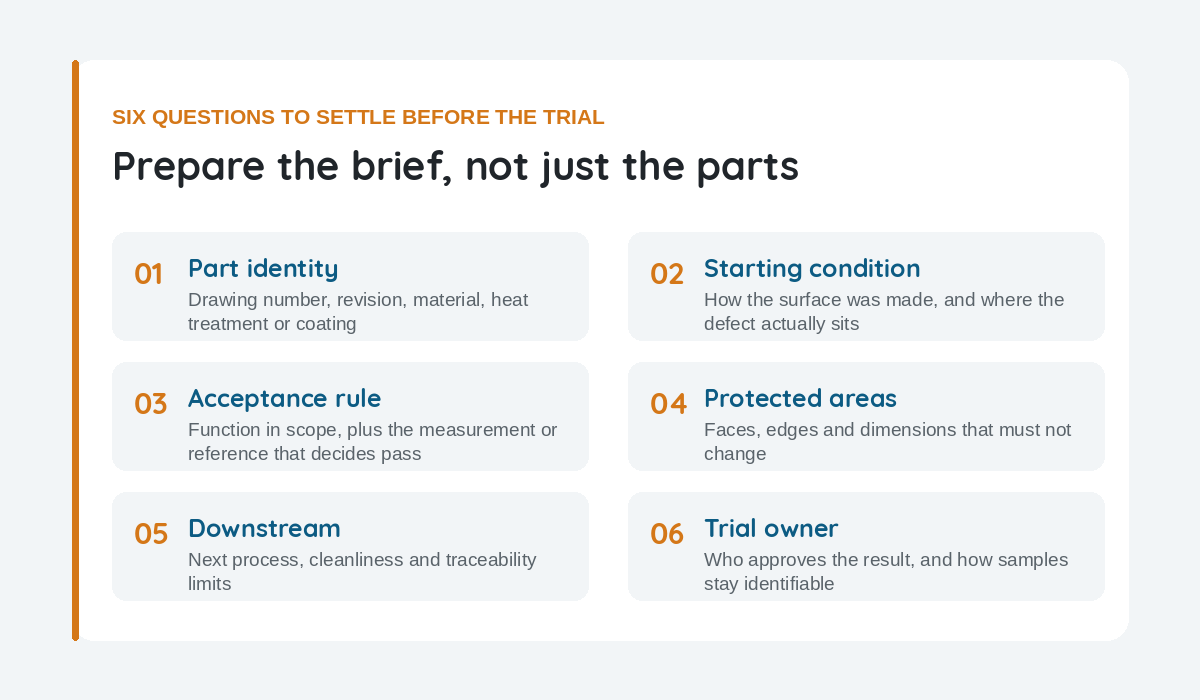
Start with the facts a process engineer cannot guess. Include the part name or drawing number, the revision, the material, and any known heat treatment, coating or plating state. Then describe how the present surface was produced: machining, casting, stamping, cutting, laser or waterjet cutting, or an earlier finishing step.
If the defect is localised — a burr on one edge, scratching on one face, discolouration in one area — mark its position on the drawing or on a clearly labelled photograph. A general instruction such as "polish the whole part" hides the feature that actually controls process selection.
Give the part envelope, approximate weight, and any geometry that could trap media or liquid. Flag threads, narrow slots, deep cavities, blind holes, thin walls, sealing faces, datums and cosmetic surfaces. These are the features that decide whether a vibratory, barrel, centrifugal-disc, magnetic or dry route can be considered at all.
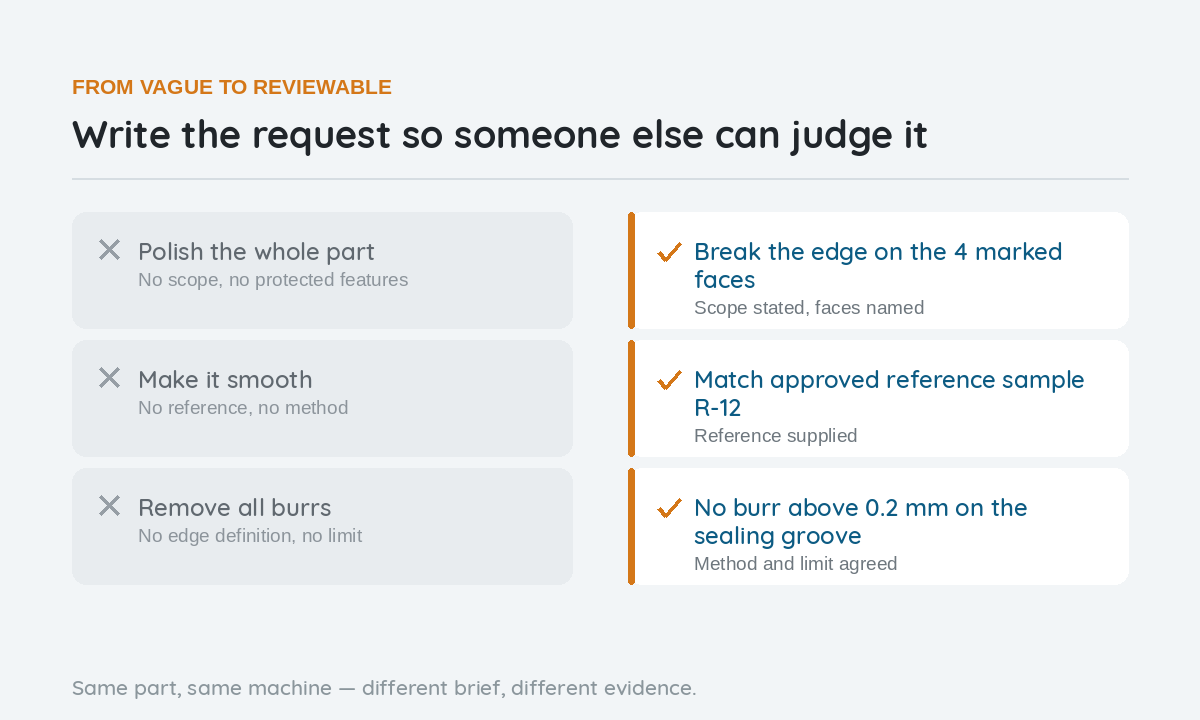
Describe the outcome in terms another person can review. Is the purpose to remove a hazardous edge, to prepare the surface for a coating or weld, to improve appearance, or to change a measurable finish? Name the exact edges or faces in scope, and name the areas that must not be rounded, thinned, scratched or otherwise altered.
Where a drawing already specifies an edge break, radius, roughness or other limit, send that drawing and say how the result will be inspected. Where the requirement is visual, supply an approved reference sample, or define the lighting and viewing method that will be used consistently. Photographs are good at locating a feature; they are not a substitute for an agreed measurement on a part that is safety-, fit- or sealing-critical.
The same visible result is not acceptable for every next step. State whether the part will be welded, coated, plated, assembled, sealed, cleaned or packed for a controlled environment. State any residue, contamination, corrosion, dimensional or traceability limits that apply to your process.
It is also worth saying what the part will be inspected against on arrival: a drawing, a sampling plan, a first-article report, or a visual standard. If your quality system requires documentation with the sample, say so at enquiry stage rather than after the trial.
Mass-finishing equipment covers vibratory bowls and tubs, rotary and centrifugal barrels, centrifugal-disc machines, magnetic finishers and dry systems. Media families include ceramic, plastic, steel and dry media such as walnut shell or corncob, each with its own shape, size and compound pairing. These are starting points for a technical discussion, not interchangeable recommendations.
Part size, material, geometry, surface target, batch size and protected features have to be reviewed together. Ask why a particular process family is being proposed, what it is expected to change, what risks remain, and which observations or measurements will decide whether the trial passes. A machine name, a catalogue comparison or a "one-pass" claim is not evidence on your part.
If you are comparing suppliers, ask each one the same questions in the same order. That makes the answers comparable and exposes the points where a quotation is vague.
Before the trial, agree on four things: the sample identity, the objective, the acceptance method, and who approves the result. Ask how the sample and its records will be kept identifiable, and how many parts are needed to make the trial meaningful.
If several settings or media are being compared, ask that every sample is labelled so the review can connect an outcome to the condition that produced it. A trial that produces five unlabelled parts produces no information.
After the trial, compare the agreed areas and record both what improved and what did not. Note any change to edges, dimensions, appearance, trapped media, residue or downstream readiness that matters to your application. If the result is inconclusive, define the next test instead of treating the first sample as production approval.
When the sample travels to another country, a little preparation avoids a stalled trial:
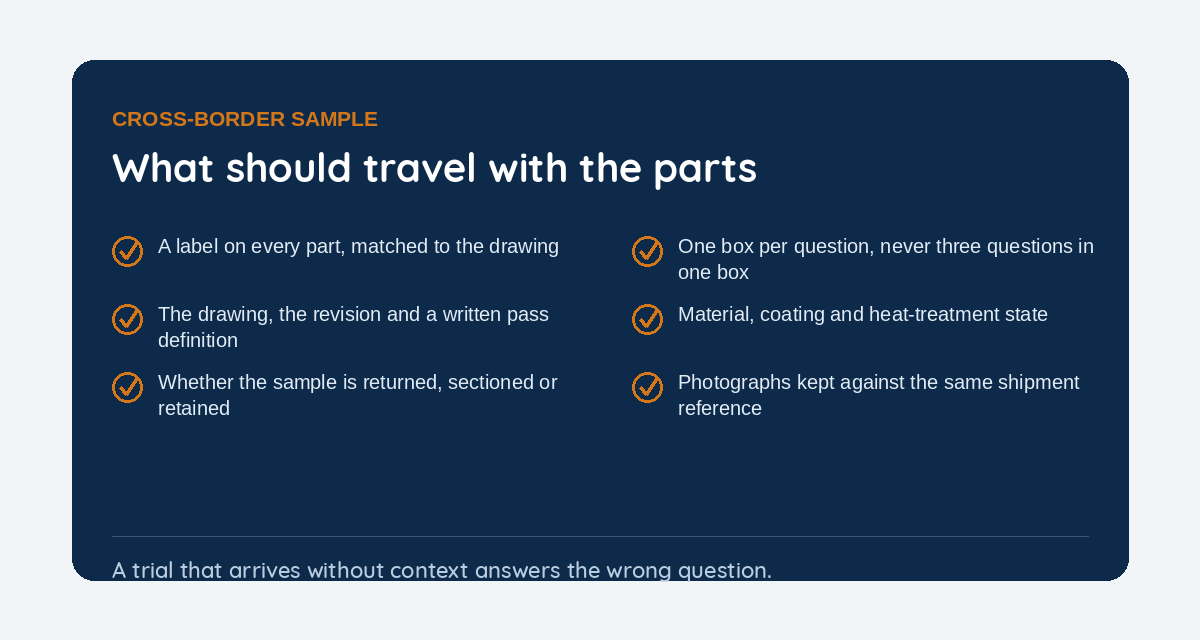
Describe the incoming condition honestly, including any handling damage that happened before shipping. A trial run on a part that was already damaged cannot tell you what the process does.
| Item | What to state |
|---|---|
| Part identity | Name, drawing number, revision |
| Material | Alloy, condition, known heat treatment or coating |
| Current route | Machining, casting, stamping, cutting, earlier finishing step |
| Feature to address | Defect or edge, marked on drawing or labelled photo |
| Geometry | Envelope, weight, fragile features, openings, trapping risk |
| Desired result | Function and the acceptance or inspection method |
| Protected areas | Surfaces, dimensions and edges that must not change |
| Downstream | Next process, cleanliness, packaging, traceability limits |
| Volume | Sample quantity, expected batch size, production pattern |
| Documentation | Inspection records or approvals required |
| Contacts | Technical contact and sample-return instructions |
Photographs help locate a feature and prepare the discussion, but they cannot show how a particular part responds to a finishing process. A physical sample may be needed before suitability can be judged; confirm the quantity and handling requirements with the supplier first.
No. A sample is a single piece of evidence. Production approval may also depend on repeatability checks, agreed inspection, process control, and confirmation that production parts match the sample in material, geometry and incoming condition. A sample trial tells you what was observed on the parts tested — nothing more, and nothing less.
Not necessarily. An enquiry may be about a sharp edge, a specified edge break, a surface appearance, or preparation for a later operation. State which function matters and how it will be accepted rather than relying on a broad label alone.
Enough to represent the range you actually produce, including the worst case you are willing to accept. If the parts vary in incoming condition, say so and send examples of that variation; a trial on the best part in the batch answers the wrong question.
SurfacePolish supplies finishing machines, media and compounds across borders, and reviews sample parts to report what was observed on the parts tested. It is not a local contract polishing shop, and a sample review is not a production approval, a certification, or a promise about tolerance, finish, cycle time, price or delivery. What it can do is give you a written record of how your parts behaved under a stated condition — which is the input a purchasing decision actually needs.
To go further, you can review the application notes, the machine families and the media and compound ranges, then send the checklist above with your parts.
Email : info@surface-polish.com


 IPv6 network supported


 +86-592-2381506