A buyer in Boston, United States in energy equipment has a grey cast iron compressor casing where the machined bore edges and drilled oil gallery entries need deburring despite graphite smearing and cast-iron dust. SurfacePolish supplies finishing machines, media and compounds across borders, and a free sample trial returns representative parts from Xiamen with an observation record and a proposed media, compound and cycle direction. This brief is written for a buyer in Boston working on energy equipment; it describes equipment, media and a scoped sample review, not a local polishing service.
What must the part be clean of, and what method and limit does the buyer use to verify cleanliness before assembly, welding, coating or a leak test?
Is deburring done before or after heat treatment, and in what metallurgical and surface condition does the part arrive at the finishing step?
Which edges on this part are functional, such as gasket lands, seat bands, stem guides, metering lands and thread entries, and which only need to be free of a sharp edge?
Treat the batch, not the individual part, as the unit that gets controlled. A charge holds a defined mass of parts sharing a material family, a burr condition and an edge requirement. Mix a thin heat-exchanger plate with a heavy valve body and the light part absorbs energy it did not need while the heavy part shields its own critical edges. Batch definition also fixes traceability. If two heats of duplex stainless or two casting lots run together, a defect found later cannot be tied back to a charge, a media age or a compound batch. Keep part numbers, material grades and heat-treatment states in separate runs, label the charge, and record how many parts were loaded and in what orientation.
Shape and size class decide where the charge can go and how it cuts when it gets there. An angle-cut triangle presents a point and a sharp edge, so it works into a corner or a thread entry and cuts hard; a sphere rolls and makes softer, more uniform contact; a cylinder or oval lies along a face and blends rather than digs. Size then sets the access limit: the medium must be comfortably smaller than the smallest opening it is expected to clear, and comfortably larger than any opening it must never enter. Those two constraints are often only a size class apart, which is why thread entries, cross-drillings and slot widths need listing before a charge is ordered. Media that fractures in service defeats the original sizing, so screen the working charge.
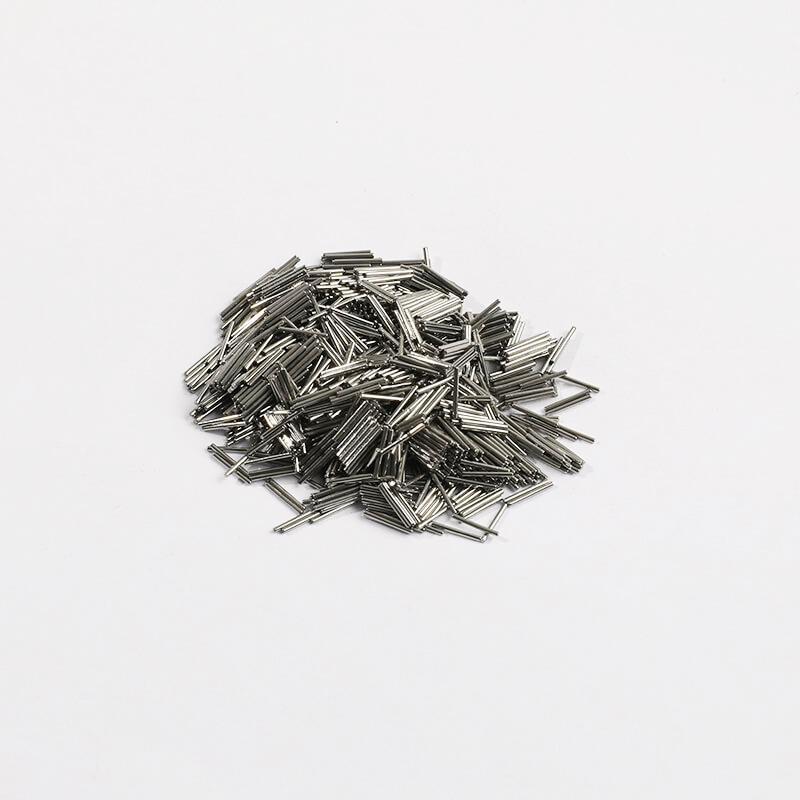
| Media | Best fit | Watch out for |
|---|---|---|
| Dry media, walnut shell with an abrasive or polishing compound | Light dry deburring, deflashing, drying and low-residue finishing of small parts and of features where a wet bath is difficult to remove | Low cutting energy so it cannot remove a substantial burr root, produces dust needing extraction, and consumption is high |
| Alumina-bearing grinding media in a dense ceramic bond | Heavy stock removal and consistent cutting on hard or work-hardened parts with generous edge limits, such as robust flanges and heavy fittings | High removal energy rounds functional edges quickly and is a poor match for thin plates, thin-wall castings and lapped sealing faces |
| Plastic media triangles and pyramids in a soft to medium grade | Deburring aluminium, brass and other soft or thin-walled parts where surface marking and edge rounding must stay minimal | Slow cut rate, media deforms and wears out of shape, and a worn charge behaves noticeably differently from a fresh one |
| Heavy-cut ceramic, angle-cut triangles in a coarse size class | Removing a substantial or thick burr root from open external edges, flange corners, cast bosses and large tapped entries on steel and stainless parts | Cuts controlled edges and gasket lands as readily as burrs, leaves a coarse surface, and lodges in slots whose width approaches the media section |
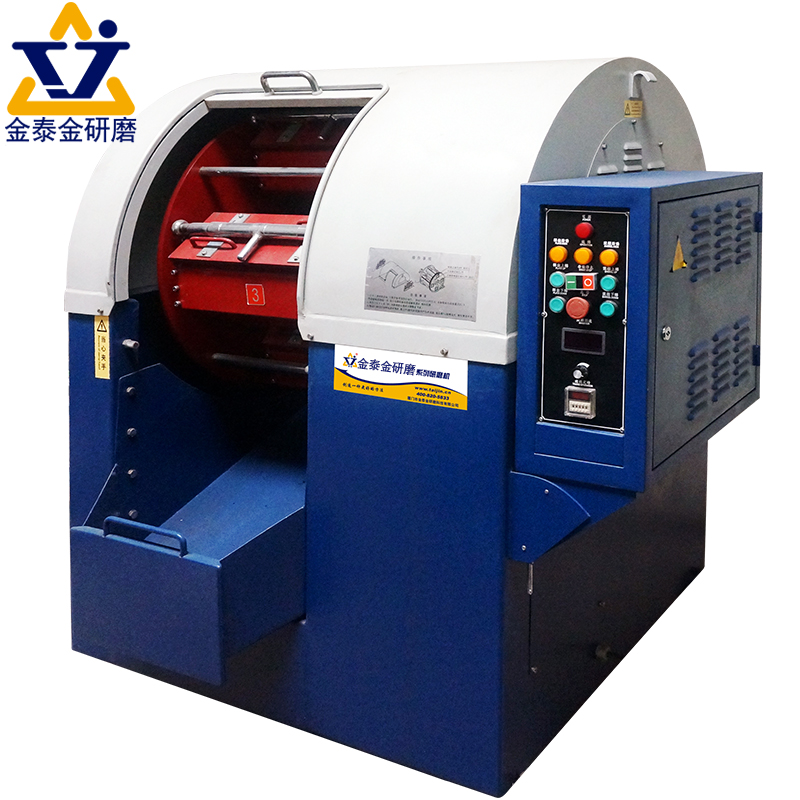
High-pressure routes, disc machines, grinding finishing machines and centrifugal barrels, earn their place when a heavy burr or a large batch makes the gentle options impractical. The trade is paid in three currencies. Edge rounding accelerates, so controlled edges need masking, orientation control or a shorter cycle. Distortion risk rises on thin walls, thin plates and unsupported sections, because the same pressure that cuts a burr can also move material. And the charge has to be balanced: centrifugal barrels in particular need an even barrel weight and a planned stop time, or the load shifts and results vary between barrels. Ask whether the part family has enough edge tolerance and section stiffness to absorb that energy. If it does not, the gentler route usually costs less overall.
| Machine route | Where it fits | What it will not do |
|---|---|---|
| Tub vibrator | Long parts such as manifold rails, shafts, long housings and stacked plate sets that cannot tumble in a bowl, with support or rotation along their length | Lower energy per unit area so heavy burrs take longer, and the tub needs floor space plus a defined part support method |
| Dry polishing machine and dryer | Drying after a wet cycle and dry light polishing or deburring of small parts, including features where residual moisture is a problem | Removes little or no material, needs dust extraction when dry media is used, and does not replace a cutting stage for a substantial burr |
| Disc finishing machine | Fast, high-energy cycles on small to medium robust parts, including batches of fittings and small housings that need a quick cut | High contact pressure rounds edges quickly and can mark or deform thin and soft parts, with results sensitive to load and disc condition |
| Grinding finishing machine | Heavier stock removal and thick burr roots on robust parts where clearing material in a shorter cycle matters more than the surface result | Aggressive edge rounding and a coarser surface, so it fits lapped seats, thin sections and tight edge bands poorly |
Contamination in this process is mostly invisible at the machine and is discovered downstream. Three forms matter on energy-equipment parts. Media fragments and abrasive fines can embed in soft surfaces or in a machined groove and later appear as particles in a fluid system. Material carryover happens when carbon steel fines or cast-iron graphite from an earlier batch stay in the charge, the machine, the rinse tank or the drying cloth and transfer to stainless parts. Compound residue and its reaction products can sit in a gasket groove, a thread or a blind hole and interfere with welding, passivation or a coating step. Control is separation and cleaning discipline, verified with a wipe or tape lift, magnification, and a flush residue check.
| Failure mode | Likely cause | How to catch it |
|---|---|---|
| Part-on-part or fixture witness marks and peening on a finished face | Insufficient separation in the load, too high a load ratio for the part mass, sharp or worn fixture contact points, or the same faces bearing contact throughout the cycle | Inspect at magnification under angled light against a retained reference, map the mark positions against the load arrangement, and check fixtures and compartments for burrs and wear |
| Loss of flatness or a dimensional shift on thin plates, thin walls and long unsupported sections | Part-on-part impacts and fixture pressure in a high-energy route, too high a load ratio, or insufficient support along a slender part | Check flatness on a surface plate or a coordinate measuring machine at marked points before and after finishing, and check the same points across parts from different load positions |
| Media lodged in a cross-drilling, blind tapped hole, keyway, groove or internal passage | Size class chosen against an average feature rather than the smallest one, media fractured into smaller pieces during the cycle, or a secondary burr that closed part of the opening | Borescope agreed passages at a fixed angle, pin gauge every tapped hole, count the charge in and out where practical, flush through a filter and inspect the residue, and compare part mass before and after |
| Thread entry deformation, a damaged lead thread or a burr folded into the first threads | Aggressive media at an unprotected thread entry, media lodging in the thread and working against it, or handling damage at load and unload | Run a go and no-go thread gauge on every tapped feature in the sample, inspect the first threads under magnification, and check the entry chamfer against the drawing |
Greater Boston's industrial base is weighted towards life sciences and advanced research and development rather than heavy manufacturing. MassBio, the Massachusetts Biotechnology Council, puts Massachusetts biopharma employment at 113,503 in 2025, a 3.1% contraction and the first annual decline in more than two decades of tracking, while biomanufacturing added 238 jobs. The Federal Reserve Bank of Boston documents scientific R&D as one of the state's fastest-growing activities up to mid-2023, with employment in scientific R&D establishments up 31% between January 2020 and July 2023, close to 50% faster than the national rate. The Federal Reserve's First District Beige Book reports manufacturing activity and revenues up slightly in recent months, with at least one manufacturer raising capital spending on automation because of labour scarcity. Boston is also a federal port of entry: CBP's Massachusetts table lists Boston (0401) and Logan Airport (0417) in the same field office district.
The nearest part of that base to this brief is marine: CBP's Massachusetts port table designates Boston (port 0401) and Logan Airport (0417) as ports of entry in a district whose field office is in Boston, making the city a customs gateway for seaborne and air cargo.
Biomanufacturing and medical-device production around Boston drives demand for burr-free, cleanable stainless and alloy parts: machined manifolds, pump and valve bodies, fittings, instrument housings and surgical-instrument components are usually specified with controlled edge radii and a defined surface finish before passivation or other customer-qualified final cleaning. Because much of the local base is R&D and pilot-scale rather than long-run production, the recurring need is a repeatable finish on small and medium lots, not a dedicated high-volume line, and the acceptance test is often a cleanliness or residue check rather than a visual one.
A Boston-area buyer should settle the cleanliness and residue specification first (which extraction, particle or TOC test the customer will run) together with the edge-break callouts, because those decide whether mass finishing is acceptable at all or whether the part has to stay with a controlled hand or disc process. For pilot and clinical lots the practical question is whether the supplier can reproduce the validated finish on a few hundred parts, not just demonstrate it on a sample.
Freight context: Boston, Massachusetts (CBP port of entry 0401), Logan International Airport / Logan Airport (CBP port of entry 0417; airport code BOS). FAA final CY2025 enplanement data list Boston's General Edward Lawrence Logan International with 21,021,153 boardings, and CBP's Massachusetts table lists Boston (0401) and Logan Airport (0417) under a Boston field office, so both the seaport district and the airport can process customs entries. Containerised finishing machines from China would normally arrive at a large East Coast container port and move inland by truck or rail, while air consignments such as sample parts clear at Logan (0417) or another East Coast gateway.
The United States has no free-trade agreement with China, so Chinese industrial machinery enters under normal-trade-relations (MFN) duty rates in the Harmonized Tariff Schedule of the United States plus any Section 301 duty that applies to the specific HTSUS subheading. USTR's four-year-review modification of the Section 301 China technology-transfer investigation imposed additional Section 301 duties or increased existing rates on certain Chinese products in strategic sectors, and created a temporary exclusion process for machinery used in domestic manufacturing: chapters 84 and 85 of the HTSUS, which cover most machinery used in manufacturing processes, are the chapters that were made eligible for exclusion requests. CBP still administers Section 301 China duties, the four-year-review increases and product exclusions. The IEEPA-based additional ad valorem duties of 2025 - including the reciprocal-tariff actions and the China synthetic-opioid supply-chain duties imposed under Executive Orders 14195 and 14257 - were ordered terminated by Executive Order 14389 of 20 February 2026 and, as soon as practicable, are no longer collected. A buyer should therefore price the MFN rate plus any applicable Section 301 rate and check whether the machine's exact subheading is covered by a current exclusion, rather than assuming either the 2025 IEEPA tariffs or a blanket China rate still applies.
The customs authority is U.S. Customs and Border Protection (CBP), part of the Department of Homeland Security. The importer of record files an entry and then an entry summary (CBP Form 7501): '"Entry Summary" refers to the documentation necessary to enable U.S. Customs and Border Protection to assess duties, collect statistics, and determine whether other requirements of law have been met.' Classification is made in the Harmonized Tariff Schedule of the United States, and an importer may request a written CBP ruling on the correct HTSUS classification and rate of duty, which is the practical way to confirm the treatment of a finishing machine before shipment. Every article of foreign origin must be marked with the English name of its country of origin 'in a conspicuous place as legibly, indelibly, and permanently as the nature of the article (or container) will permit' under 19 U.S.C. 1304 and 19 CFR 134.11. The $800 de minimis (Section 321) exemption is no longer available for ordinary freight: CBP suspended it indefinitely for all modes other than the international postal network effective 24 June 2026, so even low-value sample parts and media must go through formal or informal entry and pay applicable duty. General US industry practice is that there is no single machinery conformity mark comparable to the EU's CE marking; buyers instead verify electrical components and control panels, machine guarding against workplace-safety requirements, and any customer-specific qualification.
SurfacePolish supplies from Xiamen, China. The buyer's own destination rules, conformity marking, tariff classification and documentation responsibilities stay with the buyer; confirm them against the authorities named above before ordering.
An acceptance record is only as strong as the chain behind it. A measured roughness or edge radius means little unless the record links the part to the batch, the batch to the charge, and the charge to the media type, size class, charge age, compound and settings used on that day. Request the settings record with the returned parts, plus the media and compound identification, the cycle count on the charge and the maintenance history. On the measuring side, know the calibration status of the instrument and the uncertainty attached to the value, because a reading quoted to two decimal places on an uncalibrated gauge is not evidence. Decide which records the buyer owns and which are requested from the supplier.
Results from a small trial machine do not transfer linearly to a production machine. A larger bowl, a longer tub or a bigger barrel changes the energy per part, the path a part travels and the ratio of media to part mass. Cycle time is not a simple scale factor: doubling the load does not double the time, and running the same time in a larger machine usually removes more material from the edges than expected. The load ratio, the media-to-part volume, the compound flow per unit of charge and the unloading method all shift. Treat scale-up as its own first-article exercise on the production machine, stepping up in load while checking the same features. A trial result is a direction to test at scale.


Both positions are used, and the choice follows the burr and the edge requirement. Deburring before hardening removes the machining burr while the material is still soft and the charge cuts predictably, but hardening can then introduce scale and slight distortion, and edges may need a light blend afterwards. Deburring only after the final thermal step keeps every edge operation in one place and works on the finished metallurgical state, at the cost of a harder material that cuts more slowly and a risk of brittle edge chipping. Discuss the sequence with the heat treater and the process engineer, and record the condition the part arrives in for finishing.
Use more than one method, because each misses something. Visual inspection under angled light at magnification catches obvious sharp edges, wire edges and remaining burr fragments. A tactile check with a probe, a fine needle or a lint-free wipe drawn along the edge catches lips that have been folded flat. A radius gauge, optical comparator or moulded replica gives an edge size, and a profilometer or surface roughness tester with a suitable cut-off and traversing direction gives a profile across the edge when the geometry allows it. Microscopy helps on small features and when documenting a dispute. Compare against a master agreed before the batch.
The visible lip is the part of the burr that is easy to see and easy to blend flat. The root is the material still connected to the parent surface underneath it, and it is the part that can break free later as a particle, especially in a flowing gas or hydraulic circuit. A light refinement pass can roll the lip over and make the edge look finished while leaving the root attached. Deburring is therefore judged on whether the root has been removed, which usually means removing a small amount of parent material at the edge rather than only wiping the surface. Agree how that judgement will be made.
Use Boston, United States as the destination on the enquiry and state whether the deliverable is equipment, media and compound, a representative sample review or a line concept. A destination does not imply local stock, a local service point or a local delivery time.
Medical-device and biopharma buyers in Massachusetts typically reference FDA quality-system expectations (21 CFR 820) and ISO 13485, and bioprocessing hardware is commonly specified to ASME BPE surface-finish and roughness requirements; machined-part surface texture is called out to ASME B46.1 or ISO 4287, and residue or particle limits are normally defined by the customer's own cleaning-validation protocol rather than by a general finishing standard.
Sources were retrieved on 2026-09-29 and describe the local industrial and trade context only. They do not evidence any SurfacePolish project, shipment, installation or service in Boston.
The buyer must remove machining burrs at the bore edges and gallery entries while dealing with graphite smearing and fine cast-iron dust in the charge.
Send the material, dimensions, approximate weight, batch quantity, the incoming condition and photographs of the difficult features. Mark which features must not be contacted by media and state how the result will be inspected. This form carries source reference PSEO-0068; quote it if you prefer an additional manual reference.
Open the SurfacePolish enquiry form Email a prepared enquiry
No price, lead time, certification or result is promised here. Confirm whether a sample trial is available for the specific part and what the trial can and cannot show.
Page PSEO-0068 · revised 2026-09-29 · cross-border equipment, media and scoped sample review. City context is sourced and cited above.
Use this local checker to identify missing part and inspection information. It prepares a technical-review brief; it does not approve a machine, process recipe or production result.
Complete the part details to prepare a review brief.
Email : info@surface-polish.com


 IPv6 network supported


 +86-592-2381506