A buyer in Glasgow, United Kingdom in energy equipment has a grey cast iron compressor casing where the machined bore edges and drilled oil gallery entries need deburring despite graphite smearing and cast-iron dust. SurfacePolish supplies finishing machines, media and compounds across borders, and a free sample trial returns representative parts from Xiamen with an observation record and a proposed media, compound and cycle direction. This brief is written for a buyer in Glasgow working on energy equipment; it describes equipment, media and a scoped sample review, not a local polishing service.
Is deburring done before or after heat treatment, and in what metallurgical and surface condition does the part arrive at the finishing step?
What is the smallest internal passage, cross-drilling or tapped hole the charge must never plug, and how would a lodged medium be found and removed?
What must the part be clean of, and what method and limit does the buyer use to verify cleanliness before assembly, welding, coating or a leak test?
Treat the batch, not the individual part, as the unit that gets controlled. A charge holds a defined mass of parts sharing a material family, a burr condition and an edge requirement. Mix a thin heat-exchanger plate with a heavy valve body and the light part absorbs energy it did not need while the heavy part shields its own critical edges. Batch definition also fixes traceability. If two heats of duplex stainless or two casting lots run together, a defect found later cannot be tied back to a charge, a media age or a compound batch. Keep part numbers, material grades and heat-treatment states in separate runs, label the charge, and record how many parts were loaded and in what orientation.
Route selection starts from the tightest edge limit on the drawing, then works backwards to the least energetic machine that can still remove the burr root in a workable cycle. Energy in mass finishing comes from relative motion and contact pressure, so a disc machine or a high-amplitude bowl cuts faster and rounds every edge in proportion. That is efficient where the edge requirement is generous and wasteful where a seat land or a thread entry must keep a defined break. A gentler barrel or tub route spends more time to buy back edge control. Ask what the drawing allows at each controlled edge, how much of the burr is root rather than lip, and whether the part can tolerate the longer cycle the gentler route needs.
| Machine route | Where it fits | What it will not do |
|---|---|---|
| Grinding finishing machine | Heavier stock removal and thick burr roots on robust parts where clearing material in a shorter cycle matters more than the surface result | Aggressive edge rounding and a coarser surface, so it fits lapped seats, thin sections and tight edge bands poorly |
| Dry polishing machine and dryer | Drying after a wet cycle and dry light polishing or deburring of small parts, including features where residual moisture is a problem | Removes little or no material, needs dust extraction when dry media is used, and does not replace a cutting stage for a substantial burr |
| Disc finishing machine | Fast, high-energy cycles on small to medium robust parts, including batches of fittings and small housings that need a quick cut | High contact pressure rounds edges quickly and can mark or deform thin and soft parts, with results sensitive to load and disc condition |
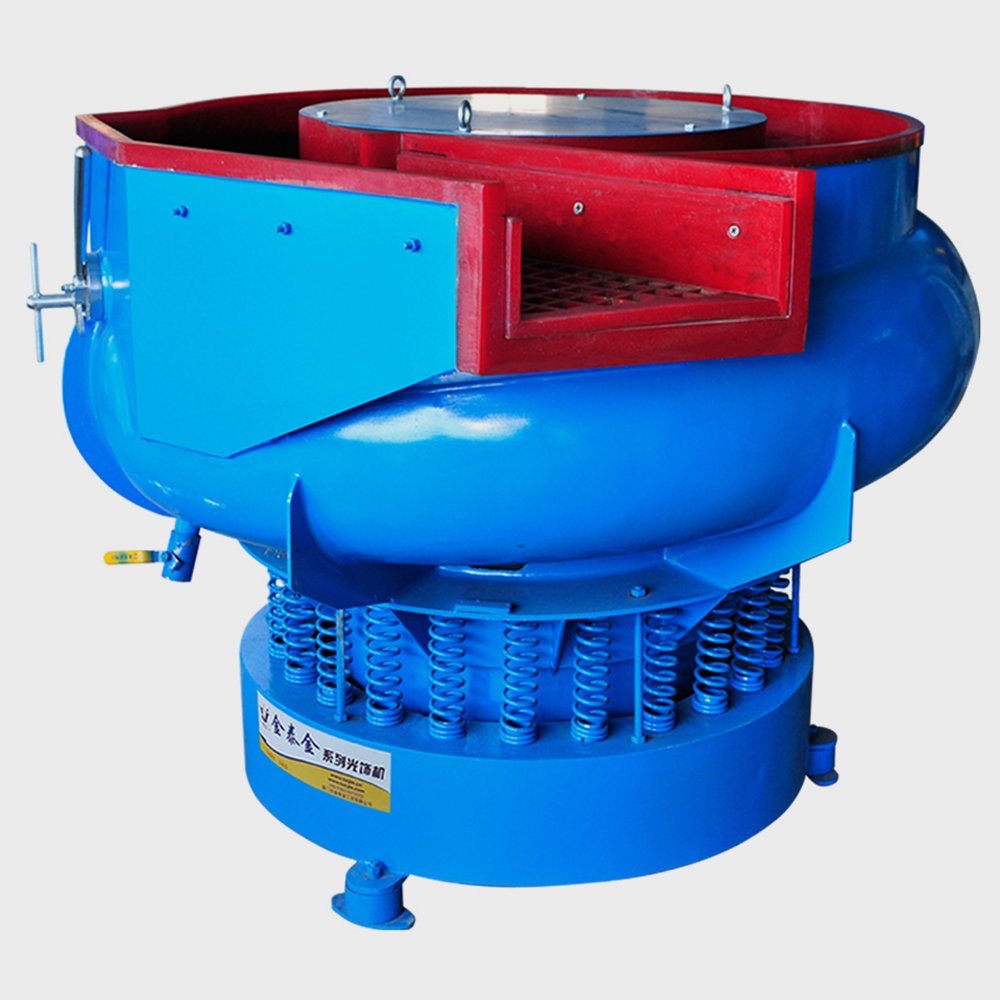
| Vibratory finishing machine (bowl) | General deburring and refinement of valve bodies, flange plates, pump components and fittings that fit the bowl and can move freely in the charge | No access to deep internal passages, constant part-on-part contact, and finished faces need separation or fixture protection |
Match media hardness and density to the workpiece, not to the finish someone wants to see. A heavy-cut ceramic cuts carbon and stainless steel edges and also cuts them quickly, which is useful for a thick Poisson burr on a flange and risky on a soft aluminium housing where the same charge peens and smears the surface. Plastic media gives up cut rate to stay gentle on soft alloys and thin sections, and steel media changes the mechanism: instead of cutting, it burnishes and can work-harden a surface. Alumina-bearing or grinding media sit at the aggressive end and suit robust, hard parts with generous edge limits. The decision is a three-way match between part hardness, burr root thickness and the tightest edge allowance. Where a hard body carries a delicate machined land, two stages beat one harder charge.
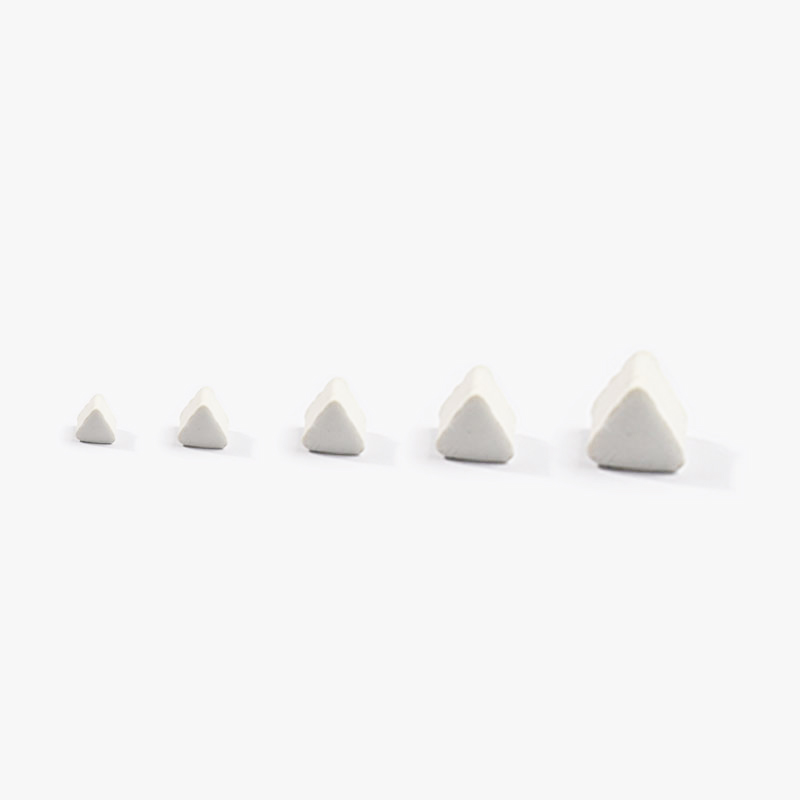
| Media | Best fit | Watch out for |
|---|---|---|
| Plastic media triangles and pyramids in a soft to medium grade | Deburring aluminium, brass and other soft or thin-walled parts where surface marking and edge rounding must stay minimal | Slow cut rate, media deforms and wears out of shape, and a worn charge behaves noticeably differently from a fresh one |
| Heavy-cut ceramic, angle-cut triangles in a coarse size class | Removing a substantial or thick burr root from open external edges, flange corners, cast bosses and large tapped entries on steel and stainless parts | Cuts controlled edges and gasket lands as readily as burrs, leaves a coarse surface, and lodges in slots whose width approaches the media section |
| Magnetic pin or needle charge | Reaching small internal intersections, radial holes and thread entries on small precision parts such as spools, sleeves and drilled fittings | Limited by part size and shape, pins must be retrieved and inspected for breakage, and the result depends heavily on fixture and field design |
| Fine ceramic spheres or small porcelain shapes in a light size class | Refinement and edge blending after a cutting stage, and light deburring of small fittings, thread entries and tighter external geometry | Small sizes enter and retain in fine passages and cross-drillings, and the charge changes size and cut rate as it wears |
Edge rounding past the drawing limit is the quietest failure in this process, because the part usually looks better, not worse. A blended edge photographs cleanly, passes a visual check and still fails the function it was specified for: a seat land that no longer seals across its designed contact band, a thread entry that loses its lead, a knife edge on a heat-exchanger plate that no longer crimps or seals. The change is cumulative, so a cycle that rounds an edge by an acceptable amount on the first part may take it past the limit on the twentieth. Catch it by measuring a defined edge feature before and after with a radius gauge, an optical comparator or a moulded replica, and by writing a maximum radius at each controlled edge.
| Failure mode | Likely cause | How to catch it |
|---|---|---|
| Tenacious compound film or reaction residue left in a gasket groove, thread or blind hole | A film-forming or silicate-bearing compound, insufficient rinse volume or temperature, or drying the part before it is genuinely clean | Wipe a defined area with solvent against a clean reference, check for a continuous water film on a rinsed sample, and inspect recessed features at magnification before packing |
| Burr still present on an internal cross-drilling intersection after finishing | No credible access route for the charge, a medium too large to enter the passage, or a cycle too short for the intersection to see enough contact | Borescope the intersection at the agreed angle on sample parts, section one representative part to expose the wall, and compare against the recorded as-received condition |
| Loss of flatness or a dimensional shift on thin plates, thin walls and long unsupported sections | Part-on-part impacts and fixture pressure in a high-energy route, too high a load ratio, or insufficient support along a slender part | Check flatness on a surface plate or a coordinate measuring machine at marked points before and after finishing, and check the same points across parts from different load positions |
| Thread entry deformation, a damaged lead thread or a burr folded into the first threads | Aggressive media at an unprotected thread entry, media lodging in the thread and working against it, or handling damage at load and unload | Run a go and no-go thread gauge on every tapped feature in the sample, inspect the first threads under magnification, and check the entry chamfer against the drawing |
Glasgow is Scotland's largest city, with a metropolitan region of 1.85 million people that Invest Glasgow records as generating £48bn GVA, and the Glasgow City Region accounts for around a third of Scotland's output, business base, research power and employment. Invest Glasgow lists clinical life sciences and biotechnology, energy and green transition, space and satellite technology, and advanced manufacturing and precision engineering among the city region's key clusters. ADS Scotland, established in 2005, reports that the aerospace, defence, security and space industries add £3.7 billion to the Scottish economy, employ 36,900 people and reached £9 billion of turnover, and its Scotland Council includes BAE Systems, Rolls-Royce, Leonardo, Thales, GE Aerospace and Babcock International.
For this brief the relevant part of that base is energy: Invest Glasgow lists 'Energy and Green Transition' as a key cluster of the Glasgow City Region, and Peel Ports' Clydeport operates Hunterston PARC, which it reports is being developed as a key player in the offshore market.
Glasgow's combination of precision engineering, an aerospace supply chain and clinical life-sciences work means machined and formed parts usually carry defined edge and surface acceptance criteria, and those are set by the customer's specification rather than by a local process convention. Clydeport's container, project and bulk cargo handling gives the city region an established route for importing finishing machines, media and compounds, with two new £25m ship-to-shore cranes at Greenock Ocean Terminal operational from autumn 2024.
A Glasgow buyer should decide early whether the part is aerospace or defence supply-chain work - where edge and surface criteria come from the prime contractor's specification - or general precision engineering, because that determines the documentation and the process route the finishing cell has to support.
Freight context: Clydeport (Peel Ports): Greenock Ocean Terminal, King George V Dock and the River Clyde network, Eurocentral (new 353,000 sq ft industrial space under a forward-funding agreement, reported by Glasgow Chamber of Commerce). Peel Ports states that Clydeport handles more than 15.4 million tonnes of cargo a year and has invested £25m in two new ship-to-shore cranes at Greenock Ocean Terminal to accommodate increased demand and support growth in transatlantic trade; the Glasgow Chamber of Commerce is the city's business body and reports industrial development at Eurocentral.
English is the working language of contracts, drawings and conformity paperwork, so quotations, technical files and Declarations of Conformity should be supplied in English. UK manufacturers have now recovered above 2019 output levels in every English region and devolved nation except Northern Ireland, and the sector is concentrated in food and drink and transport equipment, with the North West the largest manufacturing region by total output. Buyers typically expect the UKCA/CE route, a Declaration of Conformity and a UK-established economic operator to be identified before order, and they need commercial invoices, customs declarations and the C79 retained in a form their finance team can use for import VAT recovery. No source verified in this research establishes a mandated payment instrument, so payment structure should be treated as commercial negotiation rather than a regulatory requirement.
China does not appear in the alphabetical list of trade agreements in effect published by the Department for Business and Trade, so Chinese-origin machinery imported into the UK cannot claim a preferential agreement rate. Duty is instead determined by the commodity code declared on the import declaration, and the UK's customs authority is HM Revenue and Customs (HMRC), which ONS also names as the largest single data source behind UK trade-in-goods statistics. Because a GB-prefixed EORI number is a precondition for importing into England, Scotland or Wales, a Chinese seller's UK buyer must already hold that registration before any machine ships.
SurfacePolish supplies from Xiamen, China. The buyer's own destination rules, conformity marking, tariff classification and documentation responsibilities stay with the buyer; confirm them against the authorities named above before ordering.
A sampling plan for mass-finished parts has to survive two kinds of variation: variation across the batch and drift over the life of the charge. Within a batch, parts at the top of a load, parts that sat in a shielded pocket and parts nearest the machine wall may not match. Across a charge life, the twentieth run with the same media behaves differently from the first. Define the sample size, the frequency, which features are checked on each sample and which checks are destructive. Deliberately include the tightest passage, the thinnest wall and the most protected edge, and take samples from the first and last part of a run as well as from the middle. Hold the first accepted part as the reference.
Results from a small trial machine do not transfer linearly to a production machine. A larger bowl, a longer tub or a bigger barrel changes the energy per part, the path a part travels and the ratio of media to part mass. Cycle time is not a simple scale factor: doubling the load does not double the time, and running the same time in a larger machine usually removes more material from the edges than expected. The load ratio, the media-to-part volume, the compound flow per unit of charge and the unloading method all shift. Treat scale-up as its own first-article exercise on the production machine, stepping up in load while checking the same features. A trial result is a direction to test at scale.

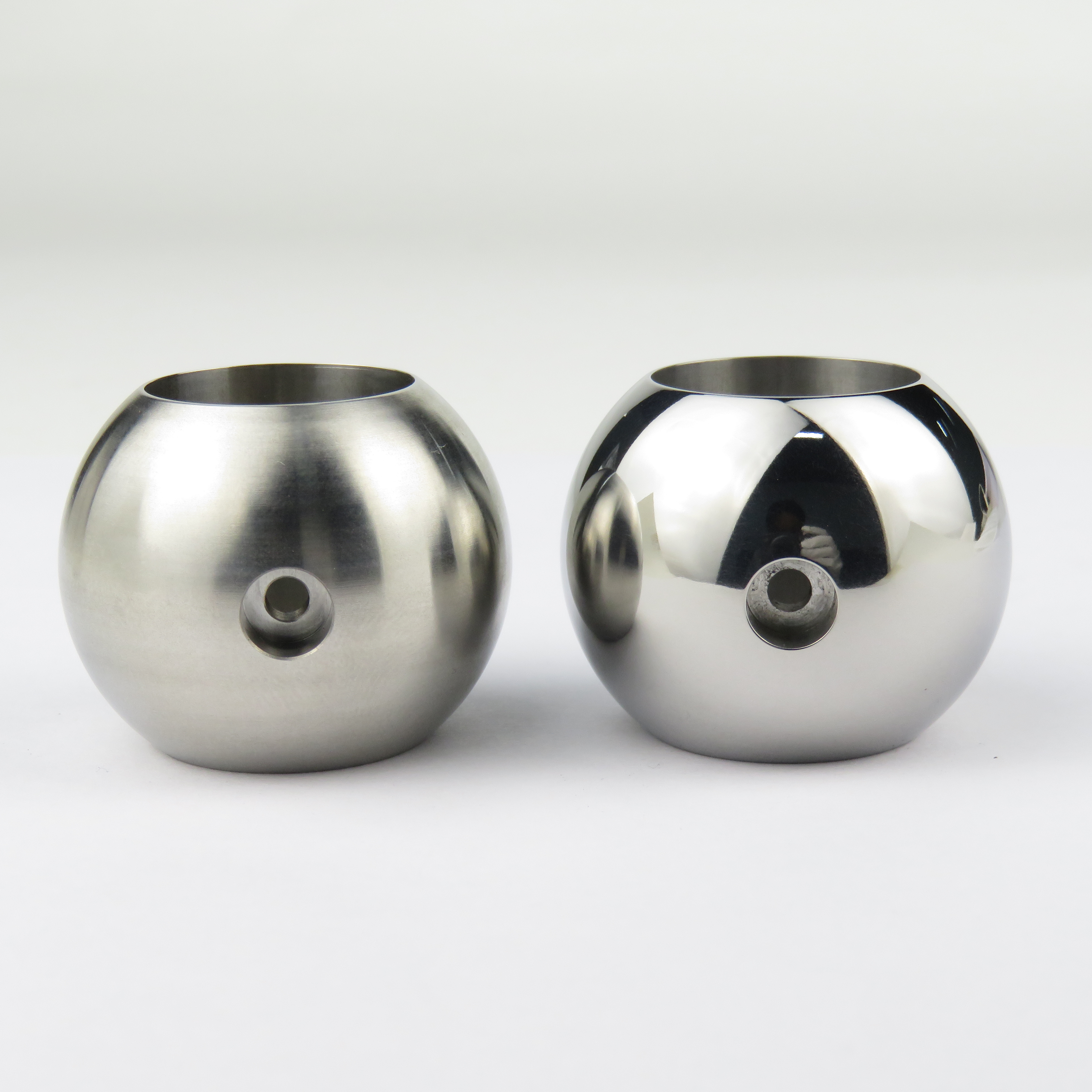
Both positions are used, and the choice follows the burr and the edge requirement. Deburring before hardening removes the machining burr while the material is still soft and the charge cuts predictably, but hardening can then introduce scale and slight distortion, and edges may need a light blend afterwards. Deburring only after the final thermal step keeps every edge operation in one place and works on the finished metallurgical state, at the cost of a harder material that cuts more slowly and a risk of brittle edge chipping. Discuss the sequence with the heat treater and the process engineer, and record the condition the part arrives in for finishing.
They can be run in the same equipment, but not safely in the same charge without a cleaning discipline. Carbon steel and cast iron leave fines and graphite that transfer to stainless parts, show up as rust staining or embedded particles, and are difficult to see at the machine. The practical approach is a dedicated charge per material family where volume allows, or a purge between families: run the machine with media and clean compound, flush the rinse tank, change or clean the drying medium and cloths, and inspect the media for embedded ferrous fines. Tell the finishing route which families will alternate, because changeover time is a real cost.
Size the charge well below the smallest opening it could enter, and treat every passage as a retrieval point rather than assuming it stays clear. List the tightest hole, slot, thread and cross-drilling first, then choose a size class against that geometry instead of the average part. Screen the working charge, because fractured media produces smaller pieces that defeat the original sizing. Plan detection: a borescope at an agreed angle, a pin gauge in every tapped hole, a count of the charge in and out where practical, a flush collected through a filter, and a part mass check. For Glasgow buyers preparing a trial, include the smallest passage.
Use Glasgow, United Kingdom as the destination on the enquiry and state whether the deliverable is equipment, media and compound, a representative sample review or a line concept. A destination does not imply local stock, a local service point or a local delivery time.
UKCA or CE marking with a Declaration of Conformity applies to machinery placed on the Great Britain market, HSE's work equipment and machinery and COSHH regimes cover operation and hazardous substances, and Scotland's aerospace and defence buyers normally receive quality and assurance requirements flowed down from primes such as those represented on the ADS Scotland Council.
Sources were retrieved on 2026-09-29 and describe the local industrial and trade context only. They do not evidence any SurfacePolish project, shipment, installation or service in Glasgow.
The buyer must remove machining burrs at the bore edges and gallery entries while dealing with graphite smearing and fine cast-iron dust in the charge.
Send the material, dimensions, approximate weight, batch quantity, the incoming condition and photographs of the difficult features. Mark which features must not be contacted by media and state how the result will be inspected. This form carries source reference PSEO-0268; quote it if you prefer an additional manual reference.
Open the SurfacePolish enquiry form Email a prepared enquiry
No price, lead time, certification or result is promised here. Confirm whether a sample trial is available for the specific part and what the trial can and cannot show.
Page PSEO-0268 · revised 2026-09-29 · cross-border equipment, media and scoped sample review. City context is sourced and cited above.
Use this local checker to identify missing part and inspection information. It prepares a technical-review brief; it does not approve a machine, process recipe or production result.
Complete the part details to prepare a review brief.
Email : info@surface-polish.com


 IPv6 network supported


 +86-592-2381506