A buyer in Hamilton, Canada in energy equipment has a cast stainless pump housing where the machined bore lip, split flange gasket face and drain port need deburring while the as-cast texture stays as specified. SurfacePolish supplies finishing machines, media and compounds across borders, and a free sample trial sends representative parts to Xiamen and returns them with an observation record and a proposed media, compound and cycle direction. This brief is written for a buyer in Hamilton working on energy equipment; it describes equipment, media and a scoped sample review, not a local polishing service.
Is deburring done before or after heat treatment, and in what metallurgical and surface condition does the part arrive at the finishing step?
Which material families and heat-treatment states share the equipment, and what separation is needed to avoid ferrous or graphite carry-over onto stainless parts?
Does the drawing state an edge break or an edge round at each controlled edge, and what maximum radius applies where over-rounding is the risk?
Deburring specifications fail more often on the incoming condition than on the finishing parameters. Two machining suppliers can deliver the same part number with visibly different burr height, edge sharpness, tool marks and trapped chips, because feed, tool wear and coolant strategy differ. A cycle that clears one supplier's burr may leave the other's root attached. Before writing any requirement, record what arrives: where the burrs sit, how tall they are, how sharp the edges are, the roughness at named points and the mass of the part. Keep one as-received reject in the sample set so the route is tested against the worst credible input rather than an average one. When the requirement is written, state the starting condition it assumes.
Match media hardness and density to the workpiece, not to the finish someone wants to see. A heavy-cut ceramic cuts carbon and stainless steel edges and also cuts them quickly, which is useful for a thick Poisson burr on a flange and risky on a soft aluminium housing where the same charge peens and smears the surface. Plastic media gives up cut rate to stay gentle on soft alloys and thin sections, and steel media changes the mechanism: instead of cutting, it burnishes and can work-harden a surface. Alumina-bearing or grinding media sit at the aggressive end and suit robust, hard parts with generous edge limits. The decision is a three-way match between part hardness, burr root thickness and the tightest edge allowance. Where a hard body carries a delicate machined land, two stages beat one harder charge.
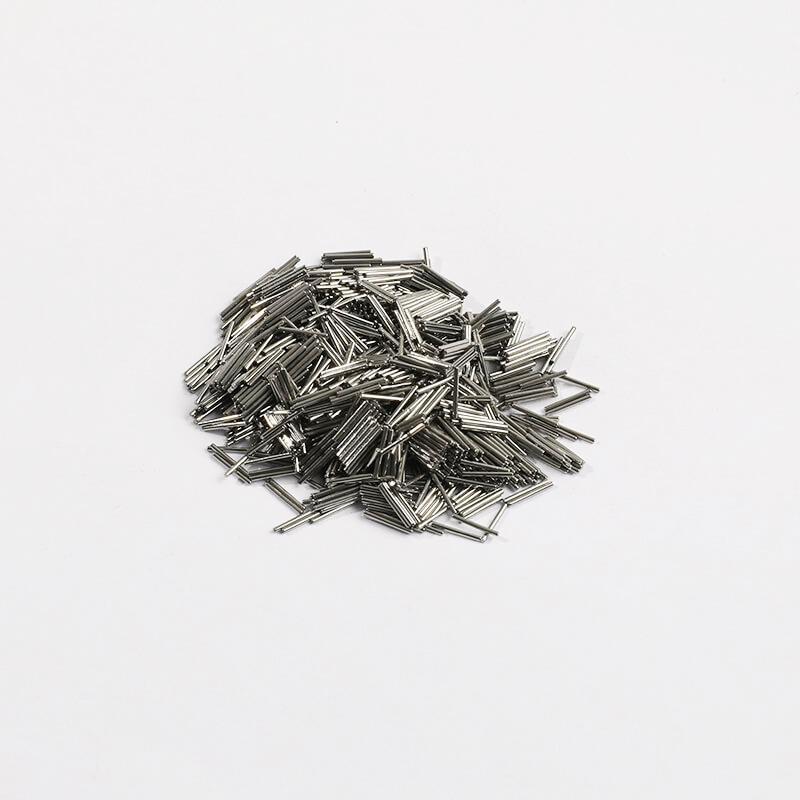
| Media | Best fit | Watch out for |
|---|---|---|
| Hardened steel media, balls and pins | Burnishing and bright finishing of stainless and hardened parts, and light edge consolidation where a cutting action is not wanted | Changes the surface by deformation rather than cutting, can work-harden or smear a soft surface, and needs corrosion protection and separation from acidic compounds |
| Alumina-bearing grinding media in a dense ceramic bond | Heavy stock removal and consistent cutting on hard or work-hardened parts with generous edge limits, such as robust flanges and heavy fittings | High removal energy rounds functional edges quickly and is a poor match for thin plates, thin-wall castings and lapped sealing faces |
| Dry media, corn cob granules with a polishing compound | Final dry polish, light edge blending and drying after a wet stage on small parts and fittings | Almost no cutting action, absorbs compound and contaminates quickly, and must be kept separate per material family to avoid carry-over |
| Heavy-cut ceramic, angle-cut triangles in a coarse size class | Removing a substantial or thick burr root from open external edges, flange corners, cast bosses and large tapped entries on steel and stainless parts | Cuts controlled edges and gasket lands as readily as burrs, leaves a coarse surface, and lodges in slots whose width approaches the media section |
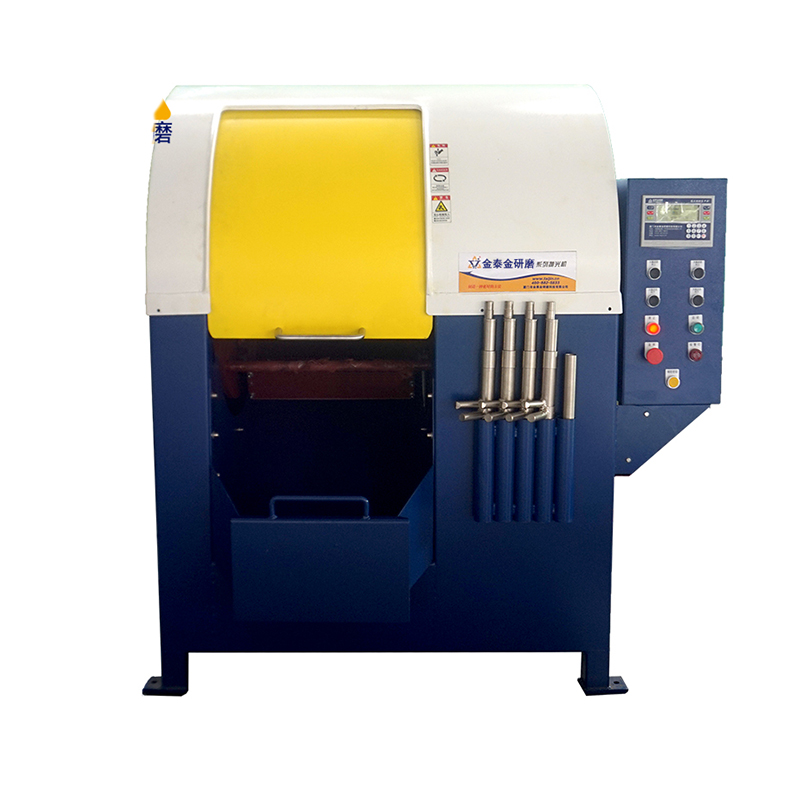
High-pressure routes, disc machines, grinding finishing machines and centrifugal barrels, earn their place when a heavy burr or a large batch makes the gentle options impractical. The trade is paid in three currencies. Edge rounding accelerates, so controlled edges need masking, orientation control or a shorter cycle. Distortion risk rises on thin walls, thin plates and unsupported sections, because the same pressure that cuts a burr can also move material. And the charge has to be balanced: centrifugal barrels in particular need an even barrel weight and a planned stop time, or the load shifts and results vary between barrels. Ask whether the part family has enough edge tolerance and section stiffness to absorb that energy. If it does not, the gentler route usually costs less overall.
| Machine route | Where it fits | What it will not do |
|---|---|---|
| Barrel finishing machine and rotary barrel tumbler | Gentle, low-impingement deburring of small, fragile or precision parts and mixed fitting batches where edge protection matters more than speed | Long cycles, no visibility while the barrel runs, and internal features can collect media and compound that must be retrieved at unload |
| Disc finishing machine | Fast, high-energy cycles on small to medium robust parts, including batches of fittings and small housings that need a quick cut | High contact pressure rounds edges quickly and can mark or deform thin and soft parts, with results sensitive to load and disc condition |
| Grinding finishing machine | Heavier stock removal and thick burr roots on robust parts where clearing material in a shorter cycle matters more than the surface result | Aggressive edge rounding and a coarser surface, so it fits lapped seats, thin sections and tight edge bands poorly |
| Vibratory finishing machine (bowl) | General deburring and refinement of valve bodies, flange plates, pump components and fittings that fit the bowl and can move freely in the charge | No access to deep internal passages, constant part-on-part contact, and finished faces need separation or fixture protection |
A burr can be bent flat instead of removed, and a bent burr is more dangerous than an obvious one. Light contact rolls a thin lip over the edge and blends it into the surface; under a bench light the edge looks finished, while the root is still attached and now forms a thin flag that can fatigue or break off in service. This is a particular risk on ductile materials, on thread entries, and on edges that were only lightly touched by a refinement pass. Visual inspection alone will not reliably separate a removed burr from a folded one. Use a tactile check with a probe or a lint-free wipe drawn along the edge, look at the edge at magnification under angled light, and take a sectioned or replica sample where the feature is critical.
| Failure mode | Likely cause | How to catch it |
|---|---|---|
| Uneven result across a batch, with over-finished edges in one zone and untouched areas in another | Part position in the charge, shielding by fixtures or other parts, a worn charge that cuts differently from a fresh one, or masking that leaked | Mark fixed measurement and inspection points on several parts, compare parts from the top, middle and bottom of the load, and record charge age against the result |
| Ferrous specking, rust staining or graphite smearing on stainless parts after a shared run | Carbon steel or cast iron fines carried over in the charge, machine, rinse tank or drying cloth, or a purge that was too short between material families | Compare against a retained reference part, inspect suspect areas at magnification, examine the charge and rinse for embedded ferrous fines, and review the changeover record against the batch history |
| Tenacious compound film or reaction residue left in a gasket groove, thread or blind hole | A film-forming or silicate-bearing compound, insufficient rinse volume or temperature, or drying the part before it is genuinely clean | Wipe a defined area with solvent against a clean reference, check for a continuous water film on a rinsed sample, and inspect recessed features at magnification before packing |
| Staining, pitting or a corrosion question on a hardened high-strength part after a wet cycle | Acid-bearing compound or contaminated rinse water, long dwell between finishing and drying, or no protective rinse for the interval before the buyer's next operation | Inspect within an agreed interval after drying, wipe a defined area with a white cloth, compare against a retained reference, and route any embrittlement question to whoever owns the downstream coating or plating specification |
Hamilton is Ontario's steel city, and the federal government describes its industrial base in those terms: the region plays a critical role in Ontario's economy, "supported by a diverse industrial base that includes advanced manufacturing, automation technologies, steel production, packaging solutions, and specialized industrial equipment". In August 2026, FedDev Ontario announced a combined investment of over CAD 12.5 million for nine Hamilton-area businesses responding to tariff-related pressures, and the backgrounder names the actual mix: custom robotic welding systems and CNC machining, steel fabrication of pressure equipment, hot-rolled steel bar production, prefabricated steel buildings, grease cartridges and industrial packaging, high-performance technical textiles for aviation, rail, defence and medical markets, and high-efficiency heating equipment. The national steel industry association frames the wider context, reporting over 40 producing facilities across Canada and a CAD 4.2 billion contribution to GDP from Canadian steel producers, and listing ArcelorMittal among its members. Automation is not incidental here — one of the funded Hamilton-area firms, Automation Design and Installation Inc., designs and manufactures custom robotic welding systems and automation solutions and is expanding into the mining and nuclear sectors.
The nearest part of that base to this brief is aerospace: Hamilton-based FELLFAB Limited, founded in 1952, is described in the federal backgrounder as an advanced manufacturer of high-performance products using specialized textiles for the aviation, rail, defence, industrial and medical sectors, and received CAD 600,000 toward a CAD 2.16 million modernisation project.
Hamilton's steel and heavy-fabrication base produces rolled bar, pressure equipment, welded structures and machined components where scale, edge condition and coating preparation are recurring production issues: mill scale and oxide on hot-rolled product, weld spatter and heat-tint on fabricated stainless, and burrs on cut and machined edges. Pressure-equipment fabrication adds a code-driven requirement, because a ground or dressed weld and a clean base metal surface are part of what the fabricator's quality system has to demonstrate. The robotics and automation cluster is a second, distinct driver: custom welding and machining cells are built to run unattended, which raises the value of a deburring or finishing step that is equally repeatable and not dependent on an operator standing at the machine.
A Hamilton buyer should settle whether the finishing step exists to meet a code or customer surface requirement or simply to prepare a surface for coating, because the first case requires documented, inspectable results and the second is a cost-and-throughput decision; conflating the two usually produces either an over-specified machine or an audit finding. The second question is how the finishing step will be loaded and unloaded inside a fabrication shop that is already organised around heavy lifts and long cycle times, since material handling, not the finishing process itself, is where most of the labour and the safety risk sits in heavy fabrication.
Freight context: Port of Hamilton (Hamilton-Oshawa Port Authority), John C. Munro Hamilton International Airport, CN and CPKC rail corridors, Great Lakes / St. Lawrence Seaway marine corridor. Hamilton combines a Great Lakes seaport with an international airport and direct Class 1 rail service, which is what allows heavy steel and fabricated industrial equipment to move in and out by water and rail rather than only by road. The Hamilton Chamber of Commerce, one of the oldest in Canada, also issues certificates of origin and maintains a tariff and trade resource hub, reflecting how much of the local manufacturing base is export-facing.
Canada's national standards system is coordinated by the Standards Council of Canada (SCC), which accredits standards-development organizations, certification bodies and testing laboratories; the SCC and CSA Group websites could not be retrieved for citation during this research, so this entry rests on the accessible Government of Canada and CCOHS material below. The Canadian Centre for Occupational Health and Safety describes standards as documents that "establish specifications and procedures to ensure the reliability of the products, methods, and services people use every day on the job", and Innovation, Science and Economic Development Canada (ISED) maintains the federal entry point for "[t]he different types of standards and certifying bodies that can be used by your business". In practice a Canadian buyer of finishing equipment references (a) the Canadian electrical safety certification of the machine and its control panel, (b) provincial occupational health and safety regulation for machine guarding, lockout and dust/ventilation control, which in Canada is enforced by the provinces rather than by a single federal inspectorate, and (c) the buyer's own customer-specific surface finish, edge-condition and cleanliness specifications, which are contractual rather than national standards. Finishing-process standards in the ISO 25.080 machine-tool and ISO 8500-series surface-preparation families are the usual technical reference points, but product-level standards sold by CSA Group were not retrievable for verification here.
The customs authority is the Canada Border Services Agency (CBSA), and importers of commercial goods must work through the CBSA Assessment and Revenue Management (CARM) system, which is where registration, the duties-and-taxes calculator, advance rulings and national customs rulings, and the commercial accounting declaration (CAD) are handled. Documentation expectations are explicit: "You must provide proof of country of origin when you import goods into Canada and, in some cases, your goods must also be clearly marked", the invoice or sales receipt must carry "a complete description of the goods", "the selling price" and "any conditions and terms of the sale", and the value for duty must be declared in Canadian currency only. Duties and taxes are layered rather than single: customs duty on the tariff item, the Goods and Services Tax calculated on the duty-paid value, and potentially excise duty, excise tax, surtax or safeguard measures. Importers must also clear non-tariff gates: goods must be admissible, some goods need permits, certificates or inspections from other federal departments that the CBSA applies on their behalf, controlled goods under the Defence Production Act require consultation with the CBSA and Global Affairs Canada before import, and "Goods manufactured or produced wholly or in part by forced or prison labour are prohibited from entering Canada", with due diligence resting on the importer. For electrical machinery, the practical conformity route in Canada is certification of the product to Canadian electrical safety standards by an accredited certification body rather than a self-declared CE-style mark; buyers should confirm the specific certification body and mark required before shipment. For a first shipment of a finishing machine or a media/compound sample lot, the fastest way to remove classification and valuation uncertainty is to use the CARM portal to request an advance ruling for tariff classification and origin.
SurfacePolish supplies from Xiamen, China. The buyer's own destination rules, conformity marking, tariff classification and documentation responsibilities stay with the buyer; confirm them against the authorities named above before ordering.
Dimensional and visual checks do not prove a part functions, so acceptance should include the functional checks that matter to the assembly. Depending on the part, that may be a fit check of a mating component, a passage-clearance check, a seal or leak test, a torque check on a tapped feature, or a check that a coating or weld will take on the finished surface. Cleanliness is a separate acceptance axis with its own method: a borescope or mirror check of internal passages, a flush through a filter with the residue inspected against a limit, or a wipe test on a defined area. Define those limits on the buyer's side, because they depend on the service environment. Establish whether the process leaves a condition that traps penetrant.
A sample trial reports what happened to the parts that were tested under the settings that were used. It cannot establish capability across other heats, casting lots or machining sources; it cannot demonstrate uniformity across a full production charge, because a trial load is small; and it cannot show how the process behaves after a charge has worn, how a coating or weld will take to the finished surface, how the part will behave in a corrosive or high-cycle service environment, or whether any cleanliness, hydrogen or regulatory requirement is met. Those questions belong to the buyer's own qualification. Close the gap deliberately: define a verification batch on production equipment, decide how many charges will be monitored, and state in advance what result would stop the route.
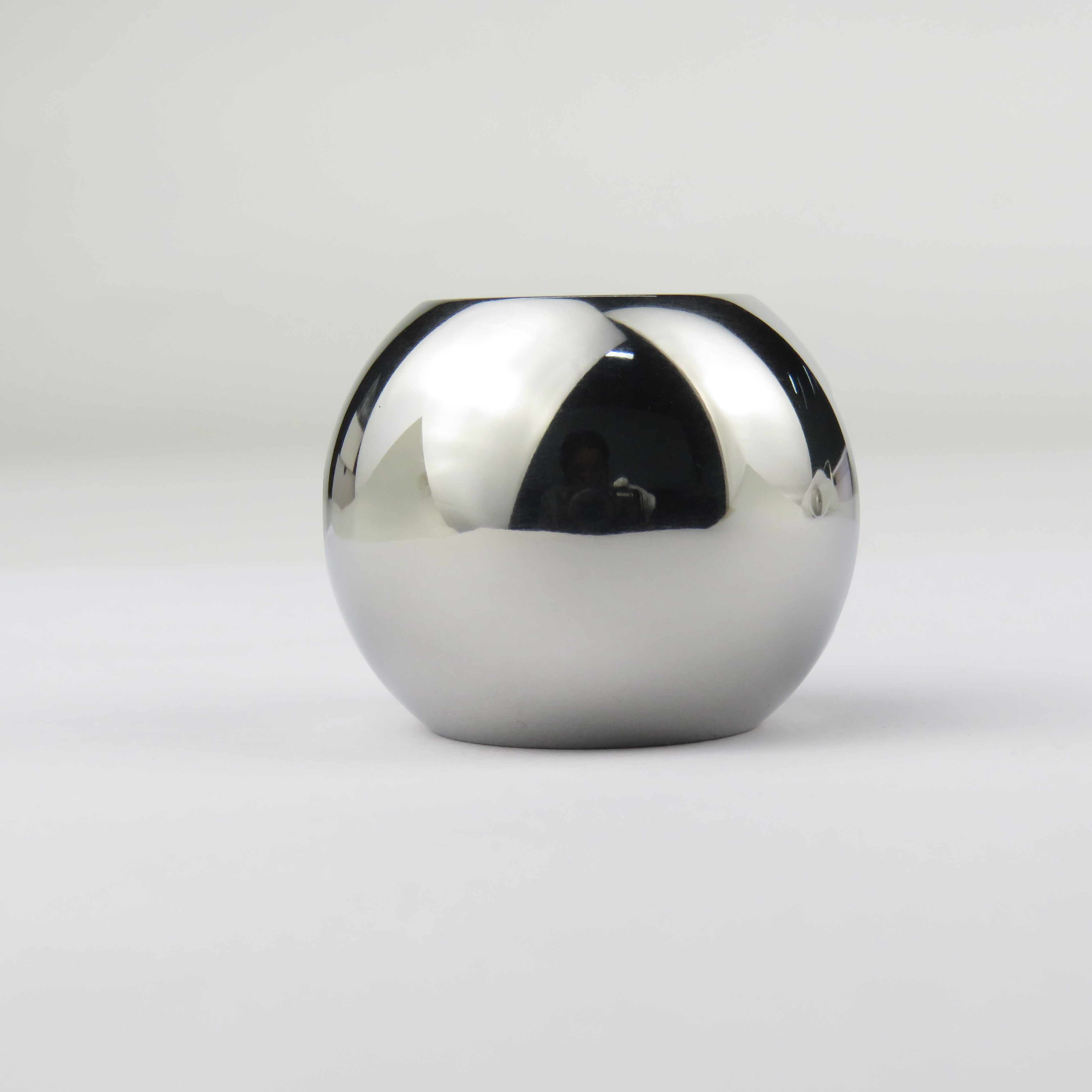
An edge break means the sharp corner is removed, usually to a small defined size, and the intent is that no sharp edge or wire edge remains. An edge round means the edge is held inside a controlled radius band, often with both a minimum and a maximum, because the function depends on the contour, for example where a seal seats or a coating must cover the edge uniformly. Specifying only the word deburr leaves the size open, and mass finishing rounds every edge in proportion to the energy used. For each controlled edge, state which of the two applies, the size or band, and how it will be measured.
They can be run in the same equipment, but not safely in the same charge without a cleaning discipline. Carbon steel and cast iron leave fines and graphite that transfer to stainless parts, show up as rust staining or embedded particles, and are difficult to see at the machine. The practical approach is a dedicated charge per material family where volume allows, or a purge between families: run the machine with media and clean compound, flush the rinse tank, change or clean the drying medium and cloths, and inspect the media for embedded ferrous fines. Tell the finishing route which families will alternate, because changeover time is a real cost.
No. A trial reports what was observed on the parts that were sent, under the settings that were used on the machine that ran them. It does not establish what will happen across other heats, casting lots, machining sources or a full production charge, and it does not demonstrate how the process behaves once the media has worn. Treat the returned parts and the observation record as a direction to test at production scale. The next step is a production-representative batch on the machine the buyer will use, with the buyer's own first-article discipline, agreed sampling and the features that matter measured against the recorded baseline.
Use Hamilton, Canada as the destination on the enquiry and state whether the deliverable is equipment, media and compound, a representative sample review or a line concept. A destination does not imply local stock, a local service point or a local delivery time.
A Hamilton fabricator normally works to the material and fabrication standards named on the customer's drawing, the welding and pressure-equipment code applicable to the vessel or structure being built, and the customer's coating or surface-preparation specification. Plant-side requirements come from Ontario occupational health and safety regulation, including guarding, lockout and welding fume control, and equipment must carry Canadian electrical safety certification.
Sources were retrieved on 2026-09-29 and describe the local industrial and trade context only. They do not evidence any SurfacePolish project, shipment, installation or service in Hamilton.
The buyer wants the machining burrs at the bore lip, split flange gasket face and drain port removed without polishing away the as-cast texture the specification protects.
Send the material, dimensions, approximate weight, batch quantity, the incoming condition and photographs of the difficult features. Mark which features must not be contacted by media and state how the result will be inspected. This form carries source reference PSEO-0168; quote it if you prefer an additional manual reference.
Open the SurfacePolish enquiry form Email a prepared enquiry
No price, lead time, certification or result is promised here. Confirm whether a sample trial is available for the specific part and what the trial can and cannot show.
Page PSEO-0168 · revised 2026-09-29 · cross-border equipment, media and scoped sample review. City context is sourced and cited above.
Use this local checker to identify missing part and inspection information. It prepares a technical-review brief; it does not approve a machine, process recipe or production result.
Complete the part details to prepare a review brief.
Email : info@surface-polish.com


 IPv6 network supported


 +86-592-2381506