A buyer in Hyderabad, India working on energy equipment has a small hardened 17-4PH valve spool whose radial metering hole intersections need a controlled edge without touching the metering lands. SurfacePolish supplies finishing machines, media and compounds across borders and runs a free sample trial that returns representative parts from Xiamen with an observation record and a proposed media, compound and cycle direction. This brief is written for a buyer in Hyderabad working on energy equipment; it describes equipment, media and a scoped sample review, not a local polishing service.
What is the smallest internal passage, cross-drilling or tapped hole the charge must never plug, and how would a lodged medium be found and removed?
Which edges on this part are functional, such as gasket lands, seat bands, stem guides, metering lands and thread entries, and which only need to be free of a sharp edge?
Is deburring done before or after heat treatment, and in what metallurgical and surface condition does the part arrive at the finishing step?
Deburring sits in a sequence, and its position relative to heat treatment changes the job. Material in the soft, as-machined state tears and smears, so a burr on a low-carbon flange or an austenitic body tends to roll rather than fracture. The same feature in a hardened or precipitation-hardened condition behaves differently: edges chip, and the burr root can be brittle enough to flake rather than peel. Heat treatment also brings scale, a decarburised skin or a changed surface that has to be removed before any finish is meaningful. Decide whether the part is deburred before hardening and receives a light edge blend afterwards, or whether all edge work happens after the final thermal step. That decision belongs with the buyer's process engineer, because it moves the operation between departments and can change which features are accessible.
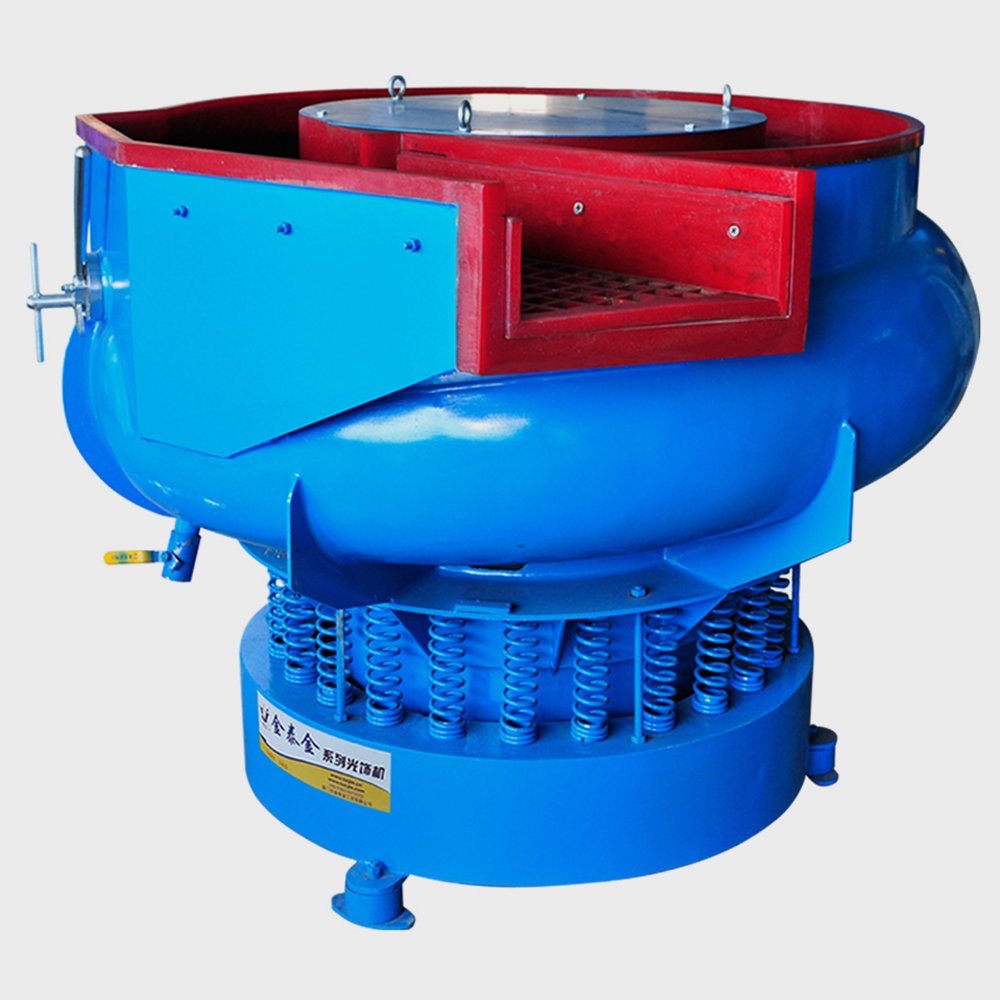
Geometry decides the machine frame before any setting does. A bowl vibrator needs the part to move freely in the charge; a long manifold body, a shaft or a stacked plate set cannot tumble that way and belongs in a tub where it can be carried, rotated or supported along its length. Mass matters as much as length: a heavy valve body sinks in a small charge and stalls the part-on-media motion, so either the charge grows or the machine size grows. Thin plates need the opposite treatment, a low load ratio and separation so they are not driven into each other. Before comparing machines, list the largest and smallest envelope in the batch, the heaviest single part, the longest unsupported span and any feature that cannot bear load. Those four numbers eliminate most of the catalogue.
| Machine route | Where it fits | What it will not do |
|---|---|---|
| Vibratory finishing machine (bowl) | General deburring and refinement of valve bodies, flange plates, pump components and fittings that fit the bowl and can move freely in the charge | No access to deep internal passages, constant part-on-part contact, and finished faces need separation or fixture protection |
| Tub vibrator | Long parts such as manifold rails, shafts, long housings and stacked plate sets that cannot tumble in a bowl, with support or rotation along their length | Lower energy per unit area so heavy burrs take longer, and the tub needs floor space plus a defined part support method |
| Disc finishing machine | Fast, high-energy cycles on small to medium robust parts, including batches of fittings and small housings that need a quick cut | High contact pressure rounds edges quickly and can mark or deform thin and soft parts, with results sensitive to load and disc condition |
| Barrel finishing machine and rotary barrel tumbler | Gentle, low-impingement deburring of small, fragile or precision parts and mixed fitting batches where edge protection matters more than speed | Long cycles, no visibility while the barrel runs, and internal features can collect media and compound that must be retrieved at unload |
A working charge is a consumable with a life curve, and most batch inconsistency is a media condition problem rather than a machine problem. Media wears down, changes size and shape, loses its cutting edge, and eventually fractures into smaller pieces and fines. As it wears, the cut rate falls and the finish improves, so a setting that was correct on a fresh charge drifts over a few hundred cycles. The charge mass also falls as media breaks, which changes the load ratio and the energy per part. Screen out broken pieces and fines, measure a sample against the size class originally specified, top up to a defined mass, and replace on a wear trigger rather than on appearance. Keep the media history with the batch record.
| Media | Best fit | Watch out for |
|---|---|---|
| Dry media, corn cob granules with a polishing compound | Final dry polish, light edge blending and drying after a wet stage on small parts and fittings | Almost no cutting action, absorbs compound and contaminates quickly, and must be kept separate per material family to avoid carry-over |
| Fine ceramic spheres or small porcelain shapes in a light size class | Refinement and edge blending after a cutting stage, and light deburring of small fittings, thread entries and tighter external geometry | Small sizes enter and retain in fine passages and cross-drillings, and the charge changes size and cut rate as it wears |
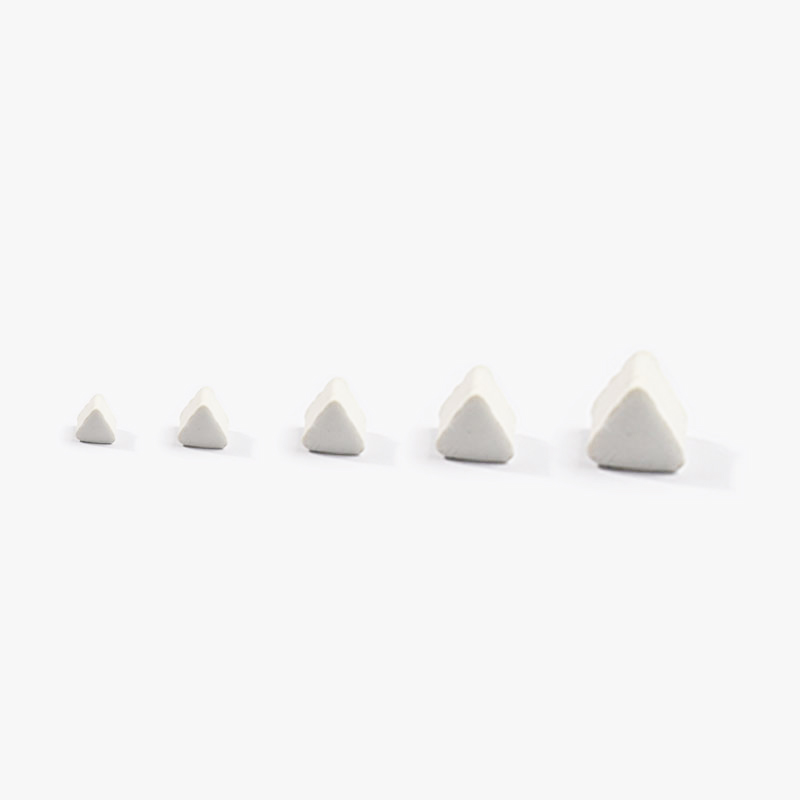
| Heavy-cut ceramic, angle-cut triangles in a coarse size class | Removing a substantial or thick burr root from open external edges, flange corners, cast bosses and large tapped entries on steel and stainless parts | Cuts controlled edges and gasket lands as readily as burrs, leaves a coarse surface, and lodges in slots whose width approaches the media section |
| Dry media, walnut shell with an abrasive or polishing compound | Light dry deburring, deflashing, drying and low-residue finishing of small parts and of features where a wet bath is difficult to remove | Low cutting energy so it cannot remove a substantial burr root, produces dust needing extraction, and consumption is high |
A burr can be bent flat instead of removed, and a bent burr is more dangerous than an obvious one. Light contact rolls a thin lip over the edge and blends it into the surface; under a bench light the edge looks finished, while the root is still attached and now forms a thin flag that can fatigue or break off in service. This is a particular risk on ductile materials, on thread entries, and on edges that were only lightly touched by a refinement pass. Visual inspection alone will not reliably separate a removed burr from a folded one. Use a tactile check with a probe or a lint-free wipe drawn along the edge, look at the edge at magnification under angled light, and take a sectioned or replica sample where the feature is critical.
| Failure mode | Likely cause | How to catch it |
|---|---|---|
| Part-on-part or fixture witness marks and peening on a finished face | Insufficient separation in the load, too high a load ratio for the part mass, sharp or worn fixture contact points, or the same faces bearing contact throughout the cycle | Inspect at magnification under angled light against a retained reference, map the mark positions against the load arrangement, and check fixtures and compartments for burrs and wear |
| Staining, pitting or a corrosion question on a hardened high-strength part after a wet cycle | Acid-bearing compound or contaminated rinse water, long dwell between finishing and drying, or no protective rinse for the interval before the buyer's next operation | Inspect within an agreed interval after drying, wipe a defined area with a white cloth, compare against a retained reference, and route any embrittlement question to whoever owns the downstream coating or plating specification |
| Loss of flatness or a dimensional shift on thin plates, thin walls and long unsupported sections | Part-on-part impacts and fixture pressure in a high-energy route, too high a load ratio, or insufficient support along a slender part | Check flatness on a surface plate or a coordinate measuring machine at marked points before and after finishing, and check the same points across parts from different load positions |
| Burr lip folded flat over the edge with the root still attached | Too light a cut for the burr thickness, a refinement-only pass used as the only stage, or a soft ductile material that rolls instead of fracturing | Draw a probe or lint-free wipe along the edge, examine at magnification under angled light, and take a sectioned or moulded replica sample where the feature is critical |
Hyderabad's industrial base combines pharmaceuticals and life sciences with aerospace and defence manufacturing and heavy electrical equipment. The city is the registered-office base of Aurobindo Pharma, an Indian generics manufacturer, and Telangana's apex chamber, the Federation of Telangana Chambers of Commerce and Industry (established 1917), runs its industry programmes at Federation House in the city. Tata Advanced Systems' Boeing joint venture delivered the 250th AH-64 Apache fuselage from its Hyderabad facility, which the company says employs over 900 engineers and technicians. BHEL keeps a dedicated R&D centre in Hyderabad and lists a Heavy Power Equipment Plant (HPEP) in the city.
The nearest part of that base to this brief is automation: The Tata-Boeing Hyderabad facility is described by Tata Advanced Systems as employing over 900 engineers and technicians and leveraging robotics and automation.
Hyderabad's mix of pharmaceutical equipment, aerospace structures and heavy electrical hardware puts deburring, edge quality and cleanliness on the production agenda: hygienic stainless components have to meet the equipment owner's cleaning and contamination requirements, while machined aerospace and power-equipment parts are checked for burrs and edge condition before assembly. Process selection also depends on whether media or compound residue can be fully removed from internal passages and crevices, which is a standard qualification question for safety-critical and hygienic parts.
Before choosing a finishing process, a Hyderabad buyer should settle whether acceptance is defined by edge condition on machined parts or by particulate and contamination cleanliness on hygienic stainless parts, and confirm on sample parts that the selected media and compound can be removed completely from the part's internal geometry.
Freight context: Hyderabad Begumpet Airport (Airports Authority of India). AAI maintains the Hyderabad airport page for Begumpet Airport and lists a cargo section. Imported machines and sample parts move under the standard Indian customs procedure — bill of entry and clearance at the airport or port of entry, or at an inland container depot — and notified products are checked for BIS compliance at import.
An Importer-Exporter Code (IEC) issued by DGFT is a key business identification number which is mandatory for exports or imports, and since the introduction of GST the IEC number is the same as the PAN of the firm (c6). The post-incorporation clearance list published by Invest India includes the IEC, a Customs- Special Valuation Branch reference and the grant of a Bureau of Indian Standards (BIS) licence, and it names the Central Board of Excise and Customs among the agencies in the framework (c10). The Foreign Trade Policy fixes the mandatory import documents as a bill of lading / airway bill / lorry receipt / railway receipt, a commercial invoice cum packing list and a bill of entry, with additional documents or NOCs possible for goods subject to product-specific compliance (c3); it also states that domestic laws, rules, orders, technical specifications and environmental, safety and health norms applicable to domestically produced goods apply mutatis mutandis to imports unless specifically exempted (c2), which is the basis on which a BIS quality-control order can bite on imported machinery. A landed-cost plan therefore needs the correct ITC(HS) classification and the basic customs duty and IGST that follow from it, plus the IEC, the bill of entry documentation and any BIS licence or registration obligation, and a related-party import can additionally be pulled into special customs valuation.
The Bureau of Indian Standards (BIS) describes itself as the National Standards Body of India and runs the country's product certification system, including products under compulsory certification, a foreign manufacturers certification scheme with nomination of an authorised Indian representative, and a registration scheme for manufacturers (c8, c9). Indian Standards (IS) issued by BIS are the reference texts Indian buyers write surface, coating and material specifications against, and BIS-recognised or BIS-empanelled laboratories are the test facilities used for certification work. Where a machine, media or compound falls under a BIS quality-control order, the licence or registration duty attaches to the product placed on the Indian market, so an overseas supplier should settle the applicable IS standard and the certification route before quoting.
SurfacePolish supplies from Xiamen, China. The buyer's own destination rules, conformity marking, tariff classification and documentation responsibilities stay with the buyer; confirm them against the authorities named above before ordering.
An acceptance record is only as strong as the chain behind it. A measured roughness or edge radius means little unless the record links the part to the batch, the batch to the charge, and the charge to the media type, size class, charge age, compound and settings used on that day. Request the settings record with the returned parts, plus the media and compound identification, the cycle count on the charge and the maintenance history. On the measuring side, know the calibration status of the instrument and the uncertainty attached to the value, because a reading quoted to two decimal places on an uncalibrated gauge is not evidence. Decide which records the buyer owns and which are requested from the supplier.
The value of a sample trial comes from the range of parts sent, not from the quantity. A box of identical nominal parts tests one geometry and one burr condition; it cannot show how the proposed route behaves on the tightest passage, the thinnest wall or the hardest material in the family. Send a small set chosen to cover the extremes: the part with the smallest internal opening, the part with the longest unsupported section, the part with the most protected edge, one part in the hardest heat-treatment state the family sees, and one as-received reject that already fails. Label every part so its identity survives the trip, and send enough pieces that some can be sectioned or measured destructively.

Use more than one method, because each misses something. Visual inspection under angled light at magnification catches obvious sharp edges, wire edges and remaining burr fragments. A tactile check with a probe, a fine needle or a lint-free wipe drawn along the edge catches lips that have been folded flat. A radius gauge, optical comparator or moulded replica gives an edge size, and a profilometer or surface roughness tester with a suitable cut-off and traversing direction gives a profile across the edge when the geometry allows it. Microscopy helps on small features and when documenting a dispute. Compare against a master agreed before the batch.
Protect it deliberately rather than relying on a gentle setting. Options include masking or plugging the face, fixturing the part so the land is held out of the mass, orienting the part so the land sees less contact, or choosing a media shape and size that blends rather than digs. Each has a cost: a masked face keeps its as-machined condition and can show a boundary line, a fixture shields the area behind it, and fixturing reduces how many parts fit in a load. Mark the land on the drawing, give it a maximum edge radius, and agree how it will be checked. Test the arrangement on the real part.
Size the charge well below the smallest opening it could enter, and treat every passage as a retrieval point rather than assuming it stays clear. List the tightest hole, slot, thread and cross-drilling first, then choose a size class against that geometry instead of the average part. Screen the working charge, because fractured media produces smaller pieces that defeat the original sizing. Plan detection: a borescope at an agreed angle, a pin gauge in every tapped hole, a count of the charge in and out where practical, a flush collected through a filter, and a part mass check. For Hyderabad buyers preparing a trial, include the smallest passage.
Use Hyderabad, India as the destination on the enquiry and state whether the deliverable is equipment, media and compound, a representative sample review or a line concept. A destination does not imply local stock, a local service point or a local delivery time.
India's national standards body is the Bureau of Indian Standards (BIS). Pharmaceutical and medical-device buyers in Hyderabad normally write finish, cleanliness and material requirements into their own equipment specifications and vendor qualification documents, on top of the applicable Indian Standards.
Sources were retrieved on 2026-09-29 and describe the local industrial and trade context only. They do not evidence any SurfacePolish project, shipment, installation or service in Hyderabad.
The buyer needs the radial hole intersections deburred to a controlled edge on a small precision part without touching the metering land diameters.
Send the material, dimensions, approximate weight, batch quantity, the incoming condition and photographs of the difficult features. Mark which features must not be contacted by media and state how the result will be inspected. This form carries source reference PSEO-0958; quote it if you prefer an additional manual reference.
Open the SurfacePolish enquiry form Email a prepared enquiry
No price, lead time, certification or result is promised here. Confirm whether a sample trial is available for the specific part and what the trial can and cannot show.
Page PSEO-0958 · revised 2026-09-29 · cross-border equipment, media and scoped sample review. City context is sourced and cited above.
Use this local checker to identify missing part and inspection information. It prepares a technical-review brief; it does not approve a machine, process recipe or production result.
Complete the part details to prepare a review brief.
Email : info@surface-polish.com


 IPv6 network supported


 +86-592-2381506