A buyer in Rome, Italy in energy equipment has a forged F316 weld-neck flange whose bore and bolt-hole entry burrs must be removed without disturbing the serrated raised face. SurfacePolish supplies finishing machines, media and compounds across borders and runs a free sample trial, returning representative parts from Xiamen with an observation record and a proposed media, compound and cycle direction. This brief is written for a buyer in Rome working on energy equipment; it describes equipment, media and a scoped sample review, not a local polishing service.
Which edges on this part are functional, such as gasket lands, seat bands, stem guides, metering lands and thread entries, and which only need to be free of a sharp edge?
What must the part be clean of, and what method and limit does the buyer use to verify cleanliness before assembly, welding, coating or a leak test?
Which material families and heat-treatment states share the equipment, and what separation is needed to avoid ferrous or graphite carry-over onto stainless parts?
Read the drawing surface by surface before any medium is discussed. On an energy-equipment part the surfaces that decide acceptance are rarely the largest: a raised-face gasket land, a valve seat bore, a stem guide diameter, a cross-drilling intersection, a thread entry and a locating spigot each behave differently under an abrasive charge. Separate them into surfaces that seal or locate, surfaces that only carry flow, and surfaces that are cosmetic. A pump housing and a manifold block may share a material grade and still need opposite treatment because one carries a machined gasket land and the other only drilled passages. Mark the protected list on the buyer's own drawing revision, then decide for each item whether it is masked, fixtured out of the mass, finished to a band, or left as-machined. That list also governs handling between operations.
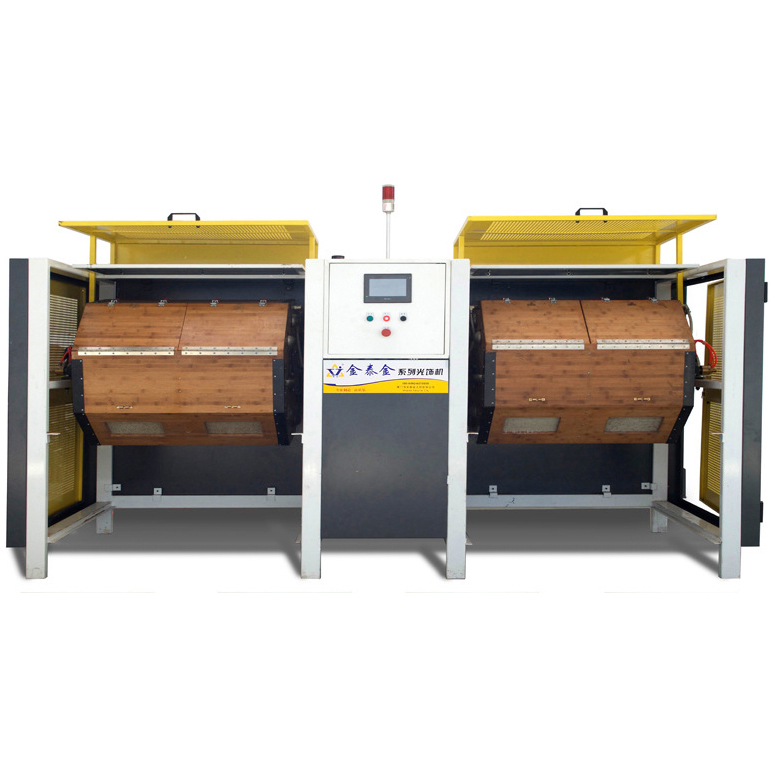
Route selection starts from the tightest edge limit on the drawing, then works backwards to the least energetic machine that can still remove the burr root in a workable cycle. Energy in mass finishing comes from relative motion and contact pressure, so a disc machine or a high-amplitude bowl cuts faster and rounds every edge in proportion. That is efficient where the edge requirement is generous and wasteful where a seat land or a thread entry must keep a defined break. A gentler barrel or tub route spends more time to buy back edge control. Ask what the drawing allows at each controlled edge, how much of the burr is root rather than lip, and whether the part can tolerate the longer cycle the gentler route needs.
| Machine route | Where it fits | What it will not do |
|---|---|---|
| Tub vibrator | Long parts such as manifold rails, shafts, long housings and stacked plate sets that cannot tumble in a bowl, with support or rotation along their length | Lower energy per unit area so heavy burrs take longer, and the tub needs floor space plus a defined part support method |
| Grinding finishing machine | Heavier stock removal and thick burr roots on robust parts where clearing material in a shorter cycle matters more than the surface result | Aggressive edge rounding and a coarser surface, so it fits lapped seats, thin sections and tight edge bands poorly |
| Disc finishing machine | Fast, high-energy cycles on small to medium robust parts, including batches of fittings and small housings that need a quick cut | High contact pressure rounds edges quickly and can mark or deform thin and soft parts, with results sensitive to load and disc condition |
| Vibratory finishing machine (bowl) | General deburring and refinement of valve bodies, flange plates, pump components and fittings that fit the bowl and can move freely in the charge | No access to deep internal passages, constant part-on-part contact, and finished faces need separation or fixture protection |
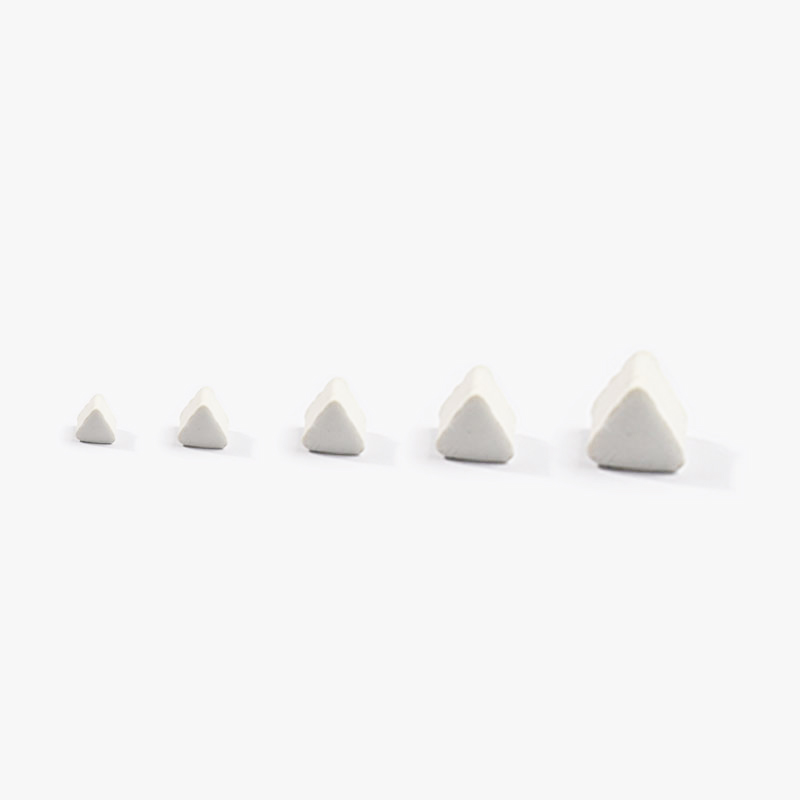
Shape and size class decide where the charge can go and how it cuts when it gets there. An angle-cut triangle presents a point and a sharp edge, so it works into a corner or a thread entry and cuts hard; a sphere rolls and makes softer, more uniform contact; a cylinder or oval lies along a face and blends rather than digs. Size then sets the access limit: the medium must be comfortably smaller than the smallest opening it is expected to clear, and comfortably larger than any opening it must never enter. Those two constraints are often only a size class apart, which is why thread entries, cross-drillings and slot widths need listing before a charge is ordered. Media that fractures in service defeats the original sizing, so screen the working charge.
| Media | Best fit | Watch out for |
|---|---|---|
| Dry media, walnut shell with an abrasive or polishing compound | Light dry deburring, deflashing, drying and low-residue finishing of small parts and of features where a wet bath is difficult to remove | Low cutting energy so it cannot remove a substantial burr root, produces dust needing extraction, and consumption is high |
| Alumina-bearing grinding media in a dense ceramic bond | Heavy stock removal and consistent cutting on hard or work-hardened parts with generous edge limits, such as robust flanges and heavy fittings | High removal energy rounds functional edges quickly and is a poor match for thin plates, thin-wall castings and lapped sealing faces |
| Hardened steel media, balls and pins | Burnishing and bright finishing of stainless and hardened parts, and light edge consolidation where a cutting action is not wanted | Changes the surface by deformation rather than cutting, can work-harden or smear a soft surface, and needs corrosion protection and separation from acidic compounds |
| Heavy-cut ceramic, angle-cut triangles in a coarse size class | Removing a substantial or thick burr root from open external edges, flange corners, cast bosses and large tapped entries on steel and stainless parts | Cuts controlled edges and gasket lands as readily as burrs, leaves a coarse surface, and lodges in slots whose width approaches the media section |
Contamination in this process is mostly invisible at the machine and is discovered downstream. Three forms matter on energy-equipment parts. Media fragments and abrasive fines can embed in soft surfaces or in a machined groove and later appear as particles in a fluid system. Material carryover happens when carbon steel fines or cast-iron graphite from an earlier batch stay in the charge, the machine, the rinse tank or the drying cloth and transfer to stainless parts. Compound residue and its reaction products can sit in a gasket groove, a thread or a blind hole and interfere with welding, passivation or a coating step. Control is separation and cleaning discipline, verified with a wipe or tape lift, magnification, and a flush residue check.
| Failure mode | Likely cause | How to catch it |
|---|---|---|
| Controlled edge rounded past the drawing limit, or an edge left sharper than the specified break | Cycle too long or energy too high for the edge allowance, dense or coarse media, an unmasked functional edge, or a drawing requirement that never stated a maximum radius | Measure a defined edge feature before and after with a radius gauge, optical comparator or moulded replica, compare against the maximum on the drawing, and check the same feature on parts from different positions in the load |
| Media fragments or abrasive fines embedded in a soft surface or machined groove | Impingement from excessive energy or charge mass, fractured media left in the working charge, or cross-contamination from a previous material family | Inspect at magnification under angled light, use a tape lift or solvent wipe on the suspect area, and screen the charge for broken media and accumulated fines |
| Uneven result across a batch, with over-finished edges in one zone and untouched areas in another | Part position in the charge, shielding by fixtures or other parts, a worn charge that cuts differently from a fresh one, or masking that leaked | Mark fixed measurement and inspection points on several parts, compare parts from the top, middle and bottom of the load, and record charge age against the result |
| Burr lip folded flat over the edge with the root still attached | Too light a cut for the burr thickness, a refinement-only pass used as the only stage, or a soft ductile material that rolls instead of fracturing | Draw a probe or lint-free wipe along the edge, examine at magnification under angled light, and take a sectioned or moulded replica sample where the feature is critical |
Rome's industrial base is concentrated in aerospace, life sciences and food rather than in heavy manufacturing; where no municipal figure is published, the regional Lazio figures are used below and are labelled as such. Lazio Innova, the regional development agency, states that in space, aeronautics and security Lazio holds a strong supply-chain specialisation both in manufacturing industry and in technology services and R&D, and that Italy's first aerospace technology district was established in Lazio in 2004 with about EUR 60 million of MIUR-Region co-financing. The same agency counts more than 450 companies in the regional bioscience production system, including large firms, multinationals, start-ups and innovative SMEs, and says the region hosts the Bioscience Technology District (DTB), for which it acts as implementing body on behalf of the region. In agri-food the agency reports over 3,400 companies employing almost 17,000 people with about EUR 550 million of annual exports. The Camera di Commercio di Roma maintains the provincial statistical and economic data on local firms.
The nearest part of that base to this brief is medical: Lazio Innova counts over 450 companies in the regional bioscience production system and describes the Lazio Bioscience Technology District (DTB), for which it acts as implementing body on behalf of the region.
Aerospace and life-science manufacturing impose edge and cleanliness requirements well beyond appearance: machined and formed aerospace parts are inspected for burrs, edge radius and surface integrity because those features affect fatigue and fit, while medical-device and pharmaceutical equipment parts must be free of retained media and contamination. Batch sizes in these sectors are often small and documentation-heavy, so reproducibility and the ability to demonstrate a controlled process tend to matter more than throughput, and the finishing step has to be described in the same quality system as the rest of the part.
The buyer should fix what 'finished' and 'clean' mean for the specific part - a surface-texture callout, an edge-radius requirement, a cleanliness limit or a cosmetic class - and agree the inspection method with the supplier, because in low-volume aerospace and life-science work the qualification evidence, not the machine's nominal capacity, is what the customer's quality system will actually accept.
Freight context: Porto di Civitavecchia, Porto di Fiumicino, Aeroporto di Roma Fiumicino - Leonardo da Vinci. The Ports of Rome and Lazio network handled 6,410,894 tonnes of goods in the first half of 2026, up 5.7% on the same period of 2025, with Civitavecchia and Gaeta also growing; the port of Fiumicino mainly supplies refined products to Rome's Leonardo da Vinci airport. Incoming non-EU equipment or sample parts clear customs at their EU point of entry and are then delivered to Rome by road, rail or air.
The customs authority is the Agenzia delle Dogane e dei Monopoli (ADM), which is the regulatory, supervisory and control authority for customs and collects the duties. Goods arriving from China are cleared by customs before they can enter the single market and are released into free circulation by means of a customs declaration; the date of acceptance of that declaration is the date used to calculate and apply the import duty and any VAT or excise duty. Importers should settle in advance who lodges the declaration and under which VAT and EORI arrangements, and must ensure the machine carries CE marking and is supported by the EU declaration of conformity and technical file. Because the CE mark is compulsory for machinery covered by the EU machinery legislation and forbidden for products outside it, the conformity route must be settled before shipment rather than at the border.
The national standards body is UNI - Ente Italiano di Normazione, a private non-profit association founded over a century ago, which develops, publishes and disseminates voluntary technical standards and adopts the European and international standards as Italian editions. For finishing work the operative references are the surface-texture series UNI EN ISO 21920-1:2022, which fixes how the surface state (roughness, waviness, primary profile) is indicated on technical product documentation, and UNI EN ISO 21920-2:2022, which defines the terms, definitions and parameters used with profile methods. Machinery safety requirements come from the EU machinery legislation rather than from UNI alone: Machinery Directive 2006/42/EC applies to machinery placed on the EU market before 20 January 2027, after which Machinery Regulation (EU) 2023/1230 takes over.
SurfacePolish supplies from Xiamen, China. The buyer's own destination rules, conformity marking, tariff classification and documentation responsibilities stay with the buyer; confirm them against the authorities named above before ordering.
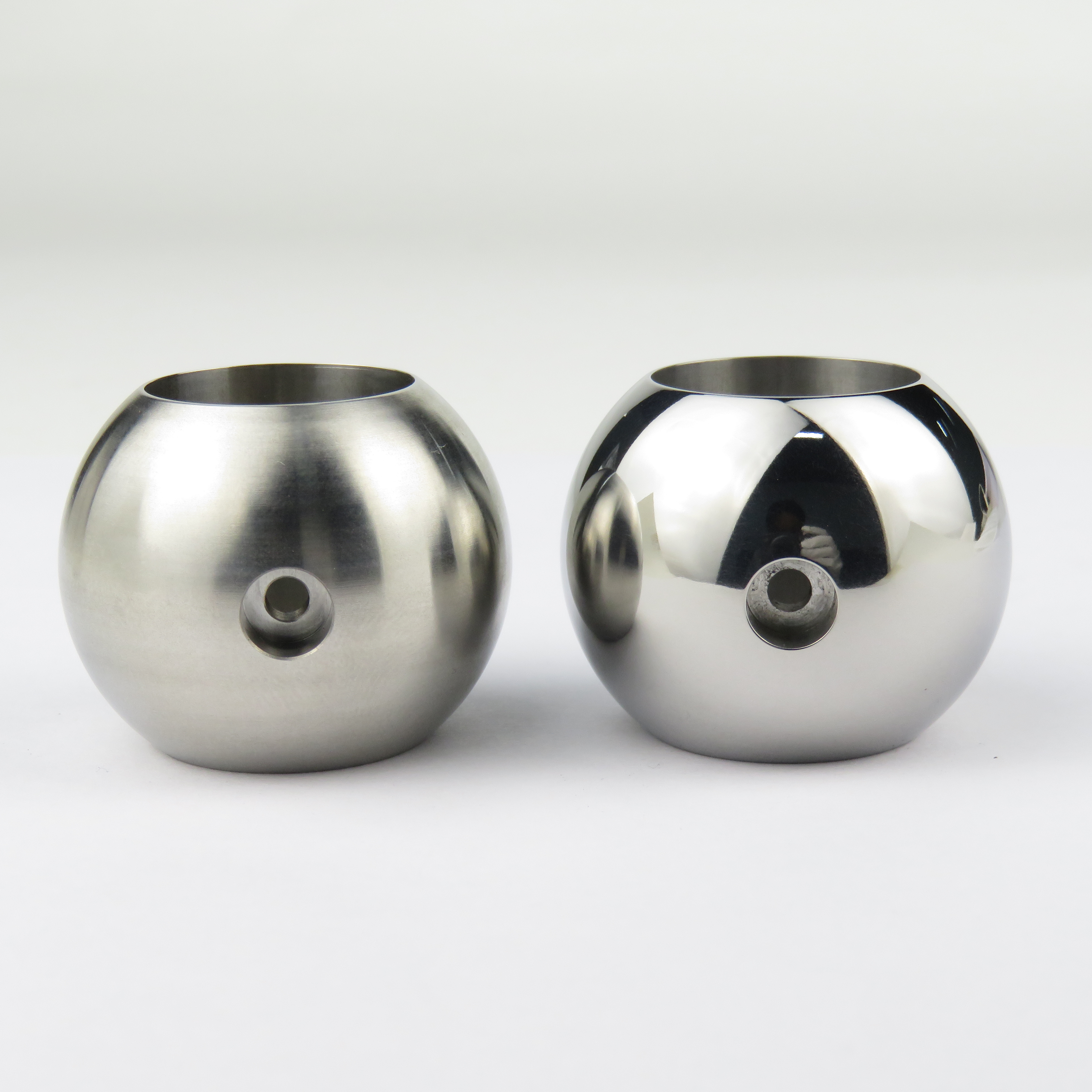
Write acceptance around measurement locations, not around a single number for the part. Mass finishing produces a gradient: an edge or a corner receives far more work than a flat face, and a recessed or shielded area receives less. A roughness value quoted without a location, a parameter, a cut-off length and an evaluation direction cannot be reproduced by anyone else and cannot be defended later. For each controlled surface, name the feature, the position on it, the parameter, the cut-off, the evaluation length and the direction relative to the machining lay. Reference the surface texture convention the buyer already uses, such as the ISO 4287 and ISO 4288 families or ASME B46.1, rather than inventing a house definition. Agree the instrument before the first part is measured.
A comparison between two media or two settings is only readable if one variable changes. Changing media size class and cycle length together produces a result that cannot be attributed to either, and the next trial starts from an unknown position. Fix the machine, the load ratio, the compound and the cycle, change one thing, and repeat with at least two or three parts per setting so a single outlier does not decide the direction. Measure at the same named positions with the same instrument and cut-off as the baseline, and keep the inspection sequence identical. Record not only what improved but what got worse or stayed unchanged; the rejected direction is often the most useful part of the record.

Both positions are used, and the choice follows the burr and the edge requirement. Deburring before hardening removes the machining burr while the material is still soft and the charge cuts predictably, but hardening can then introduce scale and slight distortion, and edges may need a light blend afterwards. Deburring only after the final thermal step keeps every edge operation in one place and works on the finished metallurgical state, at the cost of a harder material that cuts more slowly and a risk of brittle edge chipping. Discuss the sequence with the heat treater and the process engineer, and record the condition the part arrives in for finishing.
Protect it deliberately rather than relying on a gentle setting. Options include masking or plugging the face, fixturing the part so the land is held out of the mass, orienting the part so the land sees less contact, or choosing a media shape and size that blends rather than digs. Each has a cost: a masked face keeps its as-machined condition and can show a boundary line, a fixture shields the area behind it, and fixturing reduces how many parts fit in a load. Mark the land on the drawing, give it a maximum edge radius, and agree how it will be checked. Test the arrangement on the real part.
An edge break means the sharp corner is removed, usually to a small defined size, and the intent is that no sharp edge or wire edge remains. An edge round means the edge is held inside a controlled radius band, often with both a minimum and a maximum, because the function depends on the contour, for example where a seal seats or a coating must cover the edge uniformly. Specifying only the word deburr leaves the size open, and mass finishing rounds every edge in proportion to the energy used. For each controlled edge, state which of the two applies, the size or band, and how it will be measured.
Use Rome, Italy as the destination on the enquiry and state whether the deliverable is equipment, media and compound, a representative sample review or a line concept. A destination does not imply local stock, a local service point or a local delivery time.
Italian buyers specify finish through UNI, the national standards body, whose Italian editions of the EN/ISO surface-texture standards (UNI EN ISO 21920-1 and -2:2022) define how the surface state is indicated on drawings and which parameters and definitions apply when it is measured. Machinery supplied into Italy must in addition satisfy the EU machinery legislation, with Directive 2006/42/EC applying until 20 January 2027 and Regulation (EU) 2023/1230 from that date.
Sources were retrieved on 2026-09-29 and describe the local industrial and trade context only. They do not evidence any SurfacePolish project, shipment, installation or service in Rome.
The buyer must remove the machining burr at the bore and bolt-hole entries while leaving the serrated raised face untouched.
Send the material, dimensions, approximate weight, batch quantity, the incoming condition and photographs of the difficult features. Mark which features must not be contacted by media and state how the result will be inspected. This form carries source reference PSEO-0448; quote it if you prefer an additional manual reference.
Open the SurfacePolish enquiry form Email a prepared enquiry
No price, lead time, certification or result is promised here. Confirm whether a sample trial is available for the specific part and what the trial can and cannot show.
Page PSEO-0448 · revised 2026-09-29 · cross-border equipment, media and scoped sample review. City context is sourced and cited above.
Use this local checker to identify missing part and inspection information. It prepares a technical-review brief; it does not approve a machine, process recipe or production result.
Complete the part details to prepare a review brief.
Email : info@surface-polish.com


 IPv6 network supported


 +86-592-2381506