A buyer in Hobart, Australia in marine components has 3 m spools with internal root welds that no batch machine can reach. SurfacePolish supplies finishing machines, media and compounds across borders and offers a free sample trial on cut sections and production welds, which return from Xiamen with an observed condition and a proposed media, compound and cycle direction showing what an accessible surface can and cannot be finished to. This brief is written for a buyer in Hobart working on marine components; it describes equipment, media and a scoped sample review, not a local polishing service.
Which features on this part are functional, such as seal faces, journals, tapers, keyways and weld toes, and which are only cosmetic?
Can the charge or the tool reach the surfaces that matter, and which enclosed passages and blind holes can never be reached at all?
What starting condition and cleanliness baseline will the part arrive in, and who owns the pre-finish step?
Automation needs repetition more than it needs difficulty. A family with stable geometry, a fixed set of controlled features and demand that recurs every week is a candidate; a one-off fabrication with a different weld layout each time is not, however much hand work it consumes. Establish the annual and monthly quantity, how many variants sit in the family, the size difference between the largest and smallest variant, and the takt a cell would have to meet. Then count the manual hours honestly: finishing, setup and fixture change, handling, inspection and rework. If setup and changeover dominate those hours, a robot may reproduce the same inefficiency with more capital behind it. If a few stable variants consume predictable hours, the arithmetic changes and a feasibility discussion is worth having.
Compound carries the work: it cleans the part and the media, holds fines in suspension, inhibits corrosion and controls foam. A mildly alkaline or near-neutral family is typical for ferrous work, and dose is set by measured concentration rather than by eye. On stainless and duplex marine parts the chloride content is the variable to control, because chlorides left in a pit, a crevice or a thread root can start pitting long after the part leaves the shop, and both tap water and recycled rinse water carry them. Confirm the water that will actually be used, add a rinse step that reaches the same features the finishing step reached, and dry the part rather than letting it drain and stain. Foam, residue and drag-out into a clean area are part of compound selection, not afterthoughts.
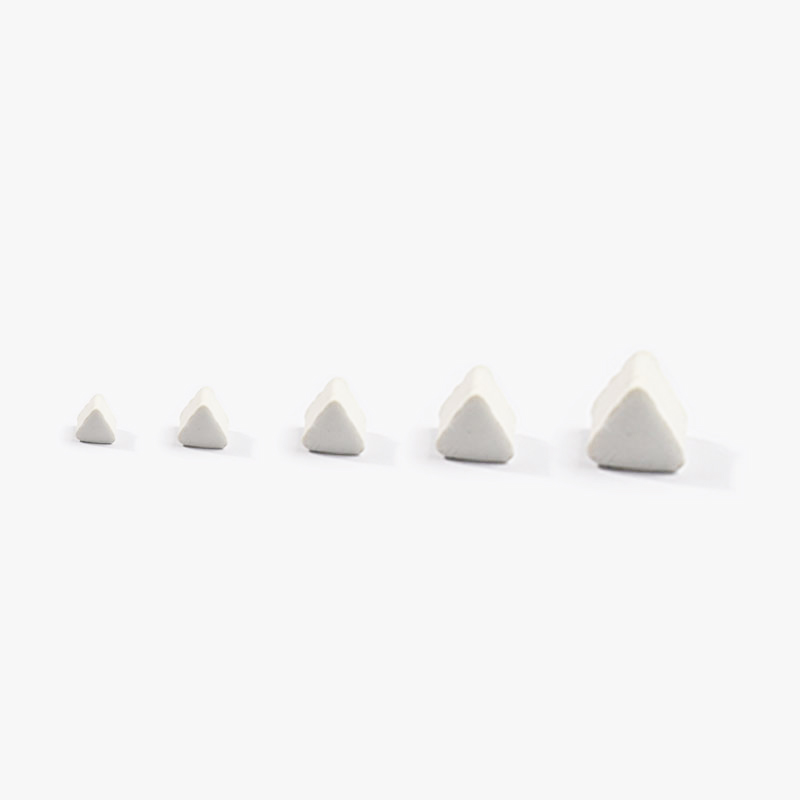
| Media | Best fit | Watch out for |
|---|---|---|
| Aluminium oxide grinding media in a dense ceramic bond | Heavier stock removal or a more consistent cut on robust stainless and duplex parts with thick edges and cast skin | High removal energy rounds functional edges quickly and is a poor match for thin panels or a knife-edge seat |
| Plastic triangles, cones and pyramids in a soft to medium grade | Deburring aluminium brackets, bronze castings and cosmetic faces where marking and edge loss must stay small | Slow cut rate, media deforms as it wears, and a worn charge behaves quite differently from a fresh one |
| Dry media such as walnut shell and corn cob with a dry polishing machine | Drying, light polishing and luster on parts that must leave the line dry, and on assemblies where a wet residue would be difficult to remove | Generates dust and needs extraction, cannot cut a burr, and organic media can carry moisture and contamination into a clean area |
| Fine ceramic or porcelain shapes in a small size class | Refinement and light edge blending after a cutting stage, and reaching tighter external geometry on small valve parts and fittings | Small sizes enter and lodge in cross-drillings and fine slots, and media wear shrinks the charge so the finish drifts over its life |
Rotary barrels, disc machines and centrifugal barrel machines cover the high-energy end. A disc machine cuts quickly on small robust parts and suits uniform batches of fittings, while a centrifugal barrel machine produces short, aggressive cycles on small precision items. A rotary barrel is gentler on fragile or thin components but runs long and hides the part while it runs. All three require the part to fit a defined working volume and to tolerate contact with other parts or with a rotating disc. None of them accepts a four-metre shaft or a two-hundred-kilogram casting. In a marine part mix they handle the small-part tail of the family, such as fasteners, small fittings, inserts and valve trim, while the large fabrications go to a tub, a hand-held tool or a considered robot cell.
| Machine route | Where it fits | What it will not do |
|---|---|---|
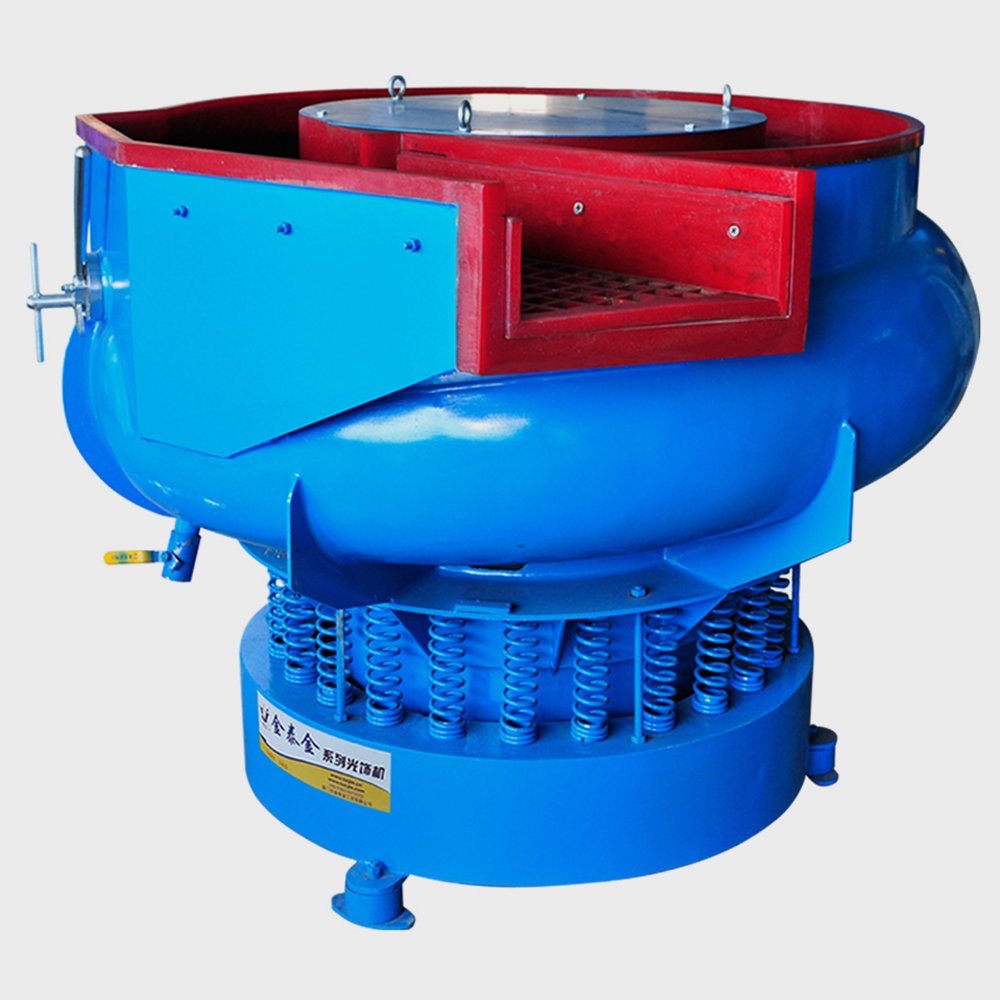
| Vibratory finishing machine (bowl) | Bulk deburring and refinement of small and medium marine fittings, cast cleats, brackets and machined valve internals that can tumble without racking | Continuous part-on-part contact and no access to internal passages; visible faces and heavy parts need separation, racking or a different route |
| Rotary barrel finishing machine | Gentle deburring of small fragile components and mixed fitting batches with generous compound flow and low part-on-part energy | Long cycles with no visibility while running, and internal passages collect media and compound that must be retrieved at unload |
| Disc finishing machine | Fast, high-energy edge breaking and surface refinement on small robust fittings and uniform batches where cycle time matters | High impingement and edge-loss risk on thin or soft parts, and the geometry must suit the disc working gap rather than a large weldment |
| Dry polishing machine and dryer | Drying parts after a wet stage and producing a dry polished surface with organic media where a wet residue would be hard to remove | No cutting action, needs dust extraction, and organic media must be kept dry and clean or it transfers contamination to the part |
A finished stainless or duplex part that develops brown bloom within days is usually showing contamination rather than a material fault. Sources include carbon steel media or brushes, a machine that also runs carbon steel, grinding dust settling on a wet surface, handling with bare or dirty gloves, and chloride carried in rinse water or left standing in a crevice. The staining often starts at a weld, a pit or a thread root, where the surface is already disturbed. Segregate stainless work, use dedicated or stainless tooling, keep the part wet only with controlled water, dry it promptly, and check with a wipe test or a free-iron check if the buyer wants one. Pitting from retained chlorides is a slower relative of the same problem, so the rinse step deserves the attention the finishing step gets.
| Failure mode | Likely cause | How to catch it |
|---|---|---|
| Medium wedged in tube-sheet holes or perforated plate openings | Hole diameter close to the media section, cylindrical or conical media that aligns with the hole, or a charge left to drain in the part at unload | Pin gauge a sample of holes across the plate, tap and back-flush each sample, and inspect the plate under oblique light for a medium sitting flush with the surface |
| Abrasive grain embedded in a soft or gummy surface | Coated abrasive or bonded wheel used on bronze, aluminium or a work-hardened surface at excessive pressure, or a loaded belt that has stopped cutting and started smearing | Inspect under low-angle light and a magnifier, wipe with a solvent-soaked cloth, and check the part after a light refinement pass rather than only as it leaves the coarse operation |
| Dwell mark or flat spot where a robot-held tool paused, slowed or changed direction | Waypoint spacing or path speed poorly set, a tool change or program transition in the middle of a visible surface, or missing compensation for tool wear along the path | Photograph the surface under raking light and compare first and last parts of a run, and measure at fixed points along the path to locate any step or band |
| Medium or a broken medium fragment lodged in a seawater passage, drain boss or internal cavity | Media size class too close to the smallest opening, a worn charge breaking down into smaller pieces, or an enclosed feature that was never mapped before the route was chosen | Count the charge in and out where the batch allows, borescope the smallest passage at an agreed angle, and flush the passage into a filter so the discharge can be examined |
Hobart's manufacturing base is smaller than the mainland capitals but unusually specialised, with world-scale capability in a few niches rather than broad heavy industry. The clearest example is shipbuilding: Incat has built high-speed aluminium catamarans at its Hobart shipyard for more than four decades, has built around 100 vessels for operators in 24 countries, employs more than 500 people, and is now building large battery-electric ferries, having been named Tasmanian Exporter of the Year 2026. The city is also the port and service centre for Tasmanian industry: TasPorts, the state-owned ports company, operates the Port of Hobart and reports that across its ports it has facilitated the movement of over 145 million tonnes of freight in the past decade, serving mining, manufacturing, timber and dairy. Hydro Tasmania, based in Hobart, is Australia's largest generator of clean renewable energy, and the state's hydro-industrial base has historically supported energy-intensive processing. Hobart Airport is Australia's southernmost airport and describes itself as curfew free.
For this brief the relevant part of that base is marine: Incat states 'For more than 40 years, Incat has delivered fast, efficient aluminium ferries to operators worldwide' and that 'From our Hobart shipyard, we have built around 100 vessels for operators in 24 countries', with a growing team of more than 500 employees and around 100 vessels built; TasPorts operates the Port of Hobart with multiple berths, slipyards and marine services.
Aluminium shipbuilding is the defining finishing challenge in Hobart: welded aluminium structures in high-speed ferries require weld dressing, oxide removal and controlled surface preparation before painting or coating, and surface defects matter for fatigue performance and corrosion resistance in a marine environment. Stainless and aluminium components used in marine fit-out, in Hydro Tasmania's generation and water infrastructure, and in food and dairy processing equipment all need burr-free edges and contamination-free surfaces for hygiene, sealing and corrosion reasons. Because volumes are low and parts are large or awkward, finishing method selection is typically driven by part size and geometry rather than throughput.
A Hobart buyer should first establish whether the surface being finished is structural aluminium that will be welded and painted, or a stainless product-contact surface in food, dairy or marine service, because the acceptable media, the cleanliness requirement and the evidence of a correct finish are entirely different in each case.
Freight context: Port of Hobart (Macquarie Wharf and Princes Wharf berths, operated by TasPorts), Hobart Airport (Australia's southernmost airport, curfew free, at Cambridge), Bell Bay (TasPorts' northern deep-water port serving Bass Strait trades). TasPorts reports that over the past decade its ports and people have facilitated the movement of over 145 million tonnes of freight, covering mining, manufacturing, timber and dairy, and it publishes quarterly trade reports by port and commodity. The Port of Hobart handles the state's southern trades through the Macquarie Wharf berths, and Incat's Hobart shipyard relies on heavy-lift vessels calling at Hobart to collect completed hulls for delivery overseas, as shown by its Hull 096 shipment. Hobart Airport is curfew free, which matters for time-critical air freight, while Bass Strait sea freight between Tasmania and the mainland is the principal route for inbound machinery.
The Australian Border Force (ABF) is the customs authority and clears imported goods through customs; all goods arriving in Australia must be declared unless an exception applies, goods valued at up to A$1,000 can be imported without a formal import declaration, and entry is made through the Integrated Cargo System (Form B650 for sea or air cargo). Generally all goods imported into Australia are liable for duties and taxes unless an exemption or concession applies, and most imports are subject to 10% GST, so classification, customs valuation and any preferential tariff claim drive the landed cost; a licensed customs broker is the normal route for a first-time importer. Electrical equipment can fall under the Electrical Equipment Safety System, under which the first Australian supplier registers as a Responsible Supplier, holds an ABN, makes a Responsible Supplier Declaration and marks the equipment with the Regulatory Compliance Mark (RCM) in accordance with AS/NZS 4417.1 and AS/NZS 4417.2. Imported goods may also require a trade description naming the country of manufacture, and machinery that is not in-scope electrical equipment still has to meet state work health and safety duties covering plant.
Australia and China are parties to the China-Australia Free Trade Agreement (ChAFTA), signed on 17 June 2015 and in force since 20 December 2015; the Australian Border Force maintains a dedicated ChAFTA page and working tariff schedule, and FTAs give importers a route to preferential rates of duty where the rules of origin are met. China was Australia's largest source of imports in 2025 at $130.2b, up 12.5% on 2024, and 56% (69,567) of Australian business importers traded at least once with China in 2020-21. A Chinese supplier of finishing machines, media or compounds is therefore shipping into Australia's single largest import stream, and preferential duty depends on origin documentation rather than on a blanket zero-tariff guarantee for every product line.
SurfacePolish supplies from Xiamen, China. The buyer's own destination rules, conformity marking, tariff classification and documentation responsibilities stay with the buyer; confirm them against the authorities named above before ordering.
Some checks decide whether the part works, and those belong to the buyer's engineering and quality functions. A pressure or leak test on a valve or pump body, a flow check through a passage, a fit check of a shaft in its bearing or a flange against its mate, a dye penetrant inspection of a dressed weld, and any corrosion or coating adhesion evaluation are buyer-side calls. The same applies to cleanliness: the buyer defines the method and the limit, and decides whether a mechanically finished part needs a passivation treatment afterwards. SurfacePolish can describe what was done to a part and what was observed on it, but it does not qualify a part for a class society, a coating specification or a service environment. Ask what evidence is needed before work starts, then plan the trial records to match.
A comparison is useful only if one thing changes at a time. Run the same part, the same marks and the same measurement plan against two options, keeping compound, concentration, cycle or path, and charge age as close as possible. Where the trial runs in a machine, charge the two options separately rather than mixing them, and add the fresh-media effect to the list of variables, since a new charge cuts differently from an aged one. For a tool-carrier comparison, use the same belt or wheel specification and reset the tool life counter between runs. Randomise the order when more than two options are compared, and have the parts evaluated by someone who does not know which is which. Record everything on the same form and photograph each option under the same lighting.
A positioner is often the cheaper answer to reach. Turning the part to present a new face to a fixed tool or to a smaller machine can remove the need for a long-reach arm and reduce the payload the arm must carry. The trade is an extra axis with its own repeatability, and a fixture that has to locate on every face it turns to. A robot arm earns its place where the tool must travel over a surface that cannot practicably be turned, or where the same motion repeats on many parts. Decide from geometry and volume, not from technology, and prove the surface before either is bought.
Partly, and the split is the useful part of the question. A robot can hold a grinder, sander or polishing head over a repeatable path with controlled pressure, which suits long weld runs, flat panels and consistent edges. It struggles where access is restricted, where the surface is free-form and required pressure changes continuously, and where a person compensates for part-to-part variation by feel. Work out which features recur in the same place on every part and which move; automate the first group and leave the second with an operator, or send parts to a machine route that already produces the surface in bulk.
A trial cannot promise a roughness value, an edge radius, a tolerance, a cycle time, a capacity or a cost, and it does not qualify a process for a classification society or any regulated use. It also cannot verify the reach, payload or accuracy of a robot the buyer has not yet selected, or the behaviour of a fixture that does not exist. One or a few parts do not describe variation across a lot, a shift or a media charge. Treat the trial as evidence about the parts tested, then close the remaining gaps with the buyer's own line trials and first-article discipline.
Use Hobart, Australia as the destination on the enquiry and state whether the deliverable is equipment, media and compound, a representative sample review or a line concept. A destination does not imply local stock, a local service point or a local delivery time.
Hobart manufacturers work to Australian Standards administered by Standards Australia, and Tasmanian marine work additionally references Australian and international maritime classification and survey requirements for vessel construction and repair. Electrically powered machinery must comply with the EESS and carry the Regulatory Compliance Mark under AS/NZS 4417.1 and AS/NZS 4417.2 where in scope.
Sources were retrieved on 2026-09-29 and describe the local industrial and trade context only. They do not evidence any SurfacePolish project, shipment, installation or service in Hobart.
The buyer wants internal weld dressing that cannot be reached by any tumbling route and needs to know what can be finished from outside only.
Send the material, dimensions, approximate weight, batch quantity, the incoming condition and photographs of the difficult features. Mark which features must not be contacted by media and state how the result will be inspected. This form carries source reference PSEO-0796; quote it if you prefer an additional manual reference.
Open the SurfacePolish enquiry form Email a prepared enquiry
No price, lead time, certification or result is promised here. Confirm whether a sample trial is available for the specific part and what the trial can and cannot show.
Page PSEO-0796 · revised 2026-09-29 · cross-border equipment, media and scoped sample review. City context is sourced and cited above.
Use this local checker to identify missing part and inspection information. It prepares a technical-review brief; it does not approve a machine, process recipe or production result.
Complete the part details to prepare a review brief.
Email : info@surface-polish.com


 IPv6 network supported


 +86-592-2381506