A buyer in Manchester, United Kingdom in marine components has 6 m rail assemblies whose weld dressing and visible finish must be consistent along the whole run. SurfacePolish supplies finishing machines, media and compounds across borders and offers a free sample trial: tube sections and a welded junction go to Xiamen and come back with an observed condition and a proposed media, compound and cycle direction for the buyer's own evaluation. This brief is written for a buyer in Manchester working on marine components; it describes equipment, media and a scoped sample review, not a local polishing service.
Which features on this part are functional, such as seal faces, journals, tapers, keyways and weld toes, and which are only cosmetic?
Can the charge or the tool reach the surfaces that matter, and which enclosed passages and blind holes can never be reached at all?
Does the part family repeat often enough, with stable geometry, to justify a cell rather than a batch machine or hand work?
Mass finishing works where a charge can flow across the surface. Sort the part into accessible and inaccessible zones and be literal about it. An open external weld run on a bracket, a cast cleat or the outside of a small valve body is reachable. The inside of a closed box section, the back of a stiffener, a narrow seawater passage and the root of a deep groove are not, whatever the medium is. Concave pockets hold media and release it slowly; sharp internal corners trap it. That map decides whether the whole part, or only some faces of it, can go to a tumbling route, and whether the remainder needs a tool that can be aimed at a surface, by hand or by an arm. Accessibility, more often than finish, is what ends the mass-finishing option.
A robot reproduces whatever the fixture gives it. A large marine part has to locate on a repeatable datum, be clamped without forcing a thin panel out of shape, and be supported so that it neither sags nor shifts as material comes off. For tool-carrier work, adding a positioner or turntable can present several faces to the arm without re-clamping, which often reduces the reach and payload the arm itself must supply, at the cost of an extra axis with its own repeatability. Build the fixture around surfaces that are not being finished, use the datums the drawing already uses, and decide early whether clamping marks are acceptable on a visible face. A trial that cannot reproduce the production fixture will not predict production variation, however good the tool path looks.
| Machine route | Where it fits | What it will not do |
|---|---|---|
| Rotary barrel finishing machine | Gentle deburring of small fragile components and mixed fitting batches with generous compound flow and low part-on-part energy | Long cycles with no visibility while running, and internal passages collect media and compound that must be retrieved at unload |
| Tub vibrator | Long parts that cannot rotate in a bowl, such as rail sections, pipe spools, linear weldments and long shafts, provided they can be supported along their length | Lower energy per unit area, so heavy weld dressing takes longer, and a long tub needs floor space plus a support method that does not mark the part |
| Vibratory finishing machine (bowl) | Bulk deburring and refinement of small and medium marine fittings, cast cleats, brackets and machined valve internals that can tumble without racking | Continuous part-on-part contact and no access to internal passages; visible faces and heavy parts need separation, racking or a different route |
| Grinding finishing machine | Taking off a heavy machining burr or a defined stock layer before a refinement pass on robust stainless and duplex work | High removal energy cuts functional edges fast, so geometry assessment and a short controlled cycle matter more than on any other route |
When a robot carries the tool, the consumable list changes from loose media to bonded abrasive, nonwoven and buffing products. Coated belts and flap wheels cut weld toes and blend edges; nonwoven wheels and discs refine and satin-finish; stitched or loose cotton wheels with a polishing compound build luster. Each type has a working speed, a contact pressure and a wear curve, and each wears in a way the cell must compensate for or an operator must adjust. Abrasive grain can embed in soft or gummy material such as bronze or aluminium, and a loaded belt cuts less and heats more. Polishing compound leaves a film that has to be removed before coating, passivation or a cleanliness check, so the tool set cannot be chosen separately from the path that carries it.
| Media | Best fit | Watch out for |
|---|---|---|
| Chloride-free mildly alkaline or near-neutral compound, liquid or powder | Cleaning, corrosion inhibition and fines suspension on stainless and duplex marine work where retained chlorides would risk pitting in service | Dose drifts with drag-out and water hardness, foam can hide the load, and rinse water must reach the same features the compound reached |
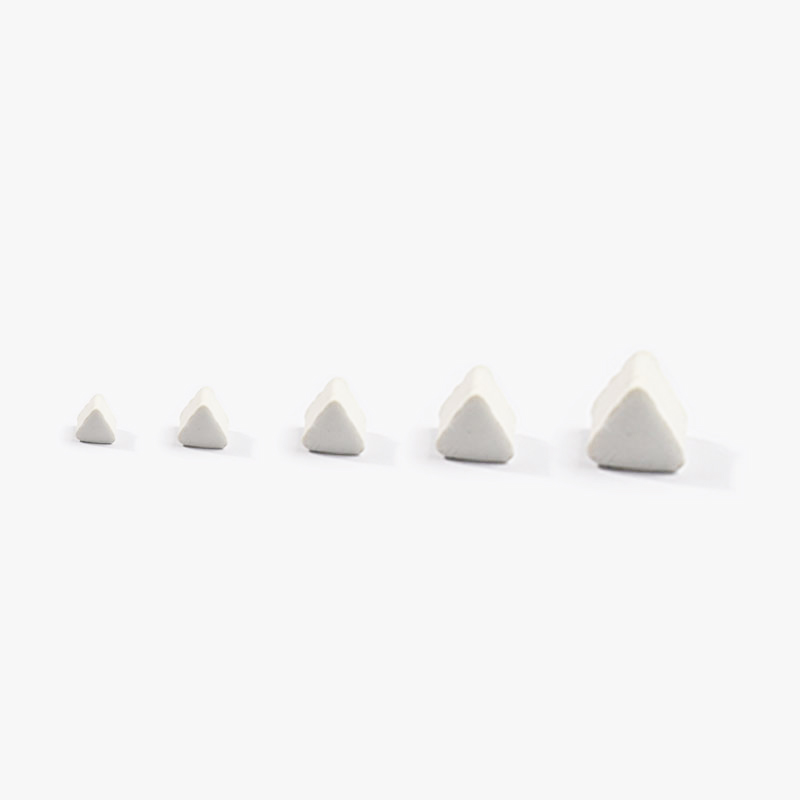
| Fine ceramic or porcelain shapes in a small size class | Refinement and light edge blending after a cutting stage, and reaching tighter external geometry on small valve parts and fittings | Small sizes enter and lodge in cross-drillings and fine slots, and media wear shrinks the charge so the finish drifts over its life |
| Bonded abrasive, nonwoven and buffing tool set for an arm or hand tool | Cutting weld toes, blending edges and building luster on large fabrications and free-form surfaces that no batch machine can reach | Each belt, wheel and compound has its own wear curve and pressure window; grain can embed in soft metal and polishing compound leaves a film that must be removed before coating or passivation |
| Steel media including balls, pins and shaped shot | Bright burnished finishing and edge blending on stainless components where appearance matters and stock removal must stay low | Transfers iron to stainless and leaves free iron that blooms in chloride service, so it needs a dedicated charge, an inhibiting compound and magnetic or screen separation |
Automation introduces a family of defects that hand work hides. Where an arm slows at a corner, dwells at a waypoint or waits for a tool change, the tool removes more material and leaves a flat spot or a visible step. Where two passes meet, a slight mismatch shows as a band. Tool wear makes the last third of a long path cut differently from the first third unless the cell compensates, and a loaded belt heats the surface instead of cutting it. These show up as texture variation rather than a measurable defect, so they are often accepted at the bench and rejected by the customer. Photograph the surface under raking light, compare the first and last part of a run, measure at fixed points along the path, and treat any visible change at a transition as a signal to review the path or the compensation.
| Failure mode | Likely cause | How to catch it |
|---|---|---|
| Keyway, spline or taper geometry lost to edge rounding | The feature was exposed to the charge without masking, or a tool-carrier path ran along the flank of the feature instead of stopping short of it | Check width, flank angle and edge break with a gauge or comparator at marked stations before and after, and confirm the protected feature against the drawing tolerance |
| Compound film, burnished residue or dried detergent left on a sealing face | Rinse that did not reach the same features the finishing step reached, compound drag-out from the charge, or a part allowed to drain and dry in position instead of being dried deliberately | Wipe the sealing face with a clean white cloth and a defined solvent, inspect the wipe, and borescope any groove or land the rinse may not have reached |
| Over-grind step or gouge at a path transition or belt change | Two passes overlapping at different pressures, a fresh belt run at the setting that suited a worn one, or an operator touching up a transition by hand without recording it | Inspect each transition zone at a fixed viewing distance under consistent lighting, and compare the zone against the surrounding surface with a roughness reading on both sides |
| Clamping indentations and part-on-part impact marks on a visible face | Gripper or fixture force applied on a finished or visible surface, no protective interface at the contact point, or parts left free to collide in a batch charge | Inspect all contact points and visible faces under raking light against a reference part, and record the fixture contact scheme used so marks can be traced to a specific clamp or pocket |
Greater Manchester is the largest city-region economy outside London, generating £100 billion in GVA according to Invest Manchester, the city region's inward investment service, whose sector offer leads on advanced materials and manufacturing, life sciences and health innovation, and low carbon. The Manchester Ship Canal runs from the Mersey estuary into the heart of Manchester as a 36-mile inland seaway whose five terminals handle 7.5 million tonnes of cargo a year. Make UK classes the North West as the strongest-performing English region and the UK region with the highest total manufacturing output, and describes the North West as the industrial heartland of Britain.
The nearest part of that base to this brief is energy: Invest Manchester lists 'Low carbon' among its sectors, and the Manchester Ship Canal operator positions the canal terminals as part of a carbon-efficient 'Green Highway'.
A city region combining precision manufacturing, life-sciences hardware and low-carbon equipment produces parts that often carry both a surface-finish specification and a cleanliness requirement, and the cleaning step after mass finishing is usually where those two specifications interact. Because media and machines can be routed to Port Salford, Runcorn Docks or Ellesmere Port through the same inland waterway that carries the region's bulk and project cargo, inbound equipment and outbound sample parts can be planned on one freight chain rather than a coastal port.
A Manchester buyer should settle the required cleanliness level first - for example whether a life-sciences or low-carbon component needs a validated post-finishing cleaning step - because that decision drives both the media choice and the effluent and waste handling the plant must provide for.
Freight context: Manchester Ship Canal terminals: QEII Dock, Ellesmere Port, Runcorn Docks, Port Warrington and Port Salford, Port of Liverpool (Royal Seaforth Container Terminal and Liverpool2), linked to the canal. Peel Ports states that the five Manchester Ship Canal terminals handle 7.5 million tonnes of cargo and that the canal runs 36 miles from the Mersey estuary into the heart of Manchester; Port Salford sits next to the M60 and M62 and provides direct vessel access from the Liverpool2 deep-water terminal, while Ellesmere Port is described as fully multimodal with road, rail and sea connectivity.
English is the working language of contracts, drawings and conformity paperwork, so quotations, technical files and Declarations of Conformity should be supplied in English. UK manufacturers have now recovered above 2019 output levels in every English region and devolved nation except Northern Ireland, and the sector is concentrated in food and drink and transport equipment, with the North West the largest manufacturing region by total output. Buyers typically expect the UKCA/CE route, a Declaration of Conformity and a UK-established economic operator to be identified before order, and they need commercial invoices, customs declarations and the C79 retained in a form their finance team can use for import VAT recovery. No source verified in this research establishes a mandated payment instrument, so payment structure should be treated as commercial negotiation rather than a regulatory requirement.
BSI is the UK's National Standards Body, and British Standards (BS, including adopted BS EN ISO texts) are the documents a UK buyer's surface-finish, edge and cleanliness specifications are normally written against and purchased through. On the plant side, HSE maintains the work equipment and machinery topic covering the safe supply and use of machinery, and the COSHH regime, which requires employers to identify, assess and control risks from hazardous substances - the regime that applies to finishing compounds, abrasive media and the dust and effluent they generate.
SurfacePolish supplies from Xiamen, China. The buyer's own destination rules, conformity marking, tariff classification and documentation responsibilities stay with the buyer; confirm them against the authorities named above before ordering.
Where a part sits in a charge changes what happens to it. Parts at the bottom carry more load and see more part-on-part contact; parts near the wall of a bowl can be bypassed; parts at the ends of a tub can be underworked. A sampling plan that draws from one position will not describe the lot. Agree the sample size, the positions sampled and the order in which parts are drawn, and include a control part measured only at the start and at the end. In a cell, the equivalent is the first part after a tool change, the first part of a shift and the part after a fixture change. Keep each sampled part with its settings record, and define in advance what happens to a lot when one sample falls outside the acceptance band.
Before a cell can be justified, the manual work has to be counted in a form a cell design can use. Time the finishing operation per unit of surface: per metre of weld, per square metre of panel, per edge, per bore. Separate that from handling, meaning finding the part, loading it, turning it, changing a belt, inspecting it and putting it down, because handling is often what a robot is really bought for. Note the variability: how long the same feature takes on a good part and on a difficult one. Then estimate the volume over which those hours recur, and compare it with a cell that earns only while it is running and loaded. Where setup and changeover dominate the hours, automating the finishing motion will not change the economics much.

No. SurfacePolish does not issue certification, qualification or approval for any regulated application, and nothing described here may be treated as such a claim. Requirements set by a classification society, a coating manufacturer or an end user are defined and verified by the buyer and its own inspection function. What SurfacePolish provides is equipment, media and compounds, a scoped discussion of a line concept, and observations from a sample trial on the parts tested under the settings used. Those observations can feed the buyer's own qualification work, but they do not replace it or shorten it.
A positioner is often the cheaper answer to reach. Turning the part to present a new face to a fixed tool or to a smaller machine can remove the need for a long-reach arm and reduce the payload the arm must carry. The trade is an extra axis with its own repeatability, and a fixture that has to locate on every face it turns to. A robot arm earns its place where the tool must travel over a surface that cannot practicably be turned, or where the same motion repeats on many parts. Decide from geometry and volume, not from technology, and prove the surface before either is bought.
Usually contamination rather than the material itself. Carbon steel media, carbon steel brushes, a machine also used for carbon steel work, grinding dust settling on a wet surface, bare-hand handling and chloride carried in rinse water can all leave something behind that starts to stain. It often appears first at a weld, a pit or a thread root. Segregate stainless work, use dedicated tooling, control the rinse water, dry the part promptly, and check with a wipe test or a free-iron check if the buyer wants one. Whether passivation follows mechanical finishing is the buyer's decision and its own requirement to define in United Kingdom.
Use Manchester, United Kingdom as the destination on the enquiry and state whether the deliverable is equipment, media and compound, a representative sample review or a line concept. A destination does not imply local stock, a local service point or a local delivery time.
UKCA or CE marking with a Declaration of Conformity is required for equipment placed on the Great Britain market, HSE's work equipment and machinery topic covers guarding and safe use, and COSHH governs the media, compounds and dust from vibratory, centrifugal or barrel finishing.
Sources were retrieved on 2026-09-29 and describe the local industrial and trade context only. They do not evidence any SurfacePolish project, shipment, installation or service in Manchester.
The buyer wants weld dressing and a consistent visible finish across long tubes that cannot be turned in a bowl.
Send the material, dimensions, approximate weight, batch quantity, the incoming condition and photographs of the difficult features. Mark which features must not be contacted by media and state how the result will be inspected. This form carries source reference PSEO-0216; quote it if you prefer an additional manual reference.
Open the SurfacePolish enquiry form Email a prepared enquiry
No price, lead time, certification or result is promised here. Confirm whether a sample trial is available for the specific part and what the trial can and cannot show.
Page PSEO-0216 · revised 2026-09-29 · cross-border equipment, media and scoped sample review. City context is sourced and cited above.
Use this local checker to identify missing part and inspection information. It prepares a technical-review brief; it does not approve a machine, process recipe or production result.
Complete the part details to prepare a review brief.
Email : info@surface-polish.com


 IPv6 network supported


 +86-592-2381506