A buyer in Saitama, Japan working on marine components has a 220 kg 316L pump casing whose flange face and seawater passage must survive weld dressing intact. SurfacePolish supplies finishing machines, media and compounds across borders and runs a free sample trial: representative parts ship to the factory in Xiamen and come back with an observed condition and a proposed media, compound and cycle direction for the buyer's own review. This brief is written for a buyer in Saitama working on marine components; it describes equipment, media and a scoped sample review, not a local polishing service.
Which features on this part are functional, such as seal faces, journals, tapers, keyways and weld toes, and which are only cosmetic?
What starting condition and cleanliness baseline will the part arrive in, and who owns the pre-finish step?
Can the charge or the tool reach the surfaces that matter, and which enclosed passages and blind holes can never be reached at all?
Start by marking on the drawing which surfaces carry a function and which carry only appearance. On marine and offshore work the functional list is short and severe: seal faces on pump and valve bodies, bearing journals and taper seats on shaft components, keyways and splines, flange faces, bolted joint lands, fit bores, and the root of a weld that will be inspected. Everything else, such as the outside of a housing, a bracket web or a handrail run, can absorb a large change in texture. That split decides how much of the part may be exposed to a mass-finishing charge or to a robot-held abrasive without masking. One wrong assumption here, such as letting a coarse medium work a mating land, turns a reasonable route into scrap, so it is the first item a feasibility discussion should settle.
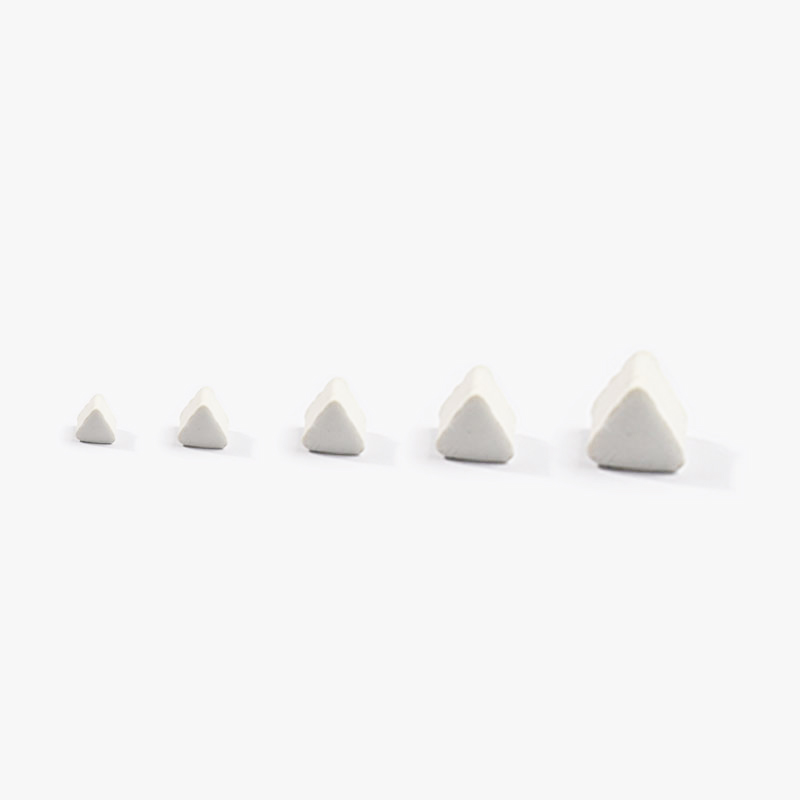
Ceramic media is chosen by shape and size class before the material name is considered. Angle-cut triangles cut edges and work into corners; cylinders and cones roll differently and can wedge; spheres are gentle and consistent but blend rather than cut. A coarse size class removes more per cycle and leaves a coarser texture, and it may not enter a narrow slot at all, while a fine class reaches tighter geometry and takes longer to move the same amount of material. On marine fittings and small castings, a medium triangle in a heavy-cut ceramic is a common starting point for edge break, followed by a finer shape for refinement. Media wear shrinks every piece, so the effective size class drifts upward in age: a charge that was correct when new can stop reaching a groove, or begin lodging in a hole, after weeks of use.
| Media | Best fit | Watch out for |
|---|---|---|
| Heavy-cut ceramic angle-cut triangles in a coarse size class | Breaking the edge of a machined or cast marine fitting and removing a substantial burr on robust stainless before a refinement stage | Cuts corners and weld toes aggressively and can round a seat or keyway, and the coarse section may not enter narrow passages at all |
| Chloride-free mildly alkaline or near-neutral compound, liquid or powder | Cleaning, corrosion inhibition and fines suspension on stainless and duplex marine work where retained chlorides would risk pitting in service | Dose drifts with drag-out and water hardness, foam can hide the load, and rinse water must reach the same features the compound reached |
| Aluminium oxide grinding media in a dense ceramic bond | Heavier stock removal or a more consistent cut on robust stainless and duplex parts with thick edges and cast skin | High removal energy rounds functional edges quickly and is a poor match for thin panels or a knife-edge seat |
| Fine ceramic or porcelain shapes in a small size class | Refinement and light edge blending after a cutting stage, and reaching tighter external geometry on small valve parts and fittings | Small sizes enter and lodge in cross-drillings and fine slots, and media wear shrinks the charge so the finish drifts over its life |
A robot reproduces whatever the fixture gives it. A large marine part has to locate on a repeatable datum, be clamped without forcing a thin panel out of shape, and be supported so that it neither sags nor shifts as material comes off. For tool-carrier work, adding a positioner or turntable can present several faces to the arm without re-clamping, which often reduces the reach and payload the arm itself must supply, at the cost of an extra axis with its own repeatability. Build the fixture around surfaces that are not being finished, use the datums the drawing already uses, and decide early whether clamping marks are acceptable on a visible face. A trial that cannot reproduce the production fixture will not predict production variation, however good the tool path looks.
| Machine route | Where it fits | What it will not do |
|---|---|---|
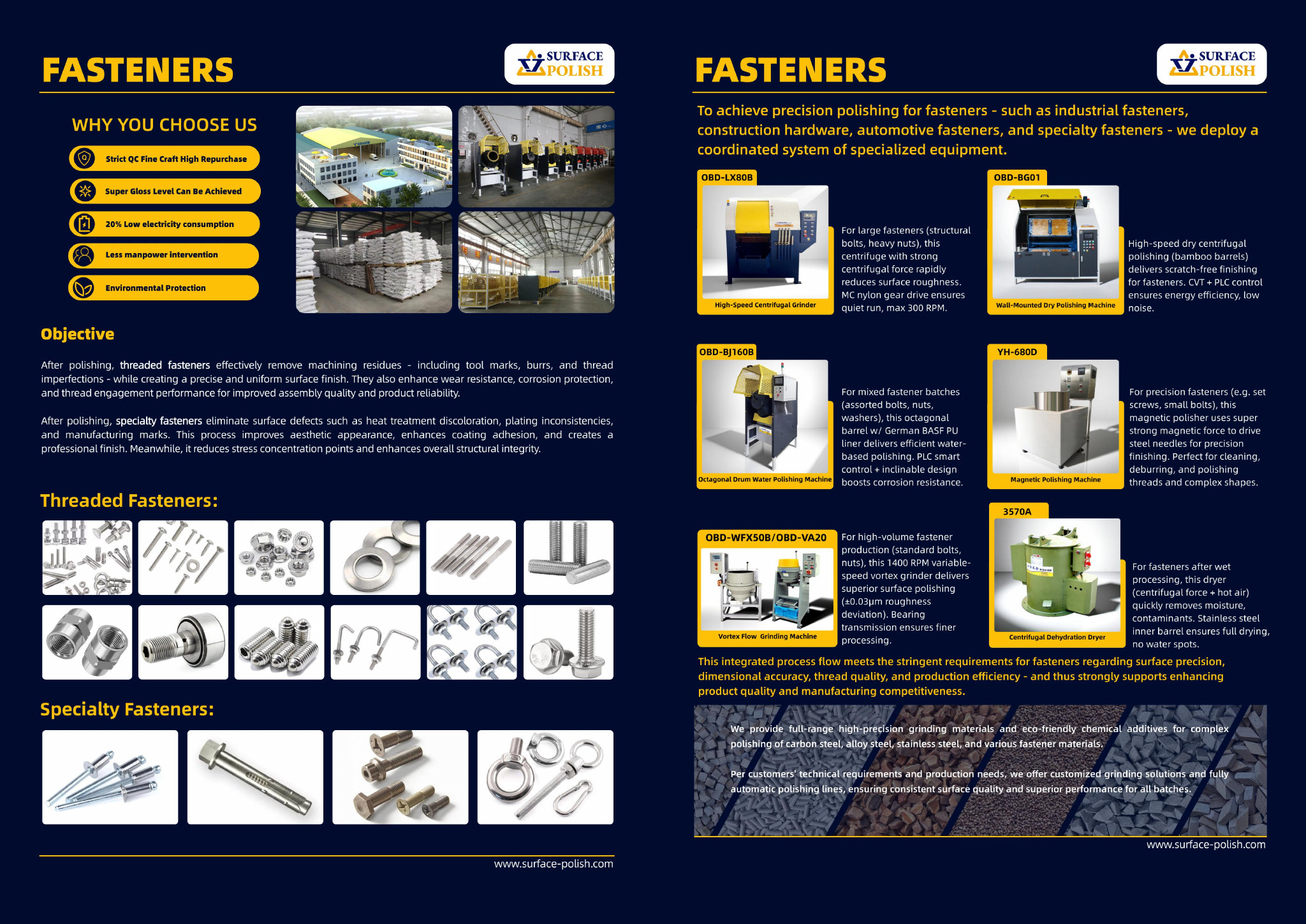
| Magnetic finishing machine | Fine deburring and light refinement of small precise features such as narrow slots, small bores and stainless fittings | A small working envelope that excludes large fabrications, with pin media that can lodge in fine passages and must be retrieved |
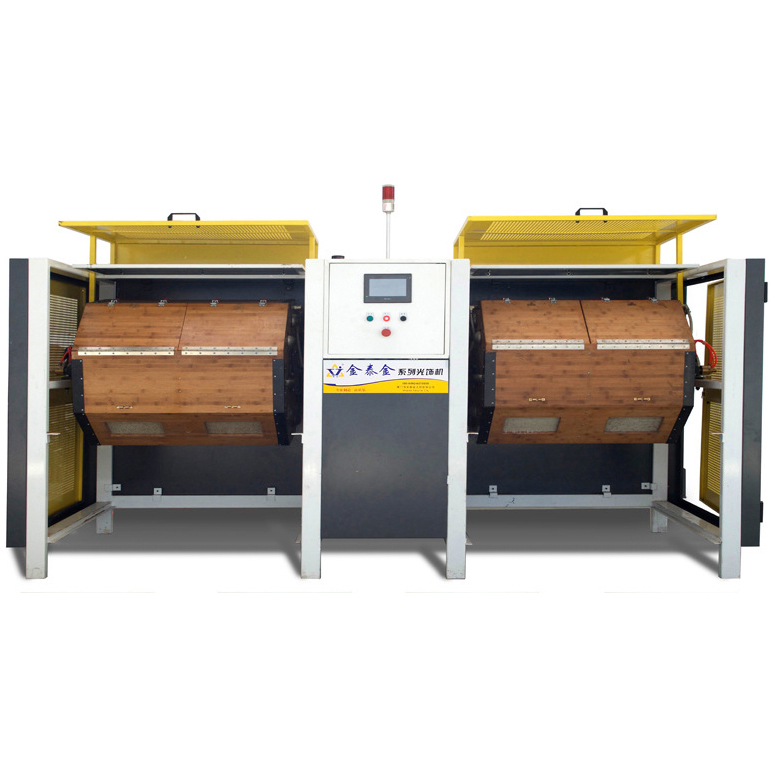
| Tub vibrator | Long parts that cannot rotate in a bowl, such as rail sections, pipe spools, linear weldments and long shafts, provided they can be supported along their length | Lower energy per unit area, so heavy weld dressing takes longer, and a long tub needs floor space plus a support method that does not mark the part |
| Grinding finishing machine | Taking off a heavy machining burr or a defined stock layer before a refinement pass on robust stainless and duplex work | High removal energy cuts functional edges fast, so geometry assessment and a short controlled cycle matter more than on any other route |
| Dry polishing machine and dryer | Drying parts after a wet stage and producing a dry polished surface with organic media where a wet residue would be hard to remove | No cutting action, needs dust extraction, and organic media must be kept dry and clean or it transfers contamination to the part |
Removing material releases residual stress, and on a large thin fabrication that means movement. A scrubber panel welded into a frame can lose flatness after weld dressing, a long shaft can bend slightly as a skin is taken off, and a bore can close or open as the surrounding metal is worked. Clamping makes this worse when force is used to pull a warped part onto a fixture, because the part springs back on release. Measure flatness, straightness and critical diameters at marked points before and after, and record the support and clamping scheme used. In a cell, gripper force and fixture datums are part of the process rather than peripheral equipment. Where drift matters, the buyer should decide whether stress relief, a reduced stock allowance or a different finishing route is the right answer.
| Failure mode | Likely cause | How to catch it |
|---|---|---|
| Rust bloom and tea staining appearing on a finished stainless surface within days | Free iron from carbon steel media or brushes, a machine shared with carbon steel work, airborne grinding dust on a wet surface, bare-hand handling, or chloride carried in rinse water | Wipe a defined area with a white cloth and record what it shows, run a free-iron check if the buyer wants one, and inspect welds, pits and thread roots under good light after the part has stood for a period |
| Dwell mark or flat spot where a robot-held tool paused, slowed or changed direction | Waypoint spacing or path speed poorly set, a tool change or program transition in the middle of a visible surface, or missing compensation for tool wear along the path | Photograph the surface under raking light and compare first and last parts of a run, and measure at fixed points along the path to locate any step or band |
| Distortion and loss of flatness on a thin welded panel after dressing | Residual weld stress released by material removal, heat from a grinding or polishing pass, or a support scheme that allowed the panel to deflect while it was worked | Measure flatness with a straightedge and feeler or a dial gauge on a stand at marked grid points before and after, with the same support scheme used both times |
| Clamping indentations and part-on-part impact marks on a visible face | Gripper or fixture force applied on a finished or visible surface, no protective interface at the contact point, or parts left free to collide in a batch charge | Inspect all contact points and visible faces under raking light against a reference part, and record the fixture contact scheme used so marks can be traced to a specific clamp or pocket |
Saitama City positions itself as a Greater Tokyo business and logistics location: its official investment guide states that the city supports the siting of research facilities, manufacturing plants and distribution facilities with one-stop administrative service, and that it is preparing new industrial accumulation sites as receptacles for incoming companies in ten districts. The guide also cites the city's medical-device manufacturing initiative (さいたま医療ものづくり都市構想) as part of its location support. The city has a dedicated policy for creating logistics-facility induction districts, justified in part by securing supplies and logistics during disasters. A separate municipal project relocates and rebuilds the central meat wholesale market together with a roadside-station-based agri-food distribution and tourism hub.
The nearest part of that base to this brief is food: The city is relocating and rebuilding its central meat wholesale market and integrating it with an agri-food distribution and tourism hub.
Medical-device manufacturing in the area puts cleanliness, edge quality and surface integrity on the critical path, because burrs or embedded media on a diagnostic or device component are a quality and documentation issue rather than a cosmetic one. General machinery and sheet-metal fabrication in the city's industrial parks needs consistent deburring and edge break before coating, welding or assembly, so one process specification rarely fits both groups.
A Saitama buyer should first decide which regime the part falls under - medical-device-related work where cleanliness and surface integrity must be documented, or general machinery where edge break and roughness callouts dominate - because that choice determines whether the sample trial has to include cleanliness verification as well as dimensional and visual checks.
Freight context: Designated 物流施設誘導地区 (logistics-facility induction districts) in Saitama City. Saitama City creates logistics-facility induction districts for facilities meeting the legal definition of a specified distribution business facility (特定流通業務施設), and it requires disaster-resilience measures and a disaster-time cooperation agreement - a sign of the city's role as a metropolitan distribution base. The city has no seaport, so freight for machines and samples moves by road and rail.
Chinese industrial machinery entering Japan is classified under the Customs Tariff Law, whose harmonised schedule sets the classification and the General Rate; the Temporary Tariff Measures Law sets a Temporary Rate for certain products, and where the WTO rate or an EPA rate for the goods is lower, that lower rate is applied. The applied rate therefore depends on the exact commodity code, and on whether an economic partnership agreement covers the goods and their origin, so a landed-cost figure has to be confirmed against the specific machine before it is quoted. Japan Customs' monthly country table for August 2026 records exports to China of 1,809,133 million yen and imports from China of 2,361,239 million yen, the largest single-country line in the Asian table, with imports from China up 22.5 per cent year on year.
The customs authority is Japan Customs, the Customs and Tariff Bureau of the Ministry of Finance, with regional customs at Tokyo, Yokohama, Nagoya, Osaka and Kobe. Any person importing goods must declare them to the Director-General of Customs and obtain an import permit after examination and payment of customs duty and consumption tax. The declaration is normally filed by the importer or by a customs broker acting as proxy, on a triplicate import (customs duty payment) declaration form (Customs form C-5020) supported by the invoice, the bill of lading or air waybill, a certificate of origin where a WTO rate applies, certificates of origin for preferential rates, packing lists and freight and insurance documents where required, plus any licence or certificate demanded by laws other than the Customs Law. More than 90 per cent of import procedures are computerised. A JIS Mark certificate is a separate, voluntary third-party scheme; foreign exporters are eligible to apply, and certification bodies must comply with ISO/IEC 17065.
SurfacePolish supplies from Xiamen, China. The buyer's own destination rules, conformity marking, tariff classification and documentation responsibilities stay with the buyer; confirm them against the authorities named above before ordering.
Most marine fabrications cannot be brought to a coordinate measuring machine, so the measurement plan has to be portable and repeatable. Use a hand-held surface roughness tester on accessible faces with the agreed cut-off and traverse direction, and record each reading location on a marked photograph rather than describing it in words. For curved or restricted surfaces a moulded replica tape can be read offline. Straightness and flatness are usually checked with a straightedge and feeler, a dial gauge on a stand, or a laser alignment system, and the support scheme used during measurement should match the one used in production. Diameters and bores are checked with micrometers, bore gauges or inside micrometers at marked stations. Whatever the instrument, use the same operator, station and setup across a comparison.
Send parts that represent the extremes, not the average. Include the part with the tightest internal passage, the thinnest section, the largest surface to be finished and the most restricted access. Include one weld sample made with the production welding procedure, because a weld toe finishes differently from parent metal. Include an as-received reject so the starting condition is documented, and mark the measurement points and controlled features on each part before shipping. Record the material grade, product form, heat treatment, as-received condition and the cleanliness requirement the part must eventually meet. Label everything and pack it so nothing is damaged in transit. A trial run on a convenient sample answers a question the buyer did not ask.
There is no universal number, but the shape of the answer is consistent: a small number of stable variants, each repeating often enough to amortise setup, with a predictable manual time content. Count the hours over a year, then subtract the hours a cell would still spend on loading, fixture changes, tool changes and inspection. If the remainder is small, a batch machine or a fixture change may be the better buy. Where a finishing route near Saitama already produces an acceptable surface in bulk, automating load and unload is usually the smaller and more certain step than automating the finishing motion itself.
No. SurfacePolish does not issue certification, qualification or approval for any regulated application, and nothing described here may be treated as such a claim. Requirements set by a classification society, a coating manufacturer or an end user are defined and verified by the buyer and its own inspection function. What SurfacePolish provides is equipment, media and compounds, a scoped discussion of a line concept, and observations from a sample trial on the parts tested under the settings used. Those observations can feed the buyer's own qualification work, but they do not replace it or shorten it.
The part has to arrive in a repeatable position and condition. That means a defined locating datum, a fixture or positioner that holds the part without distorting it, a starting condition that varies within a stated band, and a family whose geometry does not change on every job. The controlled features should be the same on every variant, and the part should be clean enough that oil or marking ink does not change how a tool cuts. If the part arrives different each time, the cell will spend its hours being adjusted rather than finishing, and the cost per part will not behave the way the original estimate assumed.
Use Saitama, Japan as the destination on the enquiry and state whether the deliverable is equipment, media and compound, a representative sample review or a line concept. A destination does not imply local stock, a local service point or a local delivery time.
Japanese buyers work to JIS (Japanese Industrial Standards) administered through the Japanese Industrial Standards Committee (JISC), which also maintains the market-creation standardisation scheme run with METI; drawings normally cite JIS or customer standards for surface finish and material conformity. For medical-device-related work, customers add their own cleanliness and quality-system requirements on top of ISO 9001 as general industry practice.
Sources were retrieved on 2026-09-29 and describe the local industrial and trade context only. They do not evidence any SurfacePolish project, shipment, installation or service in Saitama.
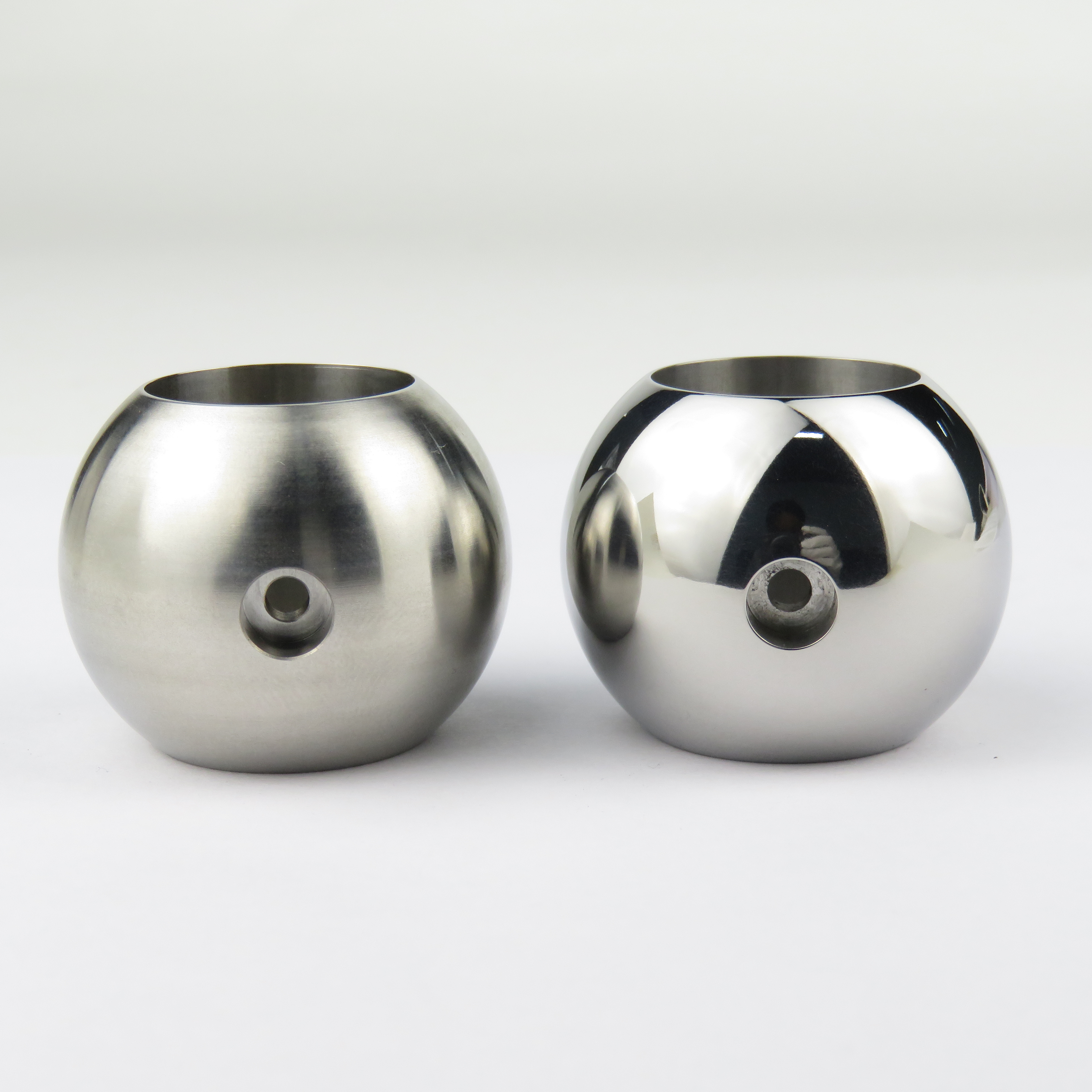
The buyer wants the weld repairs dressed and the outside cleaned up without rounding the flange face or leaving medium in the seawater passage.
Send the material, dimensions, approximate weight, batch quantity, the incoming condition and photographs of the difficult features. Mark which features must not be contacted by media and state how the result will be inspected. This form carries source reference PSEO-0886; quote it if you prefer an additional manual reference.
Open the SurfacePolish enquiry form Email a prepared enquiry
No price, lead time, certification or result is promised here. Confirm whether a sample trial is available for the specific part and what the trial can and cannot show.
Page PSEO-0886 · revised 2026-09-29 · cross-border equipment, media and scoped sample review. City context is sourced and cited above.
Use this local checker to identify missing part and inspection information. It prepares a technical-review brief; it does not approve a machine, process recipe or production result.
Complete the part details to prepare a review brief.
Email : info@surface-polish.com


 IPv6 network supported


 +86-592-2381506