A precision turned parts supplier in Florence, Italy in robotics and automation has a mixed batch of small stainless bushings and pins that need a consistent edge break without media trapped in the cross-holes. SurfacePolish supplies finishing machines, media and compounds across borders and offers a free sample trial: a representative batch travels to Xiamen and returns with observations and a proposed media, compound and cycle direction for the buyer to compare. This brief is written for a buyer in Florence working on robotics and automation; it describes equipment, media and a scoped sample review, not a local polishing service.
What is the size and mass spread inside one part family, and does one machine have to cover both a heavy casting and a small gripper jaw?
What is the smallest hole, slot, keyway or cross-drilling the charge must not enter or plug, and how will a lodged medium be detected and removed?
What does the finishing step actually have to deliver before the next operation, whether that is assembly, anodising, painting or a functional test, and who defines that requirement?
Automation work mixes scales in a way that catches buyers out. The same shop may finish a 40 kg robot base casting and a 30 g gripper jaw, and a machine sized for the casting will over-work the jaw. Load ratio, the mass of parts against the mass of the charge, is the variable that usually decides whether small parts come out even or rounded. Screen the family on its extremes: the heaviest part, the largest envelope, the thinnest unsupported wall and the smallest part that must meet the same appearance. Long linear-axis beams and thin cover plates distort under their own weight in a deep bed, while heavy castings need a chamber large enough to keep them moving. A shortlist built on the average part will miss both ends of the range.
Rotary barrel finishing is the gentle end of the range. Parts tumble in a closed drum, usually with plastic or light ceramic media and a generous compound flow, so direct impact is limited and small fragile components such as spools, pins, bushings and screw-machine parts survive. Cycles are long and the drum hides the work while it runs. Magnetic finishing works differently: a small charge of pin-shaped or fine media is driven by a moving field into narrow gaps, small bores and fine internal radii that tumbling media cannot enter, which suits precise items such as orifice plates, small valve spools and fine slot arrays. Its working envelope is small, the pins are a lodging risk in the features they are chosen to reach, and the surface signature differs from tumbling, so a roughness value from one route does not transfer to the other.
| Machine route | Where it fits | What it will not do |
|---|---|---|
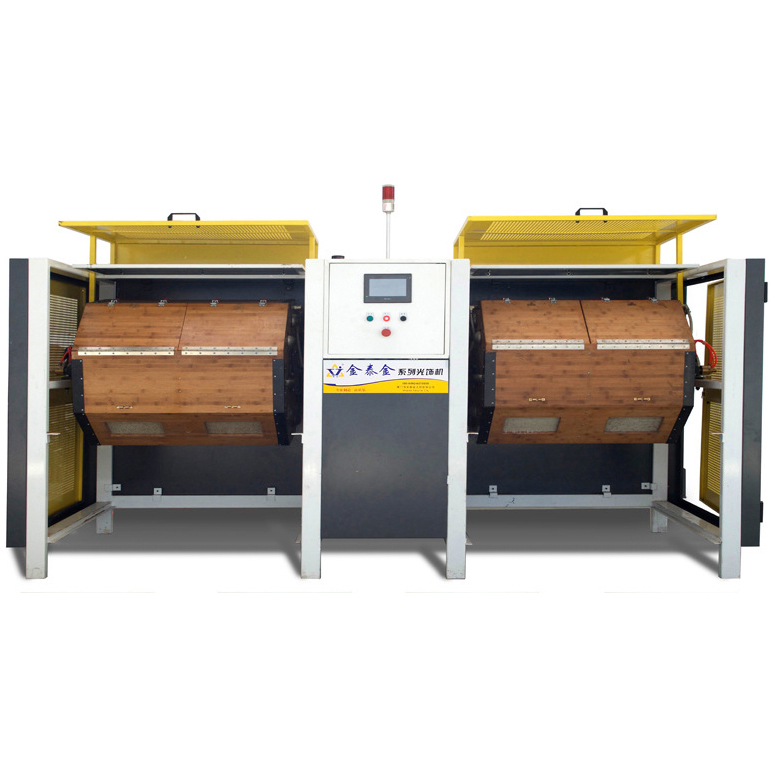
| Dry polishing machine and dryer | Removing residual moisture after a wet cycle and reducing water spotting on aluminium and stainless surfaces with pockets and threads | A finishing step only; a dry part can still carry compound film, fines and media dust, so it is not a cleanliness release |
| Magnetic finishing machine | Fine deburring and light refinement of small precise features such as small bores, narrow slots and fine internal radii | Small working envelope that excludes housings and long parts, with pin media that can lodge in the fine features it reaches |
| Tub vibrator | Long parts such as linear-axis beams, manifolds and welded frames that cannot rotate in a bowl | Lower energy per unit area so heavy burrs take longer, and large tubs need floor space and a reliable part support method |
| Grinding finishing machine | Taking off a heavy machining burr, dross or a defined stock layer before a refinement pass on robust steel and stainless work | High removal energy cuts functional edges fast and demands a tighter assessment of what may be removed and how much |
Compound carries debris away, keeps the media from loading and buffers the chemistry against the metal. Alkaline and neutral families are common for general deburring and cleaning; acidic families may be chosen where a descale or brightening effect is wanted; silicate-bearing products can leave a tenacious film that is hard to remove from a bore or a sealing land. On aluminium an effective corrosion inhibitor usually matters, because the wrong chemistry darkens the surface during or after the cycle. Concentration, flow and temperature shift the result, so dosing should be metered rather than judged by eye, and rinse water hardness, chloride content and suspended solids all affect foaming and what remains behind. Where an anodise or paint step follows, the film and smut left by the cycle become the buyer's problem, so define how the surface will be checked.
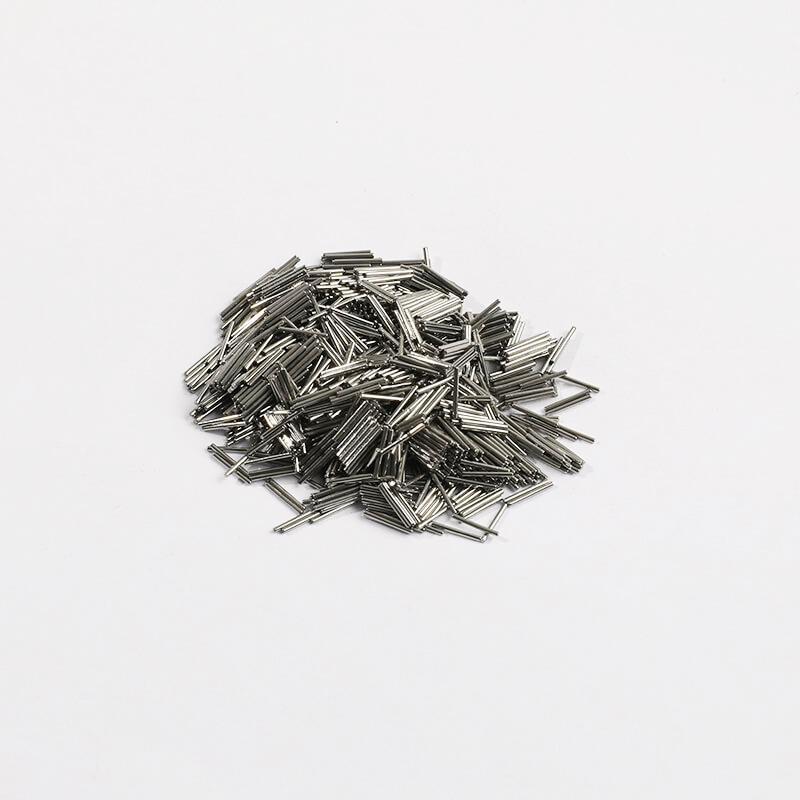
| Media | Best fit | Watch out for |
|---|---|---|
| Aluminium oxide grinding media in a dense ceramic bond | Heavier stock removal or a more consistent cut on robust steel and stainless parts with thick edges and a defined layer to remove | High removal energy rounds functional edges quickly and is a poor match for thin aluminium plates, cast housings and bore lips |
| Dry media such as walnut shell and corn cob | Drying assistance and light surface polish after a wet cycle, particularly on parts with pockets and threads that must not stay wet | Does not deburr or refine metal significantly, generates dust, and must not be treated as a cleanliness step |
| Heavy-cut ceramic, angle-cut triangles in a coarse size class | Removing a substantial milled or turned burr from open external edges and pockets on steel and stainless automation parts before a refinement stage | Cuts functional edges and corners aggressively, leaves a coarse surface on aluminium, and lodges in slots whose width approaches the media section |
| Magnetic finishing pins and fine magnetic media | Small precise items such as spools, orifice plates, small valve parts and fine slot arrays where tumbling media cannot reach the feature | Limited working envelope, pins lodge in the same fine features they are chosen to reach, and the surface signature differs from tumbling |
Edge rounding beyond limit is the failure that most often turns a finished automation part into scrap, because the features that round first are the ones that set position. A bearing bore lip, a dowel hole edge, a seal groove corner or the edge of a ground mounting land can lose a fraction of its geometry under a high-energy charge and still look uniform and polished. Coarse or dense media, an over-long cycle and a heavy load ratio all accelerate it, and aluminium rounds faster than stainless under the same conditions. Because the damage is invisible to a casual look, checking has to be deliberate: measure the feature before and after with an optical comparator, a radius gauge or a moulded replica, and compare the result with the limit on the drawing. Masking, a shielding fixture or a gentler medium are the usual mitigations to test.
| Failure mode | Likely cause | How to catch it |
|---|---|---|
| Grey aluminium smear transferred onto stainless parts in a shared batch | Aluminium fines retained in media, compound or the machine sump after an aluminium lot, with no purge before the stainless lot | Check stainless surfaces under angled light for a dull grey film, review the changeover record, and inspect the charge and sump for retained fines |
| Bearing bore, bore lip or dowel hole edge rounded past the drawing limit | High-energy route, over-long cycle, dense or coarse media, or a functional edge run without masking or a shielding fixture | Measure the defined edge feature before and after with an optical comparator, radius gauge or moulded replica, and compare it with the maximum radius on the drawing |
| Compound film, smut or tenacious residue left on a face or in a bore | A film-forming or silicate-bearing compound, insufficient rinse volume, or drying a part before it is genuinely clean | Magnify the suspect surface, wipe a defined area with solvent against a clean reference, and confirm with the buyer's own cleanliness method |
| Threads rounded, galled or opened out by edge finishing | Media working the thread crest during a long or high-energy cycle, with no plugging or masking on the hole | Run go and no-go thread gauges on every sampled hole, inspect the crest at magnification, and confirm that plugs or masks were fitted and removed |
Florence's provincial economy is dominated on the export side by pharmaceuticals: the Chamber of Commerce reports that intra-group logistics and processing traffic in the pharmaceutical sector now weighs more than half of total provincial exports (s1), and that sector turnover grew +5.4% in the first quarter of 2026 and +8.5% in the second (s2). Manufacturing production rose +1.6% year on year at the start of 2026 and moderated to +0.4% at mid-year, with the pharmaceutical component carrying the aggregate (s2). Provincial exports reached EUR 16.4 billion in the first half of 2026, +3.3% year on year, and EUR 35.1 billion on a rolling-year basis, after 2025 growth of +41.4% and more than EUR 34 billion that the chamber attributes partly to pharmaceutical flows and to US-bound frontloading (s1, s3). Away from pharmaceuticals the chamber describes traditional manufacturing sectors as showing weaker dynamics and the fashion system as being in reorganisation (s1). The Florence metropolitan area also carries a documented electronics, radar, optronics and space-navigation manufacturing base, and the local Confindustria association is promoting a Tuscan aerospace district (s4). The Chianti Classico wine zone has its two capital cities in Florence and Siena (s5).
The nearest part of that base to this brief is medical: The pharmaceutical sector weighs more than half of total provincial exports and its turnover grew +5.4% in the first quarter of 2026 and +8.5% in the second.
For the pharmaceutical-side base the finishing question is cleaning and residue control rather than cosmetic finish: burr-free stainless and alloy parts, media that will not leave contamination, and a documented cleanliness result per part number. For the electronics, radar and optronics manufacturing that the local Confindustria association describes, edge quality and surface condition on machined housings, waveguide and antenna components affect both assembly fit and electrical performance. Because pharmaceutical output here is export-driven and audit-heavy, surface and cleanliness results normally have to be recorded against a specification the customer already holds, not demonstrated on a sample alone.
The first question is whether the part is destined for the pharmaceutical or electronics base, because that decides whether the controlling requirement is a cleanliness and residue limit or an edge and surface-texture tolerance. For the pharmaceutical side it is worth establishing up front which cleanliness specification and which sampling method will be used for acceptance, since that choice constrains both the process and the media.
Freight context: Porto di Livorno, Aeroporto di Firenze-Peretola (FLR). The freight evidence available for Florence in this session is trade value rather than hub throughput: EUR 16.4 billion of exports in the first half of 2026 and EUR 35.1 billion on a rolling-year basis, with the pharmaceutical component distorting the provincial averages (s3). The Tuscan port and airport gateways named above are regional geography and were not verified against an authority page here, because the Livorno port authority site served a JavaScript challenge and the Toscana Aeroporti site returned HTTP 403 to every request made from this session.
Business is conducted in Italian; quotations, drawings, technical dossiers and declarations of conformity are normally expected in Italian, and correspondence in English is workable but rarely sufficient for a purchase order or for a conformity file. Italian industrial buyers qualify suppliers through a documented process: a part drawing with surface-texture indications, a sample or trial batch, and written acceptance criteria are the usual gate before a machine or media is specified into production. Payment and documentation norms follow Italian/EU practice - the importing entity's VAT and EORI details, invoice data matching the customs declaration, and standard EU commercial terms - so a cross-border seller should expect the conformity documentation (declaration of conformity, technical file, material certificates) to be requested before, not after, delivery.
Italy applies the EU's common commercial policy to imports from China, so Chinese industrial machinery enters under the EU Common Customs Tariff, where the duty rate depends on the type and origin of the goods and the working tariff is TARIC. Istat's August 2026 extra-EU trade release records a 16.0% year-on-year increase in Italian purchases from China, alongside strong growth from India, OPEC and Mercosur, so China remains one of the fastest-growing sources of Italian imports. Anti-dumping and other trade-defence measures apply case by case to specific product categories rather than to finishing machinery in general, so the applicable rate must be checked against the specific commodity code before a quotation is finalised.
SurfacePolish supplies from Xiamen, China. The buyer's own destination rules, conformity marking, tariff classification and documentation responsibilities stay with the buyer; confirm them against the authorities named above before ordering.
Acceptance has to exist before a trial, in the drawing and the purchase specification, not as a verbal understanding afterwards. Name each controlled surface separately, because a bearing bore, a mounting land and an external cover will not respond to one media charge in the same way. State the parameter, the cut-off length, the measurement direction and the number of readings at each location. Where an edge limit applies, express it as a maximum radius or a required chamfer at a named feature rather than as a word such as deburred. Add the cleanliness requirement the part must meet and the method by which it will be judged, and say which faces are exempt. Settling those points early avoids the common dispute in which a supplier reports a surface and a buyer rejects on a feature that was never written down.
Scale-up is mostly about holding what produced the trial result. In production that means a media charge kept at a target mass, screened on a schedule with undersize and broken pieces removed and fresh media added to a recorded level. Compound should be metered to a concentration rather than poured by eye, and rinse water quality should be known and stable. Every lot needs an identity: part numbers, quantity, machine, media charge, compound, cycle time, operator, inspection result and disposition. Where the same machine handles aluminium and stainless, define the changeover, including media purge, machine cleaning and compound replacement, and record when it happened. Cycle counting is a simple control that is often skipped: a charge that has run a known number of hours can be scheduled for replacement before wear starts producing lodged media or a drifting finish.
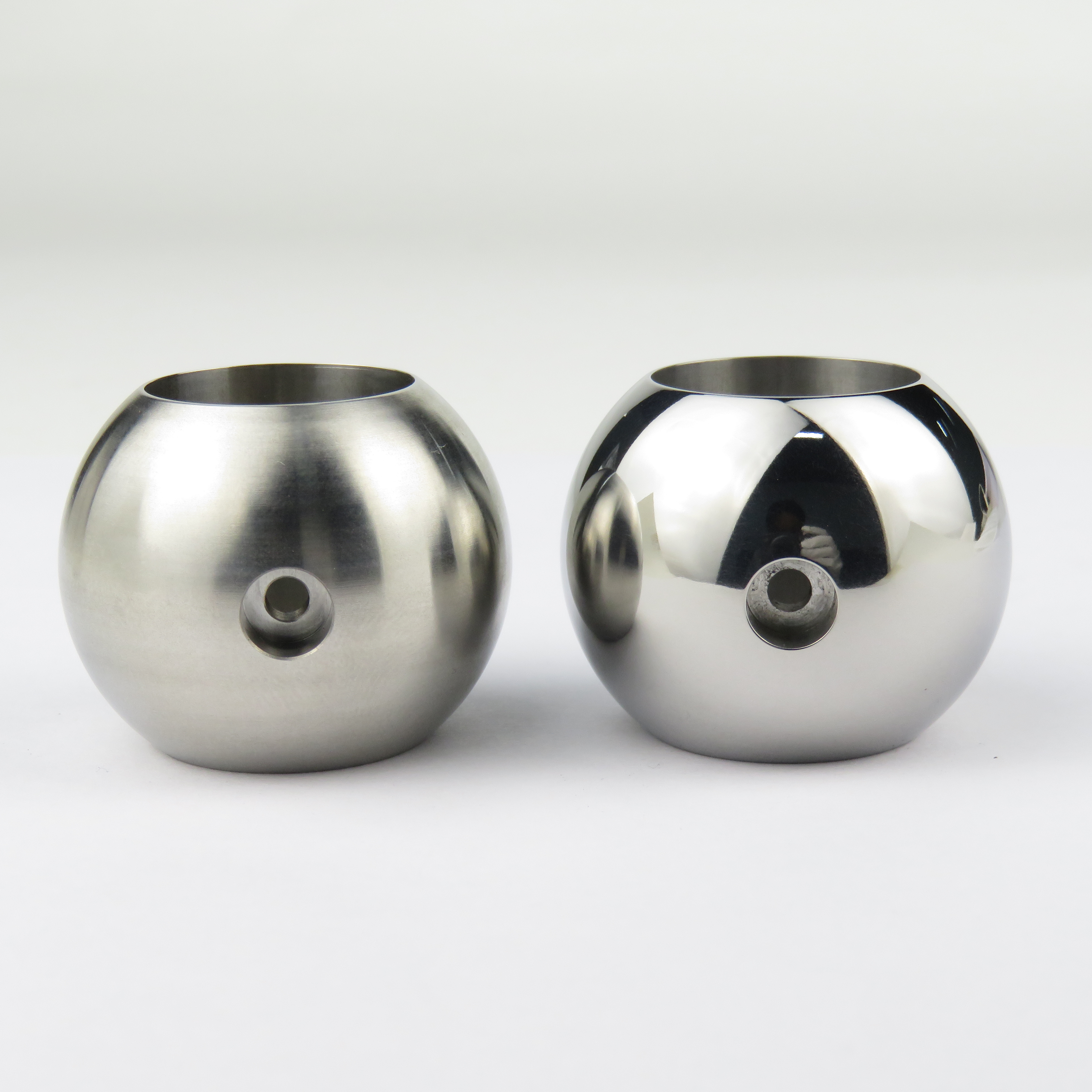
Ask for a record that identifies what was done rather than one that asserts a result. A useful record lists the part numbers and quantities in the lot, the machine used, the media type and size class, the charge mass and its age since the last screen or top-up, the compound and dose, the rinse water source, the cycle time, any interruption, the inspection results and the lot disposition. Request the media and compound data sheets. Where aluminium and stainless are processed on the same site, ask for the changeover note covering media purge, machine cleaning and compound replacement. This is finishing process documentation, not a certificate of compliance.
Yes. The offer is cross-border supply of finishing machines, media and compounds, together with a free sample trial and a scoped discussion of a finishing line concept. That means machine class, media and compound are considered as one question rather than three purchases, since a charge that suits one chamber may not suit another. The buyer keeps ownership of the part, the drawing and the acceptance criteria, and we do not verify the material, the upstream machining or the heat treatment. Bring the part family, the alloys, the size range and the features that must be protected into the discussion, along with the condition the parts arrive in.
A bore cannot be protected by the cycle alone; it is protected by what is decided before the cycle. Masking or plugging the bore, keeping the part out of contact with heavy neighbours, choosing a lighter route and shortening the cycle all reduce the load the bore sees, but none of them guarantees a dimension. That is why the bore must be measured before and after at the same points, with a bore gauge or CMM, and compared with the drawing limit. SurfacePolish does not promise a tolerance or a result; the trial reports what was observed on the parts tested, and the dimensional acceptance decision stays with your own metrology and quality functions.
Use Florence, Italy as the destination on the enquiry and state whether the deliverable is equipment, media and compound, a representative sample review or a line concept. A destination does not imply local stock, a local service point or a local delivery time.
A Florence buyer would set surface and edge requirements against ISO/UNI surface-texture standards and, for the pharmaceutical-side base, against the cleanliness and residue limits held in the customer's own device or plant specification rather than in a finishing-specific standard. Finishing operations are normally qualified as a process step inside the customer's quality system, and the Tuscan manufacturing associations run technical and standardisation desks for members.
Sources were retrieved on 2026-09-29 and describe the local industrial and trade context only. They do not evidence any SurfacePolish project, shipment, installation or service in Florence.
The buyer needs a repeatable edge break and a uniform appearance across the mixed batch without media lodging in the cross-holes.
Send the material, dimensions, approximate weight, batch quantity, the incoming condition and photographs of the difficult features. Mark which features must not be contacted by media and state how the result will be inspected. This form carries source reference PSEO-0480; quote it if you prefer an additional manual reference.
Open the SurfacePolish enquiry form Email a prepared enquiry
No price, lead time, certification or result is promised here. Confirm whether a sample trial is available for the specific part and what the trial can and cannot show.
Page PSEO-0480 · revised 2026-09-29 · cross-border equipment, media and scoped sample review. City context is sourced and cited above.
Use this local checker to identify missing part and inspection information. It prepares a technical-review brief; it does not approve a machine, process recipe or production result.
Complete the part details to prepare a review brief.
Email : info@surface-polish.com


 IPv6 network supported


 +86-592-2381506