A buyer in Mississauga, Canada working on semiconductor equipment has a slotted stainless distribution plate where edge burrs must go and the sealing face must stay flat and media-free. SurfacePolish supplies finishing machines, media and compounds across borders and runs a free sample trial: the plate travels to Xiamen and comes back with observed results and a proposed media, compound and cycle direction for the buyer's own checks. This brief is written for a buyer in Mississauga working on semiconductor equipment; it describes equipment, media and a scoped sample review, not a local polishing service.
How will a production batch be identified, segregated by material family and documented so a result can be traced to its settings?
What is the smallest internal passage, slot or hole the charge must not plug, and how will a lodged medium be detected and removed?
Which surfaces on this part are functional, such as seal lands, gas passage walls and locating bores, and which are only cosmetic?
Treat every internal feature as a potential media trap and map it before selecting a media size class. Slot widths, blind tapped holes, cross-drilled intersections, tapered gas passages, O-ring groove corners and the annular gap behind a flange are the usual retention points. A useful first pass is to measure the narrowest opening a medium could enter and the depth behind it, then compare that with the smallest medium in the proposed charge. Sharp internal corners and stepped bores hold media differently from through-hole patterns that drain freely. Where a passage cannot be avoided, the process needs a defined retrieval step such as a controlled rinse, an ultrasonic bath, a borescope inspection at an agreed angle or a pin gauge, rather than an assumption that parts come out clean. The exit of the smallest gas passage is often the hardest place to inspect.
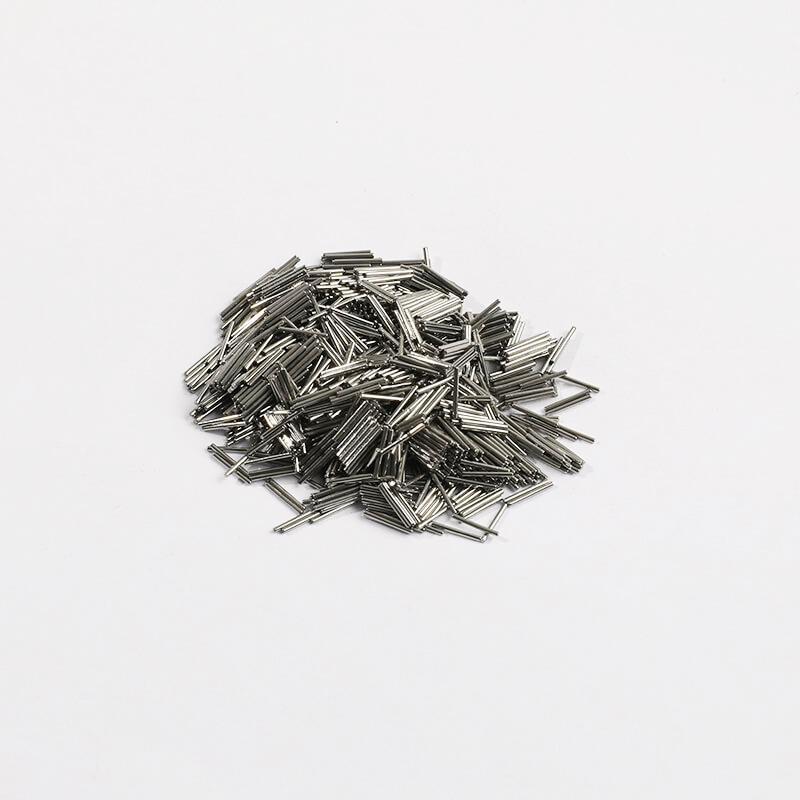
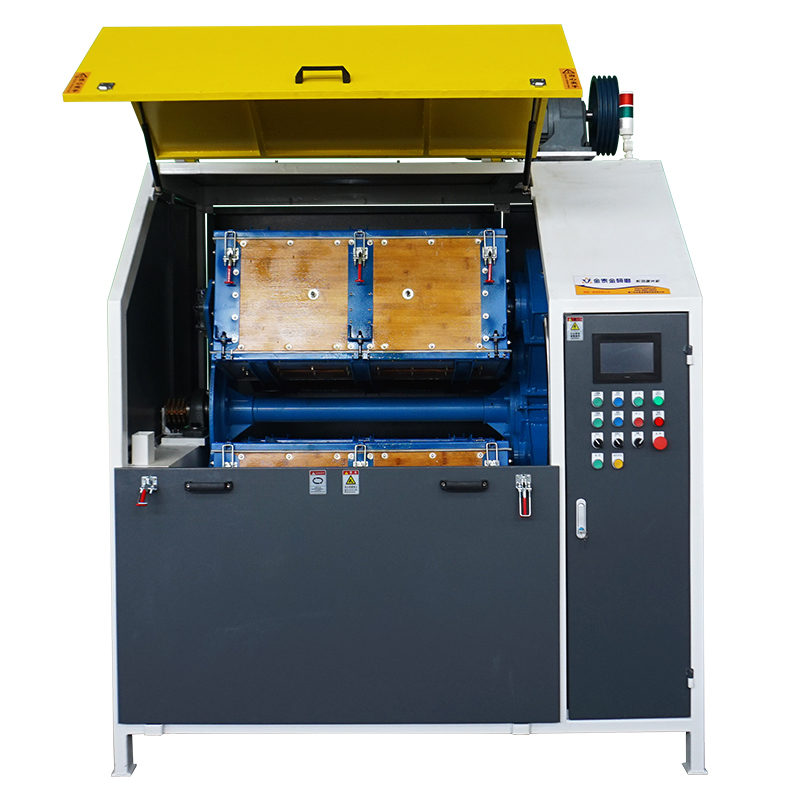
Magnetic finishing uses a small charge of pin-shaped or fine media driven by a moving magnetic field, which lets it reach narrow gaps, small bores and fine internal radii that tumbling media cannot enter. For semiconductor equipment parts it is most relevant on small precise items: gas nozzles, orifice plates, small machined inserts and fine slot arrays where the requirement is deburring and light refinement rather than bulk stock removal. The working envelope is small, so chamber bodies and long gas lines are out of scope. The media pins themselves are a lodging risk in the same features they are chosen to reach, and they are difficult to see inside a closed passage. Magnetic finishing also leaves a different surface signature from tumbling, so a roughness figure obtained on one route cannot be assumed to transfer to another.
| Machine route | Where it fits | What it will not do |
|---|---|---|
| Rotary barrel finishing machine | Gentle deburring of small fragile components and mixed fitting batches with a generous compound flow | Long cycles, no visibility while running, and internal passages can collect media and compound that must be retrieved at unload |
| Magnetic finishing machine | Fine deburring and light refinement of small precise features such as nozzles, orifice plates and narrow slots | Small working envelope that excludes chamber bodies and long gas lines, with pin media that can lodge in fine passages |
| Tub vibrator | Long gas rails, tubular manifolds, weldments and linear electrode assemblies that cannot rotate in a bowl | Lower energy per unit area so heavy burrs take longer, and large tubs need floor space and a suitable part support method |
| Disc finishing machine | Fast, high-energy edge breaking and surface refinement on small robust parts and uniform batches of fittings | High impingement and edge-loss risk on thin or soft parts, and geometry must suit the disc working gap |
Compound choice controls residue as much as it controls cutting. Alkaline and neutral families are common for general deburring and cleaning, acidic families may be used where a descale or brightening effect is wanted, and silicate-bearing products can leave a tenacious film that is difficult to remove from a sealing face or a gas passage. For aluminium, a compound with an effective corrosion inhibitor is usually necessary to avoid darkening and surface attack during and after the cycle. Concentration, flow rate and temperature all shift the result, so dosing should be metered rather than guessed. Water quality matters too: hardness, chloride content and suspended solids affect foaming, rinsing and the residue left behind. The question to put to a supplier is what the compound leaves on the part, how it is removed, and what evidence a buyer can collect to confirm removal.
| Media | Best fit | Watch out for |
|---|---|---|
| Magnetic finishing pins and fine magnetic media | Small precise items such as nozzles, orifice plates and fine slot arrays where tumbling media cannot reach the feature | Limited working envelope, pins lodge in the same fine features they are chosen to reach, and the surface signature differs from tumbling |
| Heavy-cut ceramic, angle-cut triangles in a coarse size class | Removing a substantial machining burr from open external edges and pockets on aluminium and stainless housings before a refinement stage | Cuts edges and corners aggressively, leaves a coarse surface, and lodges in slots whose width approaches the media section |
| Fine ceramic or porcelain spheres in a small size class | Refinement and light edge blending after a cutting stage, and reaching tighter external geometry on chamber bodies and plates | Small sizes enter and retain in gas passages and fine slots; media wear shrinks the charge and changes the finish over its life |
| Steel media, including balls and shaped pins | Bright finishing and edge blending on stainless components where appearance and a burnished surface matter | Transfers iron to aluminium and carbon steel, needs a corrosion-inhibiting compound, and must be separated magnetically or by screen at unload |
Compound film, media dust and embedded particles on a sealing face are the failure mode that most often forces a semiconductor equipment part back through cleaning or into scrap. The face may look acceptable under shop light while carrying a tenacious silicate film, a smear of aluminium, or fine ceramic debris forced into a soft surface. Impingement can also peen media fragments into aluminium, which is difficult to detect without magnification or a wipe test. Likely causes include too little rinse, a compound that forms a film, insufficient separation after the cycle, and drying a part before it is genuinely clean. Inspection should combine magnification of the sealing land, a solvent wipe over a defined area, and the buyer's own cleanliness method. Surface finish alone is not evidence that a face is free of residue.
| Failure mode | Likely cause | How to catch it |
|---|---|---|
| Fine media fragments or aluminium smear embedded in a soft surface | Impingement from too much energy or charge mass, media that has fractured, or cross-contamination from a previous material family | Inspect at magnification under angled light, use a wipe or tape lift on the suspect area, and check the charge for broken media and fines |
| Thin plate or liner distorted, bowed or dimensionally drifted after the cycle | Tumbling load on an unsupported thin section, part-on-part contact, or heat and pressure from a high-energy route | Measure flatness, wall thickness and critical dimensions at the same marked points as the pre-process baseline, using a CMM or surface plate and gauge |
| A ceramic or plastic medium lodged in a blind tapped hole, slot or gas passage | Media size class too close to the opening, a worn charge that has broken down into smaller pieces, or a retention feature that was never mapped | Count the charge in and out where practical, borescope the smallest passages at an agreed angle, pin gauge every hole, and rinse through a filter for a visual residue check |
| Uneven finish with unrefined pockets, corners or the shielded side of a flange | Media cannot reach the feature at the chosen size or orientation, charge flow is blocked, or the part was not repositioned during the cycle | Inspect at defined locations rather than judging the whole part, photograph the same feature before and after, and measure roughness only at the surfaces the drawing controls |
Mississauga is one of the largest manufacturing and distribution municipalities in the Greater Toronto Area, and its economic development agency positions the city specifically around industrial supply chains: Invest Mississauga's leading-industries page invites businesses to "Join a growing community of globally connected businesses and robust supply chains in Mississauga", and it maintains a public economic development data centre for the city. The city's manufacturing base sits inside the Toronto region's food and beverage cluster, which the City of Toronto measures at more than 64,000 workers across the region with more than half of those jobs located inside the city of Toronto itself, leaving a substantial remainder in the surrounding 905 municipalities including Mississauga and Brampton. Mississauga also sits inside the automotive and advanced-manufacturing belt of southern Ontario, whose supply chains the federal government is actively supporting: FedDev Ontario announced a combined repayable investment of over CAD 12.5 million for Hamilton-area businesses alone as they "respond to tariff-related pressures, strengthen domestic supply chains, and position themselves for long-term growth".
The nearest part of that base to this brief is automotive: Federal regional development funding for the southern Ontario manufacturing belt is framed around helping area businesses respond to tariff-related pressures and strengthen domestic supply chains, with over CAD 12.5 million announced for nine Hamilton-area manufacturers including steel, welding and automation firms.
Mississauga's manufacturing mix of food and beverage processing, metal fabrication and automotive-tier parts creates three distinct finishing problems in one city: stainless process and packaging equipment where weld dressing and cleanable surfaces are required, sheet-metal and fabricated enclosures where a uniform finish on visible surfaces is part of the delivered product, and machined or stamped metal components where burrs interfere with assembly, sealing or coating adhesion. Because much of this work is high-mix and short-run, the practical constraint is changeover time and the cost of dedicating a finishing step to a small batch, which is what drives interest in flexible batch machines rather than large dedicated lines.
A Mississauga buyer should settle the batch-size and changeover question before choosing equipment, because a high-mix fabricator or food-equipment builder will lose more money to media changeover and cleaning between jobs than to slow cycle times within a job. The second question is whether the finishing step is there to protect a downstream process — coating adhesion, sealing, or a customer's burr limit on an automotive drawing — in which case the acceptance criterion and the inspection method need to be agreed in writing before the machine is specified.
Freight context: Toronto Pearson International Airport (immediately adjacent to Mississauga), CN and CPKC intermodal terminals in the Greater Toronto Area, Port of Toronto (inland marine gateway), Greater Toronto Area 400-series highway freight network. Mississauga's principal logistics advantage is its position directly beside Toronto Pearson International Airport, which makes air freight of sample parts, media and urgent spares practical, combined with dense rail intermodal and highway freight capacity across the GTA. Machines arriving from Asia would normally land at a coastal container port and be railed or trucked into the GTA, with the Port of Toronto providing an inland marine option for bulk and project cargo.
China is one of Canada's ten principal merchandise trading partners and the second-largest single-country source of Canadian imports after the United States: Statistics Canada reported CAD 5,369 million of balance-of-payments imports from China in January 2025, against a CAD 2,299 million bilateral merchandise deficit that month. Canada has no free trade agreement with China, so Chinese-origin industrial machinery enters under the Most-Favoured-Nation (MFN) tariff column of the Canadian Customs Tariff; the preferential treatments listed in the tariff (CUSMA/UST and MXT, CETA/CEUT, CPTPP/CPTPT, UKT, KRT and others) do not include China, and preferential rates require proof of origin plus the applicable shipping rules, so a China-origin machine cannot claim them. Tariff classification is mandatory work, not a formality: vibratory, barrel, centrifugal and disc finishing machines are classified in Chapter 84 ("Nuclear reactors, boilers, machinery and mechanical appliances; parts thereof") according to the function of the machine, and the ten-digit Canadian tariff item drives both the duty rate and the statistics. A further landed-cost risk sits outside the tariff schedule: under the Special Import Measures Act (SIMA), the CBSA and the Canadian International Trade Tribunal may apply anti-dumping and countervailing duties to named goods, so a buyer should check the measures-in-force list for the specific product before assuming the MFN rate is the final duty.
Canada is a bilingual market for selling purposes: English is the working language of procurement outside Quebec, while Quebec buyers (Montreal, Quebec City) normally expect French-language quotations, technical documentation and after-sales support, and Quebec's Charter of the French Language makes French the default for commercial documentation in the province. Procurement expectations are formal and auditable: a Canadian industrial buyer will typically ask for the tariff classification and country of origin up front, expect a commercial invoice that satisfies the CBSA invoice requirements, and expect the seller to provide proof of origin for any preferential claim. Payment norms are bank-to-bank, with wire transfer or letter of credit rather than platform payment, and Canadian buyers commonly net-30 to net-60 from invoice, so a cross-border seller should price the working-capital gap into the offer. Certificates of origin for export documentation are issued through chambers of commerce, which is why chambers such as the Hamilton Chamber of Commerce and the Winnipeg Chamber of Commerce offer document certification. The current trade environment adds policy risk to landed cost: Canadian federal programs are explicitly framed around responding to U.S. tariffs, with the FedDev Ontario Regional Tariff Response Initiative described as supporting "businesses to respond to tariff pressures" in southern Ontario, and tariff and surtax measures can change by Order in Council, so quotations should state the tariff basis and the date on which the landed-cost calculation was made.
SurfacePolish supplies from Xiamen, China. The buyer's own destination rules, conformity marking, tariff classification and documentation responsibilities stay with the buyer; confirm them against the authorities named above before ordering.
Functional checks catch the failures that visual inspection and roughness measurement miss. On a vacuum part that means the buyer's own leak test on the assembled component, which is the only way to see a seal land that has been rounded or a residue film that opens a virtual leak path. On a gas line it means a flow check against a reference part, since an internal burr or a lodged medium changes conductance. Dimensional verification belongs on a CMM or with hand gauges at the features that can move: slot widths, bore diameters, flange flatness, position of dowel holes and wall thickness on thin parts. Thread gauges confirm that a tapped hole was not rounded out by edge finishing. These checks are performed by the buyer's quality function against the buyer's limits; a finishing report is supporting evidence, not a qualification.
A sample trial answers a narrow question: what happened to these parts under these settings on this equipment. It does not prove that a production lot will be uniform, because bowl size, load ratio, media age and operator practice all shift the outcome. It does not establish a particle count, a cleanliness level or fitness for a cleanroom or any regulated process environment, and it does not transfer a roughness value from a coupon to a complex geometry. It cannot guarantee a cycle time, a cost per part, a capacity or a delivery schedule, and it does not qualify a machine, medium or compound for a semiconductor application. Treat the returned parts and the settings record as evidence for the buyer's own engineering decision, and plan the production route with its own first-article and sampling discipline.
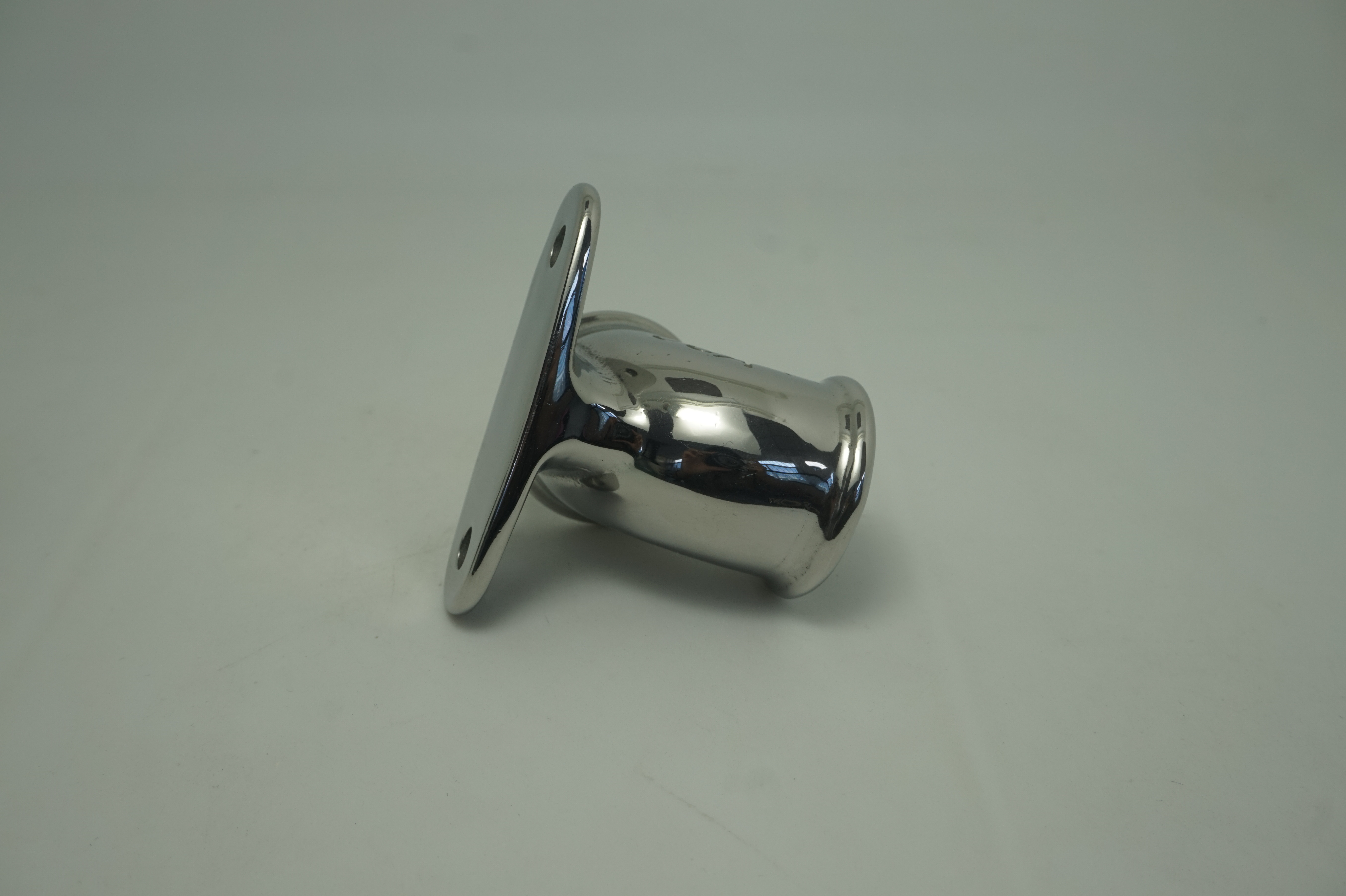
It can change a surface, but whether it lands inside a specified band is something to measure rather than assume. The parameter, the cut-off length, the measurement direction and the reading locations all have to be fixed first, because a seal land, a bore and an outer wall respond differently to the same charge. A trial result applies to the geometry and settings tested, not to every part in the family. SurfacePolish does not guarantee a roughness value. Send parts with a marked measurement plan, ask for readings at those points, and set your own acceptance band from data you can verify in Mississauga.
There is no single best medium, because aluminium is soft and the trade-off is between cut rate and surface damage. Plastic media is often the safer starting point where a sealing face or a thin wall must be preserved, while a fine ceramic can cut faster if edges tolerate more energy. The deciding variables are the smallest opening a medium could enter, the smallest radius that must not be rounded, and the surface condition the buyer needs. Media size class usually matters more than the broad material name. Send a marked-up aluminium part with its tightest passage and one controlled face, and let the trial compare two size classes.
A batch record should identify what was done rather than simply assert a result. Ask for part numbers and quantities, the machine used, the media type and size class, charge mass and age since the last screen, the compound and dose, the rinse water source, cycle time, inspection results and the lot disposition. Request the media and compound data sheets offered by the supplier. Where aluminium and stainless are processed on the same site, ask for the changeover note covering media purge, machine cleaning and compound replacement. This is finishing process documentation, not a certificate of compliance, and it supports your own traceability in Canada.
Use Mississauga, Canada as the destination on the enquiry and state whether the deliverable is equipment, media and compound, a representative sample review or a line concept. A destination does not imply local stock, a local service point or a local delivery time.
A Mississauga buyer references Canadian electrical safety certification of the equipment, Ontario occupational health and safety requirements for guarding and lockout, and — for food and beverage customers — the food-safety expectations that apply to product-contact surfaces and cleaning procedures. Automotive-tier customers add their own drawing-level specifications for burr limits, edge condition and surface roughness.
Sources were retrieved on 2026-09-29 and describe the local industrial and trade context only. They do not evidence any SurfacePolish project, shipment, installation or service in Mississauga.
The buyer needs the slot edges deburred and the sealing face kept flat, with no media left in the slot array.
Send the material, dimensions, approximate weight, batch quantity, the incoming condition and photographs of the difficult features. Mark which features must not be contacted by media and state how the result will be inspected. This form carries source reference PSEO-0155; quote it if you prefer an additional manual reference.
Open the SurfacePolish enquiry form Email a prepared enquiry
No price, lead time, certification or result is promised here. Confirm whether a sample trial is available for the specific part and what the trial can and cannot show.
Page PSEO-0155 · revised 2026-09-29 · cross-border equipment, media and scoped sample review. City context is sourced and cited above.
Use this local checker to identify missing part and inspection information. It prepares a technical-review brief; it does not approve a machine, process recipe or production result.
Complete the part details to prepare a review brief.
Email : info@surface-polish.com


 IPv6 network supported


 +86-592-2381506