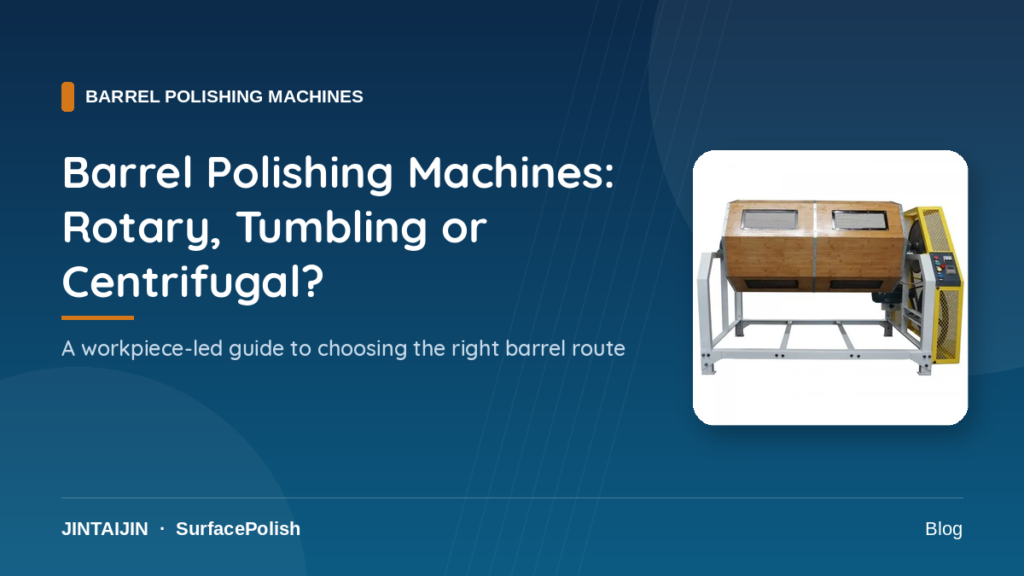
“Barrel polishing machine” sounds like a single product. It is not. The word barrel can mean a drum that turns on its own axis, a container carried around a centrifugal path, or — loosely, in supplier catalogues — a vibratory machine that happens to be cylindrical. Those machines do not create the same contact pattern on your part.
So before anyone quotes a size or a price, it is worth establishing what you are actually buying and what your part has to tolerate. This guide sets out the routes, the questions that separate them, and the facts a supplier needs to answer usefully.
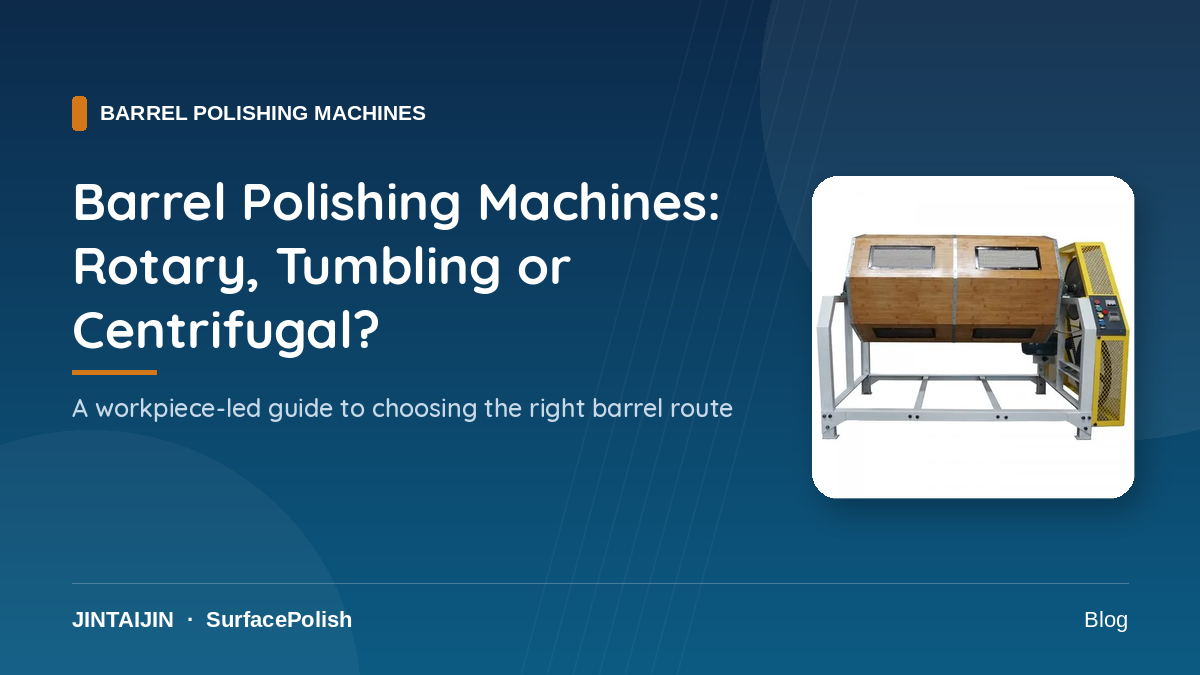
Three different requests get mixed into the same search phrase, and they lead to three different answers.
Deciding which of the three you are actually asking for removes most of the confusion before any technical comparison starts.
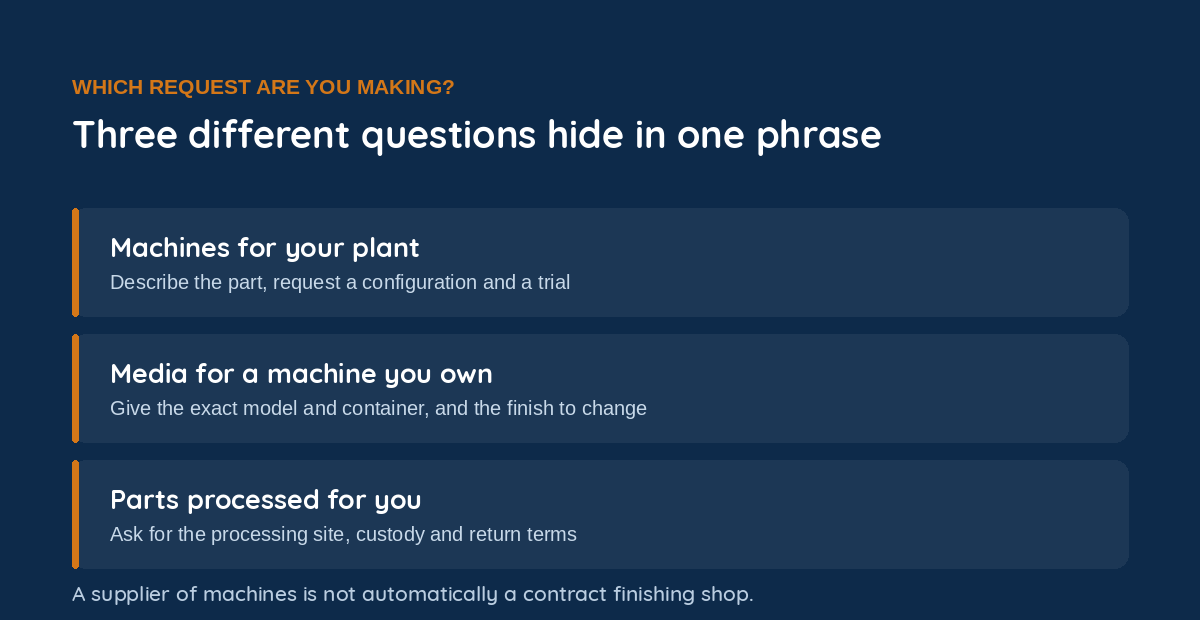
| Route | Motion and configuration to confirm | Main part-specific question |
|---|---|---|
| Horizontal rotary barrel / tumbler | One or more drums rotate about their own axis; chamber shape, compartments, lining and wet or dry setup vary by model. | Will cascading parts and media reach the required faces without unacceptable collisions, lodged media or dimensional change? |
| Centrifugal barrel | Barrels are carried by a rotating machine while their own motion is controlled; the model and container arrangement matter. | Can the part and its delicate features tolerate the proposed load, contact and handling? |
| Vibratory bowl or tub | A vibratory motion moves the load through a different chamber path; separation may be built in or external. | Is this genuinely the better route for the part envelope, the separation and the required contact pattern? |
This is a screening table, not a selection algorithm. Other routes — dry wood or bamboo media, drag finishing, magnetic finishing — may be worth considering when a specific part justifies them. Two assumptions are worth avoiding: that wet is always gentle, and that a shiny part has passed your acceptance method simply because it is shiny.
It is also worth being precise about names. Not every vibratory finisher is a rotary barrel, and a machine described as a “drum” by one maker may be a different configuration at another. Ask for the motion, not the noun.
Four properties of the part do most of the work in narrowing the field:
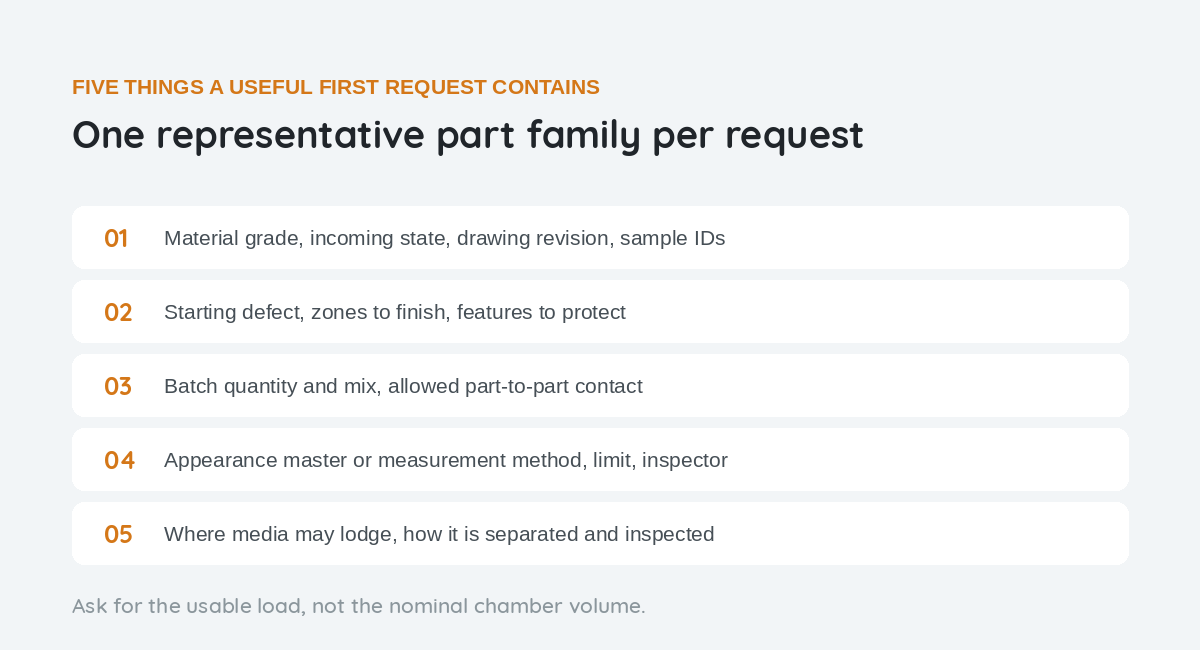
Use one representative workpiece family per request. Mixing several unrelated parts into one enquiry is the most common reason an answer comes back vague.
Then ask the supplier to state the exact offered model and current revision, the usable load rather than the nominal chamber volume, the media and compound, the containment and separation arrangement, the utilities, the settings used in the trial, before-and-after photographs linked to the same sample IDs, measured inspection results and any rejects. Ask for a quote that separates machine, options, starter media and compound, trial, installation, freight and support. Lines that are not quoted should stay not quoted, not silently become zero.
A buyer has small metal fittings with burrs at a cross-hole and a protected sealing face. The only input provided is “barrel polishing machine”. The honest answer is that the part and the acceptance definition are missing: there is no drawing of the cross-hole, no stated acceptable edge condition, no sealing-face criterion, no part count, and no method to confirm that no media remains.
With the part data in hand, a horizontal rotary barrel, a centrifugal barrel and a vibratory route can each be trialled or ruled out on evidence. No model, cycle time or finished-part claim follows from the search phrase alone — and any supplier who offers one without the part data is guessing.
They produce different contact patterns, and the comparison depends on the part. A high-energy route may reach a result in fewer passes, but it also applies different forces to edges, thin walls and cosmetic surfaces. Treat any blanket speed claim as a question to test on your parts, not a specification.
Sometimes, for some parts. Barrel routes tend to suit smaller parts in larger batches, and they process parts in bulk contact; vibratory routes handle many long or flat parts differently and often allow easier in-process inspection. The deciding factor is usually geometry and the feature you must protect.
The mass of parts and media a process can actually work effectively — which is not the same as the volume or the maximum weight the container can physically hold. Quoting a chamber size alone does not tell you what the machine will finish well.
You can get a useful answer from a well-documented part, and that is often enough to narrow the route. But where a protected feature, an edge condition or a media-lodging risk is involved, a sample trial is what turns a plausible recommendation into evidence about your part.
Decide what you are buying, describe the part and the acceptance rule, and ask for the motion and the usable load rather than the noun. That sequence makes the answers from different suppliers comparable — which is the point of an enquiry.
SurfacePolish supplies finishing machines, media and compounds across borders and reviews sample parts to report what was observed on the parts tested. It is not a local contract finishing shop, and a sample review is not a production approval, a certification, or a promise about finish, cycle time, price or delivery. To go further, review the application notes, the machine families and the media and compound ranges.
Email : info@surface-polish.com


 IPv6 network supported


 +86-592-2381506