
Centrifugal Barrel Finishing Machine: How It Works and How to Specify One
A centrifugal barrel machine is not a faster vibratory machine. It is a different geometry that trades loading convenience for contact pressure, and that trade changes which parts it suits.
If you are still deciding between the three finishing routes — rotary barrel, vibratory, or centrifugal — that decision belongs on a different page: barrel polishing machines. If you have already narrowed it to the centrifugal family and now need to choose between the disc and the barrel type, that comparison is here: centrifugal disc vs barrel. This page assumes the barrel type is your candidate and covers how it works, when it is the wrong choice, and how to write a specification.
What a Centrifugal Barrel Machine Actually Does
Buyers searching for a centrifugal barrel finishing machine usually have parts that take too long in a vibratory bowl or suffer nicks in a standard tumbler. A centrifugal barrel finisher — or centrifugal barrel tumbler — solves both through planetary centrifugal force, delivering the highest contact pressure among our barrel finishing machines.
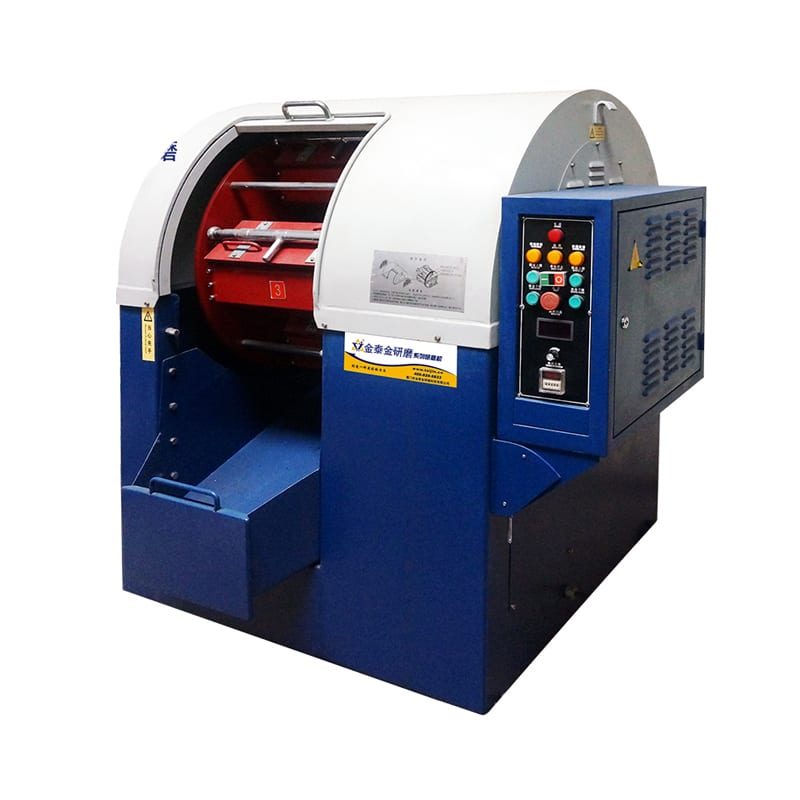
The three motions in one machine: turret, barrels, media
A centrifugal barrel machine works like a high-speed Ferris wheel, combining three simultaneous motions inside one frame:
- Main turret rotation: A central turret wheel spins on a horizontal shaft, carrying sealed drums around its rim.
- Barrel counter-rotation: Belts, chains, or gears drive each drum on its own axis opposite the main turret.
- Compacted media sliding: Inside each drum, parts, media, water, and compound press against the outer wall while sliding smoothly.
Note: The planetary motion — main turret rotation with counter-rotating sealed drums — is explained in the text above rather than shown as a separate diagram.
Why the barrels counter-rotate
If the drums were locked stationary on the turret, centrifugal force would pin parts and media against the outer wall like laundry in a spin dryer. Counter-rotating each barrel pulls the compacted mass back around the drum axis into a dense sliding pack, giving pure sliding abrasion without airborne part collisions.
What the high-G condition changes compared with a vibratory machine
Inside a vibratory bowl, cutting pressure comes only from normal gravity and media weight. Inside a centrifugal barrel, planetary rotation generates multiple times normal gravity inside each drum, changing process behavior in three ways:
- Faster stock removal: Multiplied contact pressure forces abrasive grains into tough stainless or titanium burrs that vibratory bowls barely polish over.
- Part-to-part separation: Because the media pack is compressed under high force, workpieces stay trapped and cushioned inside the media matrix rather than striking neighboring parts.
- Isotropic surface texture: Multi-directional sliding under high pressure produces a uniform, non-directional finish often called centrifugal iso finishing on gears, bearings, and medical implants.
Where the name "Harperizing" comes from
Older aerospace and medical drawings often specify "Harperizing" rather than centrifugal barrel finishing. Named after the Harper company, the term simply refers to planetary centrifugal barrel tumbling in a sealed counter-rotating drum.
The Two Families Under the Centrifugal Name
Buyers searching for a centrifugal finishing machine or centrifugal polishing machine often mix up the two distinct architectures that share the centrifugal label: barrel machines and disc machines.
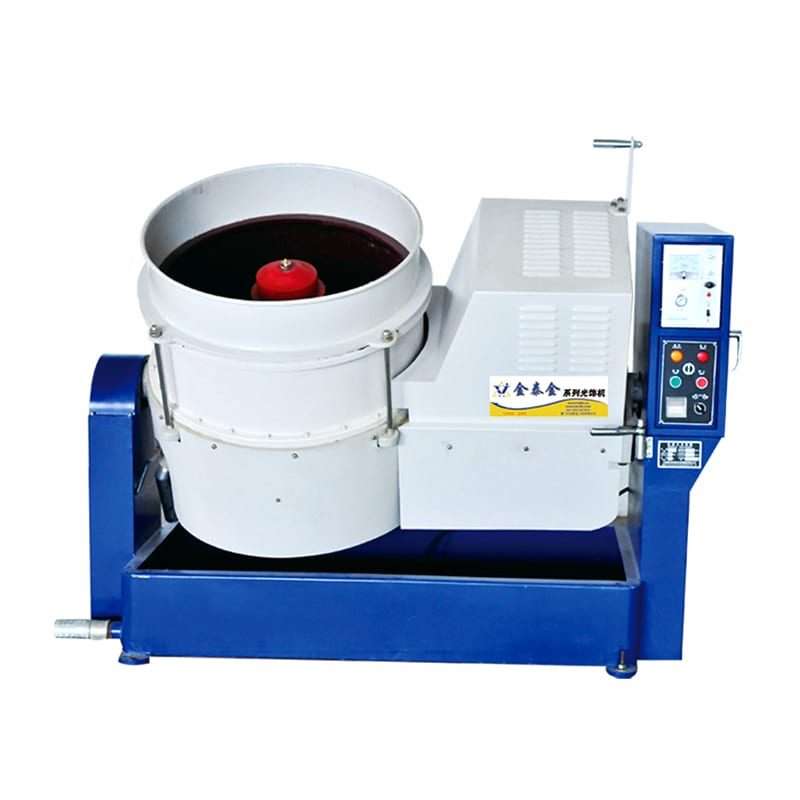
Barrel machines — sealed drums on a turret
In a centrifugal barrel machine, such as our OBD-BJ series, the chambers are enclosed, rubber-lined polygonal drums mounted around a rotating turret. Operators load a measured charge of media, parts, water, and compound, clamp the watertight cover shut, and run a sealed batch cycle.
Disc machines — open bowl with a spinning disc at the bottom
In a centrifugal disc finishing machine — or centrifugal disc finisher, like our CF series under disc finishing machines — an open polyurethane bowl sits above a spinning floor disc. That disc drives parts and media in a continuous roll.
Why they are not interchangeable
These two machines are not interchangeable. An open disc machine flushes continuously, loads fast, and automates easily, but the gap between the spinning disc and stationary wall can pinch paper-thin parts.
A barrel machine seals the batch inside a closed drum with zero disc gap and generates higher sliding pressure for heavy cutting or mirror burnishing. The trade-off is slower batch unloading between cycles.
Which one takes which part
Choose a disc machine for high-volume batches of small, robust stampings or fittings that need rapid deburring and fast turnaround. Choose a centrifugal barrel when parts are delicate, thin, or high-value, when you need a heavy radius or mirror burnish, or when thin edges would jam a disc gap.
When a Centrifugal Barrel Is the Right Answer (and When It Is Not)
Most equipment brochures act as if a centrifugal deburring machine can process every part in your shop. In reality, high-energy planetary tumbling has sharp physical boundaries.
Four conditions that point to centrifugal barrel
A centrifugal polisher is the strongest candidate when your job meets one or more of these four conditions:
- Small, high-value parts that cannot tolerate nicks: Bone plates, dental brackets, watch cases, and aerospace fittings stay separated inside the compacted media.
- Tough alloys that stall vibratory bowls: Titanium, Inconel, tool steels, and nitinol respond quickly to high-G sliding pressure.
- Isotropic pre-polish or mirror burnishing: Turbine blades, implants, and gear teeth receive uniform smoothing across roots and flanks.
- Thin stampings that jam open disc gaps: Reed valves, shims, and tiny washers stay safely inside a sealed drum.
Three conditions that point away from it
Conversely, three part conditions tell you immediately that a centrifugal barrel is the wrong machine:
- Large, bulky, or heavy castings: Barrel mouth openings and drum diameters limit part size. A part without ample media clearance will bruise the liner or collide with the wall.
- Long shafts, extrusions, or wide flat plates: Elongated parts cannot turn end-over-end inside a compact drum and belong in a rectangular trough vibrator.
- Deep, narrow blind holes requiring bottom deburring: Compacted ceramic or plastic media cannot circulate into the dead end of a deep blind bore; use magnetic pins instead.
Use the four-column decision table below to verify whether your part belongs in a centrifugal barrel.
| Your Part Situation | Use Centrifugal Barrel? | Why It Works or Fails | Better Alternative if No |
|---|---|---|---|
| Small precision parts needing a nick-free mirror luster | Yes | Compacted media cushions parts and prevents collision | None for loose batch processing |
| Cross-holes and recessed slots needing deburring | Yes | High sliding force pushes fine media through slots | Magnetic pin finisher for ultra-fine holes |
| Large, heavy castings or structural housings | No | Drum diameter and lid opening restrict part envelope | Rectangular tub vibrator or drag finisher |
| Long shafts, rods, or flat sheet panels | No | Insufficient drum length for parts to roll freely | Linear tub vibrator or wide-belt sander |
| High-volume uniform small stampings needing fast deburring | Yes | High contact pressure strips burrs in short cycles | Centrifugal disc finisher for faster unloading |
| Complex thin-walled parts prone to crushing | Conditional | Excessive turret speed or heavy media can dent walls | Variable-speed barrel at low speed or rotary tumbler |
| Deep blind bores with burrs at the bottom | No | Compacted media bridges over deep blind openings | Magnetic pin finishing or thermal deburring |
The honest comparison against vibratory finishing
Buyers often ask whether a centrifugal tumbler will replace their existing vibratory finishing machine. Neither machine replaces the other.
Vibratory finishing runs at lower energy over longer cycles in an open chamber, suiting medium and large parts with easy hoist loading. Centrifugal barrel finishing concentrates high sliding force into a compact sealed drum for small, tough, or delicate parts. Having both machines in the same shop is normal: vibratory bowls handle general deburring and large castings, while the centrifugal barrel handles tough alloys, surgical parts, and fine burnishing.
How to Specify the Machine
When working with a centrifugal polishing company or equipment builder, machine specification starts with your part rather than a brochure code. At our Xiamen plant, founded in nineteen ninety-two, we build equipment across twenty-one machine platforms and six product lines, backed by twenty-four authorized Chinese IP rights.
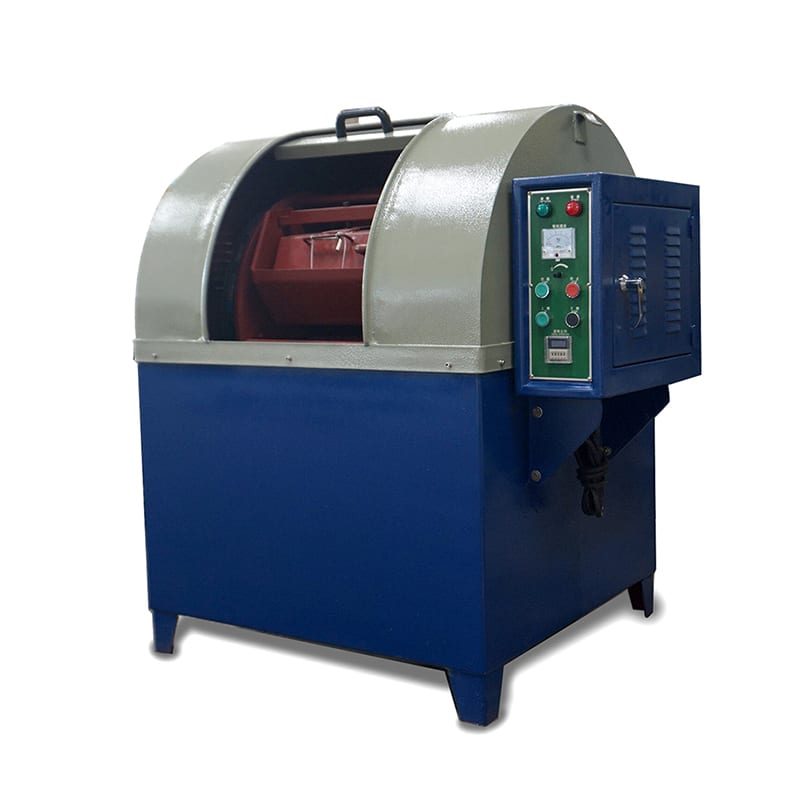
Start from the part, not from the machine
Before looking at turret sizes, lock down four facts about your production part:
- Maximum part size: Internal drum diameter and length must leave ample media clearance around the longest part diagonal.
- Batch weight and throughput: Total shift volume and lot size govern drum capacity.
- Alloy and wall stiffness: Thin brass stampings and hardened tool steel require different contact pressures.
- Target surface grade: Single-stage deburring needs one media grade, while mirror finishing requires multi-stage media changes.
Barrel count and volume — what the numbers mean
Centrifugal barrel machines are typically built with two, four, or six drums on the turret. A common mistake is assuming that more barrels automatically mean higher output.
More barrels do not always mean a better machine. Adding drums shrinks individual drum diameter, limiting part size, though it lets job shops run separate part lots in one balanced cycle. Focus on total payload per batch and batch changeover frequency.
Speed and control range — what you actually need
A fixed-speed machine is only acceptable if your factory runs the exact same stamped steel part every day. As soon as you process multiple part geometries, switch between cutting and burnishing, or run thin-walled parts, a variable-frequency drive is mandatory.
Variable speed lets operators run high turret speed for initial deburring and lower speed for gentle refinement or delicate parts, while PLC jogging stops drums at loading height.
Loading, unloading, and separation
Never specify a centrifugal barrel without planning how parts and media get in and out of the drums. Unlike an open vibratory bowl, sealed centrifugal barrels must be opened and emptied between batches.
Small units use lift-off drums, whereas industrial units like our automatic-separation OBD-BJ platform tilt drums over a motorized vibratory screen deck. When batches change often, unloading speed dictates daily output.
The specification checklist
Before requesting a formal quote, confirm these eight items on your specification sheet:
- Part dimensions and weight: Drawings of your largest, smallest, and most fragile workpieces.
- Incoming material state: Machined, stamped, cast, laser-cut, or heat-treated condition.
- Surface goal: Edge deburring, matte pre-plate prep, or mirror burnish.
- Batch volume and frequency: Lot sizes and daily batch turnovers.
- Drum unloading style: Lift-out drums for small lots or tilting drums with motorized screening.
- VFD and PLC controls: Recipe storage for turret speeds and cycle timers.
- Barrel dividers: Internal partitions for isolating delicate parts.
- Plant utilities: Power supply, rinse water, and settling drain.
Media and Compound in a High-Energy Machine
You cannot scoop coarse vibratory media and soap out of a trough vibrator and dump them into a centrifugal barrel. The high-G environment inside a sealed drum changes how media wears and how compound behaves.
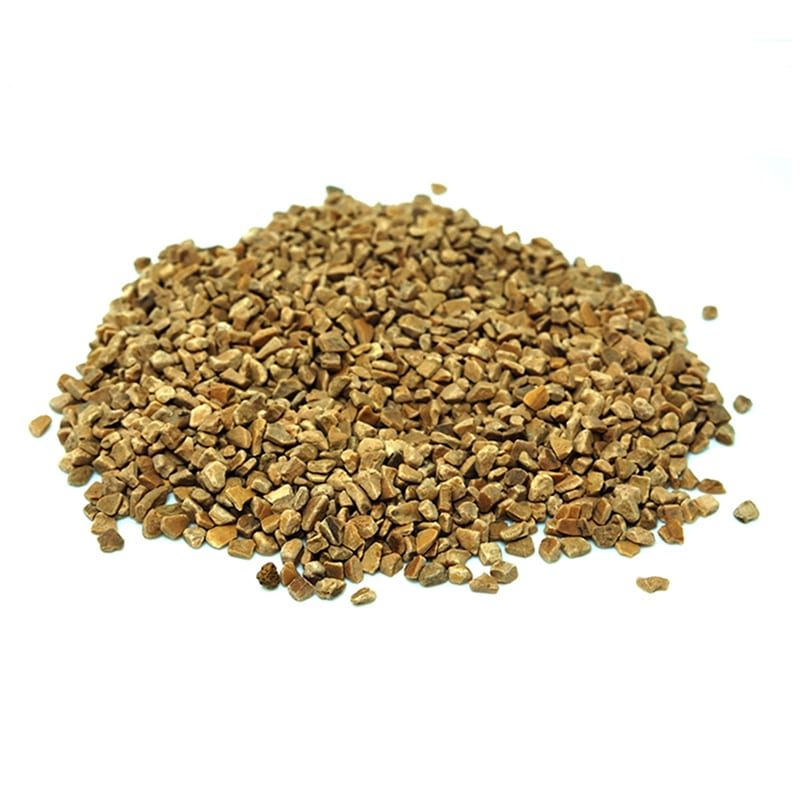
Why media choice is narrower than in a vibratory machine
Coarse, sharp ceramic wedges that work in a vibratory bowl will crush into gravel and gouge parts under high-energy centrifugal pressure.
Centrifugal barrels require smaller, denser, and smoother grinding media — such as fine ceramic cylinders, spheres, angle-cut cones, or high-density plastic media for aluminum and brass. Because turret force multiplies contact pressure, fine media in a centrifugal barrel cuts fast while leaving a much smoother surface profile. For more on media shapes, see our vibratory tumbler media selection guide.
Non-abrasive media for mirror work
For a mirror luster on jewelry, watch bezels, or medical instruments, shops switch to non-abrasive steel finishing media, porcelain balls, or dry walnut shell. Non-abrasive media removes zero metal, cold-rolling micro-peaks flat into a mirror reflection.
What the compound has to do differently at high G
Inside a sealed drum with no continuous drain flow during the cycle, water and finishing compounds must survive intense friction and heavy swarf generation:
- High thermal stability and lubricity: Multiplied sliding force generates rapid heat inside a closed rubber-lined drum, requiring a tough lubricating film to prevent glazing.
- Strong swarf suspension: Because abraded metal fines cannot drain while spinning, the compound must keep fines suspended so they do not press back into the parts.
- Low-foam chemistry: Excess foam or gas buildup inside a sealed barrel creates pressure under the lid and starves the sliding zone of lubrication.
The three-stage sequence
Reaching a pre-plate or mirror finish in a centrifugal barrel follows a strict three-stage sequence that cannot be skipped:
- Stage One — Cut: Dense fine-grit ceramic media and cutting compound strip burrs and tool marks.
- Stage Two — Refine: Smooth plastic or fine ceramic media refines the surface into an even satin base.
- Stage Three — Burnish: Non-abrasive porcelain, steel media, or dry walnut shell compresses the satin base into a mirror shine.
Failure Modes Specific to Centrifugal Machines
When a centrifugal barrel batch goes wrong, high energy magnifies the mistake quickly. A setting error that barely shows up in a vibratory bowl can bend thin parts or wear liners in a few runs.
Diagnosing high-energy defects before scrapping parts
Before altering your media recipe, always check three mechanical basics on a centrifugal barrel. Verify total drum fill level, turret speed setting, and weight balance between opposing drums on the turret wheel.
The four-column troubleshooting table
Use the diagnostic table below to identify and fix failures unique to centrifugal barrel equipment.
| Surface or Machine Symptom | Root Cause | Shop-Floor Check | Corrective Action |
|---|---|---|---|
| Parts come out bent or dented on thin walls | Turret speed is too high, drum is under-filled, or media is too heavy | Compare deformed zones against wall thickness and fill ratio | Lower turret speed via VFD, increase media ratio, or use lighter plastic media |
| Internal holes or slots still hold burrs | Media size is too large to enter holes or parts nest together | Check if stones bridge across hole mouths | Switch to smaller cones or pins and lower part loading density |
| Deep gouges or coarse scratches appear | Media is too sharp for high-G pressure or contains crushed chips | Screen a bucket of media to check for broken fragments | Screen out crushed chips and step down to a finer, rounder ceramic grade |
| Surface turns hazy instead of reaching a mirror | Final stage used abrasive media or dirty swarf contaminated the drum | Check whether final media contains abrasive grit | Flush barrel liners thoroughly and use non-abrasive media for burnishing |
| Polyurethane barrel liner wears prematurely | Running drums with insufficient fill volume or unlubricated grit | Measure total charge height inside the drum before closing | Maintain proper fill level and dose sufficient lubricating compound |
| Results vary from one barrel to another | Unequal water dosing, loose drive belts, or uneven media wear | Sample and compare parts from each drum separately | Check counter-rotation belt tension and standardize compound dosing |
Cost: What Drives It
When engineering teams evaluate a centrifugal barrel installation, looking only at the machine purchase price misses the operating picture. Total process cost comes from five cost lines that behave differently from open vibratory lines.
Five cost lines in a centrifugal installation
Every centrifugal barrel operation pays for five ongoing cost components:
- Equipment amortization: Fixed capital cost of the turret, counter-rotation drive, and screening deck spread over batch volume.
- Media wear: High-density ceramic or steel media costs more upfront and wears faster under multiplied pressure.
- Compound dosing: High-lubricity liquid compounds and water dosed per batch.
- Turnaround labor: Operator time spent opening lids, dumping drums, and screening parts.
- Scrap and rework: Risk of over-cutting or bending parts if speed and timers are misconfigured.
Why the cycle time is not the whole story
Brochures often boast that a centrifugal barrel finishes parts in a fraction of a vibratory cycle. That is physically true while the turret is spinning, but floor managers pay for floor-to-floor time, not just spin time.
A centrifugal barrel has a short cycle, yet loading, clamping lids, dumping, and screening take longer than unloading a centrifugal disc or vibratory bowl. When batches are small and change frequently, the time saved during spinning gets eaten up by manual drum handling.
Where volume changes the economics
Centrifugal barrel economics shine on high-value precision parts like implants and turbine blades where vibratory bowls fall short, and on recurring batches using automated tilting drums with vibratory screening.
Remember our manufacturing boundaries as you plan your budget: we build mass finishing machines, media, and compounds. We do not offer contract part processing, electroplating, anodizing, sandblasting, heat treating, or handheld polishing tools.
Frequently Asked Questions About Centrifugal Barrel Finishing
What is the difference between centrifugal barrel and centrifugal disc?
A centrifugal barrel machine mounts sealed drums around a vertical turret wheel, pressing parts and media into a high-pressure sliding pack ideal for delicate, thin, or high-precision components. A centrifugal disc machine uses an open stationary bowl with a spinning floor disc, trading peak pressure for faster loading and easier automation on robust small parts.
Can a centrifugal barrel machine produce a mirror finish?
Yes, within mass finishing limits. Stepping from fine ceramic cutting to plastic refinement and finishing with non-abrasive porcelain, steel media, or dry walnut shell produces a bright mirror luster on watch cases, jewelry, and implants. Dead-flat optical plates still require flat lapping.
What parts should not go into a centrifugal barrel?
Do not load large castings that exceed drum clearance, long shafts or flat panels that cannot turn inside the barrel, or parts with burrs hidden at the bottom of deep blind bores. Delicate thin-walled tubes should also run at reduced turret speeds so compacted media weight does not dent the walls.
How is centrifugal barrel finishing different from vibratory finishing?
Vibratory finishing shakes an open bowl at normal gravity for gentle, general-purpose deburring across many part sizes. Centrifugal barrel finishing spins sealed counter-rotating drums at multiple times normal gravity, cutting tough burrs faster while cushioning delicate parts inside a compressed media pack.
Do I need one barrel or several?
Centrifugal barrel machines always mount at least two opposing drums (usually four) to keep the high-speed turret balanced. Four drums let you run a larger combined batch or four weight-balanced part lots at once.
What media do centrifugal barrel machines use?
Centrifugal barrels use dense, smooth media that resists crushing, including fine ceramic cylinders for steel, plastic cones for aluminum, and non-abrasive steel balls, porcelain, or walnut shell for mirror burnishing. To size barrel volume and media recipes for your parts, reach out on our contact page to review your drawings.
 +86-592-2381506


 IPv6 network supported
