

Centrifugal Disc Finishing Machine: Open-Bowl Mechanics, Gap Control, and Shop Limits
From across an aisle, an open-top centrifugal disc finishing machine looks like a compact stationary tub. Look down into the running bowl, however, and a spinning bottom disc flings parts and media outward against a fixed polyurethane wall in a tight toroidal roll. That fast turnover cuts burrs far quicker than a vibratory bowl, provided your parts clear the bottom running gap.
How this guide connects to our other equipment pages: Searches for a centrifugal finishing machine, centrifugal polisher, or centrifugal tumbler cover two distinct architectures sharing one family name. Closed planetary drum units belong in centrifugal barrel finishing machines, while the head-to-head choice between open discs and closed drums sits in comparing centrifugal disc and barrel finishing. If you are still weighing high-energy units against standard bowls, start with our vibratory finishing overview. This guide stays strictly inside the open bowl centrifugal finisher: gap seals, wet gap flushing, thin-part jamming limits, batch turnaround, and polyurethane wear inspection.
Toroidal Flow Mechanics Inside an Open-Bowl Centrifugal Finisher
Every disc finishing machine builds cutting pressure by pairing a fast-spinning floor with a fixed vertical brake wall. Understanding how energy moves between those two surfaces explains both fast cycle times and process limits.
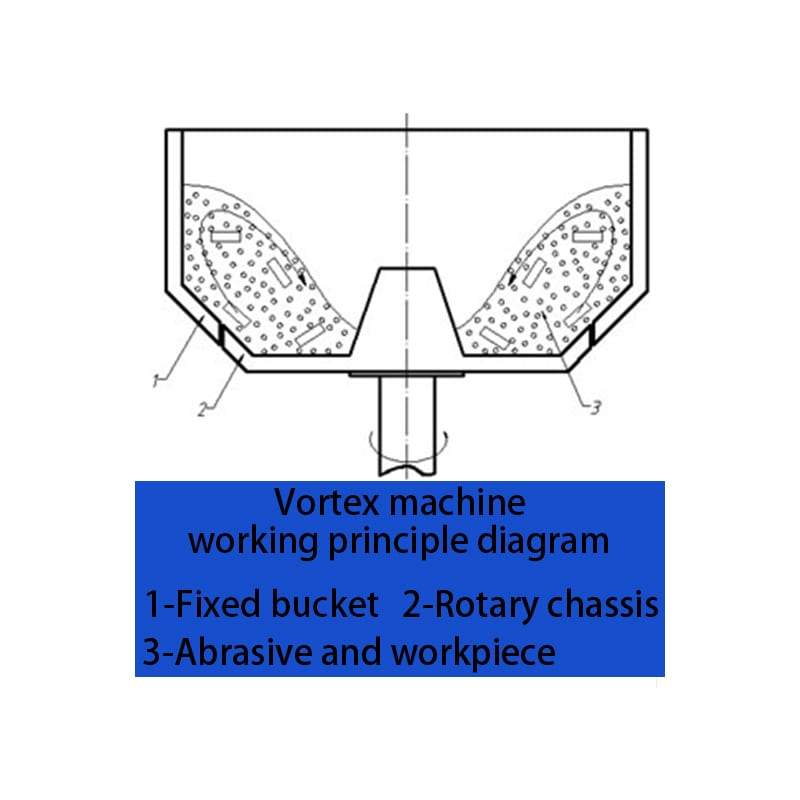
How the rotating bottom spinner accelerates the charge outward
At the base of our disc finishing machines, a molded rotor — the spinner — turns on a vertical spindle. Centrifugal force flings the bottom layer of media and parts outward toward the bowl wall. Unlike a spring-mounted vibratory tub, the outer shell bolts rigidly to the frame while the rotor injects energy straight into the load, giving small rigid parts intense sliding contact.
How the stationary polyurethane wall brakes and folds the stream
When the outward stream hits the stationary polyurethane wall, friction slows its horizontal spin and drives the pile upward along the liner contour. Fresh media pushing from underneath curls the rising column inward at the crest so it cascades back into the center of the spinner. Nearly all burr cutting and edge radiusing happen in the shear zone where fast bottom media meets the slower upper pile.
Why open-top visibility changes in-cycle inspection on the shop floor
Because the bowl stays open at the top, operators watch the toroidal roll live without stopping the spindle or unbolting a sealed drum lid. During setup runs on machined stainless fittings, toolmakers pluck a single part straight out of the rolling pile with a gloved hand, rinse it, and check edge break under shop light. Open access makes an open bowl centrifugal finisher simple to monitor and pair with overhead dosing nozzles across small batches.
Dry disc configurations versus wet open-bowl disc machines
Most metal deburring runs wet with metered water and liquid compound, though dedicated dry disc units exist for fine polishing with treated walnut shell or wood pegs. Wet bowls rely on steady water flow to remove heat and swarf, whereas dry units run gentler rotor speeds and air clearances suited to light organic media. Never load dry organic granules into a damp chamber, and never run ceramic stones dry inside a wet bowl, or friction will blister the polyurethane spinner.
The Spinner-to-Ring Gap Seal: The Heart of Every Disc Machine
Ask any seasoned maintenance technician what separates a dependable centrifugal disc finishing machine from a chronic floor headache, and they point to one place: the running gap between the rotating bottom spinner and the stationary lower wear ring.

Mechanical geometry of the rotating disc and stationary wear ring
The spinning disc can never rub the stationary wall directly without burning both surfaces. Instead, builders engineer a narrow annular gap around the perimeter where the rotor edge meets the fixed lower ring. On builds like our high-energy centrifugal disc finishing machine and our CF-series centrifugal disc finishing machine, precision spindle bearings hold the rotor concentric and flat so gap width stays even. Shim packs or threaded housings let mechanics reset axial height as mating edges wear.
Why gap clearance must stay tighter than both parts and media
That perimeter slot enforces one strict shop rule: every workpiece and every tumbling stone in the chamber must stay thicker than the running gap. If a flat shim, wire pin, or worn stone sliver slips edgewise between the spinning rotor and fixed ring, the disc drags it around the track like a lathe bit. In moments, one jammed metal blank can gouge a trench around the urethane lip, overload the drive, or bend thin parts into scrap.
Ceramic gap rings versus molded polyurethane labyrinth seals
Builders configure perimeter seals around two material pairs based on part thickness and grit. Hot-cast polyurethane lips offer resilient cushioning and tolerate minor grit passage during heavy deburring with mid-sized stones, allowing bolt-in replacement. Hard ceramic or steel wear rings pair lapped faces with pressurized water films to hold tighter gaps on watch parts, jewelry findings, or fine brackets.
How fine broken media fragments wedge and score the running clearance
Even when new parts and fresh media clear the gap, fractured stones and undersized grit create hidden damage. Across dozens of shifts, ceramic and plastic pellets abrade down until flat chips match the width of the slot. When crews skip fine screening between batches, sharp mineral shards pack into the annular gap and grind away the urethane lip from within.
Wet Gap-Flushing Water Control and Thermal Discipline
High-energy centrifugal action packs substantial mechanical power into a compact volume of parts, stones, and liquid. Without steady water flushing through the bowl, frictional heat rises fast enough to stain metal and blister urethane linings.

Why water enters through the gap or spray ring rather than sitting stagnant
In a properly plumbed wet centrifugal polisher, clean water and metered compound enter continuously while dirty liquid drains through slotted floor plugs or an under-disc trough. On gap-flushed designs, pressurized water flows upward across the lower seal seam itself, forming a liquid barrier that pushes fine silt back into the bowl before it reaches spindle labyrinths. Overhead spray bars wet the rolling pile from above so every part stays coated in fresh lubricating solution.
Balancing lubrication, swarf evacuation, and cutting traction
Water flow inside a centrifugal tumbler acts like a cutting throttle rather than a plain rinse tap. Too little water traps grey swarf inside the pile, burnishing dark fines back onto stainless or aluminum faces. Too much water floods the spinner so stones hydroplane over the urethane floor instead of climbing the wall. Operators adjust dosing pumps until the pile rolls crisply while dark swarf trickles from the drain.
What happens to polyurethane linings when flushing flow starves
Polyurethane absorbs stone impact well under cool water flow, yet degrades fast when starved of cooling liquid. If a kinked hose, clogged strainer, or dry tank stops flow mid-cycle, sliding friction spikes bowl heat rapidly. Overheated urethane softens, turns tacky along the rotor edge, and peels off its steel backing plate; checking drain outflow at start-up prevents costly rotor damage.
Recirculating settling tanks versus fresh metered dosing setups
Shops running an open-bowl centrifugal finishing machine choose between once-through tap-water metering and closed-loop settling tanks or centrifugal clarifiers. Once-through dosing feeds clean water and fresh compound to every batch, preventing grit carryover on cosmetic parts headed to plating or anodizing. Recirculating tanks cut water usage sharply on general deburring cells, provided operators desludge settling baffles on schedule and top up rust inhibitors; pumping gritty water back through a tight gap speeds ring wear.
Thin-Part Gap Lodging Limits and Workpiece Geometry Boundaries
No machine finishes every drawing in a shop. Knowing which geometries thrive in an open disc bowl — and which belong in a closed barrel or vibratory tub — prevents torn seals and ruined lots.

Why flat washers, shims, and thin stampings dive into the gap
Flat stampings, spring shims, feeler blades, and thin washers represent the classic mismatch for a standard disc finishing machine. Because toroidal flow sweeps downward along the wall straight toward the floor seam, flat blanks align parallel to the slot like coins sliding toward a chute. Even with a wide face, a razor-thin edge dives straight between the spinning lip and fixed ring. Thin stampings belong in vibratory bowls with anti-stick fluid or closed barrels with zero floor seam.
Heavy compact parts that stall the toroidal roll or bruise neighbors
Chunky forgings, long shafts, and heavy castings overpower the compact track of a disc chamber. Large parts sink onto the spinning floor instead of floating inside the media cushion, dragging across the urethane spinner and nicking neighboring parts. Open-bowl centrifugal finishers excel on small-to-medium rigid parts — CNC brackets, bone plates, watch cases, fasteners, and carbide inserts — that ride suspended in the rolling stream.
Matching media body density and shape to high-energy disc turnover
Because centrifugal force multiplies contact pressure, coarse stones that cut gently in a vibratory tub can peen faces or over-round corners in a disc unit. Most recipes step down one grit grade, pairing fine-cut ceramic tumbling media for steel burr removal or plastic cones for pre-plate refinement on brass and aluminum. See choosing among five tumbling media materials for material comparisons.
Speed control via variable-frequency drives during delicate brightening stages
Industrial disc machines drive the main spindle through a variable-frequency inverter so operators match rotor speed to each recipe stage. Brisk rotor speed during initial cut-down strips milling burrs fast, while lowering inverter frequency during porcelain burnishing softens impact so corners stay crisp without micro-nicks. Variable speed inside one bowl lets precision shops combine deburring and smoothing without moving parts between machines, provided coarse swarf is flushed clean before changing compound.
| Workpiece Category | Disc Fit | Shop Behavior | Better Alternative |
|---|---|---|---|
| Small CNC stainless brackets | Strong fit | Floats in toroidal roll; fast cut | Vibratory bowl for huge lots |
| Thin flat shims and washers | Poor fit | Dives into gap and jams rotor | Closed barrel or vibratory bowl |
| Fine-wire pins and needles | Poor fit | Wedges into perimeter clearance | Magnetic polisher or closed barrel |
| Rigid brass and zinc hardware | Strong fit | Smooth cut with plastic media | Vibratory tub for long handles |
| Carbide inserts and tool bits | Strong fit | Even edge honing under pressure | Closed barrel for extreme force |
| Heavy castings and long shafts | Poor fit | Sinks onto rotor; nicks neighbors | Fixtured tub or trough vibrator |
| Stamped jewelry and watch blanks | Conditional | Safe only above hard-ring gap | Closed barrel for wafer-thin stock |
Batch Turnaround, Tilting Unload, and Downstream Separation
Fast cutting inside the chamber means little if operators spend twice as long scooping wet stones out by hand. Smooth turnaround pairs quick bowl tilting with dual-deck screening and immediate spin drying.

Manual tilting chambers versus pneumatic tilt-and-screen stations
Compact and floor-standing disc finishers mount the bowl on pivot trunnions driven by a handwheel gear or pneumatic cylinder. When the timer stops the spindle, the operator tilts the chamber forward over an oscillating screen to dump parts and media together. Integrated stations catch working media in a lower return pan or hopper for quick reloading into the upright bowl, keeping idle turnaround between batches brief.
Keeping media classification clean so undersized grit never returns to the bowl
Screening after a disc batch handles two jobs at once. The top deck separates finished parts from working media, while a fine lower classification mesh drops broken chips and worn undersized stones into a reject tray before media returns to the bowl. Skipping lower-deck screening is the fastest way to ruin a centrifugal polisher gap seal: every undersized pebble reloaded into the hopper becomes a wedge waiting to jam the seam next batch.
Rinsing and spin-drying immediately after high-energy unloading
Parts leaving a wet centrifugal tumbler carry fine swarf and active compound across freshly cut bare metal. Leaving wet steel gears or stainless fittings sitting in a tote invites flash rust, water spots, and white residue in blind threads before inspection starts. Routing separated parts straight through a clean spray rinse and into a heated centrifugal spin dryer locks in cleanliness; read our shop guide on post-finishing separation, washing, and drying.
Structuring a sample trial to lock down load ratio and cycle rhythm
Before committing production lots to a disc cell, run a controlled trial on worst-case machined parts rather than scrap coupons. Media-to-part volume ratio is unforgiving in a compact disc bowl: crowding parts starves the media cushion and causes corner nicks, while underloading wastes bowl space. Recording fill height, inverter speed, water flow, compound code, and time builds a repeatable floor card; follow our buyer checklist for preparing a surface finishing sample test.
Inspecting Wear Rings, Polyurethane Linings, and Drive Bearings
Because an open-bowl disc unit concentrates sliding speed along one compact perimeter seam, a brief end-of-shift check prevents weeks of unplanned spindle and liner repair later.

Feeler-gauge and visual checks along the spinner-to-wall perimeter
At every shift end — or right away if an operator hears a rhythmic scraping tick — empty the bowl, hose the seam clean, and inspect the full rotor lip. Slide a non-marring plastic feeler strip at four clock points around the spinner to confirm even clearance. Uneven gap readings side to side point to grit under the hub, loose bolts, or spindle bearing play, whereas even widening all around shows normal wear ready for axial shim adjustment.
Reading asymmetrical polyurethane wear bands on the upper brake wall
Cast polyurethane walls show honestly how crews run the machine. A healthy wet disc finishing machine wears its fixed wall smoothly in an even band just above the lower curve where outward flow turns upward. Sharp grooves right at the seam signal chronic undersized grit lodging, while sticky, darkened, or crazed urethane across the rotor face proves the bowl ran starved of flush water. Catching thin spots before bare steel shows allows clean re-lining without weld repair.
Protecting the main spindle housing and lower labyrinth drain path
Beneath the spinning disc sits a drain trough and labyrinth shield that guides dirty water out the hose while keeping abrasive mud off the spindle bearings. When operators shut flush water off early before unloading, ceramic silt cakes inside that trough and creeps toward the bearing seal. Hosing out the empty bowl and drain chute every shift preserves quiet bearing rotation.
Planning liner re-bonding and spare ring swaps before catastrophic scoring
Smart maintenance teams stock spinners and wear rings as scheduled consumables rather than waiting for steel-on-steel contact. Keeping a spare cast rotor or seal ring on the shelf lets mechanics swap wet-end parts during a weekend stop while sending the worn hub out for hot-cast urethane re-bonding before raw steel grinds raw steel.
| Shop Symptom | Likely Root Cause | Floor Check | Corrective Action |
|---|---|---|---|
| Rhythmic scraping tick | Shard or thin part in gap | Inspect perimeter seam | Clear wedge; screen out fine chips |
| Sluggish toroidal roll | Excess water flooding rotor | Check drain and surface | Trim water feed until roll grips |
| Tacky dark urethane rim | Heat from water starvation | Check strainer and drain | Clear water line; check liner bond |
| Corner nicks on parts | Parts crowding media cushion | Check media-to-part ratio | Reduce batch count or rotor speed |
| Dull grey film on metal | Dirty water or weak compound | Wipe wet part with cloth | Clean settling tank; check dosing |
| Uneven perimeter gap | Hub dirt or bearing play | Gauge four clock points | Clean hub seat; check bearings |
| Slurry near drive base | Mud blocking lower trough | Inspect under-disc chute | Flush drain chute every shift |
What We Manufacture, and Where Our Boundary Sits
At Xiamen Jin Tai Jin Grinding Technology Co.,Ltd., founded in 1992 in Xiamen, we build industrial mass finishing machines and consumables in our own plant and state plainly both what we manufacture and where our boundary sits.

Our Xiamen manufacturing base, machine platforms, and verified compliance records
In our Xiamen facility, we build 21 machine platforms — 8 vertical models under CE attestation certificate M.2023.206.C88121 and 13 horizontal models under M.2023.206.C88120, valid 2023-07-25 to 2028-07-24 — under ISO 9001 certificate 00726Q01571R001, valid 2026-06-03 to 2029-06-02. Our engineering holds 24 granted Chinese IP rights, consisting of 1 invention patent, 17 utility models, and 6 design patents; verify our records on certifications. Standard builds ship in twenty-five to thirty-five days and custom builds in forty-five to sixty days, paired strictly with our eight compounds: HM3, JTJ20, JTJ25, JTJ50, JTJ60, JTS5, LC10, and MC8.
How our disc finishing line fits alongside barrels, bowls, and magnetic units
Because no single machine architecture suits every part drawing, we manufacture open-bowl centrifugal disc finishers alongside closed centrifugal barrel units, vibratory bowls and tubs, rotary barrels, magnetic pin polishers, oscillating separators, and centrifugal hot-air dryers, plus ceramic, plastic, porcelain, steel, and organic media. When a buyer sends stout CNC brackets alongside thin shims, our engineers never force both into one disc bowl — we match each geometry to the machine family whose clearances fit safely.
Why we build equipment rather than running a subcontract job shop
Buyers researching a centrifugal finishing machine occasionally ask to send recurring lots to our plant for subcontract tumbling. Our commercial boundary is strict: we manufacture finishing machines, media, and compounds for factories and finishing shops, and we never take contract finishing or toll-processing orders. Running a job shop would compete with our equipment customers and pull engineering focus away from weldments, urethane molds, spindle assemblies, and pre-shipment commissioning.
Processes and surface treatments outside our manufacturing scope
Stating clear technical boundaries saves buyers wasted time when drawings call for non-mechanical treatments. Beyond declining toll work, we do not manufacture electroplating lines, anodizing tanks, passivation baths, powder-coating booths, PVD vacuum coaters, sandblasting cabinets, shot-blasting turbines, heat-treatment furnaces, handheld grinders, electropolishing lines, or CNC machine tools. If your floor needs an in-house centrifugal disc cell, media, and wet chemistry configured around your parts, reach our engineers via contact us.
Frequently Asked Questions
How does an open-bowl centrifugal polisher differ from a vibratory bowl on small parts?
A vibratory bowl shakes its spring-mounted tub so media rubs parts gently under normal gravity, suiting large mixed loads and thin stampings. An open-bowl centrifugal polisher spins a bottom rotor inside a fixed polyurethane wall, driving a fast toroidal roll that cuts tough burrs in a fraction of a vibratory cycle, provided parts are rigid and thicker than the bottom perimeter gap.
Why do thin stamped parts jam inside a centrifugal disc finishing machine?
Every open-bowl disc finisher requires a narrow running gap between the spinning bottom rotor and the fixed lower wear ring so the surfaces never rub. Flat shims, thin washers, and fine pins align edgewise with downward wall flow and slip into that slot, jamming the rotor and scoring the urethane lip; thin parts belong in closed barrels or vibratory bowls.
Can I run a wet centrifugal tumbler dry to save rinsing steps?
No, never run ceramic or plastic media dry inside a wet-configured centrifugal disc bowl. Without steady water and compound flushing, intense sliding friction builds rapid heat that softens and blisters cast polyurethane spinners while baking grey metal dust onto parts; dry disc polishing requires dedicated dry machines running light treated organic media at slower speeds.
How often should operators inspect the gap ring and polyurethane lining?
Operators should hose the seam clean and visually check gap clearance at every shift end, using a plastic feeler strip weekly across four clock positions. Catching wedged stone chips early and screening worn undersized grit out of the media charge after every batch prevents deep groove scoring on both the spinning lip and stationary wall.
What details do your engineers need for a disc machine configuration review?
Send part drawings or photos showing alloy, minimum edge or wall thickness, incoming burr state, target surface finish, batch size per shift, and downstream steps like plating or assembly. Checking minimum part thickness first lets our engineers confirm whether an open-bowl disc finisher, closed centrifugal barrel, or vibratory bowl fits your floor before running sample trials.
 +86-592-2381506


 IPv6 network supported
