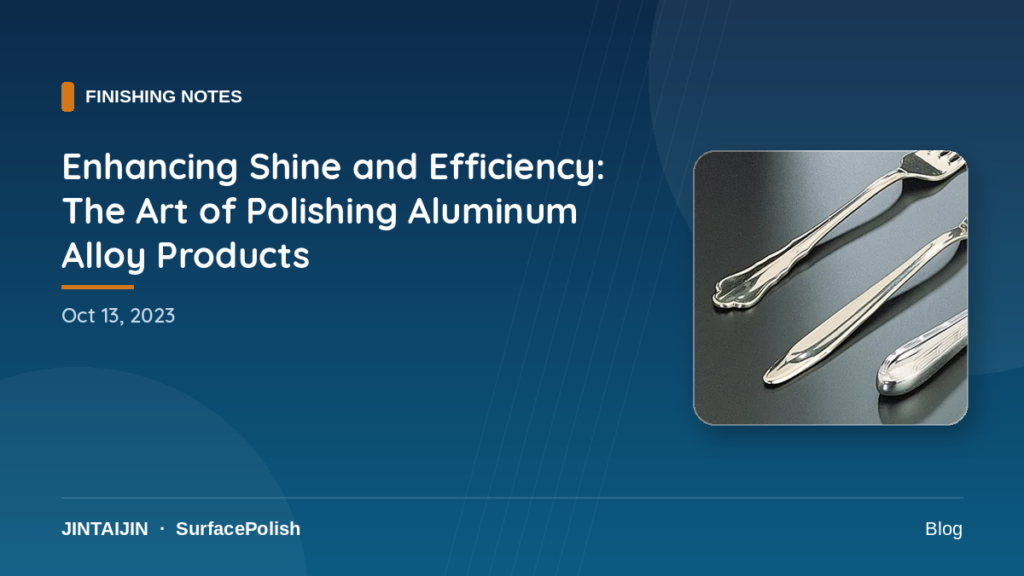
Enhancing Shine and Efficiency: The Art of Polishing Aluminum Alloy Products
Polishing is a crucial step in the production process of aluminum alloy products, giving them a dazzling finish that appeals to consumers and businesses alike. In this article, we will explore the various techniques, equipment, and benefits of polishing, with a special focus on the state-of-the-art technology provided by Jintaijin, a company with over two decades of experience in the industry.
Equipment and Techniques:
Vibratory Polishing Machines: Jintaijin offers a range of vibratory polishing machines, each designed for specific applications. These machines use vibratory motion to agitate the aluminum alloy products along with polishing media, resulting in a uniform and smooth surface. The technology's versatility makes it suitable for both small-scale and large-scale production.
Rotary Drum Polishing Machines: For more intricate or delicate items, Jintaijin provides rotary drum polishing machines. These devices gently tumble the products, ensuring a flawless finish without any damage. They are particularly useful for components with complex geometries.
Polishing Abrasives: The choice of polishing abrasives is critical to achieving the desired finish. Jintaijin offers a wide range of abrasives, including abrasive powders and compounds, tailored to different materials and applications. These abrasives effectively remove imperfections and blemishes, leaving a high-gloss surface.
Benefits of Polishing:
Time and Labor Savings: Polishing with Jintaijin's advanced machines significantly reduces the time and manual effort required compared to traditional methods. The automation and efficiency of these machines result in substantial time and labor savings.
Mass Production Capabilities: Large-scale industrial machines by Jintaijin can handle batch polishing, allowing manufacturers to streamline their production processes and meet higher demand. This scalability is especially advantageous for industries requiring mass production.
Consistent Quality: The use of advanced technology ensures consistent and high-quality finishes across all products. Whether you're polishing a single item or thousands, you can expect the same level of excellence in the end result.
With a strong focus on innovation and a team of seasoned professionals, Jintaijin has been at the forefront of the polishing machine industry for over 20 years. They hold patents for cutting-edge technologies that have revolutionized the polishing process, setting new standards for quality and efficiency.
In conclusion, the art of polishing aluminum alloy products has evolved with the introduction of advanced equipment and abrasives. Jintaijin, with its experience and patented technologies, has played a pivotal role in this transformation. By investing in their equipment, manufacturers can save time, labor, and resources while ensuring top-notch quality in their finished products.
| Aluminium condition | Consideration | Starting direction |
|---|---|---|
| Soft material marks easily | Aluminium takes marks from heavy media | Softer media such as plastic, and a lower load |
| Smearing during polishing | Aluminium can smear rather than cut | Check media grade against the surface before lengthening the cycle |
| Edges that must stay sharp | Aluminium rounds quickly | Shorter cycle with edges checked on a sample |
| Tarnish or oxidation present | Polishing over oxidation traps it | Remove oxidation in an earlier stage |
| Bright decorative finish | Brightness comes from the final stage | Stage the grades down progressively |
| Mixed alloys in one batch | Different alloys respond differently | Run similar alloys together |
Directions to test on a representative sample, not validated results for a specific component.
Aluminium is soft, but the more important characteristic for finishing is that it smears. Under a media that presses more than it cuts, aluminium does not develop a clean surface: it deforms locally, and the surface takes on a rubbed, slightly dull appearance that can look polished at a glance but has no definition under light.
The practical consequence is that media choice matters more than cycle length on aluminium. Lengthening a cycle that is smearing does not remove the smearing; it produces more of it. Changing to a softer or coarser media, or adjusting the compound, is the more effective response — and it is the change that is most often skipped because the cycle seems like the obvious lever.
Aluminium also rounds edges quickly. Because the metal is soft, the same cycle that produces an acceptable surface on steel can visibly change an edge on an aluminium part. Edges should be checked against the starting condition rather than assumed to be unchanged.
Aluminium oxidises readily, and parts that have been stored or handled carry an oxide layer before finishing begins. Finishing over that layer tends to work it into the surface rather than remove it. As with copper, removing the oxide in an earlier stage keeps the finishing stage working on metal rather than on oxide.
After processing, a freshly finished aluminium surface begins to react again quickly, particularly in humid conditions. How the parts are handled, packed and stored after drying is therefore part of the process rather than something that happens afterwards. Parts that are to remain bright need protection from that point onward.
Email : info@surface-polish.com


 IPv6 network supported


 +86-592-2381506
