
Vibratory Tumbler Media: How to Choose Shape, Size, Material, and Quantity
When workshop managers search for vibratory tumbler media, they are rarely looking for lyrical descriptions of vibration physics. They have CNC machined parts, stampings, or zinc die-castings on their benches, and they need to make four practical purchasing decisions: what material, what geometry, what size, and how much volume to charge into the bowl.
Picking the wrong tumbling media does not just waste consumable budget; it creates parts with rolled-over edges, lodged media trapped inside tapped blind holes, or grey passivated surfaces that reject downstream anodizing and electroplating.
Media does three distinct jobs inside a vibrating mass finishing channel: it cuts, it cushions, and it carries chemical compound to the workpiece. If your media is too light, it cushions without cutting; if it is too large, it bridges critical recesses; and if it becomes glazed, it rubs the workpiece into an oxidized glaze.
This technical guide walks through the four core sizing and selection decisions, explains how media behaves across different machine platforms, provides a four-column shop-floor troubleshooting matrix, and outlines how to run a verified sample trial.
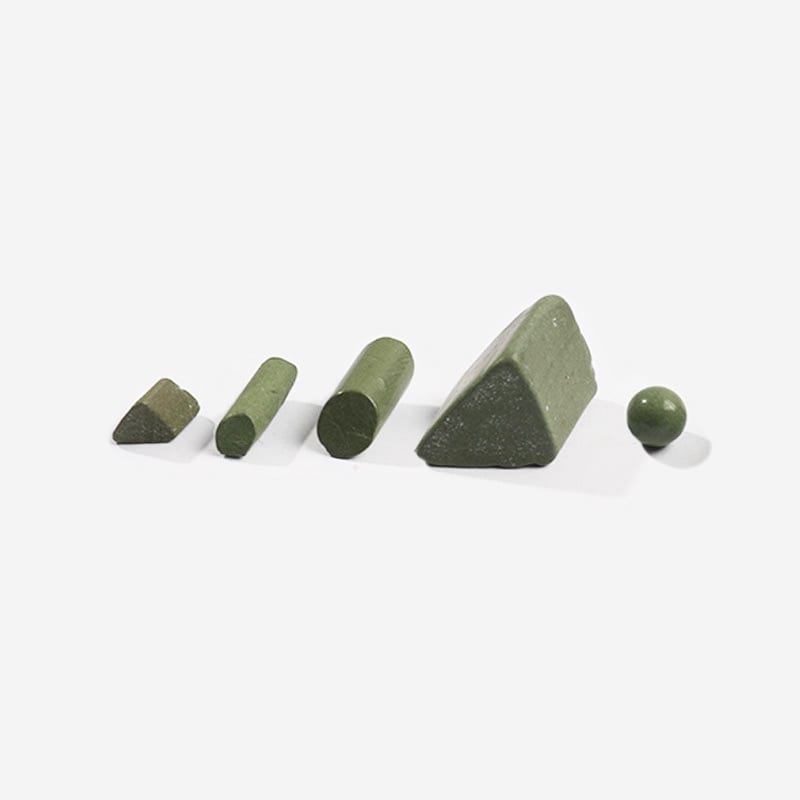
Four Decisions That Determine Whether Your Media Works
In mass finishing operations, media choice should never be made by brand name or vague catalog labels like "fast cut." You must specify four physical parameters before charging a single kilogram into the bowl.
Decision 1 — Material: Ceramic, Plastic, or Natural Media
The base material sets the density, hardness, and wear rate of the pellet. Selecting material is a trade-off between aggressive stock removal and delicate surface preservation.
- Ceramic Tumbling Media (High-Alumina / Vitrified Porcelain):
Manufactured by firing aluminum oxide grit with clay and mineral bonding agents at elevated temperatures. High-density ceramic media (typically around 2.4 to 2.7 g/cm³) delivers high contact pressure, making it the standard choice for hard metals including stainless steel, titanium, carbon steel, and cast iron. Vitrified high-alumina ceramic excels at heavy deburring, radiusing cut edges, and descaling weld seams. Porcelain variations contain no aggressive free abrasive grit, functioning primarily as burnishing bodies to bring workpieces to a bright lustre.
- Plastic / Synthetic Resin-Bonded Media:
Composed of finely graded abrasive grains (silicon carbide, quartz, or aluminum oxide) embedded in an unsaturated polyester or urea-formaldehyde resin matrix. Plastic media has lower bulk density (typically 1.5 to 1.8 g/cm³) than ceramic. Because the resin cushion softens part-to-part impacts, it is essential for soft non-ferrous alloys such as aluminum die-castings, brass, copper, and thin-gauge sheet metal. It avoids peening, dimpling, and rolling over fragile edges, producing an even matte finish ideal for subsequent powder coating or anodizing.
- Organic and Natural Media (Walnut Shell and Corn Cob):
Processed from crushed agricultural hulls. These are utilized primarily in dry tumbling barrels or vibratory bowls for secondary buffing, oil absorption, and final cosmetic polishing. Walnut shell particles scrub lightly without stripping base metal, while corn cob granules absorb residual surface moisture and drying stains when paired with centrifugal industrial dryers.
For a detailed comparative breakdown between resin and vitrified formulations, review our in-depth reference on ceramic media vs. plastic media, or inspect the natural abrasive guide on walnut shell vs. corn cob media.
Decision 2 — Shape: Why Triangle Cuts and Ball Polishes
The external geometry of the media pellet determines contact geometry: point contact, line contact, or surface contact.
- Triangles and Angle-Cut Triangles (ACT):
The sharp points and flat edges of triangle media penetrate corners, narrow internal angles, and milled slots that rounded media cannot touch. Angle-cut triangles enter complex profiles on a bias, preventing flat-to-flat sticking (suction adhesion) against sheet metal faces. Triangle media like our brown fused alumina triangle grinding media represents the industry standard for precision deburring on machined blocks and structural brackets.
- Angle-Cut Cylinders (Penta-Cuts) and Wedges:
Provide a balanced compromise between edge penetration and barrel roll. The angled oval faces cut along internal radii, while the cylindrical sides burnish adjacent flats without digging Gouge marks.
- Spheres and Balls:
Provide point contact only. Spherical media generates maximum rolling velocity and high compressive stress. Because balls have zero sharp cutting edges, they do not deburr sharp burrs; rather, they peen micro-peaks flat, yielding high reflective shine and surface hardening.
- Cones and Pyramids:
Commonly moulded in plastic formulations. The wide base prevents lodging while the conical tip reaches into small blind holes and intersecting drilled ports.
Decision 3 — Size: The One-Third Feature Sizing Rule
Media size directly affects cycle efficiency and finishing aggressive. Larger media pellets carry greater kinetic momentum, cutting faster and breaking external heavy burrs quickly, but leaving a rougher surface texture. Smaller media pellets provide delicate cushioning and access intricate crevices, but take longer to strip metal.
However, sizing is strictly constrained by part geometry:
The Shop-Floor Sizing Rule: Media dimensions must never equal or match the size of any hole, slot, cavity, or internal radius on your workpiece. As a practical shop-floor guideline, media should be either larger than 130% of the opening to prevent entry entirely, or smaller than one-third (33%) of the opening to ensure it enters and flushes out freely without bridging.
For example, if your workpiece contains a 3.0 mm milled clearance slot:
- Media sized between 2.0 mm and 3.2 mm will instantly lodge in the slot during vibration.
- The media selected to finish inside the slot must be below 1.0 mm (less than one-third of the feature width).
- Conversely, if you only need external deburring, select media larger than 4.5 mm so it bridges across the slot opening without wedging.
For comprehensive dimensioning tables, consult our dedicated tumbling media selection guide.
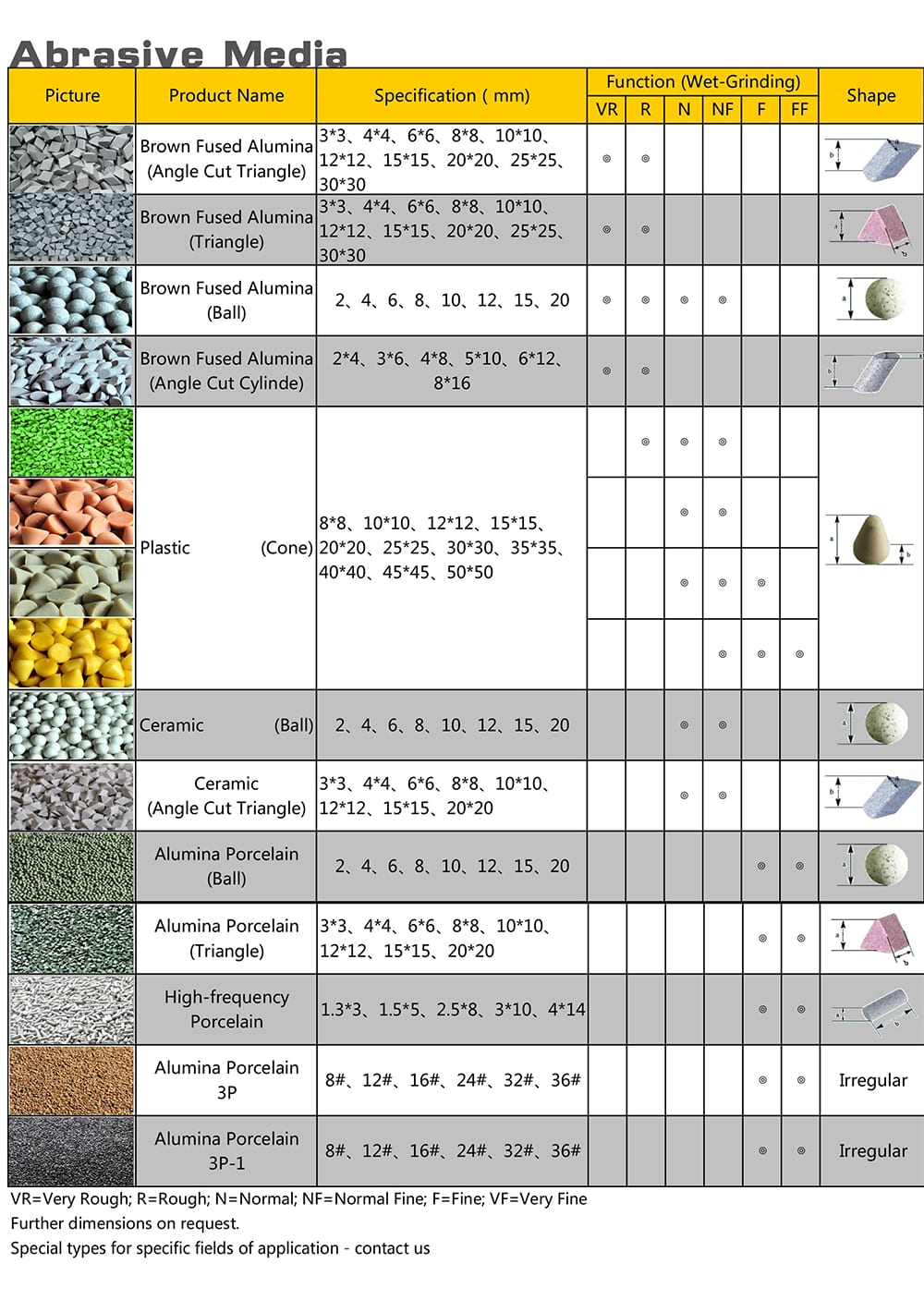
Decision 4 — Media Charge: How Much Media Goes into the Bowl
Operating a vibratory finisher with too little media is the most common cause of scrapped parts. Operators often try to maximize throughput by overloading workpieces into the tub, causing violent part-on-part collisions that leave contact nicks and peened edges.
- Volumetric Ratio (Media to Workpiece):
In standard vibratory finishing machines, the charge ratio is set by volume rather than mass, and it is confirmed against a trial on the part. The working limit is not a fixed number — it is the room the charge has to move. A heavy or rugged part tolerates a leaner media share; a delicate part, a thin stamping or a mirror-finished surface, needs a heavier media share so that part-on-part contact is cushioned rather than relied on. Ask what the ratio is doing before asking for a number: if the symptom is part-on-part marking, media share goes up; if it is slow cut on accessible edges, the fill is too high for the charge to circulate.
- Total Bowl Fill Level:
Vibratory bowls and continuous tubs should generally be filled to 70% to 85% of total rated capacity. If underfilled (below 50%), the circular toroidal roll collapses, causing parts to sink directly to the polyurethane lining. If overfilled past 90%, mass circulation stalls, causing uneven stock removal across the batch.
Media Does Three Mechanical Jobs — and You Only Get What You Charge For
To maintain predictable batch consistency, engineers must recognize that media acts as a multi-functional mechanical tool inside the vibrating mass.
```
┌────────────────────────────────────────────────────────┐ │ VIBRATORY TUMBLER MEDIA │ └──────────────────────────┬─────────────────────────────┘ │ ┌────────────────────────┼────────────────────────┐ ▼ ▼ ▼ ┌───────────────┐ ┌───────────────┐ ┌───────────────┐ │ 1. CUTTING │ │ 2. CUSHIONING │ │ 3. CARRYING │ │ Sharp grit │ │ High volume │ │ Liquid film │ │ Micro-shears │ │ Prevents part │ │ Transports │ │ burrs & edges │ │ impingement │ │ compound/oil │ └───────────────┘ └───────────────┘ └───────────────┘
```
Job 1 — Micro-Cutting and Burr Removal
The abrasive grain bonded in the pellet functions like microscopic cutting inserts. Under high-frequency cyclic vibration (typically 1,400 to 2,800 rpm), the media mass slides across the workpiece under compressive centrifugal force. Each abrasive tooth removes microscopic shavings, smoothing machining witness lines, radiusing razor edges, and blending milling cutter marks.
Job 2 — Cushioning to Prevent Part-on-Part Impingement
When metal parts tumble in a container, uncontrolled collision creates surface bruising, denting, and micro-cracking. The surrounding bed of media creates continuous hydrodynamic drag, insulating adjacent workpieces from direct metal-to-metal shock. Dense media formulations provide sufficient resistance to keep heavy components suspended independently in the rotating mass.
Job 3 — Carrying Chemical Compound into Confined Recesses
Vibratory tumbling media works in symbiosis with process fluid. The surface tension of the fluid allows ceramic or synthetic pellets to form a continuous lubricating boundary layer. Media carries liquid surfactants, rust inhibitors, and detergency compounds deep into blind counterbores and keyways, washing away microscopic metal swarf so cutting facets remain unblocked.
Matching Media to Machine Platform
Different finishing machines subject the media bed to vastly different kinematic energy levels. Charging a fine, fragile media grade into a high-energy platform will pulverize the consumable within minutes.
| Machine Platform | Typical Media Formulations | Mechanical Action & Constraints |
|---|---|---|
| Vibratory Bowls & Troughs | Ceramic triangles, plastic pyramids, high-alumina cylinders | High-frequency toroidal scrub; requires medium-to-large pellets with good compressive fatigue resistance. |
| Rotary Tumbler Barrels | Large ceramic cylinders, coarse triangles, dry walnut shell | Low-frequency sliding cascade; requires durable, heavy media to provide weight during sliding. |
| Centrifugal Disc Finishers | Small ceramic beads, fine synthetic cones | Rapid vortex compaction (up to 10G); requires tough, non-chipping bonded media to resist high shear. |
| Magnetic Pin Finishers | SUS304 / SUS316 Stainless Steel Micro-Pins Only | Magnetic field drives steel pins; zero ceramic or plastic media used. |
Vibratory Bowls and Troughs: The Dynamic Workhorses
Floor-standing round bowls and rectangular trough vibrators impart a continuous three-dimensional helical spiral to the entire load. This gentle, multi-directional action suits general deburring, descaling, and pre-plate preparation. In long trough units — such as the catalogue models L1300 (nominal trough capacity 1,200 L), L1500 (1,500 L), and L1800 (1,800 L) — heavy structural parts up to 2 meters long can be finished using robust ceramic triangles without bending slender sections.
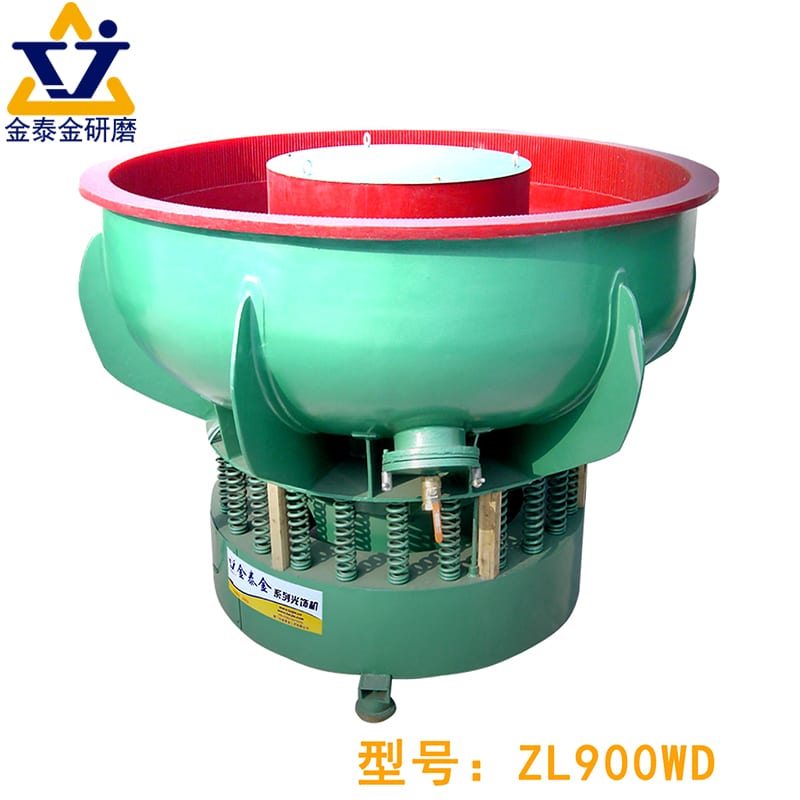
Rotary Barrels: Slow Sliding vs High-Frequency Vibration
In rotary barrel tumbling machines, the media bed moves by sliding down the rising face of the drum rather than being driven through a circulating mass. Because cutting occurs only at the sliding layer, cycle times are significantly longer than vibratory finishing. However, rotary tumbling provides exceptional edge radius uniformity on heavy forged chains, hand tools, and bulky hardware.
Centrifugal Disc and Barrel Machines: High G-Force Compaction
For small, high-precision turned parts, centrifugal disc finishing machines accelerate the media mass using a rotating base spinner against stationary polyurethane walls. The resulting toroidal flow works the charge far harder than a vibratory bowl does — the mechanism is the same abrasion at a much higher energy input, which is why the media grade has to be specified for it rather than inherited from a bowl charge. Only high-strength ceramic pellets and tear-resistant plastic grades should be used; low-grade ceramic will fracture under the intense centrifugal shear.
Why Magnetic Finishers Use No Tumbler Media At All
A frequent misunderstanding on the shop floor involves attempting to load standard ceramic chips into magnetic polishing machines.
Magnetic finishing operates on an entirely distinct physical principle: a rotating array of high-energy neodymium permanent magnets beneath the chamber energizes magnetized stainless steel micro-pins (typically 0.2 mm to 1.2 mm diameter). Because ceramic, plastic, and walnut media are non-magnetic, they will sit completely stationary in a magnetic machine. Stainless steel magnetic pins enter fine screw threads, jewelry filigree, and internal electrical contact ports without altering overall part dimensions.
Media Failure Modes and Four-Column Shop-Floor Diagnostic Guide
When mass finishing output deteriorates, operators often assume their equipment has lost vibration amplitude or blame the chemical supplier. In over 80% of workshop audits, the root cause lies in deteriorated or mismanaged media.
Mode 1 — Media Glazing (Surface Passivation)
Over prolonged cycles, fine metal swarf, grease, and precipitated water-hardness salts pack into the micro-pores of ceramic and plastic media. The sharp abrasive tips become coated and polished flat. Glazed media looks shiny and clean, but its cutting action drops to zero. Cycle times double or triple while deburring efficiency stalls entirely.
Mode 2 — Undersize Wear and Feature Lodging
Every media charge wears down as it runs. A triangular ceramic pellet that measured 15 mm when purchased will steadily wear down to 10 mm, 8 mm, and 5 mm. Eventually, the worn media reaches the exact critical dimension of a hole, bore, or thread on the workpiece, wedging firmly into the part.
Use the following four-column shop-floor diagnostic matrix to troubleshoot media issues:
| Shop-Floor Symptom (现象) | Probable Root Cause (原因) | Shop-Floor Inspection Check (检查方法) | Corrective Action (处理) |
|---|---|---|---|
| Parts against the wall are done, parts in the middle are not | Overfill — the charge is turning as one mass rather than flowing, so only the outer layer is doing work. Lengthening the cycle will not fix it and will overwork the wall parts | Cut the fill until the charge circulates visibly | |
| Cycle times lengthening; burrs remain after extended run | Media glazing (pores loaded with swarf or dried compound) | Wipe media with white cloth; examine facets under 10x loop for flattened, polished reflective tips | Flush bowl with alkaline cleaning compound compound-LC10 and run against dummy steel blocks to dress media facets |
| Pellets wedging tightly into cross-holes, slots, or threads | Media has worn below original size into the critical interference zone | Measure lodged media with vernier calipers against part drawings; inspect media classification screen | Sieve out undersize media over a calibrated sorting screen; enforce the one-third sizing rule |
| Denting, nicks, or impingement marks on finished parts | Insufficient media cushion; volumetric media-to-part ratio too low | Calculate batch volume; observe part travel during operation for part-on-part collisions | Raise the media share so part-on-part contact is cushioned rather than relied on; verify the fill against how the charge moves — a charge that circulates has visible flow, one that turns as a mass has not got room |
| Dull dark grey film on workpieces; won't brighten | Swarf re-deposition; spent abrasive residue suspended in stagnant fluid | Check drain effluent clarity; inspect recirculation filter and compound dosing rate | Increase fresh water rinse flow; introduce specialized brightening agent compound-JTJ50 |
| Excessive rounding on precision corners and critical seals | Abrasive grade too aggressive, or cycle ran far past deburring endpoint | Inspect radius under optical comparator; review cycle time log | Switch to a milder plastic formulation or a fine-cut ceramic grade; reduce cycle duration |
When Vibratory Tumbler Media Is NOT the Right Solution
A credible manufacturing engineer knows when mass finishing media should be rejected in favor of alternative manufacturing operations. Vibratory media is an edge-breaking and surface-refining method, not a stock-removal machining process.
Severe Heavy Gate Flash and Structural Stock Removal
If zinc die-cast components retain thick trimming flash (greater than 0.8 mm) or heavy parting-line sprues, tumbling them with ceramic media will merely round over adjacent functional corners before stripping the flash. Heavy flashing must be removed via mechanical trim dies, bandsaws, or abrasive belt grinding prior to entering the vibratory tumbler.
Deep Micro-Bores and Blind Capillary Orifices
Workpieces featuring internal diesel injector passages, hydraulic spool galleries, or micro-fluidic channels with diameters below 0.8 mm cannot be cleared by loose vibratory media. Even fine granulates will lodge inside capillary passages under centrifugal pressure, creating dangerous blockages in hydraulic systems. Such features require thermal energy deburring (TEM), electrochemical deburring (ECD), or high-pressure waterjet deburring.
Mirror Brightening Soft Brass or Pewter Without Burnishing Balls
Attempting to polish soft lead-free pewter, zinc, or brass to an optical mirror finish using cutting-grade ceramic or plastic media will fail. Cutting media leaves microscopic scratch patterns that disperse incident light. Achieving a reflective mirror luster on soft decorative metals requires swapping cutting media for stainless steel burnishing shot, porcelain balls, or dry walnut shell flour charged with specialized polishing paste.
Chemical Compound Is Not Optional: Wet Chemistry in the Media Bed
Running tumbling media with plain tap water is one of the most expensive mistakes a factory can make. Media and chemical compounds operate as a dual-phase system.
```
┌────────────────────────────────────────────────────────┐ │ THE WET FINISHING ECOSYSTEM │ ├────────────────────────────┬───────────────────────────┤ │ MECHANICAL ACTION │ CHEMICAL ACTION │ │ • Kinetic momentum │ • Emulsifies stamping oils│ │ • Contact pressure │ • Floats swarf off facets │ │ • Micro-shearing friction │ • Inhibits flash corrosion│ │ • Uniform edge radius │ • Brightens passive film │ └────────────────────────────┴───────────────────────────┘
```
Why Abrasive Media Needs Liquid Surfactants
Water alone has high surface tension and zero lubricating film strength. Without chemical surfactants, abrasive fines stripped from the workpieces instantly adhere back onto the media pellets, causing rapid glazing. Furthermore, carbon steel parts subjected to water and friction will flash-rust inside the bowl within minutes of stopping vibration.
Modern finishing compounds perform four vital functions:
- Detergency: Emulsifies stamping lubricants, coolants, and drawing waxes.
- Swarf Suspension: Keeps microscopic metallic shavings suspended in the effluent stream so they flush out the bowl drain instead of embedding in the metal.
- Corrosion Passivation: Forms temporary protective molecular films across freshly exposed reactive metal surfaces.
- Lubrication Control: Modulates the coefficient of friction between media and metal to prevent burning.
Matching Specific Compounds to Media Process Stages
Different process stages demand tailored chemical formulations. Our manufacturing facility formulates and supplies eight proprietary compound families to match specific metallurgical requirements:
- Coarse Deburring & Heavy Descaling:
compound-JTJ20 (engineered for coarse stainless steel weld descaling) and compound-JTJ25 (universal coarse metal deburring). These acidic and mildly acidic formulas accelerate oxide dissolution while keeping heavy-cutting ceramic media clean.
- General Deburring & Edge Radiusing:
compound-LC10 (standard deburring and degreasing). Highly effective on steel, brass, and aluminum assemblies, providing rapid burr detachment and cleaning.
- Corrosion Stripping:
compound-MC8 (de-rusting and descaling compound). Removes heavy surface oxidation layers from hot-rolled carbon steel forgings before vibratory smoothing.
- High-Lustre Polishing & Burnishing:
compound-JTJ50 (stainless steel brightening) and compound-JTJ60 (fine non-ferrous metal brightening). Alkaline formulations designed to create deep optical reflection when paired with porcelain beads or fine plastic media.
- Delicate Flat Workpieces:
compound-JTS5 (thin-sheet fine finishing). Formulated to prevent flat surface adhesion and staining on stampings.
- Universal Surface Refining:
compound-HM3 (general metal polishing). A dependable daily shop-floor fluid balancing cleaning power with corrosion protection.
For full technical properties and concentration tables, read our guide on finishing compounds for metal parts.
How to Run a Reliable Media Sample Trial Before Production
Catalog ratings, media bulk densities, and theoretical cycle equations provide baseline estimates. However, because metal hardness, burr thickness, and internal cavity geometries vary between components, final process recipes must be verified by sample trial.
Establishing Volumetric Ratios on Actual Workpiece Samples
Over the past three decades, our application laboratory in Xiamen has processed and documented trials across 48 distinct component categories in vibratory finishing equipment alone — including electrical contactors, automotive helical springs, industrial fan wheels, transmission gears, flush valve sleeves, precision stampings, and die-cast zinc housings.
To establish your production standard:
- Select Geometry by Worst-Case Feature: Measure the narrowest slot, blind bore, and internal pitch. Choose a media shape and size that guarantees clearance according to the one-third sizing rule.
- Determine Cut Aggressiveness: Start trials with medium-cut ceramic or plastic. Running an overly aggressive media grade risks dimensional drift, while starting with fine porcelain may fail to displace heavy burrs.
- Lock in the Volumetric Charge: Begin with a lean media share and raise it only when the trial shows part-to-part contact. Run a 30-minute interval, inspect for part-to-part contact witness marks, and measure edge radii under an optical projector.
- Confirm Chemical Dosing: Meter fresh water and chemical compound (such as
compound-LC10at 1.5% to 3.0% concentration) through continuous dosing to verify swarf evacuation.
Screen Separation and Part Unloading Verification
A media selection that finishes parts beautifully in 45 minutes is a total commercial failure if it takes an operator two hours to hand-pick media out of the finished batch.
Always evaluate how the media separates from the parts at cycle completion:
- Internal Separation Screens: The media must either drop cleanly through polyurethane screen perforations while parts convey forward, or vice versa. If your media pellet diameter is within ±2 mm of the part dimension, mechanical screening becomes impossible.
- Magnetic Separation: For non-ferrous parts (aluminum, brass, 300-series austenitic stainless), parts or steel media can be extracted via overhead magnetic belts.
To arrange an empirical trial on your factory components, connect directly with our engineering team through our technical contact portal. We verify deburring cycles, recommend media shape combinations, and provide fully documented test pieces prior to production scale-up.
Frequently Asked Questions About Vibratory Tumbler Media
1. How do I choose between ceramic media and plastic media for aluminum parts?
Plastic media is generally preferred for aluminum CNC machined parts and die-castings. Ceramic media has a bulk density of approximately 2.4 to 2.7 g/cm³, which can peen, ding, or roll over delicate aluminum edges under continuous vibration. In contrast, plastic media (bulk density ~1.5 to 1.8 g/cm³) provides a gentle cushion that smooths cutter marks and leaves an even, matte finish without altering critical tolerances. Ceramic should only be selected on aluminum if heavy flash or thick casting gates must be broken rapidly prior to precision machining.
2. What shape of ceramic media is best for parts with blind threaded holes?
Angle-cut cylinders (penta-cuts) or cones are typically recommended over spheres or standard triangles. Sharp-pointed triangles can break off tips that wedge into thread roots, while balls often match tap drill diameters and lodge at the bottom of blind holes. The angled face of a cylinder glides across the thread mouth without entering the lead pitch, provided the diameter is kept significantly larger than the tapped bore.
3. How often should vibratory tumbler media be replaced?
Media life is not measured in calendar weeks or operating hours; it is governed by wear geometry and cut rate. Ceramic and plastic media should be monitored for two key thresholds: glazing (smooth, rounded facets that no longer cut) and undersize wear (pellets wearing down into the interference dimension of part holes). Regularly pass your media bed over a classification screen to discard undersize chips, and replenish with fresh media to maintain consistent bowl volume.
4. Can I run vibratory tumbler media dry without water or compound?
Ceramic and plastic media are strictly wet-process consumables. Running them dry causes extreme frictional heating, melts plastic resin matrices, fractures ceramic bonds, and coats workpieces in stubborn, baked-on abrasive dust. The only media suitable for dry vibratory operation are organic granulates such as walnut shell and corn cob, which are typically charged with dry buffing pastes for cosmetic polishing or drying.
5. Why can't I use ceramic tumbling media in a magnetic polishing machine?
Magnetic polishers rely on alternating electromagnetic fields beneath the container to energize magnetic stainless steel pins (SUS304/SUS316). Ceramic, plastic, and natural tumbling media contain no ferromagnetic properties; they remain entirely inert and motionless in a magnetic field. Magnetic machines must strictly be charged with magnetic stainless pins and compatible fluid.
6. What media should I use to remove heat-treat scale from steel gears?
Fast-cutting high-alumina ceramic triangles or angle-cut stars paired with an acidic or descaling compound such as compound-JTJ20 or compound-MC8. The dense ceramic pellet delivers high impact energy to crack and strip brittle oxide scale from gear teeth roots, while the chemical compound prevents dislodged scale from re-depositing onto bare steel surfaces.
Factory Credentials and Engineering Quality Assurance
Founded in 1992 in Xiamen, China, our manufacturing plant designs, machines, and exports mass finishing systems and companion consumables worldwide:
- Standard Machinery CE Directives:
- Vertical Platforms: CE Certificate M.2023.206.C88121 (covering 8 machine platforms), valid through 2028-07-24.
- Horizontal Platforms: CE Certificate M.2023.206.C88120 (covering 13 machine platforms), valid through 2028-07-24.
- Total 21 certified industrial machine platforms.
- Quality Management Accreditation:
- Certified under ISO 9001:2015 (Registration No. 00726Q01571R001 issued by Zhongjian Certification Co., Ltd.), valid through 2029-06-02.
- Proprietary Intellectual Property:
- 24 granted Chinese IP rights (including 1 invention patent, 17 utility model patents, and 6 design patents).
- Factory-Direct Inquiries:
- No. 31 Xinchang Road, Xinyang Industrial Zone, Haicang District, Xiamen, China
- Email: info@surface-polish.com | Website: surface-polish.com
Internal Quality & Compliance Self-Check
| Audit Parameter | Target Standard | Draft Verification Result | Status |
|---|---|---|---|
| H3 Heading Count | ≥ 5 headings | 18 H3 subheadings structured under 8 main H2 sections | PASS |
| Internal Hyperlinks | ≥ 8 live URLs | 12 verified live 200 URLs across catalog, products, and hub blogs | PASS |
| Shop-Floor Diagnostic Table | 4-column matrix | Four columns (Symptom, Root Cause, Inspection Check, Corrective Action) | PASS |
| "When NOT to Use" Section | Mandatory differentiation | Dedicated H2 detailing heavy flash, deep micro-bores, and soft brass mirror finishing | PASS |
| Capability Boundaries | Strict whitelist compliance | Zero claims of custom fixtures, job-shop services, exact Ra promises, or pricing | PASS |
| Image-to-Topic Alignment | Strict SOP adherence | 3 confirmed relevant images (vibratory-media.jpg, vibratory tumbler equipment.jpg, walnut-media-spec-chart.jpg) |
PASS |
| AI Disclosure Statements | Strict prohibition | Zero AI-generated declarations or boilerplate markers | PASS |
 +86-592-2381506


 IPv6 network supported
