
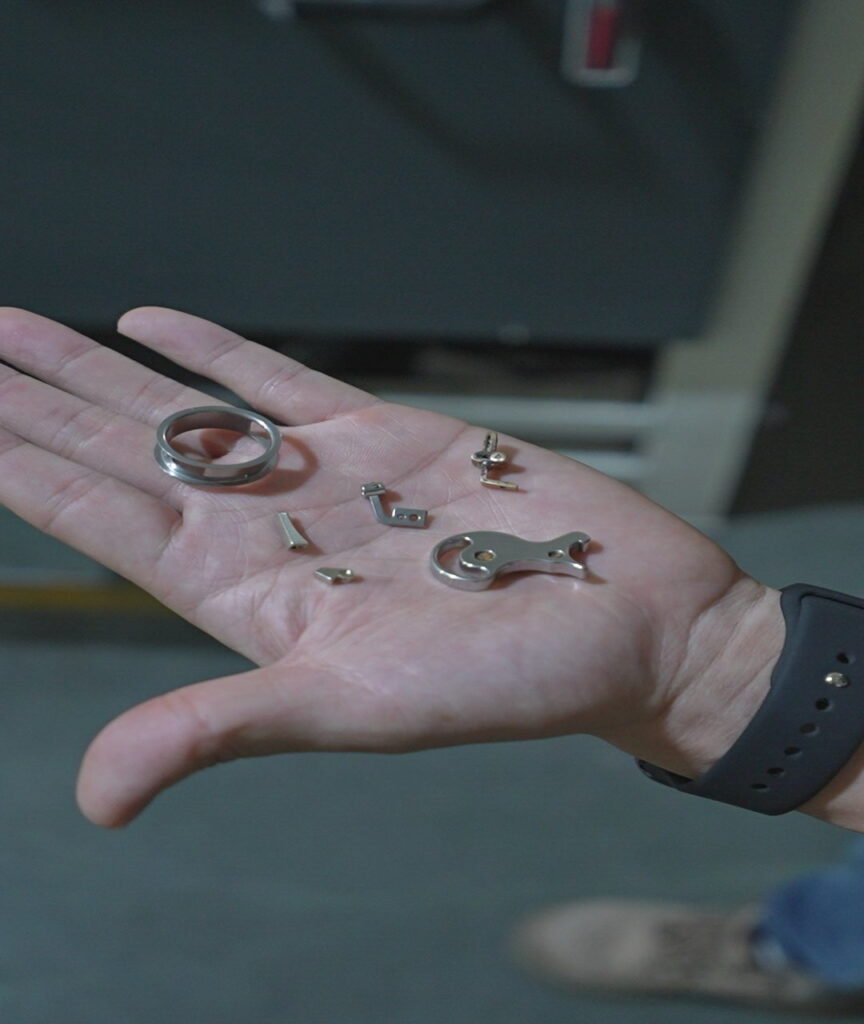
Deburring Machine: How to Choose Between Vibratory, Centrifugal, Magnetic and Barrel
A deburring machine is not one kind of equipment. There are four routes we build, and they differ in how the abrasive is brought into contact with the burr — a flowing charge, centrifugal force, a rotating tool, or a flexible needle mass. That difference decides what the process can reach: a cross-hole, a thread root, a long edge on a stamped part, or the whole surface of a die casting.
Choosing by the machine name gets you a quotation. Choosing by what the burr is attached to and where it sits gets you a working process. This page sets the four routes against each other on that basis, gives the numbers we publish, and is specific about which parts should be deburred another way.
What you see when the route is wrong
Every one of these is a real complaint, and each points at a different route rather than a different setting:
| What you see | Which route is probably missing |
|---|---|
| Burr gone from outside faces, untouched inside a cross-hole or thread root | Need a flexible contact — magnetic finishing, or a much finer media in a flow machine |
| Edges rounded so far that the part no longer measures | The route cuts everywhere, not just at the burr — you needed a controlled local cut |
| Parts tangled, nested or dented against each other | Free-tumbling route used where parts should have been held or separated |
| Part distortion, or a thin wall bowed | High-energy route where the wall thickness could not take it |
| Long cycle with the burr still there | Charge too fine for the burr, or a spent charge — a grade problem, not a route problem |
The first and the second are the pair that decides most projects, and they pull in opposite directions. If the burr is in a place only a soft or fine mass can reach, the process is slow; if the process is fast, it rounds the edges you may need to keep. Almost every deburring specification is a point on that trade.
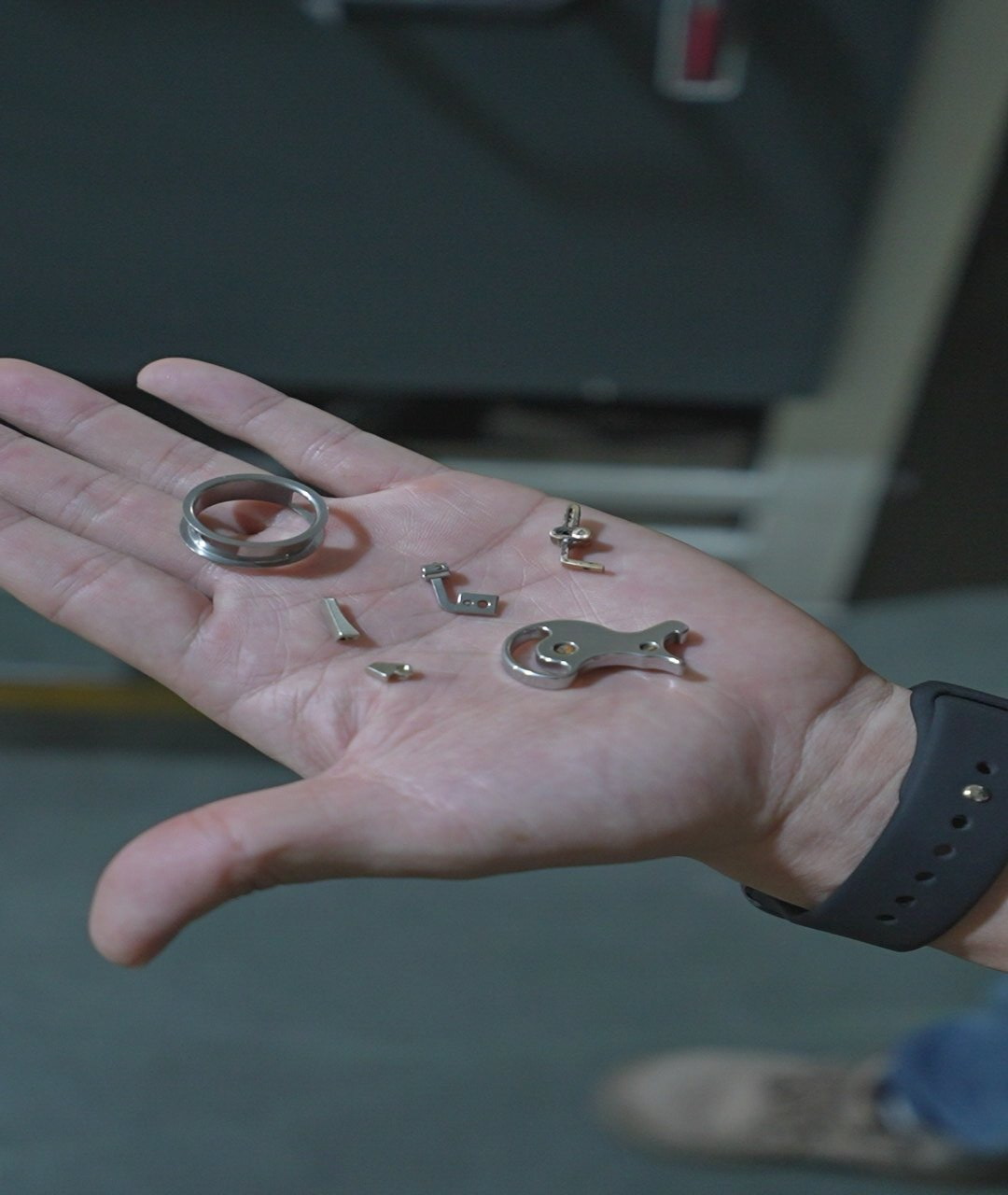
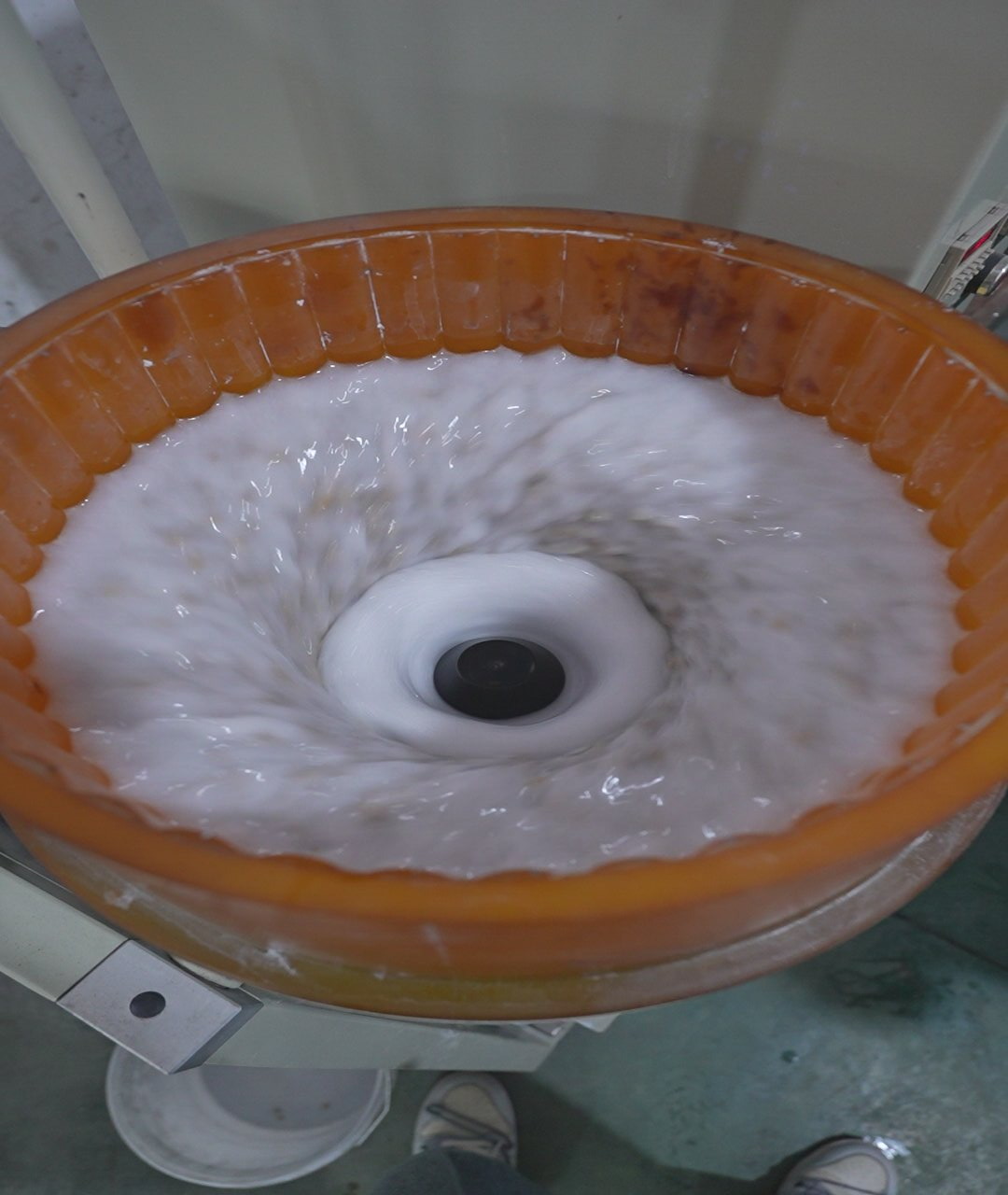
The four routes, by how the abrasive reaches the burr
- Vibratory (bowl and tub). A charge of media is driven past the workpiece in a flow. The cut is even over the whole surface and a batch goes in at once, which is what makes it the general-purpose answer. Its limit is the depth of a feature: the flow reaches what it can flow past.
- Centrifugal (disc and barrel). Centrifugal force presses the charge against the part, or holds the part against a rotating tool. The cut is much faster and much more energetic, so the same stock comes off in a fraction of the time — which is exactly what makes it wrong for thin walls and right when cycle time is the constraint.
- Magnetic. A flexible mass of steel needles is drawn to the part and follows its contour, so the contact is spread over the whole surface without a fixed tool. This is the route for burrs in slots, cross-holes and thread roots, and it is why it reaches places a tool cannot and does not round a sharp edge the way a tool does.
- Barrel (rotary and octagonal). The whole charge rotates together. It is the volume answer for simple shapes where the part can tumble freely and the media only has to reach the outside — and the wrong answer for anything that would tangle or that has a feature needing a specific contact.
The consequence for a buyer: the same part can be a two-minute job on one route and a two-hour job on another, and the fast route may not reach the burr at all. That is why "which deburring machine" cannot be answered without the drawing.
What to pin down before comparing routes
Six items on the drawing, in this order:
- Where the burr is. At an open edge, in a cross-hole, at a thread root, on a face. This single item usually selects the route.
- How strongly it is attached. A loose burr from a drilled cross-hole and a heavy casting gate are different jobs. Extending a gentle cycle to shift a heavy burr rounds every good edge before the burr goes.
- The smallest feature. Media must not exceed about one third of the smallest feature — the rule that stops the charge from either lodging or failing to reach.
- The thinnest wall. Below roughly 0.5 mm, distortion is the risk rather than cut quality.
- What must not change. Edge radius tolerance, sealing faces, thread flanks, bearing bores. "Deburr" and "keep the edge sharp" are often in the same sentence on the drawing.
- Batch and part variety. One part at volume and forty parts at low volume are different buying decisions, not just different batch sizes.
A field check before anything is quoted: put the part and a sample of the intended media in a bag and shake it. If the media will not enter the feature by hand, no amount of machine tuning will put it there.
The machines, with the numbers we publish
Each route has a family behind it. Where we publish a full table, here it is; where the right answer depends on the part, that is said plainly instead of printed as a badge.
Centrifugal barrel — LX series
| Parameter | LX60B |
|---|---|
| Nominal capacity | 60 L |
| Dimensions (L×W×H) | 1150 × 1200 × 1400 mm |
| Motor | 3.0 + 0.75 kW |
| Speed range | 0–170 rpm |
| Load capacity | 15 × 4 kg |
That load is published as 15 × 4 kg rather than one weight, and it — not the 60 L — is what decides the batch; confirm the split against your batch. See the centrifugal barrel machine, and for the disc-versus-barrel question the comparison note.
Tub vibratory — L series
| Parameter | L1300 | L1500 | L1800 |
|---|---|---|---|
| Bowl capacity | 1200 L / 42.4 cu.ft | 1500 L / 53.0 cu.ft | 1800 L / 63.6 cu.ft |
| Working chamber | 1200×1000×1000 mm | 1500×1000×1000 mm | 1800×1400×1000 mm |
| Motor (dual) | 5.0 kW × 2 | 5.5 kW × 2 | 7.5 kW × 2 |
| PU liner | 20–35 mm | 20–35 mm | 20–35 mm |
| Net weight | 2200 kg | 2600 kg | 3000 kg |
| Chamber divider | Optional | Optional | Optional |
The 20–35 mm polyurethane liner is the wear part that the tub is bought for on a heavy deburring charge, and the optional chamber divider is the cheapest way to run two part types in one machine without mixing them. Full table: L-series tub machine.
Rotary and octagonal barrel
| Model | Capacity | Motor | Speed | Net weight | Note |
|---|---|---|---|---|---|
| OBD—BJ160B | 160 L (80 L carry) | 1.1 kW | 0–50 rpm | 450 kg | Octagonal, BASF PU liner, inclinable, PLC |
| OBD—BJ400B | 400 L (200 L carry) | 2.2 kW | 0–50 rpm | 800 kg | Same, larger |
| OBD-BLG400 | 250 × 4 L | 1.1 kW | 0–60 rpm | 732 kg | Bamboo barrel, free-flowing |
| OBD-BG01 | 40 × 4 kg | 3.7 kW | 0–100 rpm | 1600 kg | High-density bamboo board, 25 mm thick, PLC |
| OBD-CJG480C / CJS480 | 40 × 4 L (80 L carry) | 3.7 kW | 0–100 rpm | 1600 kg | Double drive, CE safety tested |
Magnetic
| Model | Capacity | Motor | Speed | Net weight |
|---|---|---|---|---|
| YH-680D | 25 L | 2.2 kW | 0–1800 rpm | 100 kg |
| PY-980D | 60 L | 4 kW | 0–1800 rpm | 250 kg |
Magnetic finishing is the route for burrs inside slots, cross-holes and thread roots, because the needle mass follows the part rather than touching it at one point → the magnetic finishing guide and the magnetic finishing range.
Disc
The disc route holds one part against a rotating tool for a controlled, local cut — the answer where the finish is measured rather than judged by eye. Capacity is set by the workpiece envelope and the required removal rather than by part weight, so we quote it per part — see the disc finishing range.
The full model list, every line side by side with speed and weight, is on the catalogue page.
Deburring metal: steel, stainless, aluminium and copper
The four routes above answer "how does the abrasive reach the burr". There is a second question that decides the same route differently: what the metal is. Four metals cover most enquiries.
Steel (carbon and alloy)
The most forgiving metal on this list, and the one where the route is decided by volume rather than by risk.
- What works: any of the four routes. Steel takes a coarse cut without distorting, so the constraint is throughput and cost per part rather than process capability.
- What decides it: batch size and part geometry. Small parts in volume → bowl or centrifugal. Long or heavy parts → tub. Simple external edges on a robust part → barrel.
- The trap: the burr comes off easily, so the route is chosen on price — and then the rust window between finishing and the next operation is not planned for. Steel that comes out clean and rusts overnight was routed badly, not deburred badly.
Stainless steel
Harder, work-hardening, and the metal where an aggressive route shows its cost on the edge rather than on the burr.
- What works: vibratory and centrifugal both work; the difference is control. Stainless needs the cut taken in stages, because a single aggressive pass hardens the surface layer while it cuts, and the hardened layer is harder to finish afterwards.
- What decides it: whether the edge radius is held tightly. A tight radius rules out the highest-energy route, because the same energy that removes the burr rounds the edge past the drawing.
- The trap: assuming stainless behaves like steel at a slower rate. It does not — it work-hardens, so "run it longer" produces a harder surface rather than a better one.
Aluminium
Soft, and the metal where the wrong route produces a surface that then has to be repaired by removing more material than the original process would have.
- What works: a gentler family, or a lower-energy setting on the same family. Plastic media or a fine ceramic, staged — a coarser stage to take the stock, a finer stage with a clean compound for the brightness.
- What decides it: wall thickness and whether the part smears. Aluminium does not chip, it smears, so a route that generates heat produces a worse result the longer it runs.
- The trap: using a route and a charge set up for stainless. That combination cuts too deep, leaves a rough hard surface, and the usual recovery — take more material off — is the wrong direction.
Copper and brass
Soft like aluminium, but the failure mode is contamination and colour rather than smearing.
- What works: the same families, with a dedicated charge. Copper and brass pick up iron from a charge that has run steel, and the result is a rust spot on a polished part.
- What decides it: the colour requirement, not the burr. Brass cuts fast, so the burr is rarely the constraint — the constraint is not discolouring the part and not embedding foreign material.
- The trap: a shared charge. This is the single most common cause of a brass batch that comes out with a dull cast, and it is not visible until the parts are polished.
The rule
The route is chosen by geometry, then corrected by metal. Two parts of the same shape in steel and in aluminium can take the same machine family at different energy and different media — but a part that is fragile in one metal is fragile in all of them, and a burr inside a cross-hole is unreachable in every metal. The metal changes the aggressiveness and the contamination rules, not the physics of contact.
Where each route does not fit
This is the part a supplier is least likely to write, so be specific:
- Vibratory flow is wrong when the burr is in a feature the flow cannot enter. A deep blind slot or a thread root will still have its burr after a long cycle, and the rest of the part will be over-worked in the attempt.
- Centrifugal is wrong below roughly 0.5 mm wall, and wrong for any part with a feature that must not be radiused. Energetic processes cut everywhere, not only where you wanted.
- Magnetic is wrong for large parts and for heavy burrs. The needle mass is a finishing and light-deburring tool, not a stock-removal tool.
- Barrel is wrong for parts that tangle, nest or collide, and wrong where one face must keep a machined finish. Free tumbling does not respect a drawing note.
- Any route is wrong for parts where the burr is a folded flap rather than an edge. A fold gets peened over rather than removed, and it reappears when the part is plated or stressed.
- Any route is wrong for mixed-material loads. A charge used on steel then on aluminium carries contamination that shows up as scratches → stamped parts without tangling or part-on-part damage and small fasteners without damaging threads.
What to put in the RFQ
- The route, and the reason for it. A quotation that names only a capacity has not made a selection. The answer should say which part feature ruled the other routes out.
- A trial on your worst-case part. Send representative parts including the one you are worried about, the material, and both the finish you need and the one you will accept. The result comes back with cycle time and media consumption measured. A batch that looks fine on simple geometry can drop to half the count once a feature traps media.
- A stated acceptance criterion. What counts as a deburred edge, and how it will be measured — burr height, edge radius, a roughness figure, or a visual sample agreed in writing. Without that, a trial only tells you what the parts looked like.
- Media consumption per batch. Media life is 20–200 operating hours depending on material and cycle, so consumption has to be measured on your job. That number sets the consumable cost per part.
- Separation and drying, if the route is wet. Media that enters a feature has to come out, and a wet process needs a drying step or the residue shows as spotting weeks later → separating small parts from media. Budget both before the charge arrives.
- Dates in writing. A standard machine ships in 25–35 days from the deposit; built-to-order takes 45–60 days, and adding a separator or a dryer extends it. Sea freight from Xiamen to Rotterdam or Los Angeles adds 30–40 days. Terms are 30% deposit, balance against the shipping documents, the machine in a wooden case bolted to a pallet, and every machine runs with a charge of media before it ships.
On quality: the range is type-examined against Machinery Directive 2006/42/EC by UDEM International Certification Centre against EN ISO 12100 and EN 60204-1, under CE certificates M.2023.206.C88121 (vertical — the vibratory and barrel machines) and M.2023.206.C88120 (horizontal — the disc and magnetic machines), both valid to 2028-07-24; the quality system is certified to ISO 9001:2015 under certificate 00726Q01571R001, valid 2026-06-03 to 2029-06-02. The company holds 24 granted Chinese intellectual property rights (1 invention patent, 17 utility models, 6 design patents), with twenty-one machine platforms covered by the two type-examination certificates (8 vertical, 13 horizontal, no overlap). Equipment has been built in Xiamen since 1992.
Operating facts that apply to every wet route: noise 75–85 dB(A) at one metre, and a three-phase 380 V or 415 V / 50 Hz supply, with 220 V available on smaller units. Settle both before the order.
FAQ
What is the difference between a deburring machine and a finishing machine? In practice the same equipment: the media, the compound and the time decide whether the cycle removes a burr, smooths a surface or brightens it. Which is why "deburring machine" describes a process setting on a family of machines rather than a separate class of equipment.
Which route is best for burrs inside a cross-hole? Usually magnetic finishing, because the needle mass follows the contour and reaches a feature the flow cannot enter. A flow machine with a very fine media can reach a shallow feature, but a deep cross-hole is where the routes divide.
Can one machine do deburring and polishing? It can run both, but not in one cycle. The two want different media grades and cycle lengths, so a single charge means one of them is done badly. A two-stage process with a clean change between is the reproducible answer.
How long does deburring take? A light deburr runs 10–20 minutes; a heavy burr or a tight edge-radius control takes longer, and a high-finish polish afterwards runs 2–8 hours. A published cycle assumes a material and a removal that may not be yours, which is why the trial exists.
Do you separate the parts from the media? It has to be planned, not improvised. A screen or a separating unit is straightforward for a part much larger than the media and becomes a design problem when they are close in size — which is the point to raise it, not after the charge arrives.
 +86-592-2381506


 IPv6 network supported
