
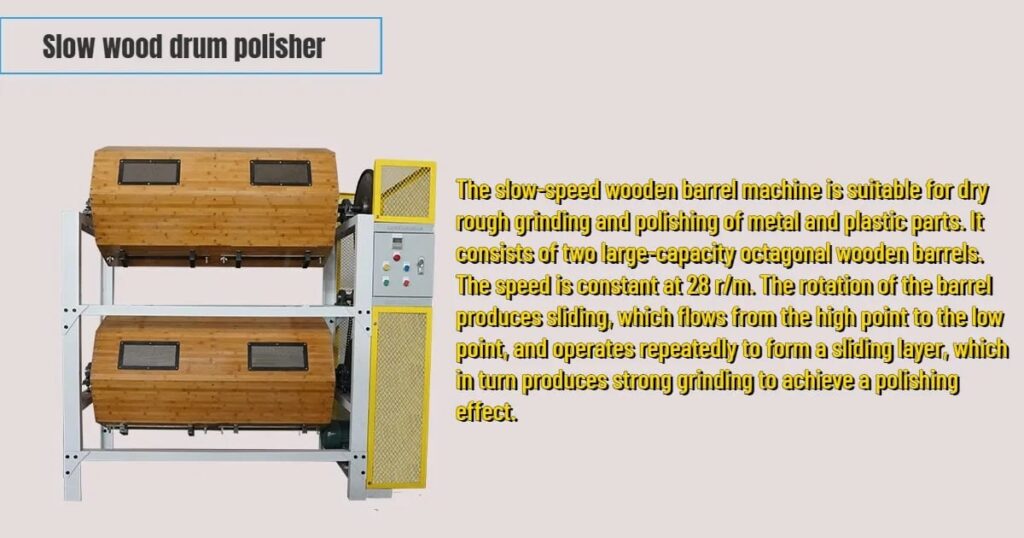
Tumbler Barrels: The Barrel Body Is the Wear Part You Are Actually Buying
A tumbler is a motor, a frame and a barrel — and the barrel decides what the machine can finish, how long it lasts and what it costs to keep running. Buyers compare motor kilowatts and litre capacities, which are printed on every catalogue page. Barrel material, liner thickness and how the lid seals are what actually govern the result, and they are what a specification table usually leaves out.
This page is about the barrel body as a component: what it is made of, how thick the lining is, how big it should be, how it seals, how it tips. It is deliberately not a model list — the rotary barrel category and the catalogue page do that. For the family decision above the barrel, barrel against vibratory tumbling is the comparison.
Product: tumbler barrels — the barrel body and its lining, for rotary barrel tumbling machines
Category: barrel finishing machines → rotary barrel tumbling machines
Used for: wet or dry tumbling of parts where the barrel is the process chamber — deburring, edge rounding, burnishing, dry polishing
Not used for: high-energy work (a centrifugal barrel is a different geometry), parts longer than the barrel's internal diagonal, or anything that needs the barrel opened mid-cycle
Order basis: barrel material + capacity + liner type and thickness + sealing arrangement + loading height
MOQ: 1 · Lead time: 25 to 35 days for a standard configuration, 45 to 60 days where the barrel is built to a non-standard size or lining
The material question comes first, and it is not about cost
Four barrel bodies are in common use, and the choice between them is decided by what the barrel has to survive:
| Barrel body | What it is good at | What it costs you | Typical use |
|---|---|---|---|
| Steel with a polyurethane liner | Durable shell, replaceable lining, works wet or dry | The liner is a consumable; a cut liner exposes steel | General metal deburring and burnishing |
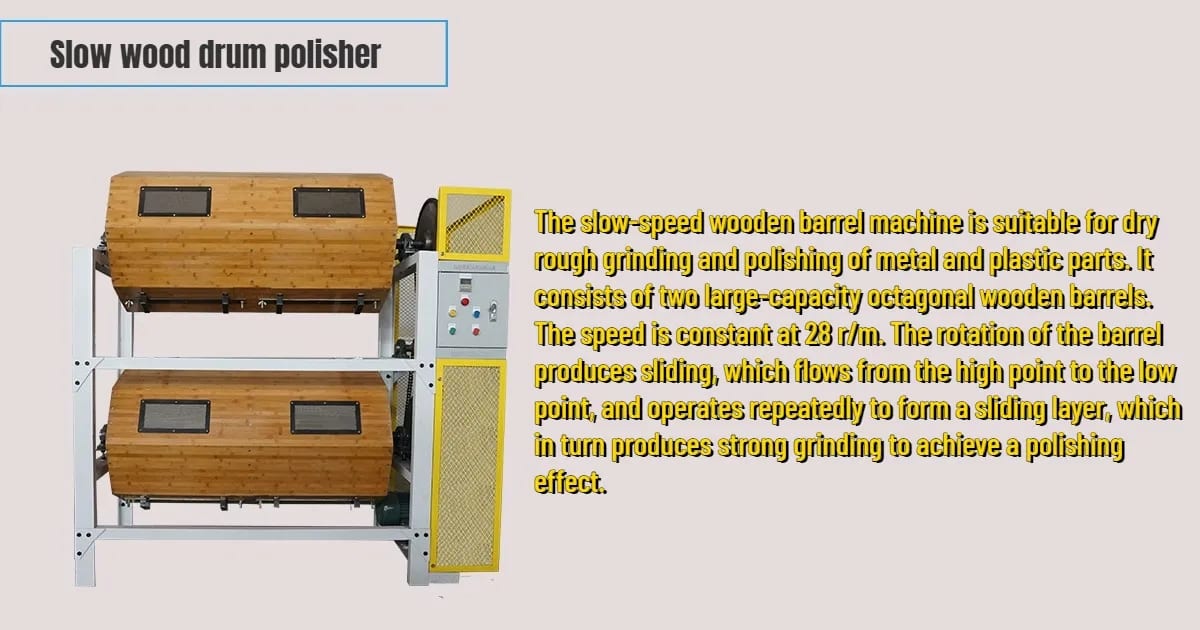
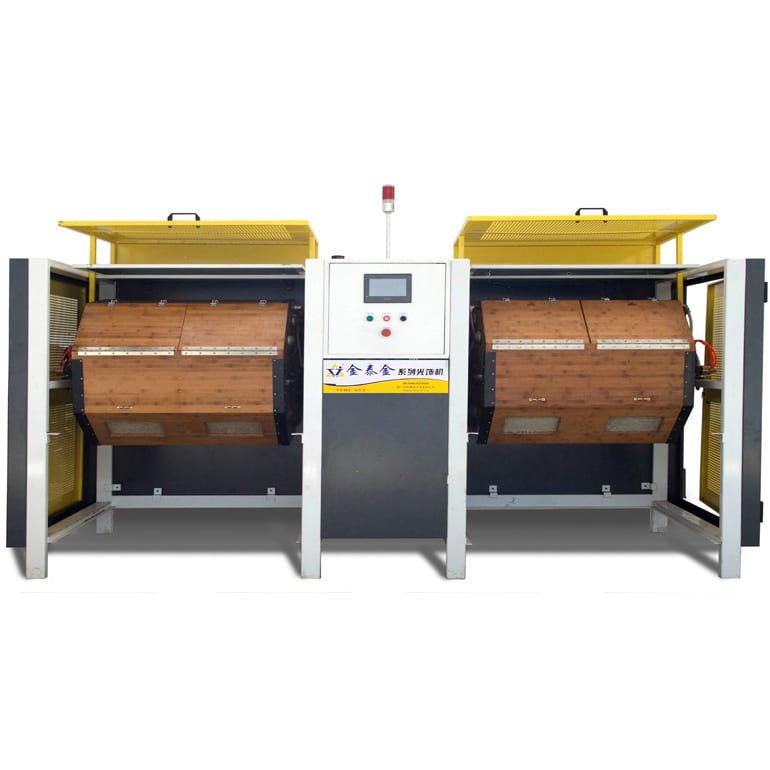
| Bamboo / wood | Quiet, naturally ventilated, self-cleaning in dry work; no rust | Wears on the slats; not for heavy wet work | Dry polishing, delicate parts, low-noise shops |
| Rubber-lined steel | No metal-to-part contact; absorbs impact | Heavier; the lining itself must be inspected | Parts that must not pick up iron, and soft metals |
| Stainless or unlined steel | Simplest and stiffest | Part-on-steel contact marks; rust risk in wet work | Coarse work where surface marking does not matter |
The two published barrel lines in our own range illustrate the split. The octagonal OBD—BJ160B and BJ400B carry a German BASF polyurethane lining and run 0–50 rpm on 1.1 kW and 2.2 kW respectively — the liner is the wear surface and the shell is there to hold it. The bamboo machines, OBD-BG01 and the CJG480C / CJS480 pair, publish a bamboo board thickness of 25 mm and run 0–100 rpm on 3.7 kW.
Those figures are the useful part of the comparison, because they tell you two things a photograph cannot. First, the PU-lined barrels run half the speed of the bamboo barrels — a lined barrel is doing slower, heavier work per revolution. Second, the bamboo machines are twice the motor: they are driving a barrel body with more mass in the wall and running it faster.
Liner thickness, and why 20–35 mm is a range rather than a number
On our tub series, the published polyurethane liner runs 20–35 mm. That range exists because liner thickness is a trade, not a maximum:
- Thicker liner, longer life. A barrel or tub is an abrasive environment; the lining is what the media actually touches. Thickness is directly the number of hours before the shell is exposed.
- Thicker liner, less working volume. Every millimetre of lining is a millimetre off the inside of the chamber. On a small barrel, the lining is a meaningful fraction of the capacity — so a heavily lined small barrel finishes fewer parts than its litre figure claims.
- Thicker liner, more mass to move. Which is a motor and bearing decision, not just a wear one.
The practical rule: specify the lining against the work, then check the capacity that results — not the other way round. A barrel bought on litres and then lined heavily holds less than the buyer expected. This is the most common surprise in a barrel offer, and it is arithmetic rather than opinion: the usable chamber is the nominal chamber minus the lining.
Where the lining shows up in a wear plan. Inspect for thinning, cuts, separation from the shell, hardening and exposed metal — and look for wear concentrated in one area, which tells you about loading rather than the liner. A small liner defect grows quickly once abrasive media reaches the exposed shell behind it, and the same wear-inspection routine covers the barrel, the lid and the drive together.
Capacity: litres are not what the barrel holds
A barrel's published capacity is a volume, and a volume is not a batch. Three things sit between the two:
- The lining. As above: the usable chamber is smaller than the nominal one once the lining is in.
- The charge. A barrel needs free volume for the media to tumble. Fill it to the lid and the charge stops rolling and starts sliding, which is why an over-filled barrel finishes worse than a correctly filled one.
- The parts. A part with a hollow or a deep feature takes disproportionately more room than its outer dimensions suggest. This is the same reason a batch count that looked fine on simple parts halves once a feature is added.
Published capacities in our range show how wide the span is: the BJ160B at 160 L with an 80 L carrying capacity, the BJ400B at 400 L with 200 L, the bamboo BLG400 at 250 × 4 L, the BG01 and CJG480C/CJS480 at 40 × 4 L / kg, and the centrifugal barrel LX60B at a 60 L nominal barrel with a 15 × 4 kg load. The pattern is the same everywhere: the carrying figure is roughly half the nominal one, and it is the carrying figure that decides the batch.
The length rule is separate and harder. A part has to tumble, not bridge. Where the part's longest dimension approaches the barrel's internal diagonal, the part stops rolling and starts sliding, and the middle of it sees no contact at all. Cut the part count and the barrel size is still wrong — this is a barrel-shape question, not a loading one.
Sealing, and the lid is where barrels leak
The lid is the part of a barrel that gets the least attention in an offer and the most in service. Four things to look at:
- The seal itself. A gasket that has taken a set leaks. On a wet barrel a leak is not just mess: compound level drops, concentration drifts and the finish drifts with it.
- The clamping arrangement. Clamps that are tightened unevenly distort the lid and load the seal on one side. Even clamping is a procedure, and it needs to be written down for operators.
- The hinge and the counterweight. A barrel lid that is heavy and unassisted is a handling risk, and on a large barrel it is also why the lid gets closed badly.
- The discharge arrangement. A barrel with a discharge door discharges faster and seals in one more place. A barrel without one is tipped to empty.
Wet barrels additionally need a drain, and the drain screen is a wear item: fine debris restricts it, and a restricted drain turns a wash into a slurry.
Tipping, loading height and the ergonomics nobody quotes
The barrel has to be filled and emptied, and on a barrel that is above waist height, that is a labour and a safety decision rather than a convenience:
- Inclinable barrels — the BJ series is published as inclinable — tip to load and unload. That is the difference between loading at the barrel mouth and lifting a load over the rim.
- Loading height is a line item in the enquiry. If the barrel mouth is high, the operator either uses a platform or lifts, and neither is free.
- Floor space and access are decided by the tipping arc, not by the machine footprint. A barrel needs clearance in front of it that a catalogue dimension does not show.
This is where a barrel differs from a vibratory bowl in a way buyers notice only after installation: a bowl is loaded from above, a barrel is loaded through an opening. The whole material-handling decision around the machine follows from that.
What the barrel body does as it wears
| What you see | The usual cause | What to check | What to change |
|---|---|---|---|
| Finish quality drifts down over months | The lining has thinned or hardened; the charge also wears | Remaining lining thickness at the thinnest point; the media's hours | Re-line; replace the worn charge on schedule |
| Parts coming out marked or grey | Lining cut or worn through to the shell; or a contaminated charge | The lining surface for cuts and exposed substrate | Re-line before the shell is damaged; dedicate a charge per material |
| Barrel leaks at the lid | Seal taken a set, clamps uneven, or a distorted lid | Gasket condition; clamp sequence; lid flatness | Replace the gasket; write a clamping procedure |
| Barrel leaks through the wall | Liner damage allowing compound behind it | The inside surface, and moisture on the outside of the shell | Stop and investigate — this is not a plumbing fault |
| Charge not rolling, sliding instead | Over-filled, or parts bridging | Fill level against the carrying capacity; the part's longest dimension against the barrel's diagonal | Reduce the load; change barrel size or part count |
| Louder than it was | Liner separation, mounting or bearings | Lining attachment; mounts; listen at the drive | Re-line or re-mount; the family runs at 75 to 85 dB(A) at one metre, so a change is measurable |
| Lid hard to close after service | Distortion from uneven clamping, or a swollen gasket | Lid flatness; gasket fit | Reseat or replace; correct the clamping procedure |
Where a barrel is the wrong body
- A part longer than the barrel's internal diagonal. It bridges. No loading fix works, and the correct answer is a tub or a different geometry.
- Very high energy work. A centrifugal barrel achieves its energy from a different geometry; sizing a rotary barrel up does not get there.
- Thin walls and fragile parts. A tumbling charge transfers load through the part. Below roughly half a millimetre of wall, distortion is the risk rather than the cut.
- Parts that must stay individually oriented. A barrel is a batch process; orientation is not controlled.
- One part, very high volume, continuous flow. A barrel is a batch machine by construction — loading, running, unloading. A line process is a different purchase.
- Dry work in a humid shop without extraction. Dry tumbling produces dust and, on bamboo or wood, a moisture question of its own.
- Any barrel where the lining is chosen after the capacity. If the chamber that results is too small, the machine is wrong and no re-lining fixes it.
What to send us before a barrel is quoted
- The part drawing, with the longest dimension, the smallest feature and the thinnest wall marked.
- The batch weight per cycle you need, and parts per batch — not the machine's litres.
- Wet or dry, and what the compound is. Wet work drives the sealing and drain decisions.
- The barrel material and lining you need, or the constraint behind it — for example, whether the parts must not touch steel.
- Loading and unloading: what lifts the parts, and how high the barrel mouth can be.
- The site services: three-phase 380 V or 415 V at 50 Hz, floor space including the tipping arc, and a noise baseline of 75 to 85 dB(A) at one metre.
- Expected hours per week, so the lining and the media are specified against a real life rather than a nominal one.
A barrel is quoted against the part and the hours, and the specification that comes out of a trial is the only one worth building. We manufacture the machines and the media that run in them, and we do not offer a job-shop finishing service — so a trial is run on your parts, and what comes back is a finish, a cycle time and a measured media consumption.
Frequently asked questions
Which barrel material should I choose? Decide from two constraints rather than from cost: whether the parts may touch steel, and whether the work is wet or dry. Where parts must not pick up iron or be marked, a non-metallic contact surface is required. Where the work is dry and quiet operation matters, a bamboo or wood body is the natural choice. Where it is heavy wet deburring, a lined steel shell with a replaceable lining is the practical answer.
How thick should the lining be? There is no single number — our tub series publishes 20–35 mm, and the right figure inside that range depends on the hours and the media. The trap is that lining thickness comes out of the capacity, so specify the lining first and read the resulting chamber, not the other way round.
How full should a barrel be? Fill it so the charge rolls rather than slides, and treat the published carrying capacity as the ceiling rather than the target. An over-filled barrel is a slow barrel, and the mistake looks like a media problem rather than a fill problem.
Can I run a barrel unattended? Mechanically yes, which is why lid sealing and clamps matter: an unattended barrel that leaks loses its compound level and returns a batch that missed the specification.
Why does the finish change after the barrel has been in service a while? Two consumables wear at once. Lining wear changes the contact surface and the working volume; media wear changes the cut and the size spread. Media life is 20 to 200 operating hours depending on material and cycle, so the change is expected rather than a fault — scheduled, not diagnosed.
Will a bigger barrel finish my part better? Usually not better, and often slower per part. The result depends on the charge rolling against the part, so a barrel too large for the batch has slack and the load does not develop. Size to the batch, not to the largest model.
Max Xu, Sales — Xiamen Jin Tai Jin Grinding Technology Co.,Ltd.
No. 31, Xinchang Road, Xinyang Industrial Zone, Haicang District, Xiamen
info@surface-polish.com
Barrel dimensions, lining figures and capacities quoted here are the published values for the models named; where a lining is not published for a configuration, none is stated. A finishing process is set by the material, the stock to be removed and the finish required, so the configuration for a specific part is confirmed against a trial on that part. We manufacture finishing equipment and the media and compounds that run in it; we do not offer a job-shop finishing service.
 +86-592-2381506


 IPv6 network supported
