
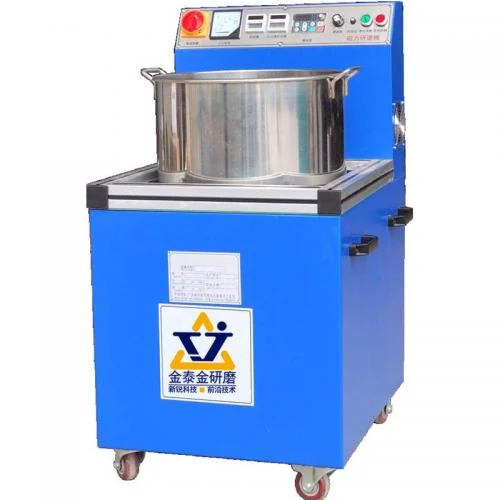
Magnetic finishing machines are commonly used in the aerospace, automotive, and medical industries to improve the surface finish of metal parts. They can also be used to remove rust and corrosion from parts, as well as to achieve a specific surface roughness or texture. When selecting a magnetic finishing machine, it is important to consider the size and shape of the parts, as well as the desired finish and production volume.
Email : info@surface-polish.com


A rotating magnetic field drives small steel pins through the working gap, and those pins act as the abrasive against the part. Because the pins are small and move independently, they reach fine features and internal shapes that bulk media cannot enter.
Small, detailed, hard-to-hold metal parts: watches, jewellery, medical components, connectors and similar work. It is particularly useful where part-on-part contact would cause damage, because parts are processed without striking each other.
It is not a bulk material-removal process, so it will not replace a heavy deburring stage. It is also unsuitable for non-magnetic materials and for large or heavy parts that do not suit the working gap.
It reaches into recesses, cross-holes and internal shapes better than bulk media, because the pins follow the magnetic field into the feature. How far it reaches depends on the geometry and on the pin size selected.
The pin size and shape, the cycle time, the carrier or compound and the loading should each be established on a sample and confirmed by inspection. The process is sensitive to small changes, so a written record makes it repeatable.
Answers are directions to test on a sample part, not validated results for a specific component.
 IPv6 network supported






 +86-592-2381506
