A buyer in Edmonton, Canada working on marine components has a 316L manifold whose cross-drillings must be deburred without lodging media in blind ports or peening the seal faces. SurfacePolish supplies finishing machines, media and compounds across borders and runs a free sample trial: the part goes to Xiamen and returns with an observed condition and a proposed media, compound and cycle direction for the buyer to verify. This brief is written for a buyer in Edmonton working on marine components; it describes equipment, media and a scoped sample review, not a local polishing service.
Does the part family repeat often enough, with stable geometry, to justify a cell rather than a batch machine or hand work?
Can the charge or the tool reach the surfaces that matter, and which enclosed passages and blind holes can never be reached at all?
What starting condition and cleanliness baseline will the part arrive in, and who owns the pre-finish step?
Marine fabrications are large and heavy in a way that narrows every route. A pump casing may weigh several hundred kilograms, a shaft can run past four metres, and a scrubber panel can be thin sheet welded into a stiffening frame. Three numbers decide the shortlist: the largest dimension that must be reached, the mass that has to be supported and turned, and how much of that dimension can be presented without the part sagging under its own weight. Long shafts and thin panels behave differently in a fixture than on a bench, and residual weld stress released by material removal moves the part afterwards. Measure the envelope and the mass, note where supports and clamps may touch, and record whether the part is stress-relieved before anyone claims a dimension will hold through finishing.
Compound carries the work: it cleans the part and the media, holds fines in suspension, inhibits corrosion and controls foam. A mildly alkaline or near-neutral family is typical for ferrous work, and dose is set by measured concentration rather than by eye. On stainless and duplex marine parts the chloride content is the variable to control, because chlorides left in a pit, a crevice or a thread root can start pitting long after the part leaves the shop, and both tap water and recycled rinse water carry them. Confirm the water that will actually be used, add a rinse step that reaches the same features the finishing step reached, and dry the part rather than letting it drain and stain. Foam, residue and drag-out into a clean area are part of compound selection, not afterthoughts.
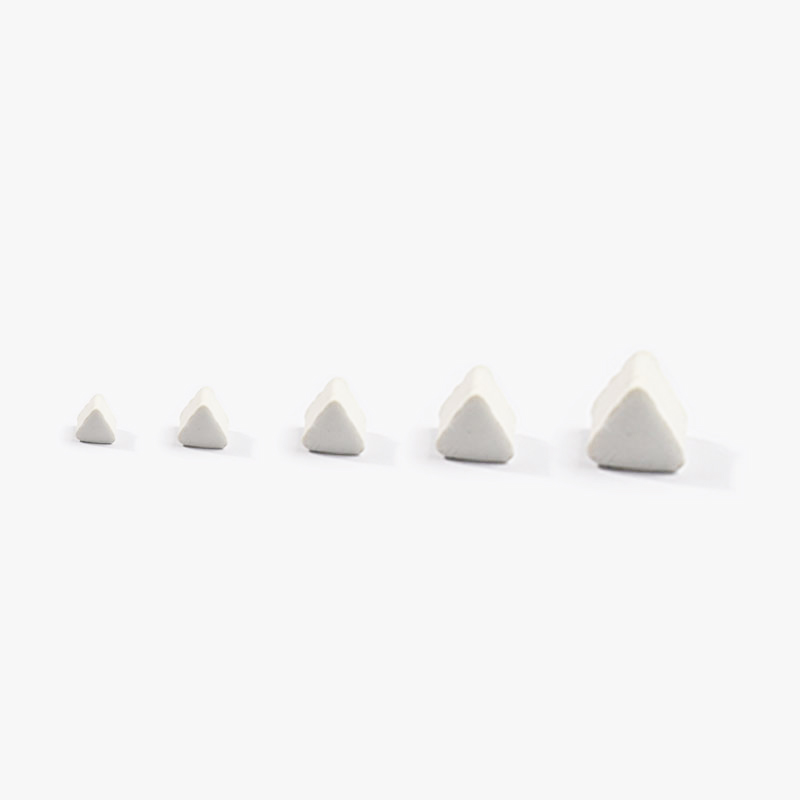
| Media | Best fit | Watch out for |
|---|---|---|
| Chloride-free mildly alkaline or near-neutral compound, liquid or powder | Cleaning, corrosion inhibition and fines suspension on stainless and duplex marine work where retained chlorides would risk pitting in service | Dose drifts with drag-out and water hardness, foam can hide the load, and rinse water must reach the same features the compound reached |
| Plastic triangles, cones and pyramids in a soft to medium grade | Deburring aluminium brackets, bronze castings and cosmetic faces where marking and edge loss must stay small | Slow cut rate, media deforms as it wears, and a worn charge behaves quite differently from a fresh one |
| Aluminium oxide grinding media in a dense ceramic bond | Heavier stock removal or a more consistent cut on robust stainless and duplex parts with thick edges and cast skin | High removal energy rounds functional edges quickly and is a poor match for thin panels or a knife-edge seat |
| Steel media including balls, pins and shaped shot | Bright burnished finishing and edge blending on stainless components where appearance matters and stock removal must stay low | Transfers iron to stainless and leaves free iron that blooms in chloride service, so it needs a dedicated charge, an inhibiting compound and magnetic or screen separation |
A robot reproduces whatever the fixture gives it. A large marine part has to locate on a repeatable datum, be clamped without forcing a thin panel out of shape, and be supported so that it neither sags nor shifts as material comes off. For tool-carrier work, adding a positioner or turntable can present several faces to the arm without re-clamping, which often reduces the reach and payload the arm itself must supply, at the cost of an extra axis with its own repeatability. Build the fixture around surfaces that are not being finished, use the datums the drawing already uses, and decide early whether clamping marks are acceptable on a visible face. A trial that cannot reproduce the production fixture will not predict production variation, however good the tool path looks.
| Machine route | Where it fits | What it will not do |
|---|---|---|
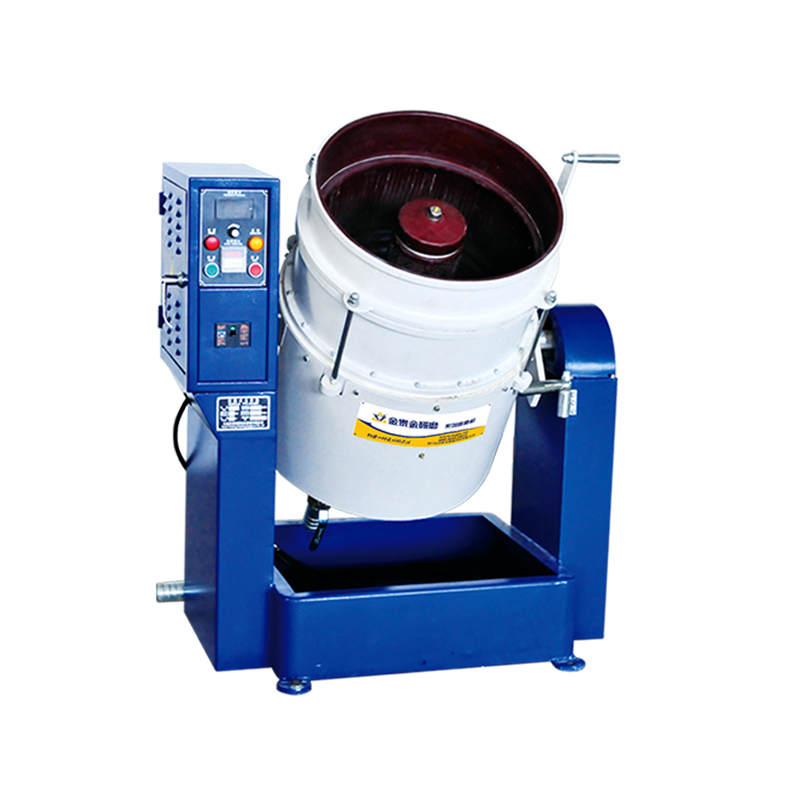
| Vibratory finishing machine (bowl) | Bulk deburring and refinement of small and medium marine fittings, cast cleats, brackets and machined valve internals that can tumble without racking | Continuous part-on-part contact and no access to internal passages; visible faces and heavy parts need separation, racking or a different route |
| Tub vibrator | Long parts that cannot rotate in a bowl, such as rail sections, pipe spools, linear weldments and long shafts, provided they can be supported along their length | Lower energy per unit area, so heavy weld dressing takes longer, and a long tub needs floor space plus a support method that does not mark the part |
| Rotary barrel finishing machine | Gentle deburring of small fragile components and mixed fitting batches with generous compound flow and low part-on-part energy | Long cycles with no visibility while running, and internal passages collect media and compound that must be retrieved at unload |
| Magnetic finishing machine | Fine deburring and light refinement of small precise features such as narrow slots, small bores and stainless fittings | A small working envelope that excludes large fabrications, with pin media that can lodge in fine passages and must be retrieved |
A pump or valve body has seawater passages, a drain boss and a row of blind tapped flange holes. A welded fabrication has an enclosed stiffener cavity or an open-ended box section. Each of these is a place where a medium, a broken fragment of medium or a slug of compound can settle and stay. The part passes a visual check on the outside and the problem appears after assembly, when a passage is restricted or a fastener will not seat. Size the medium below the smallest opening it can enter, count the charge in and out where the batch allows, borescope the smallest passage at an agreed angle, pin gauge or thread gauge the holes, and rinse through a filter so the discharge can be inspected. Blind features that were never mapped are the usual source.
| Failure mode | Likely cause | How to catch it |
|---|---|---|
| Medium or a broken medium fragment lodged in a seawater passage, drain boss or internal cavity | Media size class too close to the smallest opening, a worn charge breaking down into smaller pieces, or an enclosed feature that was never mapped before the route was chosen | Count the charge in and out where the batch allows, borescope the smallest passage at an agreed angle, and flush the passage into a filter so the discharge can be examined |
| Medium wedged in tube-sheet holes or perforated plate openings | Hole diameter close to the media section, cylindrical or conical media that aligns with the hole, or a charge left to drain in the part at unload | Pin gauge a sample of holes across the plate, tap and back-flush each sample, and inspect the plate under oblique light for a medium sitting flush with the surface |
| Compound film, burnished residue or dried detergent left on a sealing face | Rinse that did not reach the same features the finishing step reached, compound drag-out from the charge, or a part allowed to drain and dry in position instead of being dried deliberately | Wipe the sealing face with a clean white cloth and a defined solvent, inspect the wipe, and borescope any groove or land the rinse may not have reached |
| Keyway, spline or taper geometry lost to edge rounding | The feature was exposed to the charge without masking, or a tool-carrier path ran along the flank of the feature instead of stopping short of it | Check width, flank angle and edge break with a gauge or comparator at marked stations before and after, and confirm the protected feature against the drawing tolerance |
Edmonton's industrial base is built on hydrocarbons and the processing industries that grew around them, combined with a substantial aerospace and aviation maintenance presence at the provincial level. The Government of Alberta describes Alberta's Industrial Heartland as the province's designated industrial zone and an emerging international hub for petrochemicals, home to global companies including Dow Chemical and Shell, and it cites Dow's CAD 11.6 billion net-zero petrochemical plant as one of the largest private investments in provincial history. Aerospace and aviation is the other measurable cluster: the province states that Alberta is becoming a premier aviation and aircraft manufacturing hub, with De Havilland selecting Alberta for an aircraft assembly facility, parts manufacturing and distribution centre, training centre and museum, and Lufthansa Technik Canada establishing a maintenance and repair facility at Calgary International Airport. The Edmonton region also hosts defence and security manufacturing: the national defence industry association reports that Western and Northern Canada accounts for 21 per cent of Canada's defence and security industry, with aircraft maintenance, repair and overhaul among the key regional activities. The City of Edmonton tracks and publishes its own economic reporting through the Corporate Economics function, including quarterly economic updates and long-term outlook documents.
The nearest part of that base to this brief is aerospace: The Government of Alberta states that Alberta is becoming a premier aviation and aircraft manufacturing hub, citing De Havilland's aircraft assembly facility, parts manufacturing and distribution centre and training centre, and Lufthansa Technik Canada's maintenance and repair facility at Calgary International Airport.
Petrochemical and hydrocarbon processing plants in the Edmonton region depend on valves, pumps, compressors, heat-exchanger components and piping spools whose sealing surfaces, gasket faces and machined bores must be burr-free and finished to specification, and turnaround work creates a recurring demand for reconditioning those components. Aviation maintenance, repair and overhaul adds engine and airframe component work where edge condition, surface integrity and cleanliness carry airworthiness implications, and where the finishing process has to be documented. Both customer groups buy on specification and inspection records rather than on appearance, so the practical requirement in Edmonton is process repeatability and the ability to prove what was done to a part.
An Edmonton buyer should settle whether the finishing requirement is driven by seal integrity or by fatigue and cleanliness, because those two answers point to different processes and different acceptance testing; on petrochemical hardware the specification is usually a defined gasket-face or sealing-surface finish, while in aviation MRO it is edge condition and cleanliness. The second question is whether the shop can produce and retain the process records that a petrochemical operator or an aviation quality system will ask for, since a finishing cell that cannot produce evidence of repeatability will not pass either customer's audit.
Freight context: Edmonton International Airport and Alberta Aerospace and Technology Centre, CN and CPKC rail corridors, Alberta's Industrial Heartland industrial zone (Fort Saskatchewan / Strathcona County), Edmonton's inland rail and industrial parks. Edmonton combines an international airport with an adjacent aerospace and technology industrial cluster, direct Class 1 rail service, and the large contiguous heavy-industry land base of Alberta's Industrial Heartland, which is why Alberta can site petrochemical plants of the scale of the Dow investment there. For equipment import, a machine would normally arrive through a coastal container port and be railed into Edmonton, while urgent parts can move by air; heavy modules and oversized components can also move by rail directly to industrial sites.
China is one of Canada's ten principal merchandise trading partners and the second-largest single-country source of Canadian imports after the United States: Statistics Canada reported CAD 5,369 million of balance-of-payments imports from China in January 2025, against a CAD 2,299 million bilateral merchandise deficit that month. Canada has no free trade agreement with China, so Chinese-origin industrial machinery enters under the Most-Favoured-Nation (MFN) tariff column of the Canadian Customs Tariff; the preferential treatments listed in the tariff (CUSMA/UST and MXT, CETA/CEUT, CPTPP/CPTPT, UKT, KRT and others) do not include China, and preferential rates require proof of origin plus the applicable shipping rules, so a China-origin machine cannot claim them. Tariff classification is mandatory work, not a formality: vibratory, barrel, centrifugal and disc finishing machines are classified in Chapter 84 ("Nuclear reactors, boilers, machinery and mechanical appliances; parts thereof") according to the function of the machine, and the ten-digit Canadian tariff item drives both the duty rate and the statistics. A further landed-cost risk sits outside the tariff schedule: under the Special Import Measures Act (SIMA), the CBSA and the Canadian International Trade Tribunal may apply anti-dumping and countervailing duties to named goods, so a buyer should check the measures-in-force list for the specific product before assuming the MFN rate is the final duty.
The customs authority is the Canada Border Services Agency (CBSA), and importers of commercial goods must work through the CBSA Assessment and Revenue Management (CARM) system, which is where registration, the duties-and-taxes calculator, advance rulings and national customs rulings, and the commercial accounting declaration (CAD) are handled. Documentation expectations are explicit: "You must provide proof of country of origin when you import goods into Canada and, in some cases, your goods must also be clearly marked", the invoice or sales receipt must carry "a complete description of the goods", "the selling price" and "any conditions and terms of the sale", and the value for duty must be declared in Canadian currency only. Duties and taxes are layered rather than single: customs duty on the tariff item, the Goods and Services Tax calculated on the duty-paid value, and potentially excise duty, excise tax, surtax or safeguard measures. Importers must also clear non-tariff gates: goods must be admissible, some goods need permits, certificates or inspections from other federal departments that the CBSA applies on their behalf, controlled goods under the Defence Production Act require consultation with the CBSA and Global Affairs Canada before import, and "Goods manufactured or produced wholly or in part by forced or prison labour are prohibited from entering Canada", with due diligence resting on the importer. For electrical machinery, the practical conformity route in Canada is certification of the product to Canadian electrical safety standards by an accredited certification body rather than a self-declared CE-style mark; buyers should confirm the specific certification body and mark required before shipment. For a first shipment of a finishing machine or a media/compound sample lot, the fastest way to remove classification and valuation uncertainty is to use the CARM portal to request an advance ruling for tariff classification and origin.
SurfacePolish supplies from Xiamen, China. The buyer's own destination rules, conformity marking, tariff classification and documentation responsibilities stay with the buyer; confirm them against the authorities named above before ordering.
Most marine fabrications cannot be brought to a coordinate measuring machine, so the measurement plan has to be portable and repeatable. Use a hand-held surface roughness tester on accessible faces with the agreed cut-off and traverse direction, and record each reading location on a marked photograph rather than describing it in words. For curved or restricted surfaces a moulded replica tape can be read offline. Straightness and flatness are usually checked with a straightedge and feeler, a dial gauge on a stand, or a laser alignment system, and the support scheme used during measurement should match the one used in production. Diameters and bores are checked with micrometers, bore gauges or inside micrometers at marked stations. Whatever the instrument, use the same operator, station and setup across a comparison.
Send parts that represent the extremes, not the average. Include the part with the tightest internal passage, the thinnest section, the largest surface to be finished and the most restricted access. Include one weld sample made with the production welding procedure, because a weld toe finishes differently from parent metal. Include an as-received reject so the starting condition is documented, and mark the measurement points and controlled features on each part before shipping. Record the material grade, product form, heat treatment, as-received condition and the cleanliness requirement the part must eventually meet. Label everything and pack it so nothing is damaged in transit. A trial run on a convenient sample answers a question the buyer did not ask.
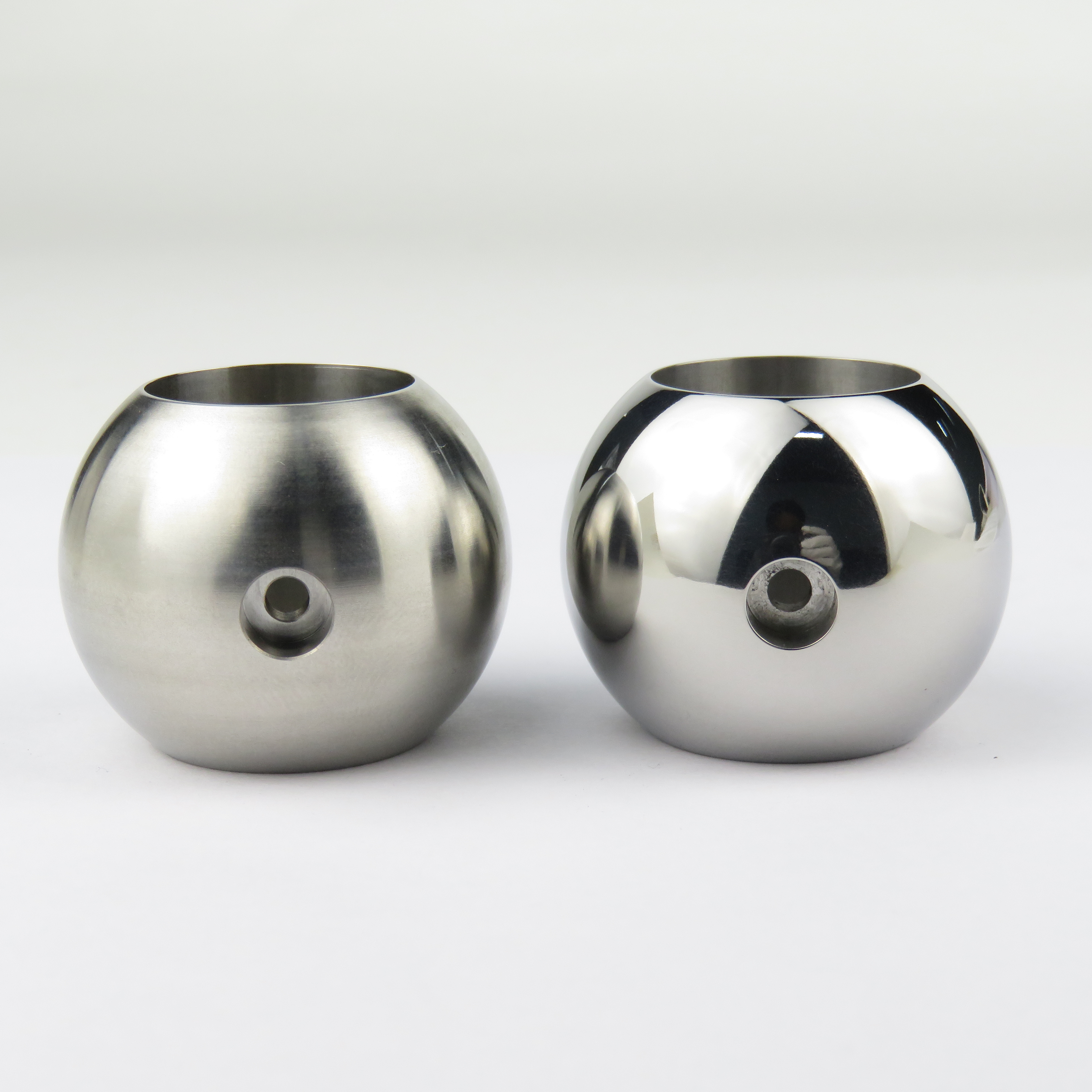
Mask or shield it, or choose a route that does not reach it. A taper and a keyway are usually damaged by the same edge rounding that improves the rest of the part, and a seal face suffers from peening or from a coarse medium. Practical options are a mechanical mask or boot, leaving a stock allowance that is finished later by a controlled operation, holding the part in a fixture that excludes the protected zone, or selecting a gentler medium and a shorter cycle. Measure the feature before and after at marked points, and put a maximum radius or a minimum remaining edge on the drawing.
Partly, and the split is the useful part of the question. A robot can hold a grinder, sander or polishing head over a repeatable path with controlled pressure, which suits long weld runs, flat panels and consistent edges. It struggles where access is restricted, where the surface is free-form and required pressure changes continuously, and where a person compensates for part-to-part variation by feel. Work out which features recur in the same place on every part and which move; automate the first group and leave the second with an operator, or send parts to a machine route that already produces the surface in bulk.
A free-form surface gives the tool no straight reference, so the tool has to follow changing curvature while holding constant contact pressure and surface speed. On a large blade the arm must reach the whole face, which pushes against reach and stiffness limits, and the wheel or belt wears as it travels, so pressure has to be adjusted along the path. Heat builds wherever the tool dwells. Hand polishing works because an operator feels all of this continuously. Automating it needs force control, a path generated from a model, and tool-wear compensation, and it still needs a process that has first been proved by hand at the bench.
Use Edmonton, Canada as the destination on the enquiry and state whether the deliverable is equipment, media and compound, a representative sample review or a line concept. A destination does not imply local stock, a local service point or a local delivery time.
An Edmonton buyer in the petrochemical and oil and gas chain works to the applicable pressure-equipment and piping standards their engineering contractor names, together with Alberta occupational health and safety requirements and Canadian electrical certification for equipment installed in the plant. In aviation MRO, the requirements come from the transport-aircraft maintenance regime and the customer's approved process specifications rather than from a finishing-specific national standard.
Sources were retrieved on 2026-09-29 and describe the local industrial and trade context only. They do not evidence any SurfacePolish project, shipment, installation or service in Edmonton.
The buyer needs internal burrs removed from the cross-drillings while the seal faces and thread flanks stay clean and free of lodged media.
Send the material, dimensions, approximate weight, batch quantity, the incoming condition and photographs of the difficult features. Mark which features must not be contacted by media and state how the result will be inspected. This form carries source reference PSEO-0146; quote it if you prefer an additional manual reference.
Open the SurfacePolish enquiry form Email a prepared enquiry
No price, lead time, certification or result is promised here. Confirm whether a sample trial is available for the specific part and what the trial can and cannot show.
Page PSEO-0146 · revised 2026-09-29 · cross-border equipment, media and scoped sample review. City context is sourced and cited above.
Use this local checker to identify missing part and inspection information. It prepares a technical-review brief; it does not approve a machine, process recipe or production result.
Complete the part details to prepare a review brief.
Email : info@surface-polish.com


 IPv6 network supported


 +86-592-2381506