

`Multi Metal Polishing Compound` Guide (`compound-JTJ50`): Brightening Non-Ferrous & Titanium Mirror Faces

Finishing engineers choosing a multi metal polishing compound for 6061 aluminum housings, turned brass valves, copper busbars, Zamak zinc covers, and Grade 5 titanium fasteners face a tight chemical balancing act. Harsh acidic descalers (MC8) etch soft non-ferrous surfaces black, while heavy-duty alkaline cutting soaps lack the brightening surfactants needed to keep reactive aluminum and brass spotless during Stage 2 mirror burnishing.
The central thesis of this guide is straightforward: achieving pit-free, isotropic mirror luster with compound-JTJ50 multi metal polishing compound requires completing abrasive Stage 1 cutting and Rz leveling first (synthetic plastic cones for aluminum/brass/zinc or high-frequency ceramic for titanium), rinsing away every trace of Stage 1 abrasive grit, pairing JTJ50 with iron-free high-alumina spheres or OBD-30..100 magnetic pins in continuous single-pass clean water into a settling tank, and immediately spin-drying in heated 35A/70A dryers.
In this engineering guide, you will learn how compound-JTJ50 compares with HM3 and stainless-focused JTJ20/JTJ60 brighteners, pair it with ZL bowls, LLB50 toroidal discs, and OBD magnetic polishers, and prevent grey oxide haze and calcium water spots.
How compound-JTJ50 Brightens Non-Ferrous Alloys Without Etching

Balanced Non-Ferrous Surfactant & Corrosion-Inhibitor Action
Unlike general Stage 1 compound-LC10 cutting soap or acidic MC8 ferrous descaler, compound-JTJ50 multi metal polishing compound is formulated with gentle brightening surfactants and corrosion inhibitors tuned for reactive non-ferrous surfaces. During Stage 2 wet tumbling, JTJ50 cushions rolling contact, prevents dull aluminum-oxide smutting, and holds bright metallic contrast on 6061 aluminum, brass, copper, bronze, Zamak zinc, and Grade 5 titanium. Review our compound for aluminum guide and mass finishing compounds guide.
Comparing JTJ50 With HM3 and JTJ20/JTJ25/JTJ60
Both compound-JTJ50 and compound-HM3 excel as non-ferrous Stage 2 brightening compounds alongside iron-free high-alumina spheres and OBD-30..100 magnetic pins; whereas JTJ20, JTJ25, and JTJ60 are tuned specifically for high-luster 304/316 stainless steel and carbon steel mirror burnishing alongside 304 stainless balls. Keeping chemical drums clearly color-coded ensures non-ferrous lines never cross into acidic MC8 zones. See our compound JTJ60 fine polishing guide.
Why Stage 1 Abrasive Leveling Must Precede compound-JTJ50
Compound-JTJ50 is a Stage 2 burnishing brightener, not a Stage 1 burr-removing compound. Dumping un-deburred die castings or rough CNC brackets straight into high-alumina balls with JTJ50 produces shiny peaks sitting over rough matte Rz valleys. Complete Stage 1 leveling first using resin plastic cones (LC10) for aluminum/brass/zinc or high-frequency ceramic (LC10) for titanium. Explore our synthetic plastic tumbling media guide and porcelain ball burnishing media guide.
SurfacePolish Brightener |
Primary Alloy Scope | Paired Stage 2 Media | Process Role | Key Shop-Floor Rule |
|---|---|---|---|---|
JTJ50 (Multi Metal) |
Aluminum, brass, copper, zinc, titanium | High-alumina spheres / OBD pins |
Non-ferrous mirror brightening | Enforce Stage 1 spray rinse first |
HM3 Non-Ferrous |
Aluminum, brass, titanium | High-alumina spheres / OBD pins |
Bright pit-free burnish flow | Pair with filtered clean water |
JTJ60 Stainless |
304/316 stainless steel |
304 stainless balls / high-alumina |
High-luster silver mirror polish | Keep carbon-steel tramp chips out |
JTJ20 / JTJ25 |
Carbon steel, brass, stainless | 304 stainless balls & ball-cones |
Heavy ball-pressure mirror luster | Spin-dry steel in 35A/70A immediately |
LC10 (Stage 1 Cut) |
Multi-alloy Stage 1 deburring | High-frequency ceramic / plastic |
Flushing swarf & stripping scale | Keep Stage 1 cutting grit out of Stage 2 |
Media & Machine Pairing: High-Alumina Spheres, OBD Pins, and LLB50 Discs
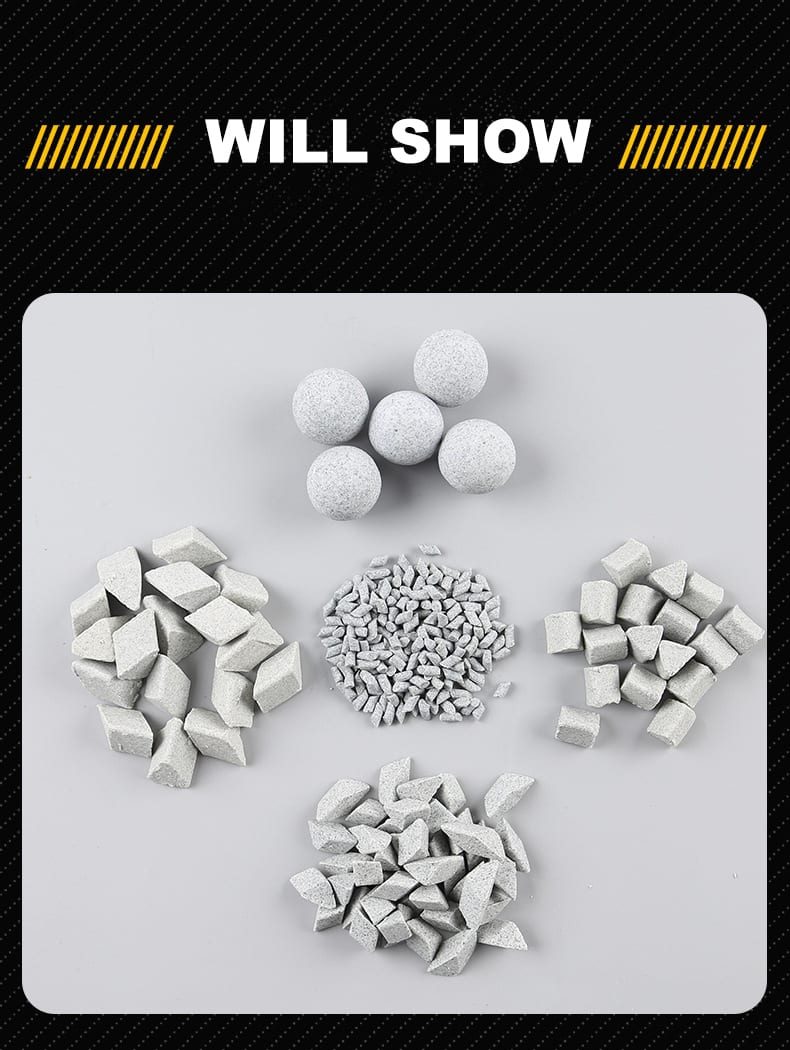
Iron-Free High-Alumina Spheres & Ellipses Inside ZL Bowls and LLB50 Discs
Because high-alumina porcelain contains zero free iron and weighs roughly half as much as stainless steel shot, pairing compound-JTJ50 with high-alumina spheres or non-lodging ellipses inside standard ZL circular bowls, ZXL divided troughs, or LLB50 toroidal centrifugal discs delivers brilliant mirror compression on aluminum and titanium without orange-peel hammering or galvanic pitting. Read our high-alumina polishing media guide and centrifugal disc finishing machine guide.
Fine Ferromagnetic Pins Inside OBD-30..100 Magnetic Polishers
When turned brass connectors, watch-case bezels, or Grade 5 titanium dental implants have narrow knurling, cross-bores, and blind threads that porcelain spheres skip over, OBD-30..100 magnetic polishers spin ferromagnetic stainless pins rapidly through compound-JTJ50 solution—brightening deep internal pockets in minutes without distorting thin walls. Explore our magnetic polishing machine guide and tumbler pins magnetic finishing guide.
Protecting Long Extrusions Inside ZXL and L1300–L1800 Divided Troughs
Long CNC aluminum rails, optical trims, and forged brackets clash end-to-end inside open circular bowls. Run long non-ferrous parts inside ZXL or L1300–L1800 divided troughs fitted with lane dividers and even overhead JTJ50 spray nozzles so every contour brightens cleanly without bending. See our divided trough vibratory finisher guide.
Single-Pass Flow, Settling Tanks, and Spot-Free 35A/70A Drying
Continuous Flow-Through vs. Dirty Sump Recirculation
Recirculating stagnant sump water pushes suspended aluminum oxides and spent soap straight back onto mirror faces—creating a stubborn grey film that dulls specular contrast. Run continuous single-pass clean water (ideally filtered soft water on optical aluminum) paired with metered compound-JTJ50 into a multi-baffle settling tank after upstream alkaline pre-degreasing.
Clean Separator Rinsing, Heated 35A/70A Spin-Drying, and Corncob Follow-Up
Pass brightened batches across your vibratory separator screen beneath a filtered clean-water spray bar, then transfer them immediately into a heated 35, 35A, 70, or 70A centrifugal spin-dryer—adding a quick dry corncob or fine walnut shell (8#-80#) wipe pass when optical mirror parts demand zero calcium water spots. Review our centrifugal dryer guide and corncob drying media grades guide.

Multi-Shift Bed Care, Liner Inspection, and Troubleshooting
Cleaning Darkened High-Alumina Beds With compound-LC10
Even with clean single-pass JTJ50 flow, hard shop water or trace oil can slowly darken high-alumina spheres over weeks of use. Run a brief empty media-only wash cycle using warm clean water and compound-LC10 until drain effluent turns clear, then recharge fresh JTJ50 brightener cleanly.
Enforcing Stage 1 Rinse Barriers and Bowl Liner Checks
Never let Stage 1 abrasive silicon-carbide grit ride into a JTJ50 Stage 2 bowl! Dedicate color-coded transfer baskets and inspect polyurethane bowl ribs weekly so cracked liners never nick mirror aluminum. See our polyurethane bowl liner replacement guide.
JTJ50 Brightening Issue |
Likely Root Cause | Immediate Correction | Preventive Standard |
|---|---|---|---|
| Dull grey haze on mirror aluminum | Dirty static sump or oily CNC parts | Pre-degrease batch; restore single-pass JTJ50 |
Upstream alkaline wash + settling tank |
| Random fine scratches on mirror face | Stray Stage 1 cutting grit carried into tub | Scrub bowl/screen; flush high-alumina bed |
Enforce Stage 1 spray rinse & separate totes |
| White mineral rings post-drying | Hard tap water air-drying slowly | Filtered rinse + heated 35A/70A spin-dry |
Stage heated centrifugal dryer at chute |
Black pitting on Zamak zinc/aluminum |
Acidic MC8 cross-contaminated line |
Flush bowl; lock MC8 away from non-ferrous |
Color-code & lock chemical drums |
| Shiny peaks with dark matte valleys | Skipped Stage 1 plastic/ceramic cut | Route batch back to Stage 1 LC10 cutting |
Verify uniform matte Ra after Stage 1 |
Optimizing JTJ50 Dosing Across Bowls, Discs, and Magnetic Polishers
Adjusting Flow Rates Inside ZL Circular Bowls vs. LLB50 Centrifugal Discs
Inside ZL circular bowls (ZL250W, ZL900W, ZL900C), metered single-pass compound-JTJ50 flow wets cascading high-alumina spheres smoothly while sweeping microscopic oxides through bottom drain grates. Inside high-energy LLB50 toroidal centrifugal discs, keep slightly brisker clean-water flow active so elevated friction heat never evaporates brightener film prematurely.
Calibrating Closed-Chamber Charges Inside OBD-30..100 Magnetic Polishers
Unlike drain-through vibratory bowls, OBD-30..100 magnetic finishing chambers run fixed bath charges where rotating magnets spin thousands of ferromagnetic pins through JTJ50 solution. Refresh magnetic bath charges cleanly between batches so abraded brass or titanium fines never dull subsequent loads.
Protecting 6061 Aluminum Anodize Quality With Iron-Free Media & Chemistry
When downstream sulfuric anodizing is specified, pairing iron-free high-alumina porcelain spheres with clean filtered water and compound-JTJ50 inside dedicated non-ferrous tubs guarantees bright, streak-free oxide growth without galvanic spotting.
Logging Brightener Pump Rates and Water Quality Weekly
Track JTJ50 peristaltic pump flow, spray-bar water filtration cartridges, and settling tank overflow clarity weekly so third-shift mirror brightness matches first-shift optical standards.
Multi-Shift Safety, Storage, and Process Qualification
Locking MC8 Ferrous Descalers Out of Non-Ferrous Brightening Cells
Never stage acidic MC8 chemical drums anywhere near JTJ50 or HM3 brightening lines; unmistakable color-coded drum fittings and locked chemical manifolds prevent catastrophic aluminum or zinc etching.
Storing Reserve JTJ50 Drums and Qualifying Sample Parts First
Keep reserve compound-JTJ50 drums sealed indoors above freezing temperatures, and always run sample part trials first to lock exact high-alumina sphere sizing and JTJ50 dosing before pallet-scale launch.
Factory Capabilities & Verified Multi-Metal Chemistry Supply
Founded in 1992, Xiamen Jin Tai Jin Grinding Technology Co.,Ltd. (SurfacePolish) engineers and manufactures 21 machine platforms backed by 24 granted Chinese IP rights and more than 200,000+ solutions across certified facilities (ISO 00726Q01571R001, CE M.2023.206.C88121, and CE M.2023.206.C88120). Alongside ZL circular bowls, ZXL/L1300–L1800 divided troughs, LLF120/LLB50 centrifugal finishers, OBD-30..100 magnetic polishers, and 35/35A/70/70A dryers, we supply compound-JTJ50 multi metal polishing compound, HM3, LC10, MC8, JTS5, JTJ20, JTJ25, and JTJ60 matched to iron-free high-alumina spheres, resin plastic cones, high-frequency ceramic, 304 stainless balls and magnetic pins, corncob, and walnut shell (8#-80#). Standard machines ship in 25–35 days and custom automated lines ship in 45–60 days. Send sample non-ferrous or titanium parts to surface-polish.com for complimentary two-stage process validation. Honest boundaries apply: we do not supply anodizing dye tanks, electroplating rectifiers, or diamond lapping pastes.
Frequently Asked Questions About compound-JTJ50 Multi Metal Polishing Compound
What metals work best with compound-JTJ50 multi metal polishing compound?
Compound-JTJ50 multi metal polishing compound works best on 6061 aluminum, brass, copper, bronze, Zamak zinc die castings, and Grade 5 titanium—delivering bright, pit-free mirror luster when paired with iron-free high-alumina spheres or OBD-30..100 magnetic pins.
Can compound-JTJ50 remove heavy CNC burrs or deep tool marks?
No. Compound-JTJ50 is a Stage 2 non-abrasive burnishing brightener. Always complete Stage 1 deburring and Rz leveling first using synthetic plastic cones (LC10) for non-ferrous alloys or high-frequency ceramic (LC10) for titanium.
How does compound-JTJ50 differ from compound-MC8 or compound-LC10?
MC8 is an acidic ferrous descaler (never for aluminum/zinc), LC10 is a Stage 1 cutting/flushing compound, and JTJ50 is a Stage 2 multi-metal brightener formulated to prevent tarnish and maximize mirror reflectivity.
Can I use compound-JTJ50 inside an OBD-30..100 magnetic polisher?
Yes. Compound-JTJ50 pairs cleanly with ferromagnetic stainless steel pins inside OBD-30..100 magnetic polishing chambers to brighten narrow threads, knurling, and jewelry bezels rapidly.
Why do aluminum parts turn dull grey even when compound-JTJ50 is added?
Grey smearing occurs when dirty sump slurry recirculates, bottom drain grates plug, or oily CNC parts bypass upstream alkaline pre-degreasing. Maintain clean single-pass flow into a multi-baffle settling tank.
What drying step prevents white water spots after JTJ50 mirror burnishing?
Rinse parts under filtered clean water on the separator screen and transfer them straight into a heated 35, 35A, 70, or 70A centrifugal spin-dryer, adding warm dry corncob buffing if optical clarity is specified.
Can compound-JTJ50 be poured into dry corncob or walnut shell barrels?
No. Never add water or liquid compounds to corncob, walnut shell (8#-80#), or hardwood pegs; dry organic media swells and clumps when wet. Spin-dry parts first before any dry organic pass.
How can I test compound-JTJ50 on my aluminum or brass parts before buying drums?
Send representative raw production parts to surface-polish.com for complimentary lab testing; our process engineers run Stage 1 cutting plus Stage 2 high-alumina/JTJ50 burnishing and return finished samples before you order.
How does compound-JTJ50 affect Grade 5 titanium medical implants or fasteners?
Because compound-JTJ50 contains zero harsh chlorides or iron-bearing descalers, pairing it with iron-free high-alumina porcelain spheres inside clean single-pass water delivers bright, smooth Grade 5 titanium surfaces ready for ultrasonic cleaning and nitric passivation.
Can compound-JTJ50 clean darkened high-alumina porcelain spheres?
Light darkening from hard-water mineral scale responds far faster to an empty media-only strip-wash using warm clean water and compound-LC10 until drain water runs clear, after which normal JTJ50 brightening resumes cleanly.
Should I filter rinse water after JTJ50 mirror burnishing on brass hardware?
Yes. Hard tap water leaves faint white calcium rings on mirror brass and 6061 aluminum if parts air-dry slowly; filtered clean-water spray rinsing followed immediately by heated 35A/70A centrifugal spin-drying keeps mirror faces spotless.
What happens if I overload parts in a ZL bowl during JTJ50 burnishing?
Over-packing parts starves your tumbler media ratio cushion so heavy brass valves or aluminum housings collide part-on-part, leaving crescent peening dings across mirror chamfers regardless of brightener quality. Keep generous high-alumina media volume around every batch.
Can compound-JTJ50 replace Stage 1 LC10 plastic deburring on die-cast aluminum?
No. Compound-JTJ50 is strictly a Stage 2 non-abrasive brightening surfactant; thick die-cast parting lines and CNC burrs must still be cut away in Stage 1 synthetic plastic cones with compound-LC10 first.
Why should shops keep separate high-alumina tubs for 6061 aluminum vs. brass?
Although compound-JTJ50 brightens both 6061 aluminum and brass cleanly, brass oxide fines left in a shared sphere bed can subtly tint bright anodized aluminum parts. Maintaining dedicated color-coded high-alumina bins per alloy family guarantees pure, consistent color tone across shifts.
How does single-pass JTJ50 flow prevent foam buildup inside LLB50 centrifugal discs?
Inside high-speed LLB50 toroidal centrifugal discs, continuous clean water paired with metered compound-JTJ50 flushes spent soap film through the rim seal smoothly, preventing thick foam cushions that otherwise slow high-alumina ball burnishing pressure.
What happens if worn high-alumina chips or cracked spheres stay inside a JTJ50 tub?
Even though high-alumina spheres wear extraordinarily slowly, any chipped or cracked porcelain piece exposes sharp edges that can scratch soft mirror aluminum. Inspect sphere beds periodically during LC10 strip-washes and purge damaged chips across your separator deck.
How do I keep multi-shift JTJ50 mirror results consistent from morning to night shift?
Audit JTJ50 dosing pump flow rates, clean-water spray-bar filtration cartridges, and multi-baffle settling tank overflow clarity daily at shift handover, logging target cycle times directly beside each machine.
Can compound-JTJ50 be used on Zamak zinc die-cast hardware without blackening?
Yes. Unlike acidic MC8 descalers or harsh caustic cleaners that blacken Zamak zinc instantly, gentle neutral/mild compound-JTJ50 paired with iron-free high-alumina spheres or OBD magnetic pins brightens pre-leveled zinc castings cleanly into uniform pre-plate luster.
Why is tumbler media ratio important when burnishing brass valves with JTJ50?
Even with high-lubricity compound-JTJ50 cushioning every contact point, overloading heavy brass valves into an under-filled high-alumina ball bed lets parts strike neighbors during upward flips and leaves crescent dings across mirror threads. Maintain generous ball cushion depth around every batch.
How does polyurethane bowl liner wear affect JTJ50 mirror burnishing?
Cracked or glazed polyurethane bowl ribs inside ZL bowls or LLB50 discs can nick delicate mirror aluminum faces as they tumble. Weekly visual checks around discharge dams and drain grates keep Stage 2 mirror surfaces flawless.
Should I add dry corncob wipe buffing after JTJ50 and 35A spin-drying?
Whenever optical aluminum trim or decorative brass hardware shows faint hard-water misting or demands maximum dry contrast, following 35A/70A centrifugal spin-drying with warm dry corncob granules lifts every trace of surface haze cleanly.
How do I prevent carbon-steel grinding sparks from ruining JTJ50 aluminum tubs?
Locate ferrous grinding and MC8 descaling equipment physically separate from non-ferrous JTJ50 burnishing lines, and enforce strict color-coded bins, catch baskets, and scoops across every shift.
Can compound-JTJ50 run inside ZXL and L1300–L1800 divided troughs for long extrusions?
Yes. Long CNC-machined 6061 aluminum architectural trims and aerospace ribs ride safely inside ZXL or L1300–L1800 divided linear troughs equipped with multiple overhead JTJ50 spray nozzles so every lane receives uniform lubricating brightener without end-to-end clashing.
What happens if compound-JTJ50 dosing drops too low during Stage 2 burnishing?
Starving JTJ50 flow strips away the lubricating surfactant film around high-alumina spheres, turning bright non-ferrous surfaces dull grey and increasing friction against polyurethane bowl ribs. Checking peristaltic pump lines daily keeps mirror contrast sharp across shifts. Always document exact pump dosing speeds, filtered rinse pressures, and 35A/70A spin-dryer times beside each bowl so second- and third-shift teams match morning optical brightness consistently without cloudy smears or mineral spots.
Can compound-JTJ50 be mixed with LC10 inside the same chemical tank?
Never blend Stage 1 cutting soap (LC10) with Stage 2 compound-JTJ50 brightener inside one feed drum; keep Stage 1 abrasive cutting and Stage 2 non-ferrous burnishing strictly separated with thorough clean-water separator spray rinsing in between.
 +86-592-2381506


 IPv6 network supported
