
High-Energy Centrifugal Tumbler Guide: Planetary Barrels vs. Toroidal Discs for Micro-Part Finishing
Manufacturing engineers finishing miniature surgical screws, carbide cutting inserts, watch bezels, and turned brass connectors quickly hit the physical speed limit of conventional circular vibratory bowls. Because tiny lightweight parts lack sufficient mass to sink and circulate briskly inside a large vibrating bed, vibratory cycles stretch out endlessly—while aggressive tumbling risks tangling delicate clips. Deploying a high-energy centrifugal tumbler (LLF120 planetary barrel or LLB50 toroidal disc) compresses multi-hour vibratory runs into minutes with repeatable precision.
The central thesis of this guide is clear: selecting and operating the right industrial centrifugal tumbler depends on matching part fragility and inspection workflow to the two high-energy architectures—choosing an LLF120 sealed planetary centrifugal barrel for ultra-fragile carbide tools, thin bone plates, and titanium screws for dental implants requiring zero stationary-wall impact, or an LLB50 open-top centrifugal disc finisher for rapid toroidal vortex batches needing live visual checks and tilt-bowl unloading—paired with non-lodging high-frequency ceramic, resin plastic, or high-alumina media, LC10/HM3/JTJ chemistry, and 35/35A/70/70A centrifugal drying. For related platform guides, see our centrifugal barrel finishing machine guide, centrifugal disc finishing machine guide, and metal parts tumbler guide.
LLF120 planetary barrel and LLB50 toroidal disc)Why High-Energy Centrifugal Tumblers Beat Vibratory Bowls on Micro-Parts
In a standard circular vibratory bowl, gravitational acceleration limits how hard lightweight media presses against lightweight parts.
Multiplying Media-to-Part Sliding Pressure Smoothly
A high-energy centrifugal tumbler replaces gravity-limited vibration with rotational centrifugal acceleration. Every high-frequency ceramic stone, resin plastic cone, or high-alumina sphere presses against the workpiece with multiplied effective weight, shearing tough stainless and titanium burrs rapidly while keeping parts cushioned inside the moving media bed.
Eliminating Long Multi-Hour Vibratory Cycles
Because sliding pressure multiplies dramatically inside LLF120 and LLB50 chambers, micro-fasteners, watch clasps, and sintered contacts that require hours in a standard ZL bowl often finish cleanly in 15–45 minutes.
Preserving Crisp Thread Crests and Delicate Micro-Edges
Even with high sliding energy, parts stay packed inside the media stream rather than dropping through empty air—protecting fragile thread crests and precision carbide edges from free-fall chipping.

LLF120 Planetary Centrifugal Barrel vs. LLB50 Centrifugal Disc
Although both machines qualify as a high-energy centrifugal tumbler, their chamber physics and shop-floor workflows differ sharply.
LLF120 Planetary Barrel: Sealed Counter-Rotation and Zero Wall Discontinuity
Four sealed, polyurethane-lined hexagonal or cylindrical drums sit around a rotating main turret. As the main turret spins one way, each drum counter-rotates smoothly on its own axis—pressing the charge evenly against the outer drum wall with zero stationary-wall friction. Choose an LLF120 centrifugal tumbler for brittle carbide inserts, titanium screws for dental implants, thin medical plates, and multi-stage cut-to-mirror sequences requiring zero collision impact.
LLB50 Centrifugal Disc: Open-Top Toroidal Vortex and Tilt Unloading
An LLB50 centrifugal tumbler spins a bottom polyurethane-coated disc inside a stationary vertical cylinder, flinging media up the stationary wall into a continuous toroidal vortex. Choose an LLB50 when parts are robust enough for toroidal flow (stamped buckles, brass connectors, watch cases) and operators want instant open-top mid-cycle inspection plus rapid tilt-bowl screen unloading.
When ZL Bowls, ZXL Troughs, or OBD Magnetic Polishers Fit Better
Large gears, wide automotive castings, and long turbine blades exceed compact centrifugal drums—route them to ZL circular bowls (ZL250W, ZL900W, ZL900C) or ZXL/L1300–L1800 divided linear troughs. Meanwhile, non-magnetic alloys with narrow blind bores finish cleanly in OBD-30..100 magnetic polishers. Compare options in our surface finishing machinery guide and magnetic polishing machine guide.

| Comparison Criterion | LLF120 Planetary Barrel |
LLB50 Centrifugal Disc |
Circular Bowl (ZL Class) |
|---|---|---|---|
| Motion Physics | Counter-rotating planetary high-G | Open-top toroidal vortex | 3D helical corkscrew roll |
| Fragile Micro-Part Safety | Maximum (zero stationary wall hit) | High (watch thin part gap) | Moderate (parts circulate slowly) |
| Mid-Cycle Visual Check | Stop turret & unlatch drum lid | Instant open-top sampling | Instant live sampling |
| Unloading Speed | External screen dump | Rapid tilt-bowl onto screen | Pneumatic flap + screen deck |
| Chemistry Mode | Sealed wet batch (LC10/HM3/JTJ) |
Continuous single-pass flow-through | Continuous single-pass flow-through |
Media Selection and Chemistry Control in High-Energy Chambers
High rotational G-forces amplify both media wear and chemical reaction rates—making disciplined recipe control essential.

high-frequency ceramic and high-alumina media sized for tight micro-part access in a centrifugal tumblerHigh-Frequency Ceramic vs. Resin Plastic vs. High-Alumina
High-FrequencyPreformed Ceramic: Small triangles and angle-cut cylinders shear tough CNC burrs on304/316stainless, titanium, and carbide tools. Read our ceramic grinding media guide and aluminum oxide tumbling media guide.- Resin-Bonded Plastic Cones & Pyramids: Lightweight non-ferrous media preventing corner bruising on soft
6061aluminum, brass, and pewter hardware. See our deburring plastic guide. High-AluminaSpheres &304Steel Balls: Non-abrasive Stage 2 burnishing media delivering low-Racosmetic luster;high-aluminais completely iron-free for medical titanium passivation and aluminum anodizing. Read our surface finish Ra vs Rz guide.
Sealed Batch Chemistry (LLF120) vs. Continuous Flow-Through (LLB50)
Inside an LLB50 centrifugal disc, continuous single-pass clean water and LC10/HM3/JTJ dosing flushes swarf out through the peripheral gap into a multi-baffle settling tank. Inside sealed LLF120 planetary barrels, avoid unvented strong acid descalers (MC8) that can generate hydrogen gas; stick to clean neutral-to-mild compound-LC10 (deburring), HM3/JTJ50 (aluminum/titanium/brass brightening), or JTJ60 (stainless burnishing) with generous clean water. See our compound for aluminum guide and metal discoloration after tumbling guide.

LC10, HM3, JTJ50, JTJ60) supporting clean lubrication in high-energy centrifugal tumbler runsWeekly Screening of Worn Media Chips
Higher sliding forces wear ceramic tips faster than open vibratory bowls. Screen out undersized worn fragments every few batches so broken tips never wedge inside hex drives, watch lugs, or LLB50 peripheral disc seams.
Operating Discipline: Gap Tolerance, Barrel Balance, and Drying
Protecting expensive micro-parts and machine liners depends on three routine shop checks.
Balancing All Four LLF120 Barrels by Weight
Always weigh media, parts, and water equally across all four planetary drums on a bench scale before latching them onto the LLF120 turret. Unbalanced drums shake bearings and produce uneven edge radii between barrels.
Measuring LLB50 Disc-to-Ring Gap and Water Back-Flush
Check the peripheral gap between the rotating spinner disc and stationary polyurethane ring weekly with feeler gauges, and always keep clean pressurized water back-flushing upward through the seam so thin stampings never wedge.
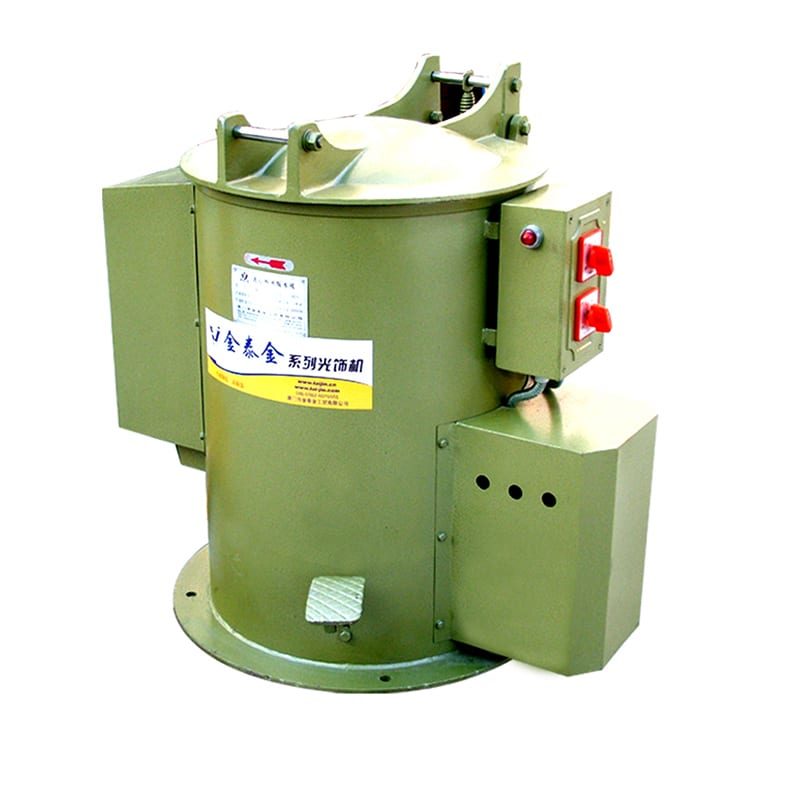
35/35A/70/70A class) preventing water spots on micro-parts exiting a centrifugal tumblerClean Spray Rinsing, Ultrasonic Flush, and 35A / 70A Drying
Immediately after separation, spray-rinse micro-parts cleanly (adding a brief ultrasonic wash for blind medical hex bores if needed), then dry promptly in a heated 35 or 35A centrifugal spin-dryer (70/70A for larger loads), followed optionally by dry corncob or walnut shell (8#-80#) buffing for mirror watch hardware. Read our centrifugal dryer guide and corn cob vs walnut media guide.
Troubleshooting Common High-Energy Centrifugal Tumbler Defects
| Defect / Symptom | Root Cause | Immediate Fix | Preventive Standard |
|---|---|---|---|
| Thread-crest rounding on dental screws | Coarse ceramic or excessive turret RPM | Step down media size; shorten timer & RPM | Qualify micro-part recipe under magnification |
Grey oxide smear inside LLF120 drum |
Low water fill or dirty un-rinsed batch | Increase clean water + HM3/LC10 |
Rinse drum & charge cleanly between stages |
Thin stampings wedging in LLB50 gap |
Worn peripheral ring or dry startup | Clear seam; adjust ring & boost back-flush | Measure disc-to-ring gap weekly |
Turret vibration on LLF120 startup |
Unequal barrel weights across turret | Unlatch & weigh all four drums equally | Standardize bench-scale barrel loading |
| Mineral rings on medical titanium | Slow air drying after screen unload | Spray rinse + 35A heated spin-dryer |
Stage spin-dryer beside separation deck |
Multi-Shift Cell Scaling and Preventive Spare Parts
High-volume precision shops maximize centrifugal tumbler utilization by staging spare pre-loaded LLF120 barrel sets beside the turret for rapid drum swaps, keeping spare polyurethane lid gaskets and LLB50 wear rings on-site, and maintaining color-coded media drums separating titanium, 304/316 stainless, and non-ferrous brass or aluminum lines. Pre-degreasing oily Swiss-turned micro-parts upstream ensures LC10 and HM3 act directly on bare metal rather than emulsifying cutting oil inside closed drums.
Staging Pre-Loaded LLF120 Spare Barrels for Zero-Wait Swaps
Keeping an extra set of four balanced polyurethane-lined barrels beside the LLF120 turret lets operators unlatch finished drums and lock in fresh pre-weighed charges in minutes—maximizing spindle-like machine utilization across continuous multi-shift production.
Pre-Degreasing Swiss-Turned Screws and Carbide Inserts Upstream
Machining coolants and thick cutting oils carried straight from Swiss CNC lathes turn closed LLF120 barrel water into greasy foam that cushions cutting energy. A quick upstream ultrasonic or alkaline wash ensures LC10 and HM3 act directly on bare metal.
Segregating Medical Titanium, Stainless, and Brass Media Drums
Never reuse ceramic or high-alumina charges between 304/316 stainless steel and Grade 5 medical titanium screws. Maintaining color-coded media drums, lids, and separation screens prevents trace iron contamination during passivation and biocompatibility audits.
Inspecting Polyurethane Barrel Corners and LLB50 Ring Seals
In high-G centrifugal tumbler chambers, sliding pressure concentrates along hexagonal LLF120 barrel corners and the outer perimeter of LLB50 spinner discs. Inspect urethane thickness at every media reload and schedule recasting before steel backing plates are exposed.
Verifying Non-Lodging Media Against Hex Sockets and Thread Pitch
Before scaling production on dental screws or watch bezels, test candidate high-frequency ceramic triangles and high-alumina spheres against internal hex drives and thread roots under shop magnification—confirming zero wedging across both fresh and worn stone sizes.
Pairing LLB50 Toroidal Discs With Multi-Baffle Settling Tanks
Because LLB50 centrifugal discs run continuous single-pass water and LC10/HM3 back-flush through the peripheral gap, piping drain hoses into a multi-baffle settling tank captures fine ceramic dust and metallic swarf before water reaches shop plumbing. See our multi-baffle settling tank guide and vibratory finishing supplies guide.
Checking Thread Crest Sharpness and Ra Under Magnification
During initial recipe qualification, pull sample screws and carbide inserts at short incremental timer intervals to inspect thread crests, hex corners, and cutting-edge hone width under magnification—locking down exact RPM and timer limits before full production begins.
Adding Dry Corncob or Walnut Shell Buffing for Optical Watch Gloss
After heated 35A centrifugal spin-drying removes bulk rinse water, decorative brass watch bezels and jewelry clasps can run a brief dry corncob or walnut shell (8#-80#) cycle inside dedicated clean dry barrels for deep showroom brilliance.
Documenting Turret RPM, Barrel Weights, and Timer Presets
Posting laminated recipe cards beside each centrifugal tumbler—listing exact media weight, part count, water volume, compound dosage, turret/disc RPM, and timer—ensures every shift reproduces identical micro-edge radius and luster.
Auditing Lid Latches, Interlocks, and Emergency Stops Daily
Verify lid safety interlocks on both LLF120 turrets and LLB50 chambers before every shift, wipe ceramic grit off barrel O-ring gaskets at every reload, and test emergency stops daily to keep high-speed rotating equipment safe.
Comparing Batch Economics: High-Energy Centrifugal vs. Multiple Vibratory Bowls
Because one LLF120 planetary barrel or LLB50 toroidal disc finishes tiny fasteners, surgical pins, and watch clasps many times faster than a standard circular bowl, a single compact centrifugal tumbler often replaces three or four oversized vibratory tubs—saving valuable floor space, reducing water and compound consumption, and delivering tighter Ra/Rz repeatability on lightweight micro-parts.
Planning Spare Wear Rings, Gaskets, and Ceramic Media Stock
High-G sliding motion accelerates normal wear on LLB50 peripheral polyurethane rings, LLF120 lid O-ring seals, and fine high-frequency ceramic triangles. Keeping spare wear rings, gaskets, and screened reserve media bags staged beside the cell eliminates unscheduled downtime across multi-shift medical and watchmaking lines.
Transitioning From Wet Cutting to Mirror Burnishing Without Contamination
When running sequential Stage 1 cutting and Stage 2 mirror burnishing inside an LLF120 or LLB50 centrifugal tumbler, flush every barrel or disc chamber thoroughly with clean filtered water between stages—or dedicate separate barrel sets to cutting vs. high-alumina burnishing—so zero stray abrasive grit dulls the final cosmetic luster.
Controlling Water Temperature and Bath Volume in Sealed LLF120 Drums
Unlike open-top LLB50 toroidal discs that run continuous single-pass water back-flush, sealed LLF120 planetary barrels retain frictional heat inside closed polyurethane drums. Charging the recommended volume of cool clean water alongside compound-LC10 or HM3 cushions micro-parts, dissipates heat cleanly, and prevents evaporated slurry from smearing delicate titanium or brass threads.
Optimizing LLB50 Tilt-Bowl Discharge and Spray-Rinsing
At the end of an LLB50 toroidal cycle, tilting the open chamber steadily onto a perforated separation screen beneath a clean-water spray rinse bar flushes spent LC10 or HM3 film off brass fittings and stamped buckles in seconds before immediate 35A or 70A centrifugal spin-drying.
Qualifying Micro-Part Recipes Under Shop Magnification
Always inspect sample dental screws, surgical pins, and carbide inserts under shop magnification after incremental trial runs—verifying thread-crest sharpness, internal hex cleanliness, and edge-radius uniformity before locking turret RPM and timer presets into production work instructions. Catching over-rounding early during sample validation saves thousands of precision fasteners from dimensional scrap once full-rate production begins.
Integrating Centrifugal Tumblers Alongside OBD Magnetic Polishers
For non-magnetic brass, aluminum, and 304 stainless fittings carrying both exterior machining burrs and deep blind bores, pairing a high-energy centrifugal tumbler (LLF120 or LLB50) for rapid exterior Ra/Rz smoothing with an OBD-30..100 magnetic polisher for internal thread sweeping delivers spotless multi-zone cleanliness without manual microscope hand-picking, cutting finishing cost per part across high-volume medical and precision hardware lines.
Factory Capabilities & Verified Centrifugal Supply
Founded in 1992, Xiamen Jin Tai Jin Grinding Technology Co.,Ltd. (SurfacePolish) engineers and manufactures 21 machine platforms backed by 24 granted Chinese IP rights and more than 200,000+ solutions across certified facilities (ISO 00726Q01571R001, CE M.2023.206.C88121, and CE M.2023.206.C88120). Standard high-energy centrifugal tumbler units (LLF120 planetary barrel and LLB50 toroidal disc), ZL circular vibratory bowls, OBD-30..100 magnetic polishers, and 35/35A/70/70A dryers ship in 25–35 days, while custom automated multi-station lines ship in 45–60 days. Send sample micro-parts to surface-polish.com for complimentary process validation before ordering. Honest boundaries apply: we do not supply dry sandblasting cabinets, electrolytic polishing baths, or ultrasonic medical sterilizers.
Frequently Asked Questions About High-Energy Centrifugal Tumblers
What is the main difference between an LLF120 and an LLB50 centrifugal tumbler?
An LLF120 centrifugal tumbler uses four sealed counter-rotating planetary barrels for zero stationary-wall impact on ultra-fragile carbide tools and medical screws, whereas an LLB50 uses an open-top toroidal vortex disc for instant visual checks and rapid tilt-bowl unloading on robust small parts. Choosing the right chamber prevents both thread-crest flattening and slow cycle bottlenecks.
Why do tiny fasteners finish so much faster in a centrifugal tumbler than a vibratory bowl?
Lightweight screws and clips lack the mass to sink and circulate briskly in a vibratory bowl; a centrifugal tumbler multiplies effective media weight via rotational G-force, compressing multi-hour cycles into minutes while keeping parts cushioned evenly inside the moving stone layer.
Can I run both wet ceramic cutting and dry corncob polishing in a centrifugal tumbler?
Yes—provided the polyurethane drums or disc chamber are scrubbed and bone-dried between wet and dry runs so zero abrasive ceramic grit contaminates dry corncob or walnut shell (8#-80#) mirror buffing. Many precision watch and jewelry shops dedicate separate barrel sets strictly to dry organic buffing.
Why must all four barrels on an LLF120 turret carry equal weight?
Equal media, part, and water weights across opposite drums keep the rotating turret dynamically balanced, preventing bearing wear and ensuring identical edge rounding across all four barrels. Always weigh each charge on a bench scale before latching drums onto the turret.
What compounds are safe inside sealed LLF120 centrifugal tumbler barrels?
Use neutral-to-mild lubricating compounds such as compound-LC10 for cutting and HM3, JTJ50, or JTJ60 for brightening; avoid unvented strong acid descalers (MC8) inside sealed drums. Rinse batches thoroughly across the separation screen and dry promptly in a 35A or 70A centrifugal dryer.
What lead time applies to SurfacePolish centrifugal tumblers?
Standard LLF120 planetary barrel and LLB50 disc centrifugal tumbler units, ZL bowls, and 35A/70A dryers ship within 25–35 days under ISO 00726Q01571R001 and CE certification, while custom automated multi-stage lines ship in 45–60 days. Send sample micro-parts to surface-polish.com for complimentary lab validation.
 +86-592-2381506


 IPv6 network supported
