
Ceramic Grinding Media in Production: Matching Preformed Shapes, Alumina Grades, and Non-Lodging Sizing to Metal Parts
Production engineers sourcing ceramic grinding media (including ceramic triangle stones and angle-cut cylinders) often assume one general-purpose grey stone can handle every deburring and polishing job on the shop floor. In reality, running heavy fast-cut ceramic triangles on soft aluminum housings bruises edges and leaves coarse scratches, while running light polishing-grade ceramic on laser-cut carbon steel stalls cycle times and leaves burrs intact.
The central thesis of this guide is clear: predictable mass finishing depends on separating vitrified high-frequency cutting ceramic from dense high-alumina burnishing ceramic, matching preformed triangle, angle-cut cylinder, or spherical shapes to part slots so stones never lodge, and running continuous wet flow-through LC10 or MC8 chemistry to keep media pores open. For related media and equipment comparisons, see our tumbler media guide, aluminum oxide tumbling media guide, and vibratory deburring machine guide.
High-Frequency Cutting Ceramic vs. High-Alumina Burnishing Ceramic
Industrial ceramic grinding media is not a single material. Inside mass finishing lines, two distinct ceramic families serve opposite stages of the surface progression.
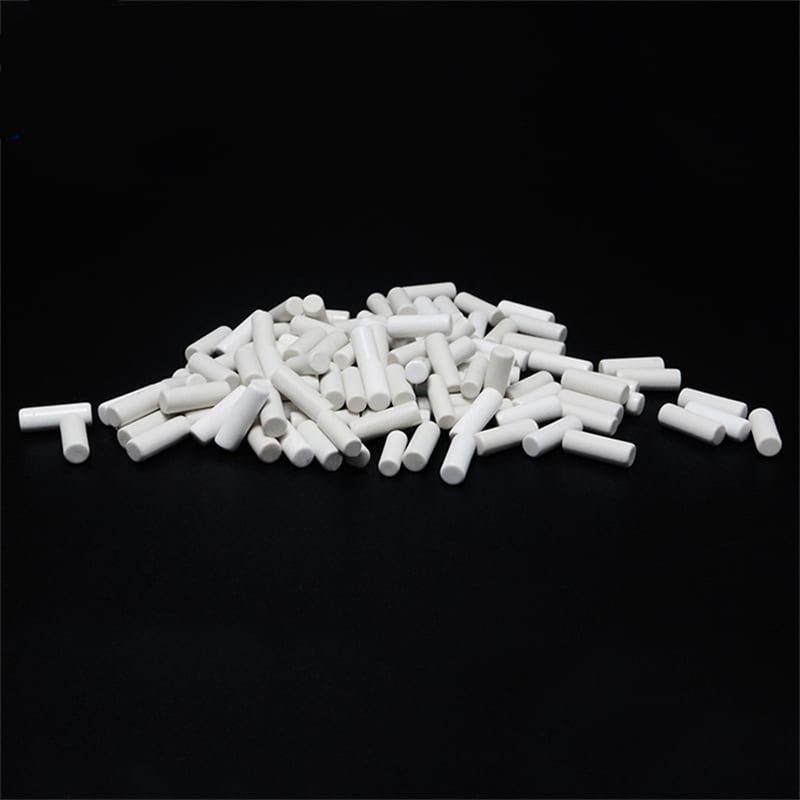
high-frequency ceramic grinding media triangles engineered for controlled burr removal on steel and stainless partsVitrified High-Frequency Ceramic Bonds for Aggressive Burr and Scale Removal
Vitrified high-frequency ceramic grinding media suspends sharp abrasive mineral grains inside a fired clay-ceramic matrix. As the stone slides across stamped carbon steel, machined stainless valve sleeves, or forged brackets, micro-fracturing exposes fresh cutting edges while worn binder sheds cleanly into the flow-through effluent. That self-sharpening mechanism makes vitrified ceramic triangles and angle-cut cylinders the primary workhorse for machining burrs, stamping flash, and heat-treat scale. In high-volume stamping and CNC lines, operators rely on high-frequency ceramic because it maintains consistent cutting pressure across long production shifts without collapsing into mud.
Dense High-Alumina Ceramic Media for Fine Smoothing and Bright Burnishing
Unlike porous cutting stones, high-alumina ceramic grinding media is sintered to high density with minimal abrasive roughness. It removes virtually no dimensional stock; instead, its smooth, heavy surface compresses and levels surface peaks on stainless steel, hardened tools, and pre-polished castings without contaminating parts with iron dust. Because high-alumina media resists rapid attrition, it generates far less sludge in the settling tank and holds tight dimensional tolerances on precision valves, medical instruments, and flatware. See our abrasive polish vs burnishing guide and steel shot burnishing media guide for how high-alumina spheres compare against 304 stainless steel shot.
When Resin-Bonded Plastic Cones Must Replace Ceramic Media
Even fine-cut ceramic grinding media can be too heavy for soft die-cast zinc, Zamak housings, or thin-walled aluminum extrusions. When part mass or alloy softness causes edge roll-over or peening marks, switching to lighter resin-bonded plastic cones or pyramids removes machining marks cleanly without bruising edges. Plastic media also prepares soft non-ferrous castings for downstream anodizing or electroplating by leaving a tight, uniform matte texture free of deep ceramic gouges. Review our metallic shot vs ceramic media guide and glass bead vs aluminum oxide media guide for cross-material trade-offs.
| Ceramic Media Family | Primary Mechanism | Target Workpiece Alloys | Typical Compound Pairing | Surface Outcome |
|---|---|---|---|---|
| Vitrified Fast-Cut Ceramic | Sharp abrasive grain shear; self-sharpening bond | Carbon steel, stainless steel, titanium forgings | compound-MC8 or compound-LC10 |
Rapid burr, laser-dross, and mill-scale removal |
| Vitrified Fine-Cut Ceramic | Controlled micro-abrasion for pre-polish prep | Machined stainless, brass valves, steel gears | compound-LC10 or compound-JTJ20 |
Smooth matte finish ready for Stage 2 burnish |
| Dense High-Alumina Ceramic | Non-abrasive compression & peak leveling | Stainless hardware, cutlery, ceramic-safe alloys | compound-JTJ50 or compound-HM3 |
Bright, low-roughness luster with zero iron transfer |
| Resin-Bonded Plastic Media (Alternative) | Gentle, low-density abrasive cut | Aluminum cavities, zinc die castings, brass bezels | compound-LC10 |
Uniform matte surface without edge bruising |
Selecting Preformed Shapes: Triangles, Angle-Cut Cylinders, and Spheres
Shape geometry determines where ceramic grinding media can reach, how fast it cuts, and whether it jams inside workpiece features.

Straight and Angle-Cut Ceramic Triangles for Flat Plates and Outer Edges
A ceramic triangle maximizes flat surface contact against laser-cut plates, stamped electrical contacts, and external perimeters. Straight-cut triangles deliver stable sliding pressure across broad faces, while angle-cut (bias-cut) triangles introduce sharp acute points that reach into right-angle corners and stepped brackets without stalling. Because triangular faces sit flat against sheet edges and stamped tabs, they remove sharp die-break burrs evenly without rounding off critical datum surfaces prematurely.
Angle-Cut Cylinders for Bores, Grooves, and Curved Recesses
Cylindrical ceramic stones—especially angle-cut cylinders—roll smoothly through curved channels, concave turbine profiles, and wide slots where flat triangles might bridge. Their rounded perimeter reduces point-impact nicking on precision threads while the bias-cut end face still reaches internal shoulders cleanly. When finishing turned valve sleeves, hydraulic fittings, and grooved collars, angle-cut cylinders maintain steady contact inside curved fillets without wedging against adjacent walls.
High-Alumina Spheres and Cylinders for Delicate Contours and Burnishing
Spherical high-alumina beads have no sharp corners to chip or wedge, making them ideal for Stage 2 bright burnishing and delicate contours. Because spheres roll rather than dig, they maintain uniform contact pressure across complex curved hinges, belt buckles, and medical or optical hardware without leaving directional scratch patterns. They also pair cleanly with compound-JTJ50 and compound-HM3 when non-magnetic stainless or brass assemblies need bright mirror-like luster without steel-shot weight.

high-alumina ceramic grinding media cylinders and spheres for low-wear smoothing and Stage 2 brighteningNon-Lodging Sizing Rules to Prevent Wedged Stones
The most costly shop-floor mistake with ceramic grinding media is ordering a stone dimension that matches a slot, keyway, or cross-hole on the workpiece. As stones wear down slightly in production, near-match sizes wedge tightly inside holes and force manual pick-out rework. Always apply the non-lodging sizing rule: specify media either large enough to bridge cleanly across the widest opening or small enough to pass straight through without touching opposite walls.

Matching Ceramic Media Grades to Vibratory, Centrifugal, and Barrel Equipment
The same ceramic stone behaves very differently depending on the kinetic energy of the machine driving it.

ZL600C class) driving continuous helical roll with preformed ceramic grinding mediaCircular Vibratory Bowls (ZL300C / ZL600C) and Linear Troughs (L1300–L1800)
Circular vibratory bowls and linear troughs keep ceramic grinding media in continuous gentle-to-moderate sliding contact with parts. Circular bowls with pneumatic separation flaps handle compact valves, gears, and springs, while L1300, L1500, and L1800 linear troughs—with optional polyurethane dividers—let long shafts and heavy housings run in ceramic media without part-on-part collision. See our vibro polishing machine guide and stone tumbler machine guide for chamber sizing rules.
High-Energy Centrifugal Disc Finishers (LLF120)
Centrifugal disc finishers accelerate ceramic grinding media inside a high-speed vortex, compressing deburring cycle times dramatically on small stampings, belt buckles, and chain links. Because sliding forces are much higher than in a vibratory bowl, centrifugal disc lines typically run denser, wear-resistant ceramic grades or high-alumina media to avoid rapid stone breakdown and premature slurry loading.
Octagonal Rotary Barrels for Heavy Descaling and Rugged Forgings
Slow-turning octagonal rotary barrels tumble ceramic stones and heavy forgings in a cascading slide rather than continuous vibration. While cycle times are longer and in-process inspection requires stopping the drum, octagonal barrels provide quiet, heavy-impact descaling for thick screwdriver blades, gas valves, and rugged steel hardware. See our ceramic wheel and rotary polisher guide for barrel-vs-vibratory comparisons.
Magnetic Polishers (OBD Series): Why Ceramic Media Does Not Belong Here
Magnetic polishing machines (OBD-30 through OBD-100) drive 304 stainless steel magnetic pins using a rotating magnetic field—they do not run ceramic grinding media. Attempting to load ceramic stones into a magnetic polisher blocks pin circulation completely. Keep ceramic grinding media strictly in vibratory bowls, linear troughs, centrifugal discs, and rotary barrels.
Wet Flow-Through Chemistry, Separation, and Post-Cycle Drying
Ceramic grinding media must always run wet with metered chemical compounds; dry operation generates dust, overheats parts, and fractures or glazes the stone surface.

Continuous LC10 and MC8 Flow-Through to Prevent Stone Glazing
In a closed static tub, abraded metal particles and worn ceramic binder accumulate in the water until they pack into the stone pores—a defect known as glazing. Continuous flow-through feeds fresh water and metered liquid compound (compound-LC10 for standard deburring, compound-MC8 for heavy derusting and scale removal) across the top of the media mass while dirty slurry drains continuously into a multi-baffle settling tank.
Two-Stage Ceramic-to-Bright Sequences (JTJ20 to JTJ50)
For stainless steel components that require both edge deburring and bright surface luster, Stage 1 pairs fine-cut ceramic grinding media with compound-JTJ20 or compound-LC10. Parts are then separated, thoroughly rinsed under clean water spray bars, and transferred to Stage 2 burnishing with high-alumina spheres or 304 steel balls and compound-JTJ50.
Heated Centrifugal Spin-Drying (35A / 70A) and Organic Polishing
After wet ceramic grinding, carbon steel and low-alloy parts will flash-rust rapidly if left damp in baskets. Route rinsed parts directly into a heated centrifugal spin-dryer (35A or 70A series) or follow with a dry corncob / walnut shell (8#-80#) tumbling stage to absorb residual moisture and leave a spot-free finish. See our corncob and cob media guide for dry polishing setups.
| Finishing Stage | Ceramic Media Choice | Liquid Compound | Machine Platform | Post-Cycle Handling |
|---|---|---|---|---|
| Heavy Forging Descale | Fast-cut high-frequency triangles |
compound-MC8 (flow-through) |
Octagonal barrel or circular bowl | Clean rinse + 35A/70A dryer |
| CNC & Stamping Deburr | Fine-cut triangles or angle cylinders | compound-LC10 (flow-through) |
Circular bowl or L1300–L1800 trough |
Screen separation + rinse |
| Stainless Pre-Bright Cut | Fine-cut ceramic cylinders / tri-stars | compound-JTJ20 (flow-through) |
Vibratory bowl or LLF120 disc |
Rinse before Stage 2 burnish |
| Bright Ceramic Burnish | Dense high-alumina spheres / cylinders |
compound-JTJ50 or HM3 |
Vibratory bowl or centrifugal disc | Heated spin-dryer (35A/70A) |
Managing Ceramic Media Wear, Breakage, and Contamination
Even properly specified ceramic grinding media wears gradually during production. Managing that wear curve keeps part quality consistent and protects downstream drains.
Screening Out Worn Undersized Fragments Before They Lodge
As ceramic triangles and cylinders wear smaller, worn tips and broken corners eventually reach a size that can wedge inside tapped holes or cooling slots. Install a scheduled screening routine—or use the perforated screen deck on circular bowls—to purge undersized fragments before they reach critical part features.
Topping Up Fresh Media to Maintain Cushion Volume
When total media volume inside the bowl drops due to attrition, the remaining part-to-media ratio rises—increasing part-on-part contact and slowing rolling speed. Top up fresh ceramic grinding media regularly to hold the chamber fill level steady rather than waiting until parts show edge dings.
Pre-Degreasing Oily Parts and Flushing Multi-Baffle Settling Tanks
Machining coolants and stamping oils transferred into a ceramic-loaded bowl bind metal swarf onto stone faces and cause heavy foaming. Pre-degrease oily parts upstream, brush the bottom bowl drain screen at shift start, and clean out settled sludge from the multi-baffle settling tank regularly.
Protecting Cast Polyurethane Linings From Sharp Ceramic Edges
Fresh fast-cut ceramic triangles have crisp corners that abrade soft or worn chamber linings. Running continuous wet LC10 lubrication cushions stone-on-wall shear and extends the service life of cast polyurethane (PU) bowl and trough linings.
Troubleshooting Ceramic Grinding Defects and Process Drift
When cycle times stretch or surface uniformity shifts mid-production, the root cause almost always lies in slurry buildup, improper loading ratios, or unscreened media wear. Systematic diagnosis restores predictable finish quality without guesswork.
Glazed Ceramic Stones Losing Cutting Speed
If vitrified high-frequency triangles feel glassy and fail to remove burrs cleanly, abraded metal fines and compound residue have packed into the stone pores. Increase clean-water flow-through, verify LC10 peristaltic pump dosing, and run a brief purge cycle with fresh water to reopen the abrasive bond.
Part-on-Part Impingement Marks and Rolled Edges
Sharp nicks on machined shoulders or dented edges on brass and aluminum housings indicate too many parts per chamber volume of ceramic grinding media. Reduce the part load so each workpiece stays suspended in a thick cushion of ceramic stones, or move long and heavy brackets into divided L1300–L1800 linear trough bays.
Excessive Ceramic Dust and Foaming in the Bowl
Heavy white foam cushions the sliding impact between stones and parts, slowing deburring to a crawl. Excessive foam usually points to over-concentrated liquid compound or residual alkaline wash carried in on un-rinsed parts. Lower the LC10 drip rate and verify upstream rinse effectiveness.
Dark Grey Smear on Stainless and Aluminum Parts
A dull grey film coating finished surfaces happens when dirty sump water is recirculated or when dense ceramic media is run too long without fresh flow-through. Switch to single-pass flow-through discharging into a multi-baffle settling tank, and rinse parts under a clean-water spray bar on the separation deck.
Wedged Ceramic Tips Inside Blind Holes and Slots
Broken triangle tips or undersized worn stones lodging inside threaded bores mean the media screening schedule has fallen behind. Screen out worn fragments immediately and re-verify non-lodging media geometry against the narrowest slot on the part drawing.
Sourcing & Factory Capabilities: Verified Mass Finishing Supply
Xiamen Jin Tai Jin Grinding Technology Co.,Ltd. has manufactured industrial mass finishing equipment and media since 1992, delivering 200,000+ workpiece finishing solutions across 21 machine platforms—including circular vibratory bowls, L1300/L1500/L1800 linear troughs, centrifugal disc finishers (LLF120), octagonal rotary barrels, OBD magnetic polishers, and 35/35A/70/70A centrifugal dryers—alongside high-frequency ceramic, high-alumina ceramic, resin-bonded plastic, walnut shell (8#-80#), and corncob media plus LC10, MC8, JTJ20, JTJ50, and HM3 compounds.
All equipment lines operate under ISO 9001 (00726Q01571R001), carry CE vertical (M.2023.206.C88121) and horizontal (M.2023.206.C88120) certification, and incorporate 24 granted Chinese IP rights. Standard machines ship in 25–35 days, with custom automated systems delivered in 45–60 days. Honest boundaries: we do not supply loose sandblasting grit, dry blast cabinets, or hobby rock-polishing jars.
Send sample workpieces, alloy details, and slot/bore drawings to surface-polish.com or call +86 189 6582 7080 for a complimentary media sizing test and sample finishing report.
Frequently Asked Questions About Ceramic Grinding Media
What is the difference between high-frequency ceramic and high-alumina ceramic grinding media?
High-frequency ceramic grinding media is a vitrified abrasive cutting stone designed to remove burrs, tool marks, and mill scale quickly. High-alumina ceramic media is a dense, low-abrasion sintered stone used for fine smoothing and Stage 2 bright burnishing on stainless steel and hard alloys.
Should I choose ceramic triangles or angle-cut cylinders for slotted parts?
Choose ceramic triangle profiles for flat plates, outer perimeters, and general stamping deburring. Choose angle-cut cylinders when parts have curved channels, internal fillets, or narrow slots where flat triangle faces might bridge or wedge.
Can ceramic grinding media be used dry without water or compound?
No. Running ceramic grinding media dry creates airborne dust, fractures brittle stone edges, overheats workpieces, and glazes the abrasive surface with smeared metal. Always run ceramic media wet with continuous flow-through LC10 or MC8 compound, reserving dry tumbling strictly for corncob, walnut shell, or hardwood media.
Why is my ceramic grinding media leaving dark grey residue on aluminum parts?
Dense ceramic media can bruise soft aluminum and leave dark oxide smear when run too aggressively or with dirty sump water. For soft aluminum cavities and zinc die castings, switch to lighter resin-bonded plastic cones with fresh LC10 flow-through, or verify clean rinse water before drying.
How do I stop ceramic media from getting stuck in tapped holes?
Check the smallest hole or slot width on your part drawing and order non-lodging media geometry that either bridges cleanly across the hole or passes freely through it. Screen out worn undersized media fragments on a fixed maintenance schedule so broken tips never reach the workpiece.
What lead time applies to ceramic grinding media and vibratory equipment orders?
Xiamen Jin Tai Jin Grinding Technology Co.,Ltd. ships standard vibratory bowls, linear troughs, centrifugal disc finishers, and centrifugal spin-dryers in 25–35 days, with custom multi-stage automated lines delivered in 45–60 days under ISO 9001 (00726Q01571R001) and CE (M.2023.206.C88121 / M.2023.206.C88120) compliance.
Can one vibratory bowl switch between ceramic grinding media and plastic media?
Yes. Circular vibratory bowls and L1300–L1800 linear troughs lined with cast polyurethane (PU) can run both ceramic grinding media and resin-bonded plastic cones, provided you unload and thoroughly wash out all ceramic grit and slurry residue from the tub and drain screen before charging softer plastic media.
 +86-592-2381506


 IPv6 network supported
