
Metal Parts Tumbler in Production: Matching Machine Physics to Part Weight, Threads, and Batch Volume
Machine shop supervisors and purchasing engineers searching for a metal parts tumbler quickly discover that "tumbler" is an umbrella word covering five completely different industrial machines—and buying a light-duty hobby drum or the wrong chamber physics leaves heavy machined parts battered, internal cross-bores untouched, or motors stalled under steel media.
The central thesis of this guide is clear: selecting the right industrial metal parts tumbler starts with part mass, collision sensitivity, and internal bore access rather than catalog liter volume—matching circular vibratory bowls to general hardware, divided rectangular troughs or fixtured drag finishers to collision-sensitive rails and gears, centrifugal discs to rapid compact cutting, octagonal barrels to rugged batch steel, and translating OBD magnetic tumblers to non-ferrous internal cross-holes. Matching chamber physics to your worst geometric constraint eliminates manual hand-deburring and scrap. For related platform guides, see our vibratory grinder guide, rotary barrel and batch sizing guide, and complex metal parts guide.
Why Hobby Tumblers Fail on Industrial Metal Parts
Shops testing mass finishing for the first time occasionally buy a small benchtop plastic-drum tumbler meant for brass reloading or rock collecting.
Light Motors Stall Under Dense Ceramic and Steel Media
Industrial preformed ceramic triangles and 304 stainless steel burnishing balls carry high bulk density. Light-duty consumer tumblers overheat motor windings, strip drive belts, and fail to lift heavy metal brackets into an active rolling cascade.
Thin Drum Linings Tear Quickly Under Sharp Stamped Steel
Laser-cut gussets and stamped steel burrs slice straight through thin hobby-grade rubber sleeves, exposing bare metal shells that rust, dent parts, and generate deafening shop noise. Industrial metal parts tumbler chambers rely on thick poured-cast polyurethane linings.
Zero Separation Decks or Flow-Through Compound Flushing
Without integrated vibrating screen decks and fresh-water LC10/MC8 flow-through, operators spend more time picking wet parts out of dirty metallic mud than the machine saves in deburring.
| Tumbler Class | Chamber Construction | Media & Compound Support | Separation & Drying |
|---|---|---|---|
| Light Hobby Drum | Thin rubber sleeve, small belt drive | Low-weight loads only; closed dirty sump | Manual hand-dump & towel dry |
| Industrial Circular Vibratory Bowl | Thick cast PU lining, heavy spring drive | Full ceramic, plastic, porcelain & 304 steel shot |
Integrated pneumatic flap + screen deck |
| Divided Rectangular Trough | Removable PU-lined bays | Zero-collision heavy or long part support | Bay-by-bay hoist / basket unload |
| Octagonal Rotary Barrel | Cast PU octagonal steel shell | Wet ceramic/steel or dry wood/walnut | External inclined vibrating screen |
Comparing the Five Industrial Metal Parts Tumbler Platforms
Each industrial chamber moves parts and media through a distinct mechanical force profile.
1. Circular Vibratory Bowls for General Stamped, Cast, and Machined Batches
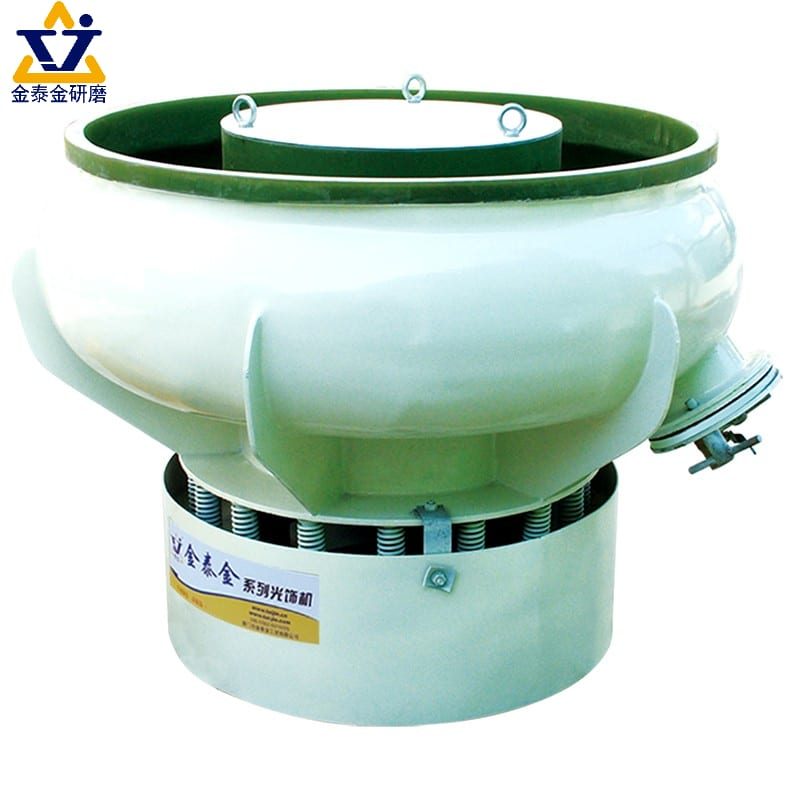
A PU-lined circular vibratory tumbler circulates parts and media continuously in a gentle toroidal spiral—delivering reliable edge rounding and deburring with built-in screen separation and steady LC10/MC8 flow-through.
2. Divided Rectangular Vibratory Troughs for Long Rails and Heavy Parts
Long CNC brackets, forged connecting rods, and heavy stainless rims bridge across circular channels and dent neighboring pieces. Divided rectangular troughs isolate one part per polyurethane compartment for zero-collision finishing.
3. Centrifugal Disc Finishers for High-Speed Compact Deburring
When floor space is tight and compact, rigid parts need rapid edge radiusing, centrifugal disc finishers spin a bottom disc to drive media in a high-pressure toroidal vortex—slashing cycle times sharply compared with standard bowls.
4. Octagonal Rotary Barrels for Rugged Batch Hardware and Dry Polishing
Octagonal rotary barrels tumble sturdy forgings, pipe fittings, and hardware quietly in wet ceramic or steel shot—and multi-tier dry rotary drums brighten brass, gold, and acrylic edges cleanly without water slurry.
5. Wide-Table OBD Magnetic Tumblers for Internal Cross-Bores
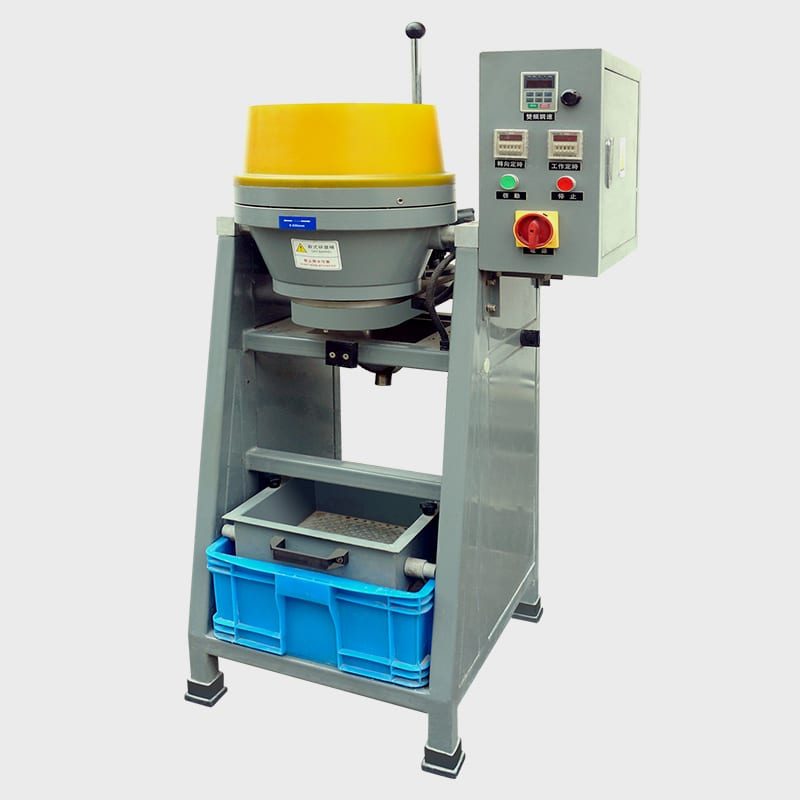
Where deep cross-drilled holes, cooling fins, or tight threads block ceramic stones on non-ferrous and 304 stainless parts, translating OBD magnetic tumblers drive fine 304 stainless pins magnetically into internal passages.
| Metal Part Geometry | Primary Risk in Wrong Tumbler | Best Industrial Tumbler Choice | Key Setup Rule |
|---|---|---|---|
| Medium brackets, clips & castings | Slow hand-sorting without screen deck | Circular vibratory bowl | Maintain generous media-to-part ratio |
| Long CNC rails, shafts & con-rods | Channel bridging & cap-to-cap denting | Divided rectangular trough | One part per PU-lined compartment |
| High-value gears, impellers & hubs | Even one collision nick scraps part | Fixtured drag finisher | Spindle-clamped zero-contact motion |
| Compact thick stampings & blocks | Slow cycle speed in open bowls | Centrifugal disc finisher | Rigid parts only (avoid thin webs) |
Brass / 304 blocks with cross-holes |
Heavy stones miss internal burrs | Wide-table OBD magnetic tumbler | Non-ferrous & 304 stainless only |
Selecting Media and Compounds for Your Metal Parts Tumbler
A tumbler is only the energy source; media and compound chemistry determine whether metal gets cut matte, de-scaled, or mirror-burnished.
Preformed Ceramic Media (LC10 / MC8) for Steel, Stainless, and Titanium
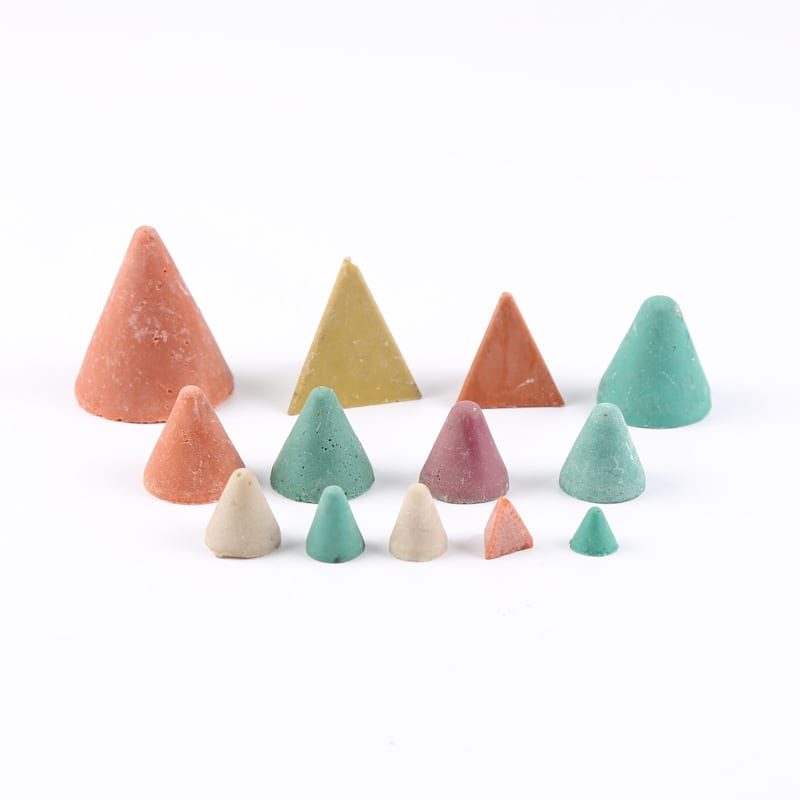
Dense aluminum oxide ceramic triangles and angle-cut cylinders cut sharp burrs, round 90-degree edges, and strip mill scale or weld heat tint cleanly under LC10 or MC8 flow-through.
Resin-Bonded Plastic Cones (Neutral LC10 / JTS5) for Aluminum and Zinc
Soft 6061/7075 aluminum and Zamak die castings bruise under heavy ceramic or steel balls. Lightweight resin-bonded plastic cones paired with neutral LC10 or JTS5 smooth CNC cusps and parting flash without dark high-pH etching.
304 Stainless Steel Burnishing Balls (PL10) for Mirror Gloss
Once Stage 1 ceramic cutting removes rough marks, transferring clean 304 stainless or brass parts into stainless steel burnishing shot with PL10 compresses peaks into bright reflective luster—provided your tumbler's motor and springs are rated for heavy steel density.
Non-Lodging Media Sizing for Holes, Louvers, and Threads
Measure every slot, louver, and counterbore before ordering media. Choose triangles, cylinders, or cones comfortably larger than every vulnerable opening—or small enough to pass straight through freely—and screen out worn undersized fragments regularly.
Post-Tumble Rinsing, Rust Protection, and Spot-Free Drying
Parts exiting a wet metal parts tumbler still require clean flushing and fast moisture removal to pass inspection.
Immediate JTJ50 Rust-Inhibited Rinse and Spin-Dry for Carbon Steel
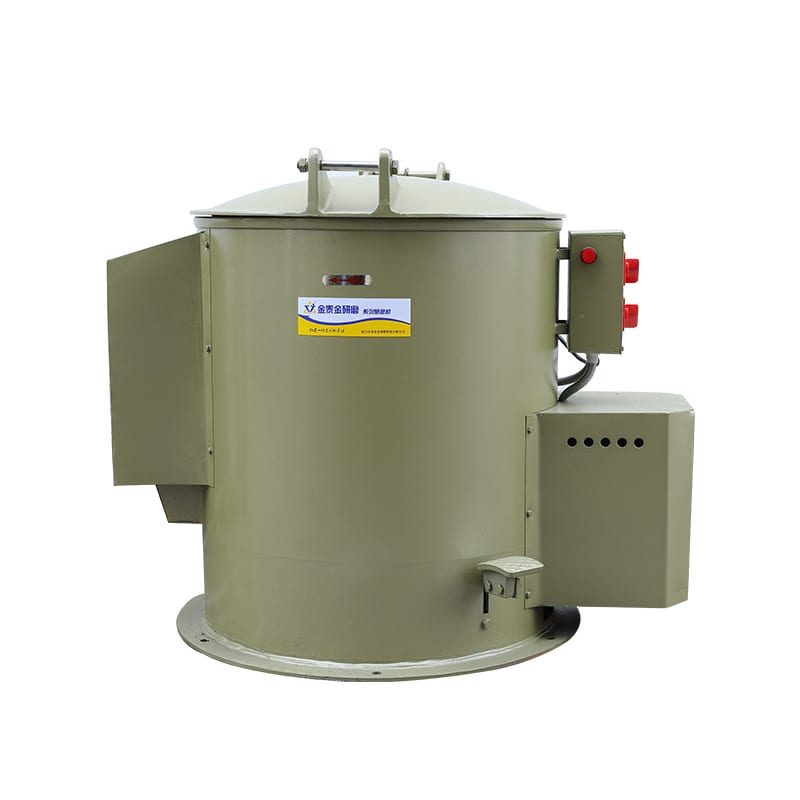
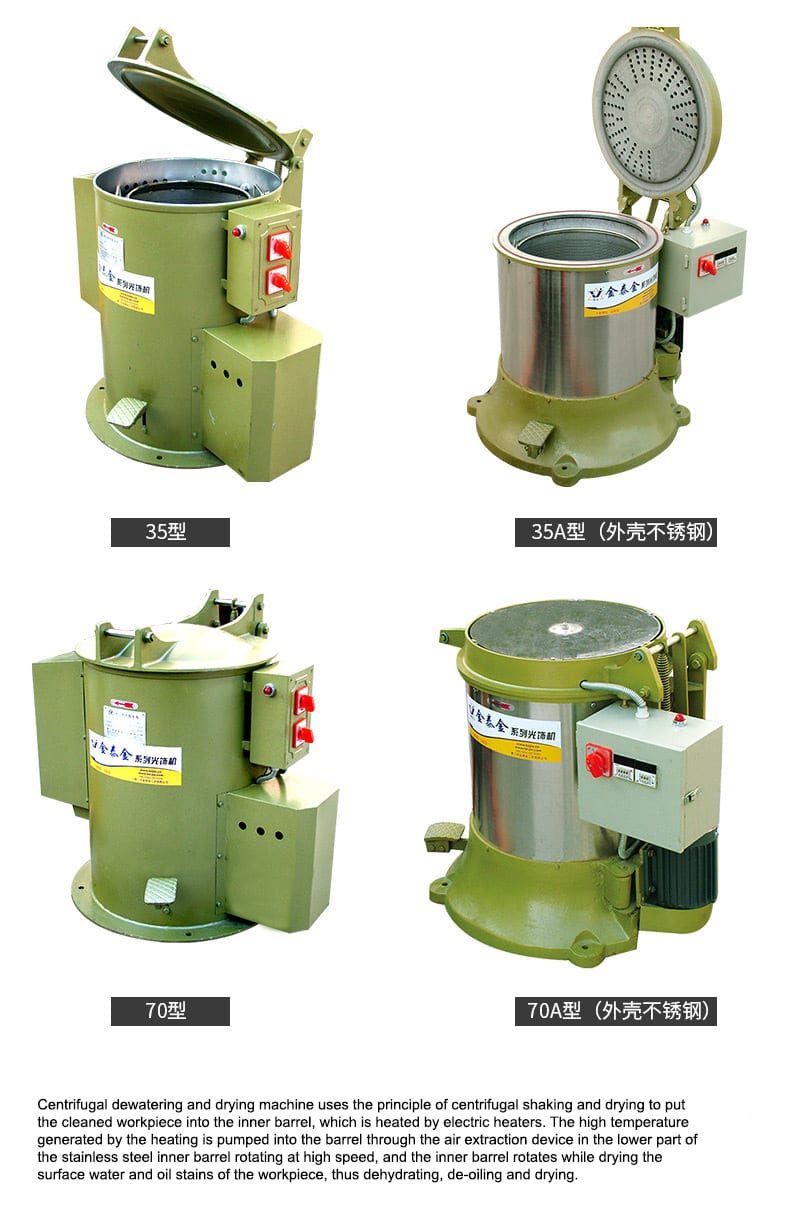
Freshly ground carbon steel and cast iron flash orange rust within minutes in humid shop air. Flush cutting slurry immediately upon unload, apply JTJ50 rust-inhibiting rinse protection, and spin-dry hot inside a centrifugal dryer.
Softened Rinse and Heated Corncob Drying for Mirror Parts
Hard municipal rinse water leaves chalky white rings on mirror 304 stainless and bright brass. Pair a clean softened rinse spray bar with a heated corncob media vibratory dryer to wipe away every droplet cleanly.
Multi-Baffle Settling Tanks Behind Flow-Through Bowls
Wet ceramic cutting generates fine gray abrasive mud. Route drain hoses through a simple multi-baffle settling tank so heavy sediment drops out cleanly before water enters shop floor drains.
Common Failure Modes When Running a Metal Parts Tumbler
Catching these four setup mistakes protects both parts and machines.
Part-on-Part Denting From Overloading the Chamber
Cramming extra parts into a tumbler starves the protective media cushion—causing colliding edges to ding and scratch. Keep media-to-part volume ratios generous.
Glazed Ceramic Stones From Oily CNC Carryover
Dumping oily machined parts straight into ceramic media coats stone pores in grease and halts deburring mid-shift. Pre-degrease oily parts first and maintain steady LC10 fresh-water flow-through.
Flat Sheet-Metal Sticking ("Shingling")
Thin flat stampings cling together face-to-face in wet media. Mix varied media shapes, moderate water flow, and feed flat parts steadily onto the moving media crest.
Magnetic Clamping Failure on Carbon Steel in Pin Tumblers
Ferromagnetic carbon steel distorts magnetic fields inside OBD magnetic pin tumblers—causing 304 pins to clump statically onto the part instead of tumbling. Run carbon steel in vibratory bowls, centrifugal discs, or rotary barrels instead.
Line Ergonomics, Utilities, and Shift-Start Maintenance
Running an industrial metal parts tumbler reliably across multi-shift production depends on clean shop-floor utilities and a two-minute operator routine.
Pre-Degreasing Oily Parts and Brushing Drain Screens
Never load greasy CNC parts straight off the lathe without hot alkaline pre-washing, and brush bowl drain screens clear at every shift start so LC10 flow-through never backs up dirty metallic mud inside the chamber.
Hoist Access and Weekly Undersize Media Screening
Provide overhead hoist or fork-truck clearance for lifting heavy ceramic or steel media drums, and screen working ceramic charges periodically so worn undersized fragments never wedge into mounting holes or cooling slots.
Honest Boundaries: What We Do and Do Not Supply
At Xiamen Jin Tai Jin Grinding Technology Co.,Ltd. (brand: Jings Polish), our workshop roots date back to 1996 and our company was formally established in 2009, delivering over 200,000+ sets of grinding and polishing solutions worldwide. Across our catalogue, we manufacture 21 machine platforms backed by 24 granted Chinese IP rights (1 invention patent, 15 utility model patents, and 8 design patents), under ISO 9001 certification 00726Q01571R001 (valid 2026-06-03 to 2029-06-02) and CE certifications M.2023.206.C88121 (Vertical, 8 models) and M.2023.206.C88120 (Horizontal, 13 models), valid until 2028-07-24.

Industrial Mass Finishing Tumblers, Media, and Compounds—Not Hobby Kits or Job-Shop Work
We engineer and manufacture industrial vibratory bowls, divided rectangular troughs, fixtured drag finishers, centrifugal disc finishers, octagonal rotary barrels, wide-table OBD magnetic tumblers, heated dryers, tumbling media, and compounds. We do not sell consumer hobby rock-tumbler kits, dry sandblasting cabinets, electroplating baths, hand-held grinders, or contract job-shop tumbling services. Standard machines ship in 25–35 days, while custom lines require 45–60 days.
Engineering Assessment Before Machine Sizing
Because alloy grade, part envelope, single-piece weight, narrowest slot/hole width, and hourly throughput dictate chamber selection, we do not promise free mail-in sample trials or guarantee cycle times before inspecting your workpiece—send clear photos and part dimensions via our custom polishing solution page for an engineering assessment.
Buyer Checklist & FAQ for Metal Parts Tumblers
Review these practical benchmarks before ordering an industrial metal parts tumbler.
What is the fastest metal parts tumbler for compact stamped steel brackets?
A centrifugal disc finisher delivers the fastest deburring and edge-rounding cycle times on compact, rigid stamped brackets—whereas medium-to-large brackets run smoothly in circular vibratory bowls with automatic screen separation.
Can one metal parts tumbler finish both aluminum housings and carbon-steel brackets?
Only if you maintain completely separate labeled media charges (plastic cones for aluminum vs. ceramic for carbon steel), scrub the polyurethane bowl clean between runs, and isolate neutral aluminum compounds (LC10/JTS5) from ferrous steel chemistry.
How do I keep delicate external threads safe inside a metal parts tumbler?
Clamp threaded parts individually inside a fixtured drag finisher, isolate one part per bay inside a divided rectangular vibratory trough, or cap exposed threads with snug protective sleeves beforehand.
Why did my carbon steel parts rust inside the tumbler even with water?
Plain tap water accelerates rusting on freshly abraded bare steel. Always maintain proper LC10 or JTJ50 compound dosing during wet cycles, rinse with rust inhibitor upon unload, and spin-dry hot immediately.
How does a centrifugal disc tumbler compare with a circular vibratory bowl for thick stamped steel brackets?
A centrifugal disc finisher spins a bottom disc to throw parts and ceramic stones into a high-pressure toroidal vortex—cutting burrs and rounding edges noticeably faster than a standard circular vibratory bowl. However, reserve centrifugal discs strictly for compact, rigid parts that will not bend under intense shear, and keep thin or oversized brackets in cushioned circular bowls or divided troughs.
Can an industrial metal parts tumbler remove laser-cutting oxide scale before powder coating?
Yes. Pairing dense preformed ceramic triangles with MC8 descaling compound inside a circular vibratory bowl or octagonal rotary barrel strips brittle oxygen-cut laser dross and rounds sharp 90-degree edges simultaneously—eliminating powder-coat pull-back along corners. Just follow immediately with a clean flush, JTJ50 rust inhibitor, and heated centrifugal drying.
Why do small stamped brass or stainless washers stick together inside a wet tumbler?
Flat washers trap thin films of compound water between adjacent parts and ride around the bowl as doubled-up stacks, leaving inner faces completely unfinished. Raise the media-to-part volume ratio, keep water flow moderate rather than flooded, and feed flat stampings gradually onto the moving media crest.
How often should cast polyurethane linings inside a metal parts tumbler be inspected?
Inspect polyurethane chamber walls and divider edges during routine monthly maintenance—especially when tumbling sharp laser-cut steel and coarse alumina ceramic—so worn linings are serviced long before bare structural steel is exposed.
Can a metal parts tumbler polish 304 stainless steel to a mirror finish without manual buffing?
Yes, provided you separate Stage 1 ceramic cutting (LC10) from Stage 2 mirror burnishing (304 stainless steel balls, cones, and satellites with PL10), rinse finished parts with clean softened water, and dry them immediately in a heated corncob dryer.
Why do 6061 aluminum castings turn dark gray inside standard steel deburring soap?
Aluminum is amphoteric and etches black in high-pH alkaline steel soaps or dirty recirculated tank water. Always run 6061 and 7075 aluminum in dedicated resin-bonded plastic cones with neutral LC10 or JTS5 flow-through chemistry.
How do I keep media from wedging inside cooling louvers or tapped holes?
Measure the narrowest slot, louver, and counterbore on your part drawing before ordering media, choose shapes comfortably larger than every opening or small enough to pass straight through, and screen out worn undersized fragments regularly.
When should a job shop choose a divided rectangular trough over a circular vibratory bowl?
Whenever part length approaches the circular bowl's radial channel width, or when heavy forged shafts, connecting rods, and precision-machined flanges cannot tolerate part-on-part contact. A divided rectangular trough isolates one workpiece per polyurethane-lined bay—delivering intense, uniform deburring and edge radiusing with zero impact nicks across the entire batch.
How does a heated corncob dryer eliminate water spots after wet metal tumbling?
Hard municipal rinse water evaporating slowly in open baskets leaves chalky white calcium rings on polished stainless steel and brass hardware. Dropping freshly rinsed parts straight into a heated vibratory bowl filled with dry corncob media wicks every trapped droplet away immediately while wiping faint compound film clean.
Can an OBD magnetic tumbler deburr hardened carbon-steel screws or cast iron brackets?
No. Strongly ferromagnetic carbon steel and cast iron distort rotating magnetic fields inside OBD tumblers—causing 304 stainless pins to clamp statically against the part rather than sweeping through threads and bores. Process carbon steel and cast iron strictly inside circular vibratory bowls, centrifugal disc finishers, or octagonal rotary barrels.
What happens if a metal parts tumbler runs with dirty recirculated tank water all week?
Closed recirculated water loads rapidly with fine metallic mud and residual machining oil—glazing ceramic stones smooth and dulling bright aluminum or stainless finishes. Continuous fresh-water and LC10/MC8 flow-through routed into a multi-baffle settling tank keeps media pores open and finishes repeatable.
How long does it take to build and ship an industrial metal parts tumbler?
Standard circular vibratory bowls, octagonal rotary barrels, OBD magnetic tumblers, and heated centrifugal dryers ship in 25–35 days, while custom divided rectangular troughs and fixtured drag-finishing cells require 45–60 days.
Why should shops separate Stage 1 ceramic cutting from Stage 2 steel ball burnishing?
Even a tiny handful of broken ceramic chips carried inside a hollow flange into a stainless steel burnishing bowl scores fresh scratches across newly burnished mirror parts. Running dedicated Stage 1 and Stage 2 chambers eliminates daily media changeovers and protects mirror consistency across every shift.
Can an industrial metal parts tumbler remove deep milling chatter or heavy torch slag?
No. Mass finishing removes uniform CNC exit burrs, light stamping edges, and laser oxide scale (MC8 + ceramic), whereas heavy primary torch slag, thick forging flash, and deep end-mill gouges must be trimmed or ground flush upstream before loading parts into the tumbler.
How does an inclined vibrating separation screen speed up batch unloading on rotary tumblers?
Dumping a closed octagonal barrel or wide-channel vibratory batch over an inclined perforated vibrating screen separates heavy ceramic or stainless media back into clean storage totes automatically while parts ride forward into rinse baskets—eliminating exhausting manual shoveling across busy multi-shift stamping and machining lines.
What details should I share before requesting a metal parts tumbler quote?
Send clear photos of your parts showing raw burrs or scale, alloy grade, overall part dimensions and weight, narrowest hole or slot size, and target hourly batch volume via our custom polishing solution page. Also note whether oily CNC coolant is present before loading, whether any delicate threads or precision bores need masking, whether 304 stainless mirror burnishing is required, and whether downstream coating, anodizing, or plating follows. Our engineers will size the exact vibratory, centrifugal, barrel, or magnetic tumbler platform, non-lodging ceramic, plastic, or steel media, multi-baffle settling tank, heated centrifugal or corncob dryer, and flow-through LC10/MC8/PL10 compound setup tailored reliably to your specific shop floor requirements and daily production output across stainless, carbon steel, aluminum, and brass batches to eliminate manual deburring, edge bruising, and flash rust on every single shift with repeatable cycle times and spotless, dry finished parts.
 +86-592-2381506


 IPv6 network supported
