

Machined Surface Roughness Guide: Leveling CNC Tool Marks With Ceramic, Plastic, and Ball Burnishing
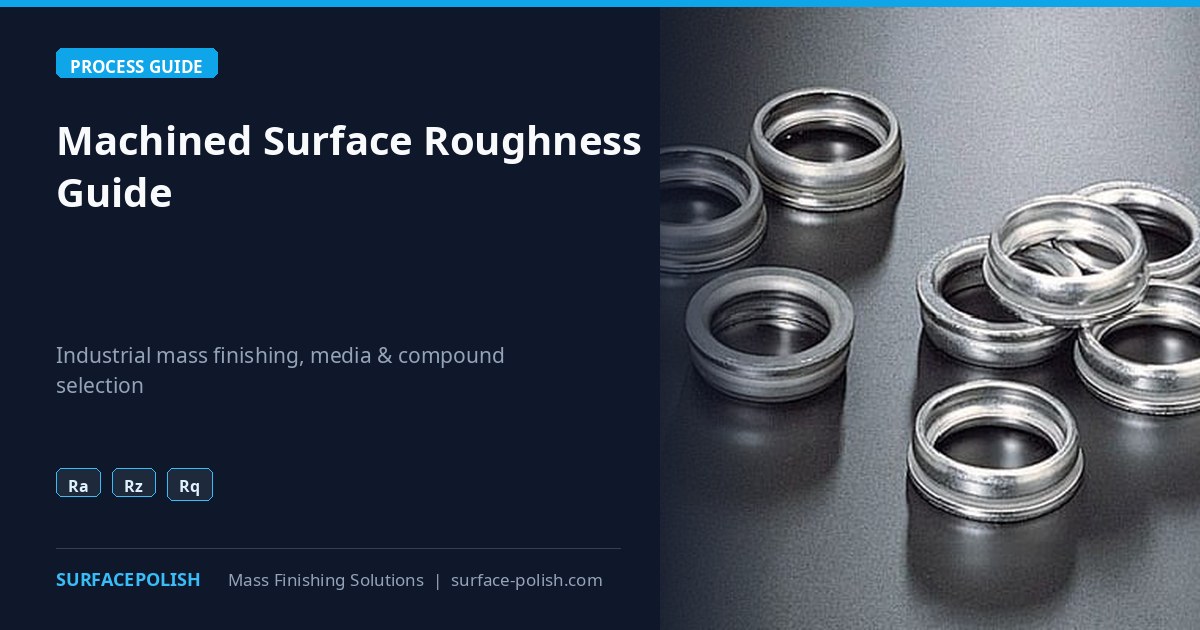
CNC manufacturing engineers and quality managers working to tighten machined surface roughness (Ra, Rz, and Rq) on turned hydraulic shafts, milled aerospace manifolds, and 304/316 stainless valve bodies often discover that dialing down CNC feed rates to chase ultra-smooth toolpaths slashes spindle productivity. Automated mass finishing inside ZL circular bowls, ZXL/L1300–L1800 divided troughs, and LLB50/LLF120 centrifugal finishers lets machine shops run fast, economical CNC cycle times while reliably leveling directional cutter scallops into uniform isotropic satin—or mirror-burnishing Ra down even further with 304 stainless balls and high-alumina spheres!
Understanding Ra, Rz, and Directional Tool Marks in Mass Finishing
Why Directional CNC Feed Marks Fail Functional Seal & Fatigue Tests
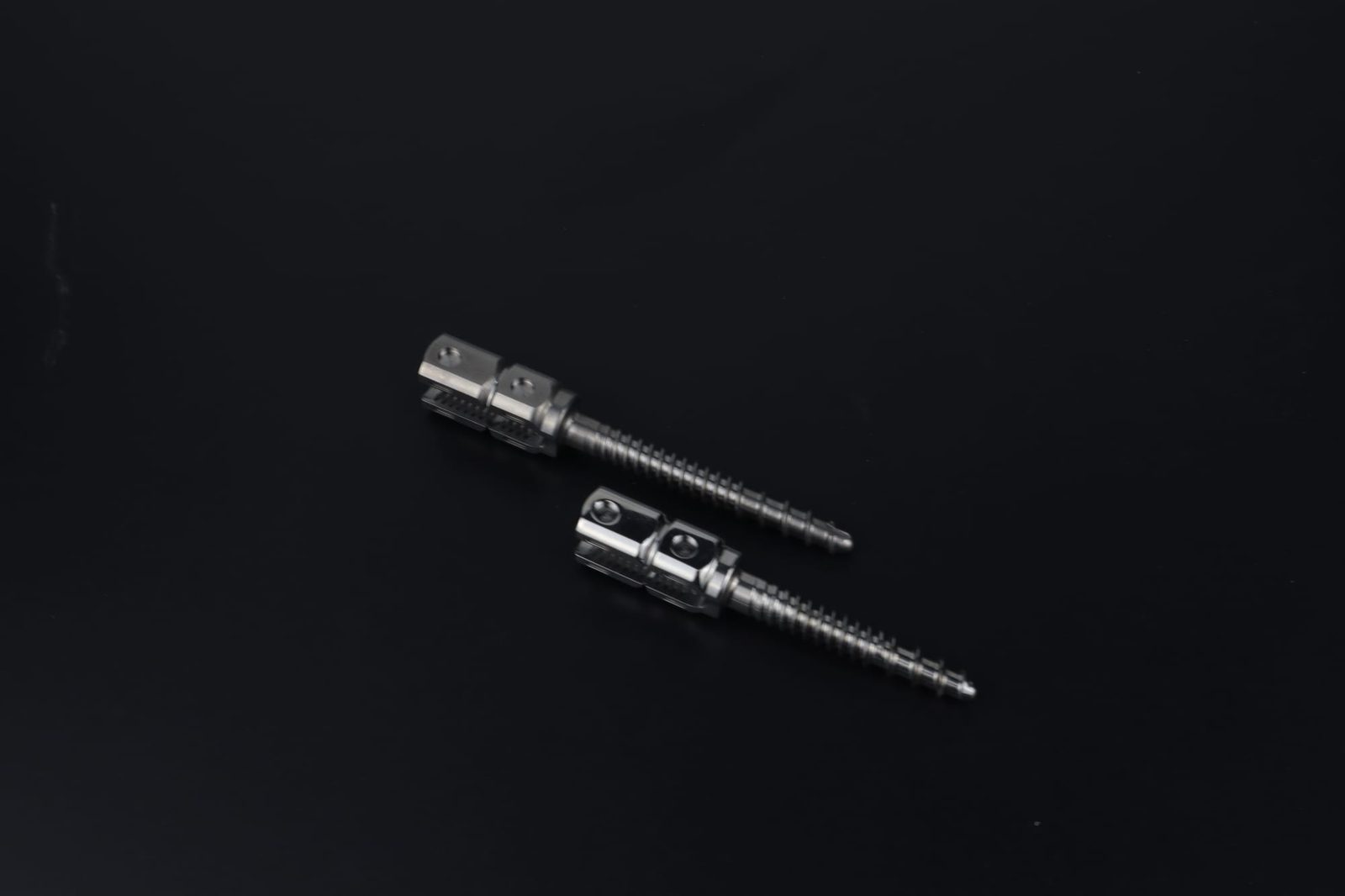
Lathe turning and ball-nose milling leave parallel microscopic helical grooves (directional lay) across sealing bores, O-ring glands, and dynamic bearing journals. Even when an average Ra reading looks acceptable on paper, directional spiral grooves act as leak paths under hydraulic pressure and stress-concentration risers under cyclic fatigue. Vibratory mass finishing replaces directional tool lay with a random, non-directional isotropic surface texture (isotropic matte) that seals reliably and resists crack initiation.
Ra (Average Roughness) vs. Rz (Peak-to-Valley Height) Before Polishing
Two parts can share an identical average Ra value while behaving completely differently in Stage 2 mirror burnishing: a surface with deep isolated Rz chatter valleys looks shiny on upper crests yet cloudy ("orange-peel") overall after ball burnishing! Stage 1 abrasive cutting (high-frequency ceramic or resin plastic cones with compound-LC10) specifically shears down tall peaks and grinds away deep Rz valleys until the entire part reaches uniform matte depth.
Balancing CNC Step-Over Speed Against Stage 1 Tumbling Cycle Time
Mass finishing is not magic for torn gouges: leaving deep roughing chatter on billet parts forces excessively long Stage 1 ceramic cycles that risk rounding critical external chamfers. Balancing moderate, high-efficiency CNC finishing passes with short Stage 1 high-frequency ceramic or plastic cone leveling cuts total part cost dramatically.
Measuring Ra Improvement Cleanly With Profilometers & Master Boards
Always measure machined surface roughness perpendicular to original CNC feed marks across multiple faces using a calibrated stylus profilometer—and pair numerical checks with sealed visual master boards beside every ZL and LLB50 station. See our surface roughness measurement guide and RMS surface finish Rq guide.
| Incoming CNC Substrate | Starting Tool Lay | Stage 1 Roughness Leveling | Optional Stage 2 Ra Reduction |
Drying & Final Inspection |
|---|---|---|---|---|
Milled 6061 / 7075 Aluminum |
Ball-nose scallops / endmill swirl | Resin plastic cones (LC10) (no ceramic) |
High-alumina spheres (HM3/JTJ50) |
Soft/RO rinse + 35A/70A + gloves |
Turned / Milled 304/316 SS |
Spiral lathe grooves / exit burrs | Fast then fine high-frequency ceramic (LC10) |
304 stainless balls (JTJ20/JTJ60) |
RO/soft rinse + 35A/70A + corncob |
| Turned Brass & Copper Fittings | Fine lathe feed lines | Resin plastic cones (LC10) |
High-alumina / OBD pins (HM3) |
Soft/RO rinse + 35A + corncob |
| CNC Carbon-Steel Hydraulics | Turning ridges + heat/scale | High-frequency ceramic (LC10 / MC8) |
304 balls (JTJ25, isolated) |
Soft rinse + immediate 35A/70A + VCI |
Grade 5 Titanium Medical Parts |
Thread-whirl / milled steps | Fine high-frequency ceramic (LC10) |
High-alumina spheres (HM3/JTJ50) |
RO/soft rinse + 35A + clean gloves |
Two-Stage Ra Reduction: Abrasive Leveling vs. Ball Burnishing
Stage 1 Leveling With High-Frequency Ceramic vs. Resin Plastic Cones
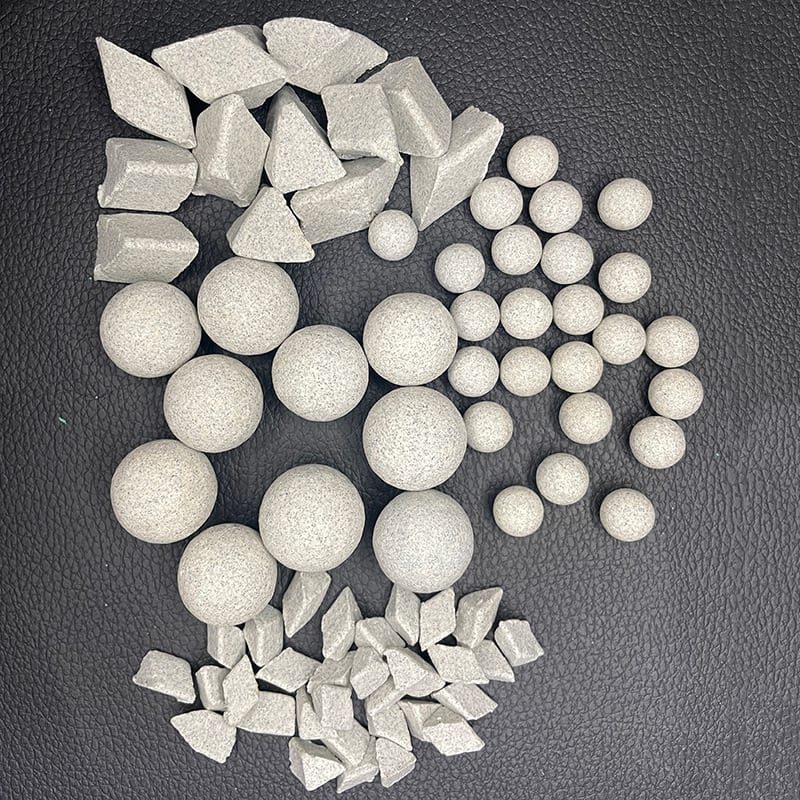
Stage 1 abrasive media removes microscopic metal peaks by controlled micro-chipping. Hard 304/316 stainless steel, alloy steel, and titanium require fast-cut then fine-cut high-frequency ceramic stones (compound-LC10) to shear tough Rz ridges flat, whereas soft 6061 aluminum, brass, copper, and Zamak require lightweight resin-bonded synthetic plastic cones (LC10) so heavy stones never hammer dimples into soft faces! Review our ceramic tumbler media guide and synthetic plastic tumbling media guide.
Stage 2 Zero-Grit Burnishing (304 Balls & High-Alumina) to Compress Ra
Once Stage 1 leveling erases directional CNC tool lay into uniform matte texture, Stage 2 zero-grit burnishing (304 stainless balls with JTJ20/JTJ25/JTJ60 on steel/stainless, or iron-free high-alumina spheres with HM3/JTJ50 on non-ferrous alloys and titanium) cold-rolls residual matte micro-peaks plastically flat—dropping final Ra cleanly without removing bulk part dimensions! Check our metal burnishing guide.
Preventing Bore Wedging With Non-Lodging Media Sizing
Precision CNC manifolds and hydraulic spools feature stepped cross-bores and O-ring grooves that trap poorly sized stones. Select ceramic, plastic cone, and ball diameters strictly via our non-lodging media sizing guide and cull worn slivers weekly via our media screening and replenishment SOP.
Reaching Recessed Threads & Undercuts With OBD Magnetic Polishers
Round spheres and cones bridge over narrow internal threads and knurled grooves. Short cycles inside an OBD-30..100 magnetic polisher (HM3 or JTJ50 bath) refine tight internal recesses cleanly without rounding precision external milled shoulders.
Chemistry, Single-Pass Flow & Upstream Coolant Removal
Stripping Emulsifiable CNC Coolants Upstream (Degreasing Before Tumbling)
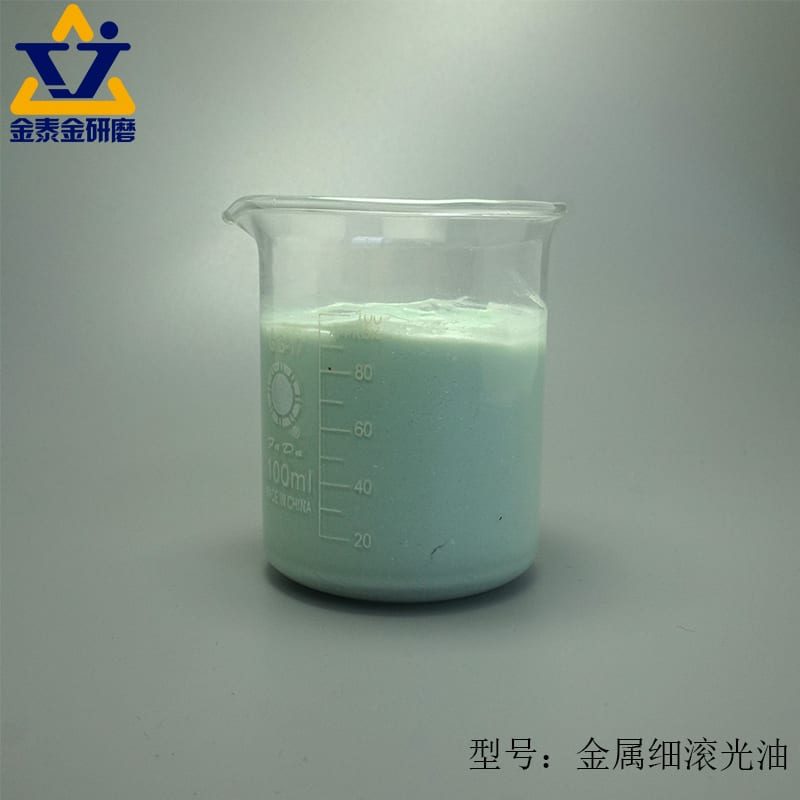
Machined parts arrive coated in high-pressure CNC coolants and sulfurized tapping fluids that glaze ceramic pores (ceramic media glazing) and ruin Stage 2 Ra compression! Always strip shop coolants upstream following our degreasing before vibratory finishing guide.
Single-Pass Flow Through vs. Dirty Closed-Sump Recirculation
Closed-sump recirculation pumps fine ceramic silt and oil sludge back onto tumbling parts—stalling Stage 1 Rz leveling and leaving cloudy grey smut on Stage 2 mirror surfaces. Run continuous single-pass flow through mass finishing dosed cleanly by peristaltic compound dosing into a multi-baffle settling tank.
Softened Water & Zero Silicone Defoamers Ahead of Coating
Hard tap water deposits calcium soap-scum rings that skew profilometer Ra readings and blister downstream anodizing or PVD coatings, while thick soap foam cushions abrasive shear and slows Ra leveling! Feed softened water, brush bottom drain grates daily, and ban silicone defoamers completely. See our water hardness in mass finishing guide and preventing foam in vibratory bowls guide.
Keeping MC8 Carbon-Steel Descaling Isolated From Precision Stainless Lines
Never bring acidic compound-MC8 or carbon-steel chips near precision 304/316 stainless or aluminum CNC cells—keep ferrous and non-ferrous finishing lines physically segregated.
Machine Selection, Tumbler Media Ratio & Spot-Free 35A/70A Drying

Protecting Tight CNC Tolerances With LLB50 Discs & ZXL Troughs
Compact turned pins and small aerospace fittings achieve rapid, uniform Ra reduction inside LLB50 centrifugal disc finishers and LLF120 barrels, while long CNC-milled shafts and heavy manifolds require divided ZXL/L1300–L1800 linear troughs with generous tumbler media ratio cushions so parts never collide.
Enforcing Clean Separator Spray Rinses Between Stage 1 and Stage 2
Even a single Stage 1 cutting grain carried into a Stage 2 304 ball bowl etches deep random scratches that spike Rz readings immediately! Mount a clean softened-water spray rinse bar across the Stage 1 vibratory separator screen and use dedicated Stage 2 color-coded totes.
Immediate Heated 35A/70A Drying & Warm Dry Corncob Wipe Buffing
Rinse cleanly finished CNC parts under softened/RO separator spray water and spin-dry immediately inside a heated 35, 35A, 70, or 70A centrifugal dryer—stopping carbon-steel flash rust and mineral spots cleanly, with warm dry corncob buffing (never wet) when optical clarity is mandatory. Review our centrifugal dryer guide and corncob drying media grades guide.
Auditing Polyurethane Bowl Liners & Catch Trays Weekly
Worn polyurethane bowl discharge ribs nick precision CNC corners during separation—inspect liners regularly via our polyurethane bowl liner replacement guide.
Troubleshooting Ra / Rz Failures Across Multi-Shift Production
Fixing High Rz Scratches, Orange-Peel Haze, and Stalled Ra Drop
Match every roughness failure directly to its root cause: sudden high Rz scratches in Stage 2 indicate stray Stage 1 cutting grit carry-over; shiny orange-peel haze signals Stage 1 ceramic/plastic leveling stopped too early; and stalled Ra drop points to glazed stones from unwashed CNC coolant or closed-sump mud.
| Roughness Failure | Likely Root Cause | Immediate Correction | Preventive Standard |
|---|---|---|---|
High Rz scratches post-Stage 2 |
Stray Stage 1 cutting grit in ball bed | Scrub bowl/screen; LC10 ball strip-wash |
Dedicated Stage 1/2 totes + screen spray rinse |
Shiny orange-peel (Ra high) |
Stage 1 leveling cut too short | Route batch back to Stage 1 fine cut | Verify uniform Stage 1 matte Ra first |
Stalled Ra drop & glazed stones |
CNC coolant oil or closed-sump mud | Empty warm LC10 wash; pre-degrease |
Upstream alkaline wash + single-pass flow |
Dimpled craters on 6061 aluminum |
Heavy ceramic stones used on aluminum | Purge ceramic; load resin plastic cones | Aluminum-only resin plastic cones + LC10 |
| Dented precision sealing faces | Low media ratio or circular collision |
Raise tumbler media ratio; load ZXL trough |
Pre-measured totes + ZXL dividers |
Restoring Glazed Ceramic, Plastic & Darkened 304 Balls With LC10
Whenever residual coolant or hard-water film glazes Stage 1 media or darkens Stage 2 304 balls / high-alumina spheres, unload all parts and run an empty warm strip-wash using softened water and compound-LC10 until drain effluent runs clear.
Auditing Profilometer Calibration & Visual Master Samples Weekly
Verify shop stylus profilometers against calibrated reference blocks weekly and maintain sealed pass/fail sample parts beside every ZL, ZXL, LLB50, and LLF120 station.
Posting Laminated Ra Target Setup Sheets Per Part SKU
Document incoming CNC roughness baseline, Stage 1 media/timer, Stage 2 ball/sphere mix, peristaltic compound dosing dial, and 35A/70A drying timer beside every machine.
High-Mix CNC Roughness Standardization & Cell Economics
Pairing Fast CNC Machining Feeds With Automated Vibratory Leveling
Machine shops that push ball-nose milling step-over slightly wider to boost spindle capacity—and then let high-frequency ceramic (LC10) or resin plastic cones (LC10) blend directional scallops isotropically in automated ZL or LLB50 batches—consistently lower combined machining-plus-finishing cost per part while improving seal-face Rz uniformity.
Protecting Tight Bearing Bores & O-Ring Sealing Lands During Tumbling
When precision hydraulic housings combine rough exterior milled walls with ultra-tight internal bearing bores, validate exact Stage 1 cycle timers and non-lodging media sizing on sample parts first—or plug critical internal bores if needed—so external Ra drops cleanly while bore tolerances stay untouched.
Scheduling Weekly Settling Tank Pump-Outs & Peristaltic Output Checks
Pump metal-ceramic wear silt from Chamber One of your multi-baffle settling tank weekly and measure peristaltic compound dosing pump output into a graduated cylinder every Friday so Ra reduction rates never drift between shifts.
Validating Target Ra & Rz Targets via Complimentary Sample Trials
Send representative raw CNC-turned or milled parts with your blueprint roughness callouts to surface-polish.com for complimentary lab testing—confirming exact Stage 1 and Stage 2 cycle times before ordering equipment.
Controlling OBD Magnetic Pin Cycles Without Roughing Mirror Flats
When machined stainless or brass hydraulic fittings require bright internal thread burr removal alongside low external Ra mirror luster, run OBD-30..100 magnetic pin polishing (HM3 or JTJ50) before final Stage 2 304 ball or high-alumina burnishing—so light pin marks on flat lands are cold-rolled completely smooth in the final ball cycle.
Handling Thin-Walled Turned Sleeves and Milled Covers Without Distortion
Thin-walled CNC-turned stainless sleeves and deep milled aluminum covers bend or ovalize if tumbled loose inside heavy ZL bowls or overloaded LLF120 barrels. Maintain generous tumbler media ratio cushions, lower vibratory motor counterweight lead angles, and isolate heavy or elongated parts inside divided ZXL/L1300–L1800 troughs so flatness and roundness tolerances stay intact.
Managing Dry Corncob Wipe Buffing for Zero-Haze Optical Ra Inspection
Dried surfactant spots or hard-water rings scatter stylus and optical roughness readings on mirror-burnished 304 stainless and 6061 aluminum parts. Enforce an RO/softened spray rinse bar across the vibratory separator screen, spin-dry immediately in a heated 35A/70A dryer, and follow with warm dry corncob buffing (never adding water to dry organic beds) before final profilometer verification.
Auditing Polyurethane Bowl Discharge Ramps and Liner Ribs Weekly
Worn polyurethane bowl ribs trap stray Stage 1 ceramic grit chips that scratch Stage 2 mirror batches and spike Rz readings unpredictably. Inspect bowl liners weekly via our polyurethane bowl liner replacement guide and dedicate strictly color-coded totes to Stage 1 versus Stage 2.
Matching Media-to-Part Ratios and Water Flow to Machined Geometries
Overloading a vibratory finishing machine with parts starves the cushioning media blanket, causing direct metal-on-metal nicking that raises Rz and ruins cosmetic flats. Follow disciplined media-to-part volume ratio loading targets alongside calibrated peristaltic compound dosing and clean flow-through water rinsing so worn ceramic fines flush continuously out the drain instead of recirculating as abrasive slurry. Balanced fluid drainage keeps Stage 1 cutting fast and predictable while protecting Stage 2 burnishing beds from turbidity and dull spotting.
Post-Finishing Centrifugal Drying & Rust-Free Part Protection
Freshly smoothed CNC components hold wash water inside tapped threads, O-ring grooves, and counterbores that quickly stain aluminum or flash-rust carbon steel if left air-drying in shop baskets. Immediately transfer rinsed batches into a heated 35A or 70A centrifugal dryer to spin moisture clean out of blind pockets without watermarking finished surfaces. For ferrous machined brackets held in humid storage before plating or assembly, finish with a clean inhibitor rinse so Ra and visual brightness remain uniform across every pallet.
Verifying Lot Consistency with Standardized Setup Cards & Stylus Checks
Repeatable machined surface roughness requires locking down every variable between CNC machining and final shipment. Post laminated setup sheets beside each machine specifying incoming tool-mark class, Stage 1 and Stage 2 media formulas, water hardness limits, compound concentration, and target stylus acceptance gates so operators catch media wear or dosing drift before an entire lot slips out of specification. Retaining sealed master witness coupons beside each ZL, ZXL, LLB50, and LLF120 station lets quality inspectors compare both visual specular sheen and quantitative Ra/Rz traces before authorizing downstream plating or assembly. Consistent documentation eliminates shift-to-shift recipe guesswork and keeps every batch inside drawing limits across both low-volume prototype cells and continuous high-throughput OEM finishing lines.
Factory Capabilities & Verified Mass Finishing Supply
Founded in 1992, Xiamen Jin Tai Jin Grinding Technology Co.,Ltd. (SurfacePolish) engineers and manufactures 21 machine platforms backed by 24 granted Chinese IP rights and more than 200,000+ solutions across certified facilities (ISO 00726Q01571R001, CE M.2023.206.C88121, and CE M.2023.206.C88120). Alongside ZL circular bowls, ZXL/L1300–L1800 divided troughs, LLB50/LLF120 centrifugal finishers, OBD-30..100 magnetic polishers, and heated 35/35A/70/70A centrifugal dryers, we supply LC10, JTS5, HM3, JTJ20, JTJ25, JTJ50, JTJ60, and isolated MC8 compounds matched to fast-cut and fine-cut high-frequency ceramic, resin-bonded synthetic plastic cones, 304 stainless balls and magnetic pins, iron-free high-alumina spheres, corncob, and walnut shell (8#-80#). Standard machines ship in 25–35 days and custom lines ship in 45–60 days. Send sample raw CNC parts to surface-polish.com for complimentary process validation. Honest boundaries apply: we do not supply stylus profilometers, 5-axis CNC machining centers, or diamond superfinishing honing stones.
Frequently Asked Questions About Machined Surface Roughness
How does vibratory mass finishing improve machined surface roughness over raw CNC cutting?
Vibratory tumbling shears down directional lathe and endmill feed ridges into a uniform, non-directional isotropic surface—improving hydraulic sealing, fatigue life, and Stage 2 mirror brightness without slowing CNC spindle speeds.
Can 304 stainless steel balls lower Ra on rough milled parts without Stage 1 ceramic?
No—304 balls contain zero cutting grit and only cold-roll surface peaks, leaving deep Rz tool valleys as shiny orange peel. Always level CNC tool marks in Stage 1 (high-frequency ceramic or plastic cones) first.
Which media lowers Ra on 6061 aluminum without dimpling the surface?
Use lightweight resin-bonded synthetic plastic cones (compound-LC10) for Stage 1 leveling, followed by iron-free high-alumina spheres (HM3 or JTJ50) if mirror luster is required—never heavy ceramic stones or 304 steel balls.
Why did Rz suddenly spike with random scratches during Stage 2 ball burnishing?
Random scratches during Stage 2 indicate stray Stage 1 cutting grit carried over in un-rinsed transfer totes or dirty separator screens. Add a clean softened-water spray rinse bar on the separator screen and segregate totes strictly.
How should I measure Ra and Rz on tumbled CNC parts?
Measure across multiple faces perpendicular to original machining lay using a calibrated stylus profilometer after clean rinsing and 35A/70A drying.
Why did Ra reduction stall mid-week inside my ZL bowl?
Stalled cutting usually indicates ceramic media glazing from unwashed CNC cutting coolants or dirty closed-sump recirculation. Run an empty warm LC10 strip-wash and enforce upstream degreasing.
Can LLB50 centrifugal disc finishers reduce Ra faster than ZL bowls?
Yes—for small-to-medium dense CNC parts, LLB50 and LLF120 centrifugal machines multiply shear force cleanly, cutting Stage 1 roughness-leveling times substantially.
How can I verify exact Ra and Rz reduction on my CNC parts before ordering?
Send representative raw CNC-milled or turned parts with your target blueprint specs to surface-polish.com for complimentary lab testing; our engineers validate Stage 1 and Stage 2 cycles and return measured samples before you order.
 +86-592-2381506


 IPv6 network supported
