

`Mass Finishing Compounds` Guide: Selecting `LC10`, `MC8`, `HM3`, `JTJ`, and `JTS5` for Single-Pass Flow
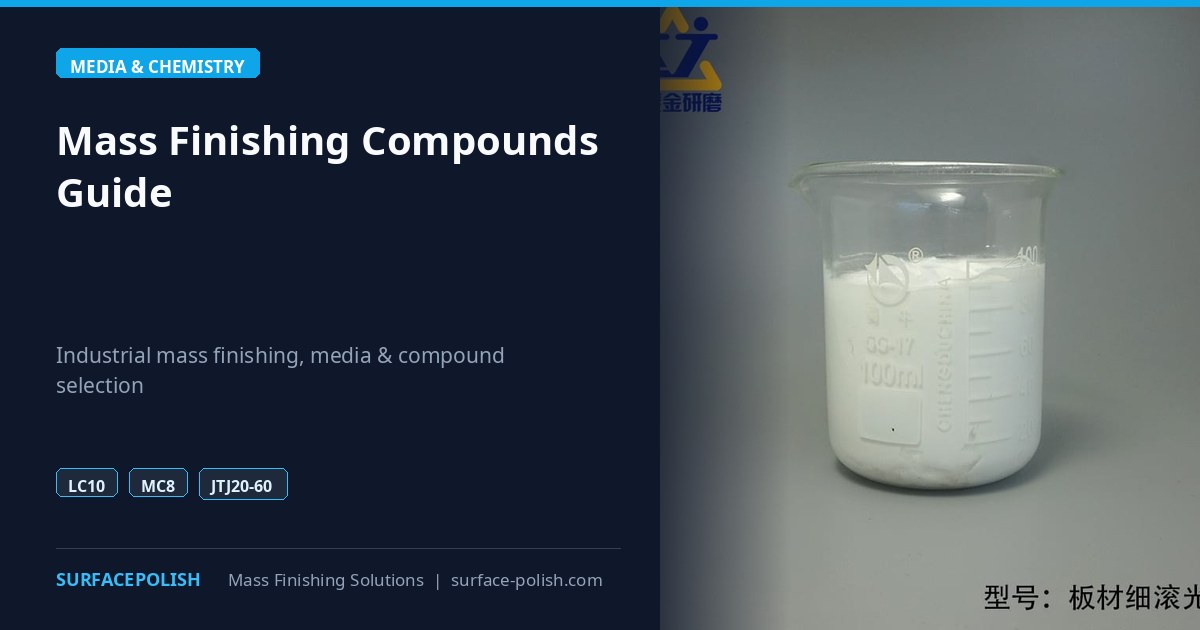
Finishing engineers often spend weeks tuning vibratory motor counterweight angles and media geometries while overlooking the liquid chemistry flowing through the tub. Yet mass finishing compounds govern half the physical work inside a wet bowl: suspending abraded metal swarf so ceramic pores never glaze shut, cushioning stainless balls to compress mirror luster without micro-scratching, preventing corrosion between shifts, and controlling foam inside synthetic plastic media cells.
The central thesis of this guide is straightforward: consistent, defect-free mass finishing requires matching mass finishing compounds (LC10, MC8, HM3, JTJ20/JTJ25/JTJ50/JTJ60, and JTS5) strictly to process stage and alloy compatibility (never dosing acidic MC8 onto aluminum or zinc), running continuous single-pass clean water into a multi-baffle settling tank after upstream alkaline degreasing, and keeping liquid chemistry strictly out of dry organic buffing barrels.
In this complete chemical selection matrix, you will map every SurfacePolish liquid compound family to its exact Stage 1 cutting or Stage 2 burnishing role, troubleshoot foam and grey-smear defects, and standardize shift dosing checks.
Why Single-Pass Mass Finishing Compounds Beat Static Dirty Sumps
Four Functions Inside Wet Bowls: Flushing, Cushioning, Brightening, and Rust Control
Liquid mass finishing compounds perform four simultaneous roles inside ZL circular bowls, ZXL divided troughs, LLB50 toroidal discs, and LLF120 planetary barrels: first, surfactants wet stone pores and float abraded metal silt straight out of bottom drain grates; second, lubricity films cushion rolling media against workpieces; third, brightening agents inhibit oxide tarnishing; and fourth, mild rust-inhibitors protect clean steel edges until spin-drying begins. Review our ceramic media glazing fix guide.
Continuous Flow-Through vs. Recirculated Sump Slurry
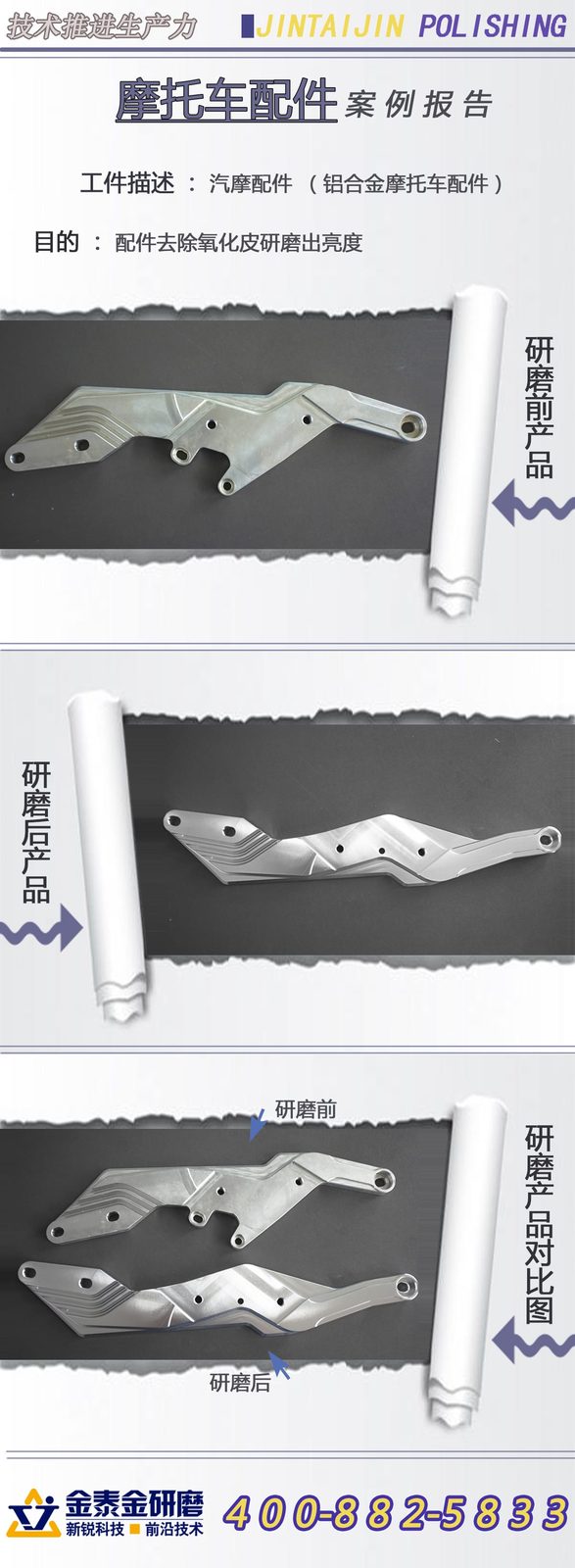
Trying to cut water usage by recirculating dirty sump slurry pumps dark metallic fines, broken abrasive dust, and emulsified oil straight back onto workpieces—leaving dull grey smears on aluminum and glazing high-frequency ceramic stones smooth. Always run continuous single-pass clean water paired with metered compound dosing into a multi-baffle settling tank.
Mandatory Upstream Alkaline Pre-Degreasing for Oily CNC Batches
Even the best mass finishing compounds cannot overcome thick cutting coolants, tapping wax, or die-cast mold-release oil dumped straight into the bowl. Mandate an upstream alkaline pre-wash tank so clean, oil-free parts meet fresh single-pass chemistry cleanly.
Honest Boundary: Liquid Compounds Never Belong in Walnut or Corncob
Never pour water or liquid mass finishing compounds into corncob, walnut shell (8#-80#), or hardwood pegs! Moisture swells organic fibers immediately into muddy clumps that pack inside blind threads. Complete all wet chemical cycles first, spin-dry thoroughly in 35A/70A dryers, and keep dry organic barrels bone-dry. See our walnut media tumbling guide and corncob drying media grades guide.
Complete Matrix: LC10, MC8, HM3, JTJ20–60, and JTS5 Compared
LC10: Daily Workhorse Cleaning & Deburring Compound
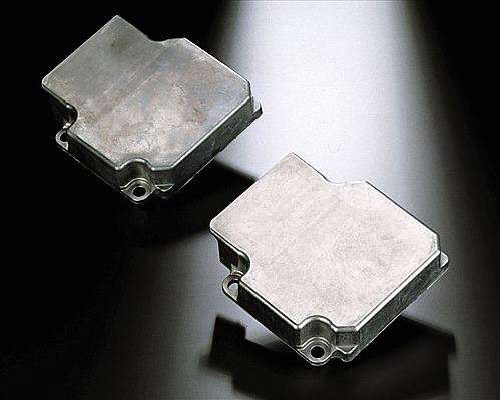
Compound-LC10 is your everyday single-pass deburring lubricant for Stage 1 high-frequency ceramic cutting (carbon steel, stainless, titanium) and Stage 1 resin-bonded synthetic plastic cutting (6061 aluminum, brass, zinc). LC10 keeps stone pores wide open, prevents grey oxide smear, and doubles as an ideal media-only bed-wash cleaner when high-alumina spheres darken. Review our deburring media selection matrix.
MC8: Acidic Ferrous Descaler (Strictly Isolated Carbon Steel)
Compound-MC8 is an acidic descaling compound engineered specifically to strip heavy black heat-treat oxide, weld heat-tint, and forge scale off carbon steel inside isolated ferrous ceramic bowls or octagonal barrels. Never let MC8 touch 6061 aluminum, Zamak zinc, or brass—acidic descalers etch soft non-ferrous alloys black and pit surfaces rapidly. See our steel polishing compound guide.
JTS5: Anti-Cling Compound for Thin Stamped Sheet Metal
Thin stamped steel washers, shims, and flat leaf springs stick tightly to planar media faces or nest together via liquid surface tension. Pairing continuous water flow with compound-JTS5 breaks capillary sticking inside ZL bowls and ZXL troughs so thin stampings tumble freely and unload cleanly across vibratory separator screen decks.
HM3 & JTJ50: Non-Ferrous Brighteners for High-Alumina Burnishing
Once Stage 1 synthetic plastic cutting finishes, transition 6061 aluminum, brass, copper, zinc, and titanium into Stage 2 non-abrasive high-alumina spheres dosed with compound-HM3 or JTJ50 for bright, pit-free mirror luster without galvanic iron spotting. Explore our compound for aluminum guide and porcelain ball burnishing media guide.
JTJ20, JTJ25, and JTJ60: High-Luster Stainless & Steel Ball Brighteners
Inside Stage 2 304 stainless steel ball lines (ZL bowls and LLF120 barrels), JTJ20, JTJ25, and JTJ60 deliver slick surfactant cushioning and crisp metallic brightening across stainless cutlery, surgical forceps, brass valves, and hardened carbon-steel hardware. See our stainless steel tumbling media guide.
| Compound Code | Chemical Role | Safe Alloy Scope | Paired Media Family | Critical Restriction / Segregation |
|---|---|---|---|---|
LC10 |
General single-pass cut & clean | Steel, stainless, titanium, aluminum, brass | High-frequency ceramic & resin plastic |
Upstream wash required for oily CNC parts |
MC8 |
Acidic heat-scale & rust descaler | Carbon steel & alloy steel ONLY | High-frequency ceramic stones |
Keep strictly away from aluminum, brass, zinc |
JTS5 |
Anti-stick sheet-metal separator | Thin stamped steel & alloy shims | Tri-star / angle-cut ceramic | Maintain steady spray flow for clean unload |
HM3 / JTJ50 |
Non-ferrous & titanium burnishing | 6061 aluminum, brass, titanium, zinc |
Iron-free high-alumina spheres / OBD |
Rinse Stage 1 cutting grit cleanly before dosing |
JTJ20/JTJ25/JTJ60 |
Heavy ball mirror brightener | 304/316 stainless, brass, carbon steel |
304 stainless balls & ball-cones |
Do not mix with abrasive Stage 1 ceramic |
Pairing Compounds With Ceramic, Plastic, and Burnishing Media Stages

Stage 1 to Stage 2 Chemical & Rinse Isolation
Never transfer wet parts straight from an LC10 or MC8 Stage 1 ceramic bowl into an HM3 or JTJ60 Stage 2 burnishing bowl! Pass parts beneath a clean-water spray rinse bar across your vibratory separator screen so both residual acid/soap and loose silicon-carbide dust flush away before Stage 2 burnishing begins. Read our pneumatic separation screen deck guide.
Controlling Polymer Foam Inside Synthetic Plastic Media Tubs
Resin-bonded plastic cones and pyramids shed fine polymer dust during wet aluminum and brass cutting. Keep single-pass LC10 clean water moving briskly through open bottom drain grates—and keep oily castings pre-washed upstream—so thick white foam never overflows the bowl rim. Review our plastic cone vs pyramid media guide.
Chemical Dosing Inside Closed LLF120 Planetary Centrifugal Barrels
Unlike open vibratory bowls with continuous drain flow, sealed LLF120 planetary centrifugal barrels hold one fixed water-and-compound charge per cycle. Measure clean water and LC10 or JTJ60 accurately, keep barrel cycles crisp, and rinse parts immediately upon unloading. Explore our centrifugal barrel finishing machine guide.
Protecting Polyurethane Bowl Liners From Chemical & Abrasive Attack
Locking acidic MC8 strictly inside dedicated chemical-resistant ferrous equipment and brushing drain slots open at shift start protects polyurethane bowl ribs from premature swelling or abrasive slurry wear. See our polyurethane bowl liner replacement guide.
Clean Rinsing, 35A/70A Spin-Drying, and Dry Organic Follow-Up
Why Heated 35/35A/70/70A Centrifugal Spin-Dryers Stop Water Rings
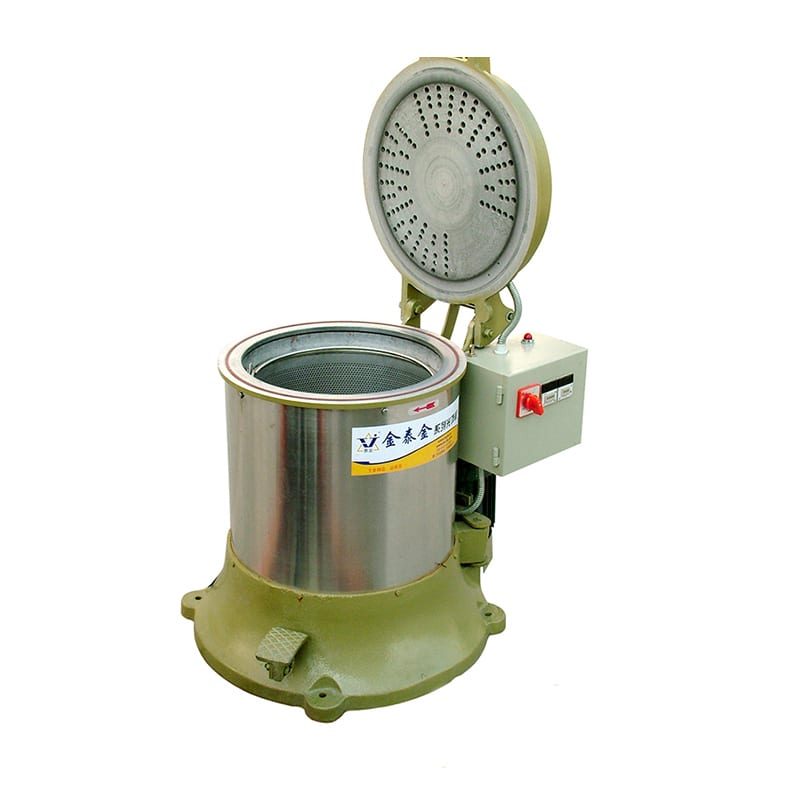
After passing under a filtered clean-water spray rinse bar on the separator screen, wet batches still hold residual rinse droplets inside threads and blind pockets. Transferring parts straight into a heated 35, 35A, 70, or 70A centrifugal spin-dryer flashes moisture away cleanly before carbon steel rusts or hard-water calcium spots mirror aluminum. See our centrifugal dryer guide.
Optional Dry Corncob & Walnut Shell Polishing Downstream

When optical hardware, brass fittings, or eyewear trim need zero water haze or warm dry sheen, follow 35A/70A spin-drying with bone-dry corncob or graded walnut shell (8#-80#) buffing in clean dry bowls or sealed octagonal barrels.
Multi-Shift Chemical Audits, Storage, and Troubleshooting
Color-Coding Chemical Drums and Auditing Dosing Pumps Daily
Color-code MC8 acidic drums, LC10 general drums, and HM3/JTJ brightener totes unmistakably so no operator accidentally hooks an acidic ferrous descaler to an aluminum high-alumina bowl! Check peristaltic pump tubing and spray nozzles every morning before shift start.
| Compound / Chemistry Defect | Likely Root Cause | Immediate Correction | Preventive Standard |
|---|---|---|---|
Black pitting on aluminum or Zamak zinc |
Acidic MC8 dosed on non-ferrous parts |
Flush bowl immediately; reload LC10/HM3 |
Lock & color-code ferrous vs. non-ferrous drums |
| Thick white foam overflowing bowl | Oily CNC parts or stagnant dirty sump | Pre-degrease batch; restore single-pass flow | Upstream alkaline wash + drain brushing |
| Glazed ceramic stones & slow cut | Starved LC10 flow or clogged drain grates |
Brush drain grates; run hot LC10 strip wash |
Audit pump rates & settling tank daily |
| Dark grey smear on mirror stainless | Dirty sump or starved JTJ60 brightener |
Restore clean single-pass JTJ60 flow |
Maintain clean multi-baffle settling tank |
| White mineral rings after drying | Unfiltered hard tap water air-drying | Filtered spray rinse + 35A/70A spin-dry |
Stage heated centrifugal dryer at chute |
Settling Tank Maintenance and Compound Consumption Tracking
Brushing Bottom Drain Grates and Monitoring Multi-Baffle Settling Tanks
Even precision-metered mass finishing compounds fail if plugged bottom drain slots trap dirty metallic slurry inside the bowl. Brush drain grates clean at shift start and empty multi-baffle settling tank compartments weekly so single-pass effluent flows smoothly.
Calibrating Overhead Spray Nozzles Across Wide ZXL Divided Troughs
Long ZXL and L1300–L1800 linear divided troughs require balanced spray-bar nozzles along the entire channel length so LC10 or HM3 compound never starves near the discharge dam.
Checking Chemical Drum Seals, Pump Tubing, and Secondary Containment
Inspect peristaltic pump tubing weekly for cracking, keep MC8 acidic drums sealed on dedicated spill-containment pallets away from aluminum lines, and verify drum inventory before multi-shift weekend runs.
Logging Chemical Usage Against Media Screening Schedules
Track daily compound drum consumption alongside weekly media chip-screening logs; sudden spikes in foam or slurry thickness immediately flag upstream alkaline pre-wash oil carryover before part quality drops.
Factory Capabilities & Verified Compound & Machine Supply
Founded in 1992, Xiamen Jin Tai Jin Grinding Technology Co.,Ltd. (SurfacePolish) engineers and manufactures 21 machine platforms backed by 24 granted Chinese IP rights and more than 200,000+ solutions across certified facilities (ISO 00726Q01571R001, CE M.2023.206.C88121, and CE M.2023.206.C88120). Alongside ZL circular bowls, ZXL/L1300–L1800 divided troughs, LLF120/LLB50 centrifugal finishers, OBD-30..100 magnetic polishers, and 35/35A/70/70A dryers, we supply the complete mass finishing compounds lineup (LC10, MC8, HM3, JTJ20, JTJ25, JTJ50, JTJ60, JTS5) matched to high-frequency ceramic, resin plastic cones, high-alumina spheres, 304 stainless balls, corncob, and walnut shell (8#-80#). Standard machines ship in 25–35 days and custom automated lines ship in 45–60 days. Send sample raw parts to surface-polish.com for complimentary media-and-chemical validation. Honest boundaries apply: we do not supply electroplating rectifiers, chromate conversion tanks, or solvent vapor degreasers.
Frequently Asked Questions About Mass Finishing Compounds
What is the difference between LC10, MC8, and JTJ60 mass finishing compounds?
LC10 is an everyday single-pass deburring cleaner/lubricant for Stage 1 ceramic and plastic cutting; MC8 is an acidic descaler reserved strictly for heavy carbon-steel scale removal; and JTJ60 is a Stage 2 burnishing brightener for mirror luster on 304/316 stainless steel.
Can I recirculate compound water to save water inside a vibratory bowl?
Recirculating dirty sump slurry pushes abraded metal fines and broken grit back onto parts—causing grey smearing and ceramic media glazing. Always run continuous single-pass clean water and metered compound into a multi-baffle settling tank.
Why should MC8 descaler never touch aluminum, brass, or zinc parts?
Acidic MC8 aggressively etches non-ferrous metals, turning 6061 aluminum and Zamak zinc dark black or pitted while attacking resin plastic media binders. Use LC10 and HM3/JTJ50 strictly on non-ferrous alloys.
Which mass finishing compound prevents thin stamped washers from sticking together?
Compound-JTS5 paired with steady single-pass clean water breaks surface tension between flat stamped steel parts and media faces—especially when combined with curved tri-star ceramic shapes.
Do I still need an upstream alkaline pre-wash if I run LC10 compound?
Yes, whenever CNC-machined or stamped parts arrive coated in cutting oil, tapping grease, or mold-release spray. Pre-degreasing upstream prevents foam spikes and keeps ceramic cutting pores open.
Can liquid mass finishing compounds be used with walnut shell or corncob media?
Never add water or liquid compounds to corncob, walnut shell (8#-80#), or hardwood pegs. Organic media swells into soggy clumps when wet; spin-dry parts first in a 35A/70A centrifugal dryer before dry buffing.
How do I clean darkened high-alumina spheres or 304 steel balls?
Leave the non-abrasive ball bed inside the bowl by itself and run a brief media-only strip-wash cycle using warm clean water and compound-LC10 until drain effluent runs clear.
How can I verify the right compound recipe before ordering drums?
Send representative raw production parts to surface-polish.com for complimentary lab testing; our engineers qualify exact Stage 1 and Stage 2 mass finishing compounds, flow rates, and media pairings and return finished samples before you order.
How does single-pass LC10 dosing affect ceramic and plastic media wear life?
Properly metered compound-LC10 lubricates sliding contact gently so vitrified ceramic and resin plastic tumbling media stay cool, self-sharpening, and free of glazed oil film—extending usable stone life while holding steady cycle times across shifts.
Can compound-HM3 replace JTJ60 on 304 stainless steel cutlery?
While HM3 excels on aluminum, brass, copper, and titanium, dedicated stainless brighteners like JTJ60, JTJ20, and JTJ25 deliver higher specular reflectivity and cleaner corrosion-resistant passivation prep on 304/316 stainless hardware.
Why should I inspect polyurethane bowl liners when running acidic MC8 descaler?
Although polyurethane resists mild process chemistry, prolonged heavy carbon-steel descaling combined with coarse ceramic grit wears discharge dams and drain grates over time. Weekly visual checks prevent unexpected liner leaks.
What water quality works best for mixing Stage 2 HM3 and JTJ60 brighteners?
Filtered soft water prevents dissolved calcium and magnesium from reacting with brightener surfactants or leaving faint white mineral rings during post-burnish 35A/70A centrifugal drying.
How does LC10 concentration affect foam inside resin-bonded synthetic plastic media tubs?
Under-dosing LC10 or starving single-pass clean water traps fine polymer resin dust inside the bowl, building thick white foam blankets that cushion cutting action. Keeping oily castings pre-washed upstream and maintaining steady single-pass LC10 water flow keeps foam under control.
Why should every shop keep separate transfer baskets for MC8 descaling vs. JTJ60 burnishing?
Residual acidic MC8 carried on shared steel baskets contaminates neutral/alkaline Stage 2 JTJ60 burnishing bowls, dulling 304 stainless balls and leaving patchy discoloration on mirror stainless cutlery or surgical instruments. Color-coded baskets enforce clean chemical isolation.
Can mass finishing compounds fix poor part-to-media cushion ratios or wrong media shapes?
No. While proper mass finishing compounds prevent glazing, corrosion, and grey smearing, they cannot stop part-on-part collision dings caused by an under-filled media bed or mechanical lodging caused by wrong stone geometry.
How do I adjust dosing when moving from ZL circular bowls to LLF120 centrifugal barrels?
Because LLF120 planetary centrifugal barrels run sealed batches without continuous drain flow, measure clean water and LC10 or JTJ60 accurately per barrel load and rinse unloaded parts promptly across a clean-water spray bar.
What happens if bottom bowl drain screens plug while running mass finishing compounds?
Plugged drain slots trap spent compound, abraded metal silt, and fractured grit inside the channel—turning single-pass flow into a stagnant dirty sump that smears aluminum grey and glazes ceramic stones smooth. Brush drain grates open at every shift start.
How should operators store reserve drums of LC10, MC8, and HM3 compounds?
Keep reserve chemical drums sealed on elevated spill-containment pallets at stable shop temperatures away from freezing loading docks and direct sunlight, with clear color-coded pump fittings so ferrous acidic MC8 never connects to non-ferrous bowls.
Can compound-LC10 protect carbon steel from flash rust during overnight bowl shutdowns?
No wet soap film protects damp carbon steel reliably across long humid shutdowns; always unload carbon-steel batches promptly, rinse cleanly over the separator spray bar, and spin-dry immediately inside a heated 35, 35A, 70, or 70A centrifugal dryer.
Why does ZXL and L1300–L1800 divided trough finishing need multi-nozzle spray bars?
Long linear divided troughs carry larger media beds end to end; spacing spray nozzles evenly along the channel guarantees uniform LC10 or HM3 wetting across every lane with zero dry dead zones. Auditing spray-bar nozzles and bottom drain grates at every shift handover keeps single-pass mass finishing compounds flowing cleanly into your multi-baffle settling tank, protecting both polyurethane bowl ribs and part surface uniformity across demanding multi-shift production schedules.
How can I dispose of spent single-pass compound effluent responsibly?
Routing continuous flow-through effluent through a properly baffled settling tank allows heavy ceramic silt and metal fines to drop out by gravity cleanly before overflow water enters plant wastewater treatment. Auditing baffle sludge levels weekly keeps single-pass mass finishing compounds running smoothly across every shift.
 +86-592-2381506


 IPv6 network supported
