
Rubber Barrel: The Lining Exists to Protect the Part, Not the Machine
A rubber barrel is not a barrel made of rubber and it is not a softer machine. It is a barrel whose working surface is an elastomer instead of steel or polyurethane, and the reason to buy one is what that surface does not do: it does not transfer iron into the part, it does not scratch a finished face, and it does not peen a thin wall.
That is a narrow reason, which is why rubber-lined barrels are specified for a specific set of jobs rather than as a general upgrade. This page is about deciding whether your job is one of them — and about what to put in an enquiry, because the lining is the whole specification. For the parts themselves, deburring plastic and rubber components covers the limits.
Product: rubber barrel — rotary barrel with an elastomer working surface, built to a drawing
Category: barrel finishing machines → rotary barrel tumbling machines
Used for: parts that must not pick up iron, parts whose finished face must not be marked, and soft materials where a metal contact surface is the problem
Not used for: stock removal where fast cutting is the point, parts that need the barrel to carry heavy impact, or any job where the barrel can be cleaned between materials instead
Order basis: drawing + the material the parts must not touch + batch weight + wet or dry
MOQ: 1 · Lead time: a barrel built to a drawing runs the custom slot, 45 to 60 days from deposit; a standard configuration is 25 to 35 days
A note on what is and is not here. We publish no rubber barrel model, lining thickness or capacity, because we build to a workpiece. Any figure below is a published value for a machine or process the decision is measured against.
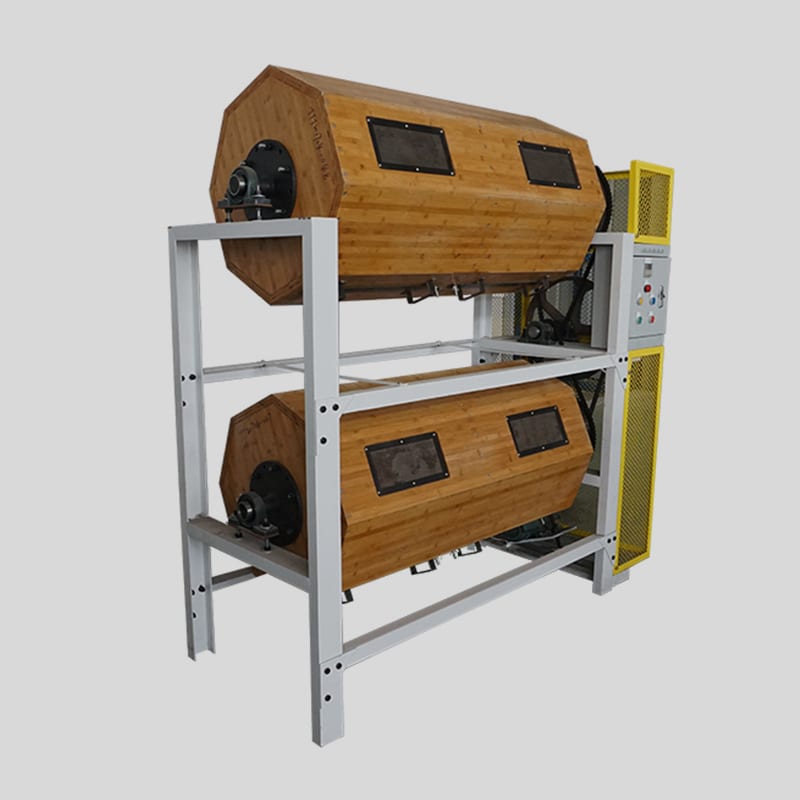
What the rubber is actually for
Three failures drive the purchase, and they have different answers:
1. Iron pickup and cross-contamination. A steel barrel in a wet charge is a source of iron. On stainless that shows up as rust spots days later — the stainless is not rusting, the contamination is. On titanium and aluminium the transfer is worse than cosmetic: a smear of the wrong metal on a surface that has to be chemically or biologically clean is a reject. A dedicated charge helps; a non-metallic contact surface is the structural answer.
The lining is not the only thing to change here: media, compound and rinse also carry contamination between jobs, which is why titanium work is specified as a dedicated line rather than a dedicated barrel.
2. Scratching a face that is already finished. A polished, brushed or coated face that goes into a barrel for a light edge break is at risk from every contact. Steel is hard and, if it carries any score of its own, it is a cutting edge; the elastomer gives instead. That is why this barrel turns up at the end of a route rather than the start: the cut was done elsewhere.
3. Impact on a soft or thin part. Aluminium, brass, zinc die castings and thin-wall parts deform rather than cut, and a resilient surface absorbs the difference between the charge and the wall. Below roughly half a millimetre of wall the risk is distortion rather than removal.
The unifying idea: the buyer is buying the absence of something, which is why a rubber barrel cannot be compared on throughput with a steel one, and why the honest comparison is against the cost of the parts it prevents from being scrapped.
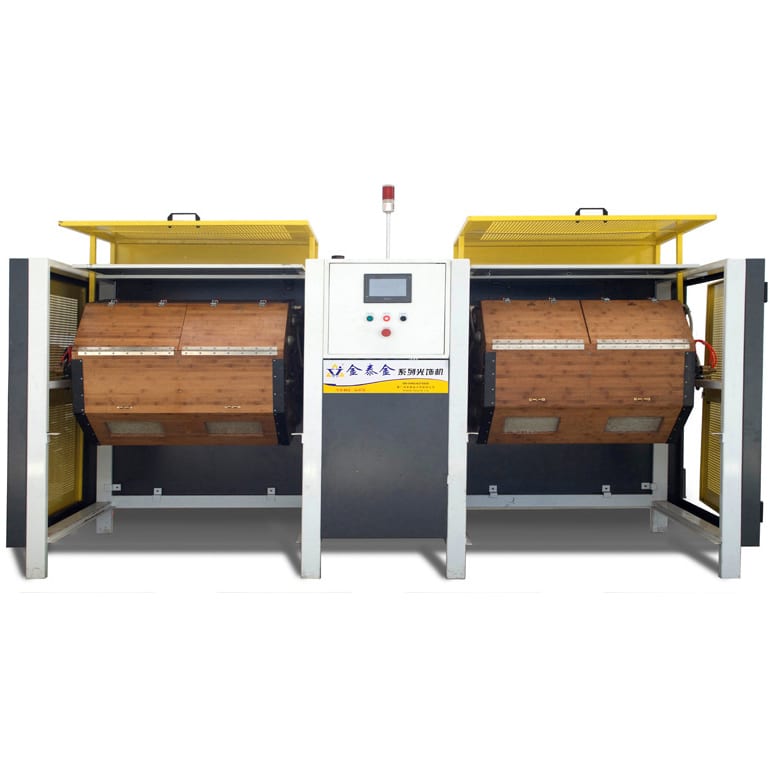
Where a rubber barrel is the right specification
Four cases, and they need to be checked in this order:
1. The part material forbids steel contact. Titanium, aluminium, copper alloys and any part that will be chemically cleaned or implanted afterwards. Where a metal smear is a defect rather than a mark, the contact surface has to be non-metallic — a requirement of the acceptance criterion, not a preference.
2. The finish is already at the target and only the edge needs attention. A part that arrives polished and needs a light radius is a part where any marking is rework. This is the most common genuine rubber-barrel job, and it is a light job: short cycle, small cut.
3. The part is soft or thin-walled. Zinc and aluminium die castings, thin sheet, small brass fittings. The published process bands still apply — a light deburr runs 10 to 20 minutes, a brightening cycle 2 to 8 hours — but on a soft part the useful end of that scale is short.
4. The shop runs several metals through the same equipment. Where the same barrel sees titanium one week and stainless the next, a non-metallic surface removes one contamination source you cannot clean.
A practical summary: rubber is bought when the part is the specification. If the requirement is "remove this much material", the barrel material is secondary. If it is "remove nothing except the burr, and leave no mark", it is the first question.
Where a rubber barrel is the wrong buy
This section saves the money, and a supplier with a barrel to sell will not write it:
- The job is real stock removal. Elastomer is not an abrasive, and a rubber-lined barrel does not cut faster for being rubber. For tenths of a millimetre off a robust steel part, a steel or PU-lined barrel running a ceramic charge is the right machine, and cheaper.
- The burr is heavy or the flash is thick. A rubber surface does not concentrate force the way a hard surface does, and heavy burrs need the cut rather than the protection.
- The media is the contamination source anyway. Buying a rubber barrel and then running the same worn charge that has been cutting steel for 150 hours does not deliver a clean surface. Media life runs 20 to 200 operating hours, and a charge that has run another metal is contaminated regardless of the lining.
- Cycle time is the binding constraint. A resilient lining absorbs some of the energy the charge would otherwise deliver.
- The part is longer than the barrel's internal diagonal. It bridges, and no lining fixes bridging.
- A clean steel barrel plus a dedicated charge would do. Where the risk is between jobs rather than between the part and the wall, a dedicated charge, a documented cleaning step and a rinse are cheaper than a specialised barrel. The honest test: has the defect been traced to the barrel surface, or assumed?
- Nobody can state what the barrel must not touch. If the enquiry is "we would like rubber", the answer is a question, not an offer: which metal must not appear, at what limit, and how is it checked?
How a rubber barrel is specified instead of chosen
Because this barrel is built to a workpiece, the specification is a conversation with four inputs. Getting these wrong is what makes a custom barrel a long project:
- What the part must not pick up, and how that is verified. "No iron" is not a specification; "no free iron detectable by the customer's test" is. Lining, media and rinse are then specified against that.
- The lining thickness, a trade exactly as it is on a PU barrel. Our tub series publishes a 20–35 mm polyurethane liner, and the same logic applies to an elastomer: thicker lasts longer, and every millimetre comes out of the working volume. We publish no rubber figure and will not offer one until the part and the hours are known.
- The hardness and the bond. A lining too soft deforms under the charge and traps material at the edges; one too hard behaves like the steel it replaced. The bond between lining and shell is where a lining fails first, which is why it is inspected at the edges and the joints.
- The barrel it goes into — capacity, drive, sealing and tipping. Those come from the barrel family, not from the rubber: the published figures apply unchanged, for example the 160 L / 80 L carrying and 400 L / 200 L carrying octagonal barrels running 0–50 rpm on 1.1 kW and 2.2 kW, or the 60 L centrifugal barrel at 3.0 + 0.75 kW and 0–170 rpm on a 15 × 4 kg load.
Alongside those, the enquiry needs the drawing with the face that must not be marked identified; the batch weight and parts per cycle; wet or dry and the compound; the expected hours per week; and the site services — three-phase 380 V or 415 V at 50 Hz and a floor that takes the machine and its tipping clearance. Noise on a barrel family runs 75 to 85 dB(A) at one metre, the baseline for noticing a change later.
What fails, and what each failure means
| What you see | The usual cause | What to check | What to change |
|---|---|---|---|
| Rust spots on stainless parts days later | Iron transferred — from the barrel, the charge, or the rinse | The lining surface for embedded metal; the charge's history | Re-line or replace the charge; dedicate a charge per metal family |
| Dark smears on aluminium or titanium | Metal pickup on a steel or contaminated surface | The contact surface and every upstream metal it touched | Non-metallic lining; dedicated media; a rinse step that is not shared |
| Marks on a face that was already finished | Part-on-part contact, or a hard surface with a score of its own | Whether the mark is a scuff or a groove — a groove is not from the lining | Reduce the load, separate parts, or change the contact surface |
| Lining lifting at the edges or joints | Bond failure, usually starting where the charge concentrates | The lining edge and the corner joints | Re-line; this is a wear-out, not a fault in use |
| Lining torn and the shell showing through | Impact, or a sharp part corner | Where the tear is, and whether a part caused it | Stop running the sharp family in this barrel; re-line |
| Charge turned grey and parts dull | Contaminated or worn media, not the lining | The charge's hours against 20 to 200 operating hours | Replace the charge on schedule rather than on symptom |
| Finish inconsistent part to part | Loading and part-on-part contact, not the barrel material | Fill level; whether parts nest | Reduce the load and distribute parts; the barrel cannot fix this |
The comparison that decides it: rubber, PU or a dedicated charge
Buyers usually frame this as rubber versus steel; the useful frame is three-way:
| Option | What it prevents | What it costs | When it is right |
|---|---|---|---|
| Rubber-lined barrel | Metal transfer from the wall, impact marking | Weight, and the custom build slot | The part material forbids steel contact, or a finished face must not be marked |
| Polyurethane-lined barrel | Most abrasion of the shell; easy to re-line | The liner is a consumable | General metal work, including most jobs where "not steel" is a worry rather than a requirement |
| Steel barrel + dedicated charge + cleaning procedure | Contamination between jobs | Discipline, and a documented procedure | The risk is between jobs, not between the part and the wall |
The third option is the one that gets skipped, and it is often correct. A barrel is a container, and much contamination in a small shop is a housekeeping question rather than a metallurgy one. If you cannot say which of the three failures you are seeing, the next step is a trial, not a purchase.
What we will and will not say about our own range
We build finishing equipment and the media and compounds that run in it, and we build to a workpiece. On rubber barrels:
- The barrel can be built to your drawing. Send the drawing, the material constraint and the batch, and the barrel and lining are specified against them, the same way any other custom configuration is.
- We will not name a rubber barrel model number or a lining thickness in advance, because we publish none. We will propose a configuration and run a trial on your parts before the specification is fixed.
- The trial is the deliverable — whether the transfer is below your limit, whether the face is unmarked, and what cycle time and media consumption resulted.
That is the basis on which every other family is offered, and why the enquiry list above is longer than it looks: a rubber barrel offer is a lining specification first.
The barrel forms are listed in our barrel finishing range, where the lining is specified against the material rather than against the drum size.
The charge it turns comes from our grinding media range, and the compound it runs with is in our consumables range.
Frequently asked questions
Is a rubber barrel better than a steel barrel? Only for the three jobs it exists for: preventing metal transfer, preventing marks on a finished face, and absorbing impact on a soft or thin part. For stock removal it is worse than a steel barrel at the same cost or more, because the contact it makes is softer. A specialist purchase, not an upgrade.
Do I need a rubber barrel to run titanium or aluminium? Not automatically — trace the requirement to the acceptance criterion. What those metals need is a non-metallic contact surface and media that has not run another metal. The charge matters at least as much as the lining, and its life is 20 to 200 operating hours depending on the work.
What thickness of rubber lining should I specify? It is a trade, not a maximum: thicker lasts longer and every millimetre comes out of the working volume. Our published polyurethane liner on the tub series runs 20–35 mm, and an elastomer is specified the same way. We publish no rubber figure, and a supplier who quotes one before seeing the part and the hours is quoting a number rather than a barrel.
Can you build one to our drawing? That is how this barrel is quoted. Send the drawing with the face that must not be marked, the material that must not be transferred, the batch weight and the wet-or-dry decision.
How long does a rubber barrel take? A barrel built to a drawing runs the custom slot at 45 to 60 days from deposit; a standard configuration is 25 to 35 days.
Will a rubber barrel stop part-on-part damage? No. Part-on-part damage is a loading and geometry question, answered by how the batch is made up and whether the parts can nest. A rubber lining changes the wall contact; it does not separate parts from each other.
Max Xu, Sales — Xiamen Jin Tai Jin Grinding Technology Co.,Ltd.
No. 31, Xinchang Road, Xinyang Industrial Zone, Haicang District, Xiamen
info@surface-polish.com
We do not publish a rubber barrel model, capacity or lining thickness; this barrel is built to a drawing and specified against a trial on the part. The figures quoted here are published values for the machines and process bands named, given as reference points rather than as a specification for a rubber barrel. A finishing process is set by the material, the stock to be removed and the finish required, so the configuration for a specific part is confirmed against a trial on that part. We manufacture finishing equipment and the media and compounds that run in it; we do not offer a job-shop finishing service.
 +86-592-2381506


 IPv6 network supported
