
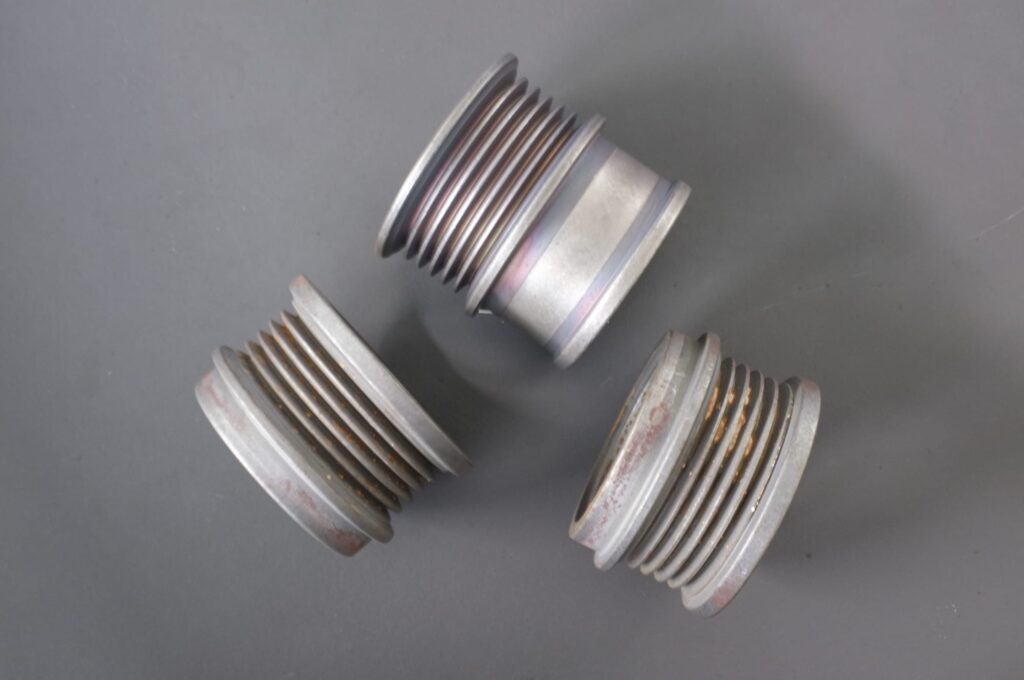
Tumble Finishing Metal: The Material Rules That Change the Process
"Tumble finishing metal" is a phrase that hides the only variable that matters: which metal. Two parts of the same geometry, run in the same machine with the same media and the same cycle, will not come out the same if one is mild steel and the other is stainless, aluminium or a zinc die casting. The burr comes off both, but the steel may come out with a rust bloom inside the hour, the stainless may come out grey rather than bright, the aluminium may come out smeared, and the zinc casting may come out with its edges rounded past tolerance.
This page is about those material rules. It covers the four properties that change a metal's tumble-finishing recipe — how it cuts, how it rusts, how its swarf behaves, and how much time you have before the next operation — and it says where the process stops working. The parameters are a starting point for a trial on your parts; a published cycle assumes a material and a removal that may not be yours.
What you see when the material was not accounted for
| What you see | What it usually means |
|---|---|
| Steel parts flash a rust bloom within hours of coming out | No rust-inhibiting compound, or parts left wet — a drying and chemistry problem, not a cut problem |
| Stainless comes out grey rather than bright | Wrong compound for the alloy, or a charge contaminated with ferrous swarf |
| Aluminium comes out smeared or blotchy | A grade meant for steel cut too deep, or the compound let the part rub dry |
| Zinc die castings lose their edges or distort | Too much energy for a low-melting, low-hardness material |
| Copper or brass darkens instead of brightening | Compound chemistry attacking the surface, or a rinse that is too slow |
| A batch is fine on Monday and rough on Friday | Media is part-way through its life and the charge changed character |
The last row is the one that catches production engineers, because nothing on the machine changed. Media wears; a charge that has lost its cut produces a different part without producing an alarm.
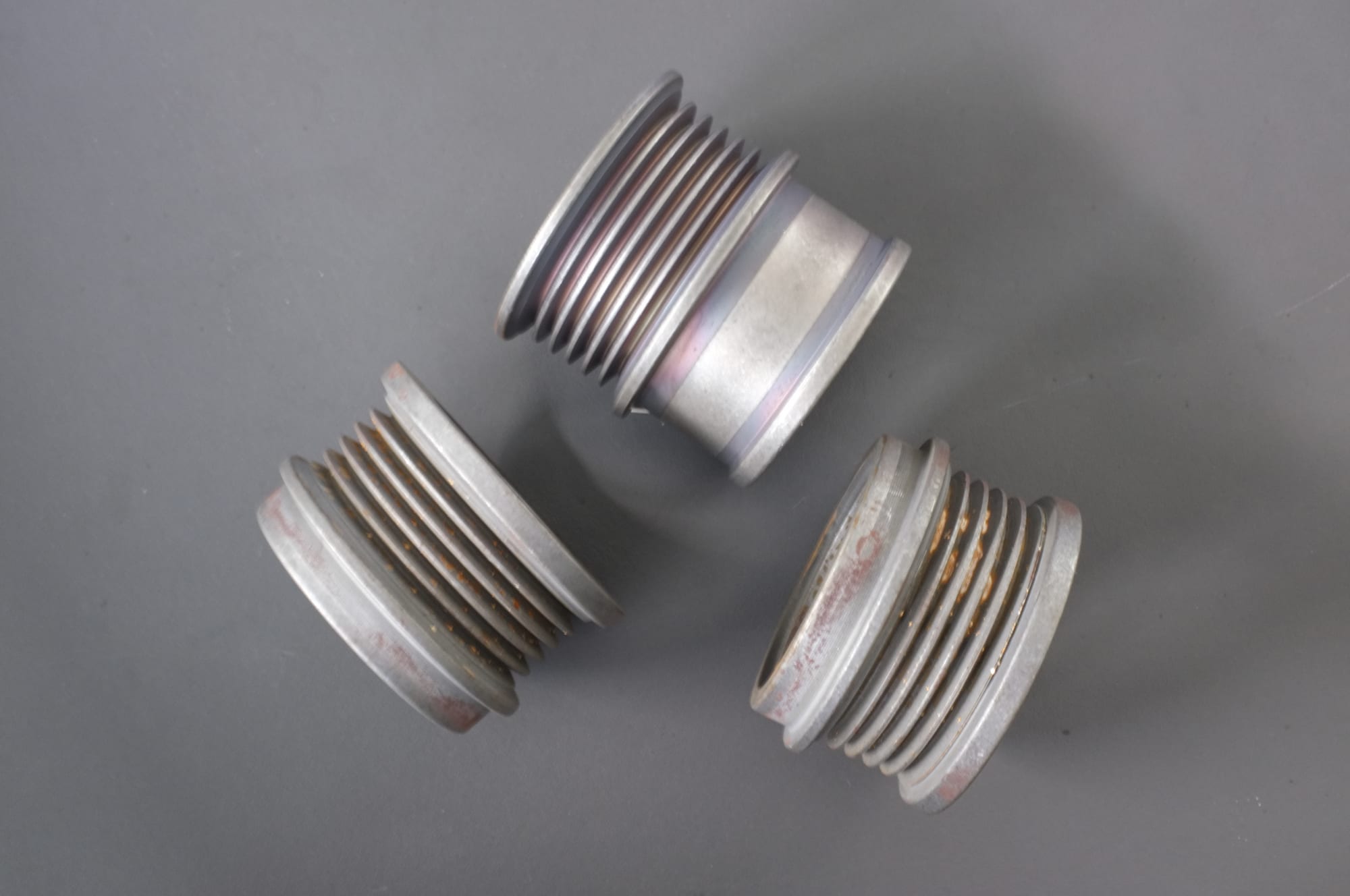
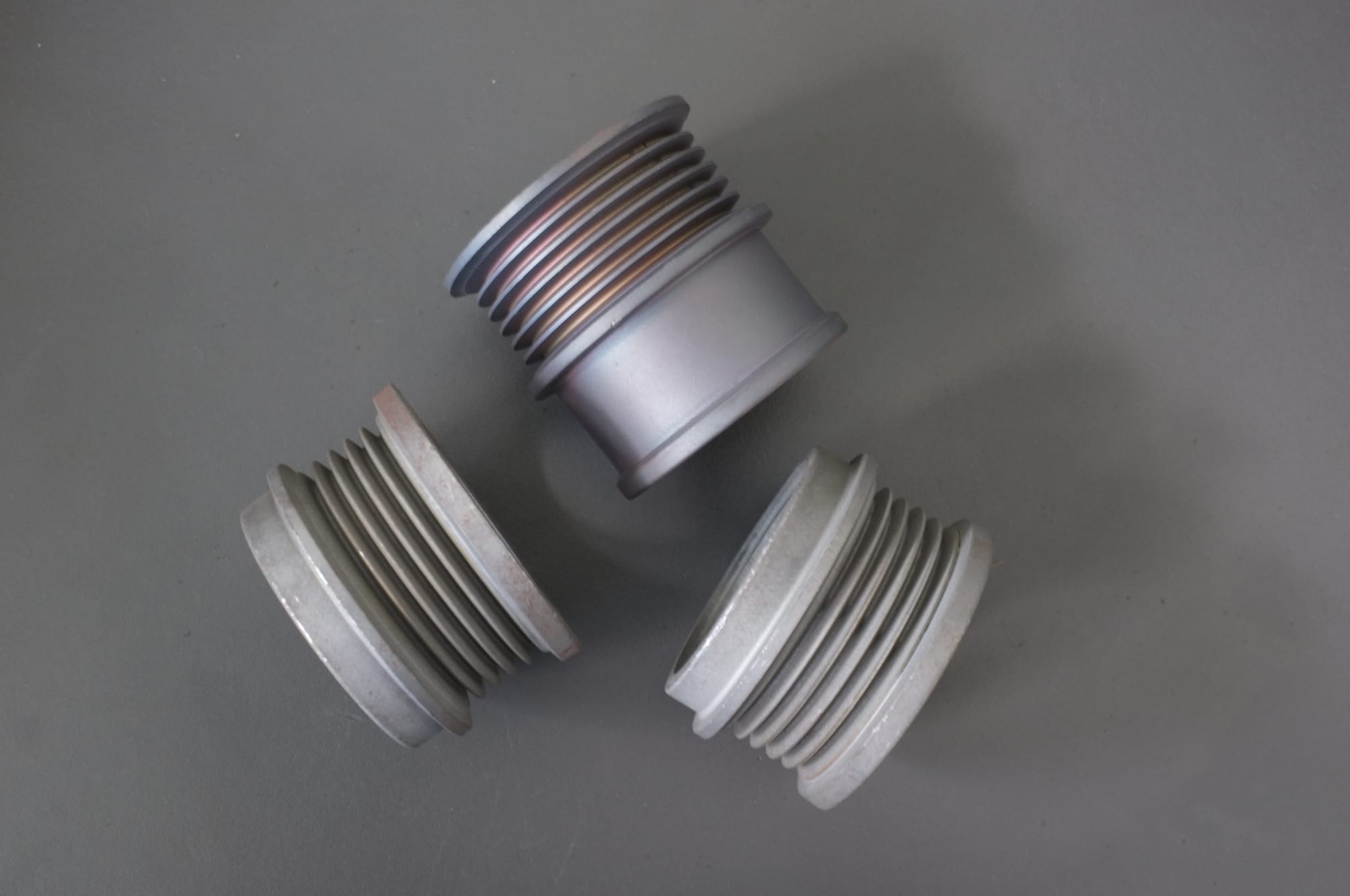
The four material properties that change the recipe
1. How the metal cuts — hardness and ductility together
Hardness alone does not predict how a metal behaves in a charge. What matters is the pair: hardness and ductility. A hard, brittle material chips and holds its edge geometry; a soft, ductile one smears and work-hardens. Stainless sits awkwardly in both camps — it is hard enough to resist cutting and ductile enough to work-harden under the media, which is why a stainless part that is cut too aggressively comes out with a skin that is harder than the metal underneath.
The practical setting is the six-point grade scale, and the two grinding tables do not use the same letters:
- Wet grinding: VR / R / N / NF / F / FF
- Dry grinding: VR / R / M / MF / F / FF
VR is maximum stock removal and FF is final brightening. For most metal work the cutting stage is N (wet) or M (dry), and the finish sequence steps down from there. What changes between metals is how far down the scale you have to go and how long each step runs.
2. How it rusts — the window between the machine and the next operation
Ferrous parts begin to corrode as soon as the water film and the air meet. A wet process leaves the part wet, and a wet finishing line without a drying step leaves a film in blind features that shows up as spotting weeks later. For steel the sequence has to be planned as cut → rinse → inhibit → dry, and the inhibit and dry steps are not optional.
Two things shorten the window further. Warm parts dry faster but corrode faster while wet, and parts with fine features hold water where a towel never reaches. If a steel batch is going to sit over a weekend, the question is not whether it will bloom but how much.
Non-ferrous metals have the opposite problem: they do not rust, but aluminium and brass stain, and copper darkens. The window is about appearance rather than corrosion, and it is shorter than most people expect — an aluminium part left wet overnight comes out with water spotting that has to be cut off, which means running the process twice.
3. How the swarf behaves — contamination between metals
Metal finishing is a wet cutting process, and cutting produces fines. Those fines stay in the charge. Run a steel job and then a stainless job in the same machine without a clean-out and the stainless comes out with embedded ferrous particles that show as rust spots after a week in service — the stainless is not corroding, the contamination on it is.
This is why titanium, medical and other contamination-sensitive work uses a dedicated charge, and why "the machine is shared" is a real constraint rather than a detail. The same logic applies to the media: a plastic media used on aluminium and then on steel carries steel fines into the aluminium.
The compound has a second job here. It carries the swarf away rather than letting it settle back onto the parts, which is why compound flow is part of the cutting mechanism, not a cosmetic addition — and why a dirty charge produces a dull part even when the media is still good. Water and compound control covers how to set and test it.
4. How much time you have before the next operation
The gap between finishing and the next process is a material property as much as a scheduling one:
- Going straight to plating or anodising: the base has to be consistent and uncontaminated, and the parts have to be dry. The finish is judged by what the coater accepts.
- Going to assembly: a rust-inhibited and dry part can wait; a wet part cannot.
- Going into storage or shipping: the inhibitor matters more than the brightness.
- Going to inspection: parts that will be handled need to be dry and free of compound residue, or the inspection itself becomes a cleaning job.
Choose the machine family by geometry, then the media by material
The machine families differ in how the abrasive reaches the part. For metal work the usual mapping is:
- Vibratory bowl — general-purpose; the media flows past the part and reaches into features, and the process can be watched and adjusted mid-cycle. The bowl range covers the compact platforms.
- Vibratory tub — long or bulky parts that will not fit a bowl; our tub range includes the L1300 at 1,200 L (42.4 cu.ft) with a 1,200 × 1,000 × 1,000 mm working chamber, 5.0 kW × 2 motors and a 20–35 mm polyurethane lining, with L1500 (1,500 L, 5.5 kW × 2) and L1800 (1,800 L, 7.5 kW × 2) above it.
- Barrel / rotary — volume work on simple shapes (rotary barrel range); the charge is part-specific, so changeover is slow.
- Centrifugal barrel — intensity rather than capacity; the LX60B is 60 L with 3.0 + 0.75 kW, 0–170 rpm and 15 × 4 kg of compartments, which shortens cycles on compact parts and rounds edges on fragile ones.
- Centrifugal disc — one part held against a rotating tool, for a controlled local cut to a tolerance.
- Magnetic finishing — a flexible needle mass for slots, cross-holes and thread roots, on light burrs.
Media then follows the material, not the machine (grinding media range). The working bands are 3–10 mm ceramic against 10–25 mm plastic, and media should never exceed about one third of the smallest feature on the part. Ceramic cuts faster and holds its shape, so it suits harder alloys and longer cycles; plastic wears progressively and cuts gently, so it suits soft alloys, thin walls and anything where cutting through the wall scraps the batch. Burnishing with steel media is a third route — it moves metal rather than cutting it, and when not to use it matters as much as when to use it.
Two numbers set the cycle: a light deburr runs 10–20 minutes and a high-finish polish 2–8 hours (frequency, amplitude and cycle time explains what the machine contributes), and the difference between them is the stock to be removed plus the finish required — two separate requirements. Media itself is a consumable with a life of 20–200 operating hours, and the signals that it is spent are the same across metals: the finish stops improving, a matte grey haze appears, and the cycle needs around 20% longer for the same result.
When tumble finishing metal is the wrong answer
- Parts that cannot be wet. Some assemblies, some coatings and some electronics cannot go into a wet charge at all. Dry media exists — walnut shell, wood, bamboo, stone powder — but dry is slower, produces dust and needs extraction.
- Thin walls. Below roughly 0.5 mm the risk is distortion rather than the cut, and a high-energy process bends the part before it polishes it. Reduce energy or change machine family; shortening the cycle does not fix it.
- Tight-pitch threads and fine recesses. Media locks into a fine thread and rounds the thread start. Use a smooth small media, mask the feature, or accept that thread forming comes after finishing.
- Deep blind features close to the media size. Media enters and does not leave, and on soft metals the lodged piece usually cannot be pushed out without marking the part.
- Heavy burrs from a cutoff, a coarse stamping or a casting. Mass finishing is a finishing process, not a repair process — tool wear, cutoff condition and die condition set the incoming defect, and a fold of metal has to be corrected upstream.
- Mixed metals in one charge. Different metals cut at different rates and finish to different colours, and steel fines contaminate stainless. One charge, one material family, one acceptance standard.
- A part whose appearance is the specification. Polishing changes the surface colour, so a part that will be plated or anodised has to be held to a consistent base rather than to "as bright as possible".
Buying a tumble finishing process: what to ask
- A trial on the worst-case part — the deepest feature, the thinnest wall or the heaviest burr. Send representative parts, the metal grade, and both the finish you need and the finish you will accept; our trials return the measured cycle time and media consumption.
- The material call-out in writing. "Metal" is not a specification; the alloy and its condition are, because they decide the grade, the compound and the cycle.
- The media specification as a grade, a size range and a shape — not as a material name. A 2-to-4 mm range covers a spread that matters on a fine feature.
- The rust or stain control step. For ferrous work ask what the inhibitor is and where in the sequence it goes; for non-ferrous ask how fast the parts are dried.
- Media and compound consumption per 100 hours. With a 20–200 hour media life, a per-kilogram price is not usable without the consumption rate.
- The full line, not just the machine. A separator, a dryer and the wash are separate quotation lines, and a wet process that cannot be dried is not a finished process. The wider machine and media list is on the catalogue, and compounds for the chemistry side of the sequence are in the finishing compound range.
- Noise and services. Expect 75–85 dB(A) at one metre from a vibratory machine, most of it from the vibrator, and three-phase 380 V or 415 V at 50 Hz as standard, with 220 V on smaller units.
- Lead time. A standard machine ships in 25–35 days from the deposit, a built-to-order configuration takes 45–60 days, media shipped with the machine adds about a week, sea transit from Xiamen is 30–40 days, and the minimum order is one machine with 30% deposit and the balance against the shipping documents. Machines are shipped in a wooden case bolted to a pallet with a spare parts kit, a media and compound starter set, tools and manuals, and each is run with a media load before dispatch.
- The credentials. The range is type-examined to Machinery Directive 2006/42/EC against EN ISO 12100 and EN 60204-1 — vertical certificate M.2023.206.C88121, horizontal M.2023.206.C88120, both valid to 2028-07-24 — and the quality system is certified to ISO 9001:2015 under certificate 00726Q01571R001, valid 2026-06-03 to 2029-06-02.
FAQ
Is tumble finishing the same as vibratory finishing? Not quite. A barrel tumbler rotates the whole charge together, so the media only reaches the outside of the part; a vibratory machine drives the media past the part in a flow, so it reaches into features. "Tumble finishing" is used loosely for both, and the machine choice should follow the geometry rather than the label — vibratory vs barrel tumbling sets out the trade.
Why do my steel parts rust after tumbling? The parts are leaving the machine wet and without an inhibitor. A wet ferrous process needs the sequence cut → rinse → inhibit → dry, and blind features hold water that a towel never reaches. If the parts are going to sit, the inhibitor and the dryer are part of the process, not accessories.
Why does stainless come out grey instead of bright? Two usual causes: a compound that does not suit the alloy, or a charge carrying ferrous fines from a previous steel job. Stainless needs its own chemistry and, for contamination-sensitive work, its own dedicated charge. The failure modes are set out in why stainless steel parts are not bright after tumbling.
Can I run different metals through the same machine? You can, with a clean-out and a charge change between them, and it is what most shops do. What you cannot do is run a contamination-sensitive job straight after a ferrous one without cleaning, because carried-over fines show up as rust spots on a part that is not rusting. High-mix work is better served by a machine that changes over quickly.
How long does a tumble finishing cycle take? A light deburr is 10–20 minutes and a high-finish polish 2–8 hours; small-part vibratory cycles usually land between 15 minutes and a few hours. The figure is confirmed on a trial, because a published cycle assumes a material and a removal that may not be yours.
Does the media need changing between metals? It wears out on a schedule rather than on a material change, but a charge that has run steel is not the charge you want for a bright aluminium finish. Media life runs 20–200 operating hours, and the spent signals — no improvement, grey haze, a cycle 20% longer — are the same regardless of what you ran through it.
 +86-592-2381506


 IPv6 network supported
