
Vibratory Separator: When Separation Runs With the Line Instead of After It
A vibratory separator is not a better screen. It is a different place in the process: a vibrating deck that sits inside the flow of work, so parts and charge are separated continuously rather than tipped out and sorted at the end of a cycle.
That distinction is the whole purchase decision, and the one a catalogue cannot show you. The same deck bolted to the end of a batch machine and the same deck mounted under a discharge chute on a line do two different jobs with two different sizing rules: one is sized against a batch, the other against a takt.
This page is about the second case. Separating one batch in a closed machine and putting the charge back is a batch question and a shorter one — the aperture against the worn charge. Here the questions are where in the line the deck sits, what the line loses when it stops, and what happens to material that is neither part nor usable media. The batch case is in media separator; the machine families are compared in vibratory against barrel tumbling.
Product: vibratory separator / vibrating deck for a mass-finishing line
Category: vibratory finishing machines → tub vibrators → separation and discharge
Used for: continuous separation of parts from media across a production run, and dewatering or classifying the discharge of a wet line
Not used for: batch-end separation inside a closed machine (that is a media separator, a different purchase), sorting parts from each other by size, or drying
Order basis: parts per hour, part and media size range, wet or dry, and where the deck sits in the line
MOQ: 1 · Lead time: 25 to 35 days on a standard machine's build, 45 to 60 days where the deck is integrated into a line layout
What changes when separation is continuous
A batch separator sees one load, then nothing, then another load. A vibrating deck on a line sees a steady stream, and that changes four things:
- The deck has to convey, not just sift. Vibration moves the retained material along the deck to the next station; a deck that separates but does not convey builds a pile and stops separating.
- Residence time becomes the design number. Material crossing the deck too fast does not stratify, so the small stuff never reaches the aperture. Residence time is set by deck length, angle and throw together — three settings that trade against each other.
- Blinding stops being an occasional fault and becomes the operating condition. A stream running for hours packs fines into the apertures continuously, so every continuous deck needs a way to keep them open: a second motion, a ball deck or a wash.
- The deck is now a line constraint. If it is the slowest element, the line runs at the deck's rate no matter how fast the finishing machine is.
That last point is the one buyers discover late. A separator that is perfectly adequate for a batch becomes the bottleneck the moment it is put inline, because a batch has slack between cycles and a line does not.
The takt arithmetic, which is the actual selection method
Work this out before any other conversation, because it decides whether inline separation is appropriate at all:
1. Parts per hour comes from the process, not the machine. The batch a cycle produces divided by the cycle time: a light deburr of 10 to 20 minutes at a known count gives one number, a brightening cycle of 2 to 8 hours gives a very different one.
2. Multiply by the deck's residence time — the time it needs to stratify and pass the charge. The line must give it, or the deck must be wide enough to achieve it across a wider stream.
3. Compare the result with the deck's capability. If the required rate exceeds what one deck can hold, the options are a wider deck, a second deck in parallel, or a buffer between machine and deck. The buffer is often the cheapest and the least likely to be quoted, because it is not a machine.
The number that falls out is a rate, a completely different specification from a screen aperture. A supplier who answers a vibratory separator enquiry with an aperture table has not understood the question — and a line bought on an aperture comes back with a deck that is always behind.
The wet case adds a second job. On a wet line the deck also dewaters: it drains compound off the parts before the dryer. That is not a nice extra but the reason many lines have a deck at all, because a wet part going into a centrifugal dryer carries film into blind features that shows up as spotting weeks later. The drying stage and the deck are one decision.
Where inline separation is the right buy
Inline separation pays in five situations, and they share a shape — the line already exists, and handling is the cost:
- The finishing machine runs continuously. Where the process is genuinely a flow rather than a series of loads, batch separation means stopping the flow to unload — a line that cannot run unattended.
- The part count is high and the part is small. Small parts are where manual handling costs the most per kilogram: an operator picking charge out of a parts bin is the most expensive step in the route.
- The part must not be handled again. A finished cosmetic or medical part should not be picked up, tipped and re-picked. A deck that moves it once is a quality decision, not only a labour one.
- The line needs a controlled, inspectable output. A deck produces a steady stream inspected at a fixed point; a batch produces a heap, and a heap is inspected by sampling.
- There is a dryer or a wash downstream. The deck is where wet end and dry end meet — cheaper than a conveyor plus a separate drain.
Where inline separation will not earn its place
This is the section the product pages leave out, and it is where the money goes:
- The process is a batch with slack. On a 2 to 8 hour brightening cycle the machine is idle at the end of every cycle and an operator can unload during it — capital spent on a wait that costs nothing.
- Low volume, many part numbers. Each part family changes the size window and a line deck is set up per window; a shop running forty part numbers on one deck spends its time changing over.
- The part is larger than the media in an obvious way. With a wide gap, batch separation is fast, cheap and hard to get wrong. The deck buys accuracy you do not need.
- No gap at all. Where the part's smallest dimension and the media's largest are within a millimetre or two, neither a batch deck nor a line deck separates reliably. The fix is media size or process, not a machine.
- Parts that nest, hook or tangle. A vibrating deck conveys a stream; it does not untangle a bundle, and part-on-part damage is a loading question.
- A wet line with heavy foam. Foam blinds a deck and floats small parts over the retaining edge. The answer is compound concentration and water chemistry, not a wider deck.
- Nobody has owned the takt number. If the enquiry cannot state parts per hour, the next purchase is a stopwatch and a shift record, not a separator.
Failure symptoms on a running line, and what each one is telling you
| What you see | The usual cause | What to check | What to change |
|---|---|---|---|
| Media in the parts stream, in bursts | Aperture above the worn smallest media, or a torn section | Sieve the current charge; inspect the deck at every shift | Finer deck; replace the torn section; keep the charge's hours recorded |
| Media in the parts stream steadily, from day one | Deck sized on new media | The size spread you actually run | Re-test with worn media, as in the batch case — the failure mode is identical |
| A pile building at the deck inlet | Deck conveys too slowly for the feed rate | Feed versus residence time; deck angle and throw | Raise the conveying setting, widen the deck, or add a buffer |
| Good separation for an hour, then carryover | Blinding — fines packing the apertures | Aperture condition mid-shift, not at start-up | Add a wash, a ball deck, or a cleaning cycle between runs |
| Parts bouncing off the deck | Throw too high for light parts, or the deck is over-fed | Throw setting against part mass | Reduce throw; feed at a controlled rate rather than dumping |
| Parts arriving at the dryer still wet | Dewatering is a separate job from separating | Drainage path, spray arrangement, residence time | Deck geometry and spray; the dryer is not the fix |
| The deck is the slowest thing on the line | Sized against a batch rather than a rate | Takt arithmetic against measured output | Wider or second deck, or a buffer between machine and deck |
| New rattle after a deck rebuild | Mounting, tension or a loose fastener | Mounts, screen tension, gate latches | Re-tension and re-torque; the 75 to 85 dB(A) at one metre band the machine family runs at gives you a baseline |
What wears, and when to change it
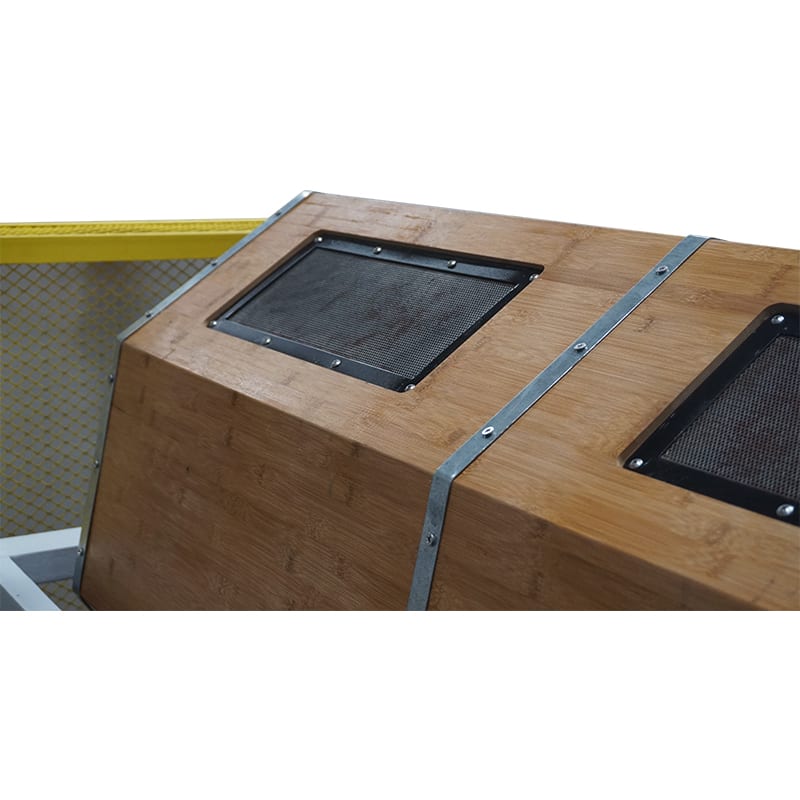
The deck is a wear assembly, and on a line wear is faster because the hours accumulate:
- Aperture growth. A woven deck stretches. The window narrows on the media side while the deck still looks serviceable — so measure the aperture when it is new and again at planned intervals. This is a measurement, not a look.
- Torn or slack sections. One torn section passes everything downstream of it. Check at every shift change on a line, not weekly.
- Reduced throw or a changed conveying speed. The cause is usually mounting, springs or drive rather than the deck itself.
- Gate, seal and chute wear. A gate that does not seat leaks charge into the parts path and reads as a screening fault.
- The charge itself. Media life is 20 to 200 operating hours depending on material and cycle. On a line running three shifts, the low end of that band arrives quickly — which is why the media order on a continuous line is a scheduled consumable, not a top-up when someone notices.
Next to the deck, the chamber's own liner is a wear part on the same logic: our tub series runs a 20–35 mm polyurethane liner, and the deck sits downstream of exactly that kind of wear.
When the deck is worth more than the machine
Two machines with the same chamber volume differ by a large factor once one has to be unloaded by hand every cycle. The separator is the cheapest component in the cell and it decides whether the machine can run unattended — the difference between earning during a shift and earning only while someone stands at it. On a line, that is the whole case.
The same logic appears on a batch machine in a smaller form: a 60 L centrifugal barrel catalogued with auto separating, on a published 3.0 + 0.75 kW drive, 0–170 rpm range and 15 × 4 kg load, is a machine whose cycle includes its own separation — and what that buys is not the machine but the operator who is not needed at the end of each cycle.
What we need before quoting one
- Parts per hour, from a measured shift or from a cycle time and a batch count. This is the first number; without it there is no rate to size against.
- The part's smallest dimension and the media's size range, including how old the charge is.
- Wet or dry, and what is downstream: a dryer, a wash, an assembly step.
- The line layout, or at least where the deck would sit and how much floor is available. A deck that does not fit the gap that exists is not a solution.
- How the line is controlled, and whether the deck must interlock with the machine. Retrofitting control into an existing panel is where integration time goes.
- The site services: three-phase 380 V or 415 V at 50 Hz and a noise baseline of 75 to 85 dB(A) at one metre.
- The acceptance criterion for the output: no media in the parts bin, a stated residual moisture, or a sample size per hour.
We manufacture the machines and the media that run in them, and we do not offer a job-shop finishing service, so the specification comes from a trial on your parts rather than from a catalogue line. A separator trial answers one question: what comes off the deck, at what rate, with what still attached. Send representative parts including the worst one, the media range you run, and the rate you need.
Frequently asked questions
How is a vibratory separator different from a media separator? Place in the process. A media separator takes a batch at the end of a cycle and decides whether the aperture passes parts or media. A vibratory separator is a vibrating deck inside a line, sized against parts per hour, and it usually also conveys and dewaters. The same physical deck can serve either role, but the sizing question is different, and the one that gets skipped is the rate.
Can I put a separator on an existing line? Usually yes, and it is a layout and control project rather than a machine project. What makes it slow are the items nobody quotes at the start: where the discharge chute lands, how the deck interlocks, and whether there is floor space for the stream to fall into.
How do I know what rate I need? Measure a shift rather than calculate from a datasheet. Parts per hour is what the line actually delivers, and it is normally lower than the arithmetic from cycle time suggests once loading, inspection and changeover are counted — a sample test on your own parts is the other half of the same measurement.
Does the separator remove the need for a dryer? No. A deck dewaters; a dryer dries. Confusing the two is how a line ends up with water spots in blind features and a dryer blamed for it.
Why does separation get worse over a shift? Fines. A continuous stream packs the apertures, and the deck separates well when it is clean and badly two hours later. That is a maintenance interval question — how you keep the apertures open — not a sizing question.
Max Xu, Sales — Xiamen Jin Tai Jin Grinding Technology Co.,Ltd.
No. 31, Xinchang Road, Xinyang Industrial Zone, Haicang District, Xiamen
info@surface-polish.com
Screen area, throw, frequency, deck angle and separation throughput are not published figures — they are set by the trial on your part and your line. A finishing process is set by the material, the stock to be removed and the finish required, so the configuration for a specific part is confirmed against a trial on that part. We manufacture finishing equipment and the media and compounds that run in it; we do not offer a job-shop finishing service.
 +86-592-2381506


 IPv6 network supported
