
Walnut Shell Media: The Dry Charge That Cuts by Scrubbing, Not by Cutting
Walnut shell media is the dry charge that works by scrubbing rather than cutting. That single physical difference — no sharp abrasive grain, just a hard irregular body pressed against the surface — explains what it can do, what it cannot, and why it behaves so differently from ceramic or even from its usual partner, corn cob.
Most pages about walnut shell list grades and applications. This one is about the mechanism, because the mechanism is what decides whether walnut is the right charge for your part.
What walnut shell actually is, physically
What it is, in engineering terms
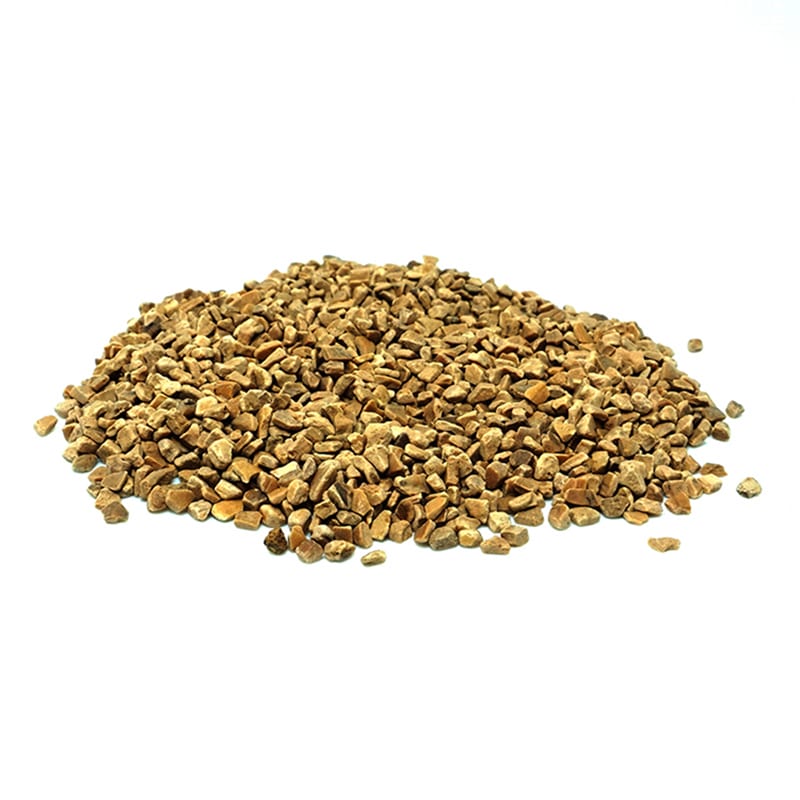
Walnut shell is a hard, tough organic body with an irregular, slightly angular surface. It is not an abrasive in the ceramic sense — there is no grit bonded into it. What it does is press against the part and scrub.
Three consequences follow directly:
| Property | What it means in the machine |
|---|---|
| No bonded abrasive | It removes material by repeated contact, slowly — not by cutting a chip |
| Harder than corn cob, softer than ceramic | It can move a burr or a light scale; it cannot take stock off a milled face |
| Irregular, slightly angular shape | It reaches into corners a smooth body polishes past, and it impregnates softer materials |
| Absorbent | It takes up oil, water and compound — which is useful on some parts and a problem on others |
| It breaks down | Walnut is a wear part that produces fines; the charge changes character as it runs |
The scrubbing mechanism is the important one. It is why walnut is good at removing light scale, tarnish, flash and burrs on soft metals, and why it is bad at removing a machining witness mark or a deep scratch — those need a cutting action, and walnut does not cut.
What walnut shell does well
The four jobs it does well
Four jobs where the scrubbing action is an advantage rather than a limitation:
1. Deburring and edge-blending on soft metals. Aluminium, brass, copper and zinc die-cast. A ceramic charge matched to stainless will smear these; walnut works them without cutting too deep.
2. Removing tarnish, light oxide and handling marks. Because it scrubs, it lifts a film without needing to remove base metal — which matters on a part that is already to size.
3. Dry processes where water cannot be used. Walnut is a dry body. On parts that must not be wetted — certain assemblies, parts with trapped moisture paths, some plastics — that is not a preference, it is the constraint that decides the charge.
4. Polishing where a compound has to be carried. Walnut absorbs and carries compound against the part. It is the same job corn cob does, with more cut and less absorption.
What walnut shell cannot do — and no cycle length fixes it
The jobs it cannot do
This is the section worth reading before a purchase, because these are the jobs where a walnut charge is bought and then found not to work.
It cannot take stock off. If the requirement is to bring a milled face down, or to remove a burr with a measurable root, walnut will not do it. A longer cycle scrubs the surface harder; it does not turn into a cutting action.
It cannot remove a scratch it did not create. Walnut polishes over a scratch rather than cutting it out. A deep scratch needs a cutting stage first — the sequence matters more than the charge.
It cannot reach a feature smaller than the media. The rule that governs every loose charge applies here: media should never be larger than about one third of the smallest feature. A 3 mm slot therefore needs media below 1 mm, and the choice is not a smooth curve — it is two safe zones with a trap between them. Media above about 1.3× the opening stays out entirely and the slot is finished by the compound alone. Media below one third enters and flushes out freely. Anything in between lodges: on a 3 mm slot that is roughly the 2.0–3.2 mm band, which is exactly where a "get as close to the feature as possible" instinct puts you. A lodged pellet stops the machine, marks the part where it jammed, and is the most common reason a charge that worked on one part fails on the next. Walnut is stocked across a range of sizes, though not in every size a part might demand — which is a specification question, not a defect.
It cannot be used where the fines are a problem. Walnut breaks down and produces fines. On an open part that is fine; inside a mechanism, or on a part with a lubricated bore, the fines are a new problem. This is why walnut is common on external surfaces and less common in assemblies.
It cannot run a short cycle and still finish. A dry scrub process is a slow one: where a light wet deburr runs 10 to 20 minutes, a dry polishing cycle runs in the hours band, not the minutes band, because the material is removed by repeated contact rather than by a cutting grain. A quotation that promises a walnut polish in a few minutes is describing a different process.
It cannot match a tight colour requirement across batches without control. As with any organic body, the charge changes as it wears — the cut falls off as the fines build. A colour requirement needs a written change interval, not a judgement call.
Walnut versus corn cob: the choice in one table
Walnut against corn cob
These two are the standard dry pair, and the difference is not "hard versus soft" — it is cut versus absorb.
| Walnut shell | Corn cob | |
|---|---|---|
| Hardness | Harder, more angular | Softer, more rounded |
| Action | Scrubs, light cut | Absorbs, burnishes |
| Best at | Tarnish, light scale, soft-metal burrs | Drying, oil absorption, light polish, delicate surfaces |
| Worst at | Anything needing stock removal | Anything needing a cut |
| On soft metals | Suitable — its usual home | Suitable, gentler still |
| With compound | Carries it, scrub action | Holds it, absorbent action |
| Fines | Produces fines as it breaks down | Produces fines, plus absorbs liquid |
| Typical pairing | Pre-polish on metal | Final polish and drying |
The rule of thumb that follows: if the part needs its surface changed in shape, walnut; if it needs its surface protected and dried, corn cob. And on a two-stage dry process, walnut runs first and corn cob second.
How to specify a walnut charge
How to write the specification
The specification is set by the part, and it is worth writing down rather than ordering "walnut media".
1. What is the defect? Tarnish and handling marks are a scrub job. A burr with a measurable root is not.
2. What is the smallest feature? This sets the maximum media size — one third of it.
3. Wet or dry? Walnut is a dry body. If the process needs water, the charge is wrong before the size is discussed.
4. What compound? Walnut carries compound against the part. The compound's job is to help the scrub and to keep the swarf from loading the body.
Two site facts that belong in the enquiry. A dry process still needs power and attention: a powered machine in our range runs on three-phase 380 V or 415 V at 50 Hz, with small models at 220 V, and it sits in the 75 to 85 dB(A) at one metre band. Walnut produces dust as it breaks down, so a dry line also needs extraction — that is a room decision, not a machine option, and it is cheaper to plan than to retrofit.
5. What is the change interval? Walnut breaks down. Media life is measured in operating hours, not calendar time, and the practical signals are that the finish stops improving, a grey or dusty film appears on the parts, and the same result takes about 20% longer.
6. What is the pack size and the lead time? Compounds ship at 20 kg barrel or 50 kg drum scale depending on the product; a standard machine is 25 to 35 days from the deposit, with a built-to-order configuration at 45 to 60 days. Media travelling with the machine means the first trial runs on arrival rather than waiting for a separate consumable order.
7. What is the acceptance criterion? A colour, a roughness, or an appearance judged against a boundary sample. On a dry cosmetic process a boundary sample is worth more than a number.
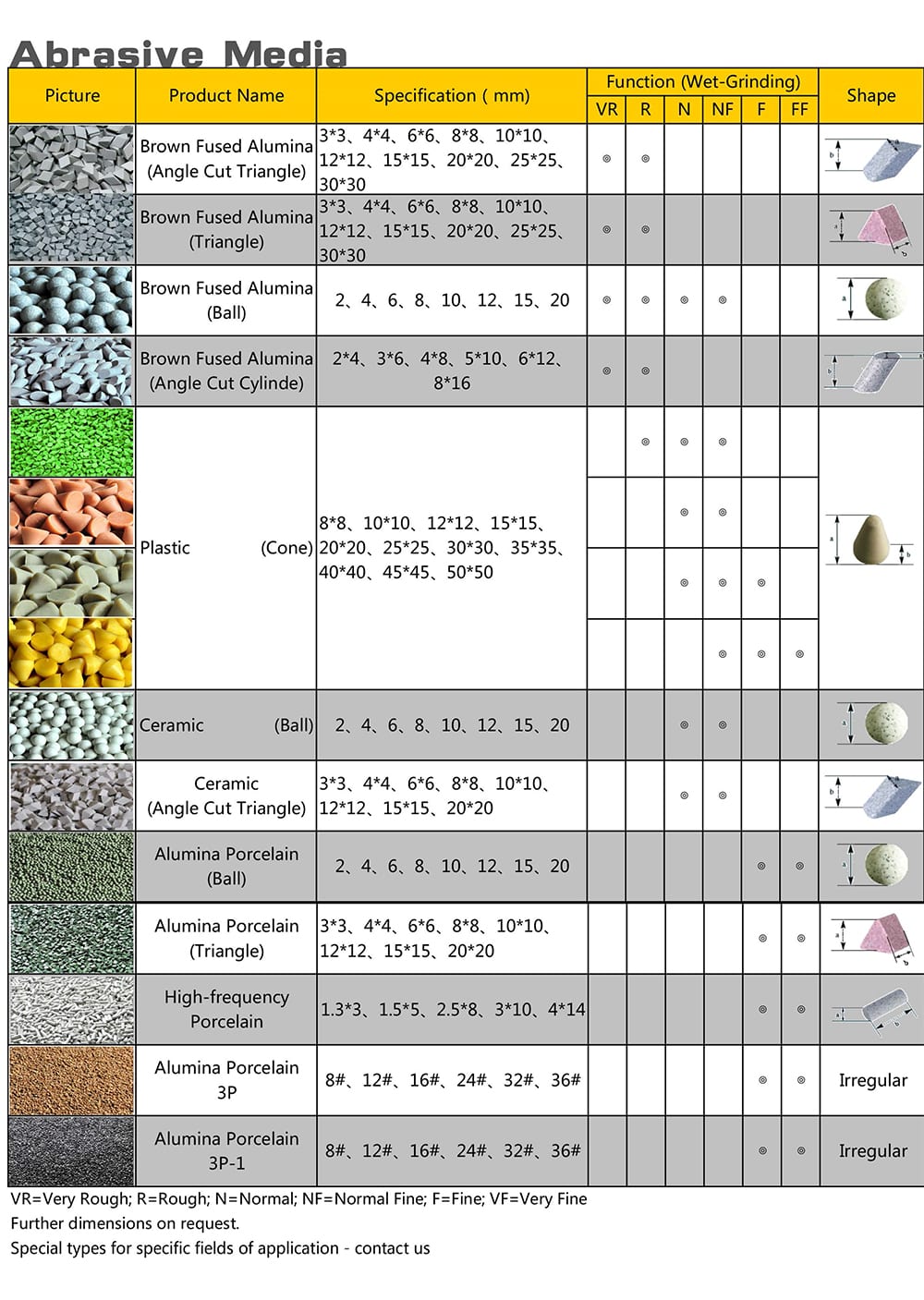
The grades we stock. Walnut shell is supplied in 8#, 12#, 16#, 24#, 32#, 36# and 80#, graded on the dry-grinding function scale from MF through F to FF, and irregular in shape. That is the range — and the size within it is set by your part, which is why the grade alone is not an order.
The two questions the chart answers. The size sets the reach: media should never be larger than about one third of the smallest feature, so a part with a 3 mm slot needs media below 1 mm. The function grade sets the cut: MF is a light cut, F refines, FF brightens. A supplier who quotes you a walnut grade without the size has given you half a specification, and the half they left out is the one that decides whether the media reaches the feature at all.
Where a walnut charge is the wrong answer
Where it is the wrong charge
Being specific here is more useful than any grade list:
- The part needs stock removed. A cutting stage is needed first; walnut cannot substitute for it.
- The part has a deep scratch to be removed. Scrubbing polishes over it.
- The part has a feature below the smallest available media. Then the job is a different process, not a different charge.
- The fines would be trapped. Inside a mechanism, a lubricated bore, or a sealed assembly, walnut's breakdown products are a new problem rather than a finished surface.
- The part must be dimensionally unchanged and the edge must stay sharp. Every loose charge, walnut included, rounds the edges it reaches.
- The requirement is a directional finish. A loose charge produces a non-directional surface by definition.
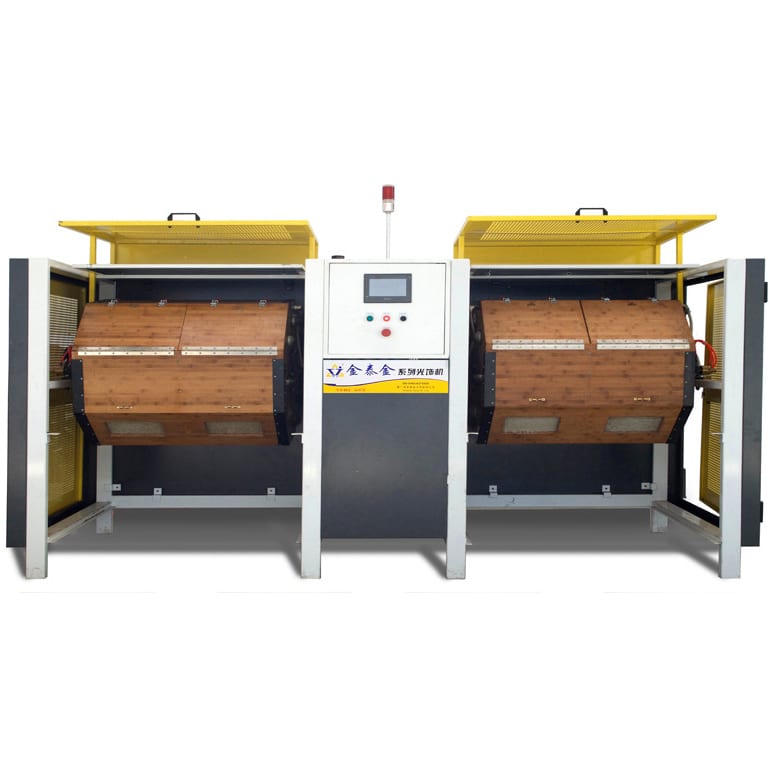
The machine the charge runs in. Walnut shell is a dry body, so it runs in a dry barrel machine rather than a wet bowl — the format our range covers as the wooden-barrel dry polishing machines, and the barrel machine pages are where those are listed. If the part you are finishing is metal rather than wood, the route is often compared against wet vibratory finishing, and the choice between them is the wet-or-dry decision rather than a media decision.
FAQ
What is walnut shell media used for? Deburring and polishing soft metals dry, removing tarnish and light scale, and carrying compound against a part that must not be wetted. It works by scrubbing rather than cutting, so it is a light-cut and polish body, not a stock-removal one.
Is walnut shell better than corn cob? Depends on the job. Walnut is harder and more angular, so it scrubs and gives a light cut. Corn cob is softer and more absorbent, so it dries and burnishes. On a two-stage dry process walnut runs first and corn cob second — they are a pair, not competitors.
Can walnut shell remove a burr? A light burr on a soft metal, yes, by scrubbing it back over a cycle. A burr with a measurable root or on a hard alloy needs a cutting action, and walnut does not provide one. The question to answer is how much material has to come off, in tenths of a millimetre.
What size walnut shell should I order? The maximum size is set by the part: media should not exceed about one third of the smallest feature. Below that, the range is confirmed against your sample. We stock standard sieve distributions — coarse, medium and fine bands — but we do not publish a single grit table for walnut, because the right band is a property of the part rather than of the product; the sieve certificate and the blend are confirmed at sampling.
How long does a walnut charge last? Measured in operating hours, not calendar time. The replacement signals are a finish that stops improving, a dusty or grey film on the parts, and a cycle about 20% longer for the same result. Walnut breaks down as it works, so the interval should be written down rather than judged by eye.
Can walnut shell be used wet? It is a dry body. It absorbs water, which changes both the scrub action and its life. On a process that needs water, the charge should be a ceramic or plastic body instead.
Max Xu, Sales — Xiamen Jin Tai Jin Grinding Technology Co.,Ltd.
No. 31, Xinchang Road, Xinyang Industrial Zone, Haicang District, Xiamen
info@surface-polish.com
This article describes how a walnut shell charge is specified; it is not a claim about any specific part's achievable result, and we do not publish a grit table for the product because the correct range is set by the part. A finishing process is set by the material, the stock to be removed and the finish required, so the charge for a specific part is confirmed against a trial on that part. We manufacture finishing equipment and the media and compounds that run in it; we do not offer a job-shop finishing service.
 +86-592-2381506


 IPv6 network supported
