
Deburring Equipment: The Forms It Comes In, and Where a Hand Tool Stops Being the Answer
"Deburring-polish.com/blog/deburring-equipment-forms-and-the-tool-boundary/) equipment" covers everything from a file in a fitter's hand to a floor-standing machine that takes a tonne of parts a shift. Those are not competitors — they sit at different points on two axes, and the purchase decision is about which point the job sits at, not which one is "best".
This page is about the forms: bench and floor machines, the four families that drive them, and the volume boundary where a hand tool stops paying for itself.
The two axes that decide the form
The two questions
Every deburring decision resolves on two questions, and the equipment form follows from them:
1. How much material has to come off, and where? A burr on an accessible external edge is a different job from a burr in a cross-hole. The first can be reached by anything; the second needs a specific family.
2. How many parts a shift, and how consistent must they be? One part is a hand tool. A thousand identical parts is a machine, because consistency and unit cost both come from removing the operator from the operation.
Cross those two and the form falls out:
| Accessible edge | Internal / restricted feature | |
|---|---|---|
| A few, low volume | Hand tool — a file, a deburring blade, a flap wheel | Hand tool, or a special process; a machine is hard to justify |
| Volume, simple geometry | Bench or floor machine — barrel, bowl, disc | Magnetic machine — the only family that reaches |
| Volume, tight tolerance | Centrifugal machineers_c12) — high energy, short cycle | Magnetic, or a secondary operation |
The important read of that table: the horizontal axis decides the family and the vertical decides whether a machine is justified at all. A shop that buys a machine for a low-volume accessible-edge job has bought a machine it will not fill; a shop that keeps a hand tool on a thousand-part job is paying for consistency it is not getting.
The forms, from smallest to largest
Hand tools — and where they stop
A hand tool is the right answer far more often than a machine salesperson would suggest, and the boundary is measurable.
A hand tool is efficient when:
- the batch is small enough that setup exceeds the work;
- the part is large or awkward to load into a machine;
- only one or two features need touching (a machine treats everything it reaches);
- the part is a one-off or a repair.
The boundary is the per-part labour, not the part count. The practical test:
If one person can deburr the batch in less time than it takes to set up, run and unload a machine cycle for the same batch — and the edge result is consistent enough to pass inspection — the hand tool wins.
Two things move that boundary:
Consistency. A hand tool produces a result that depends on who is holding it. The moment the acceptance criterion is a boundary sample rather than "take the burr off", the machine starts to pay — not on labour cost, but on scrap and rework. This is the argument that actually justifies a machine, and it is usually stronger than the labour arithmetic.
The feature. A hand tool can reach an external edge. It cannot reach a cross-hole, a thread root or the inside of a narrow slot with any consistency. When the critical burr is internal, the question is not "hand tool or machine" — it is "which machine can reach", and the answer is in the last row of the table above.
The plastic case specifically. Deburring plastic with a hand tool is where the boundary shows most clearly, because plastic burrs behave differently from metal:
- Plastic does not chip, it tears. A blade that works on steel pulls a plastic burr rather than shearing it, and leaves a white stress mark that is a cosmetic reject on a visible part.
- Heat marks the part. A spinning tool on plastic generates heat fast, and a heat mark on a machined plastic face cannot be polished out — it is a change in the material.
- The burr is often a film rather than a raised edge. On machined acrylic or polycarbonate, the "burr" is frequently a thin film at the exit edge, and a blade skates over it.
For those three reasons, plastic parts are frequently deburred dry, in a loose charge, or with a controlled low-energy process rather than by hand — and where a hand tool is still used, it is a scraper or a controlled-depth tool rather than a blade.
Bench and floor machines — the four families
Once a machine is justified, the family is set by how the abrasive reaches the part. That is the framework in the deburring machine route guide, and the forms are:
| Family | Form | Typical scale | What sets it |
|---|---|---|---|
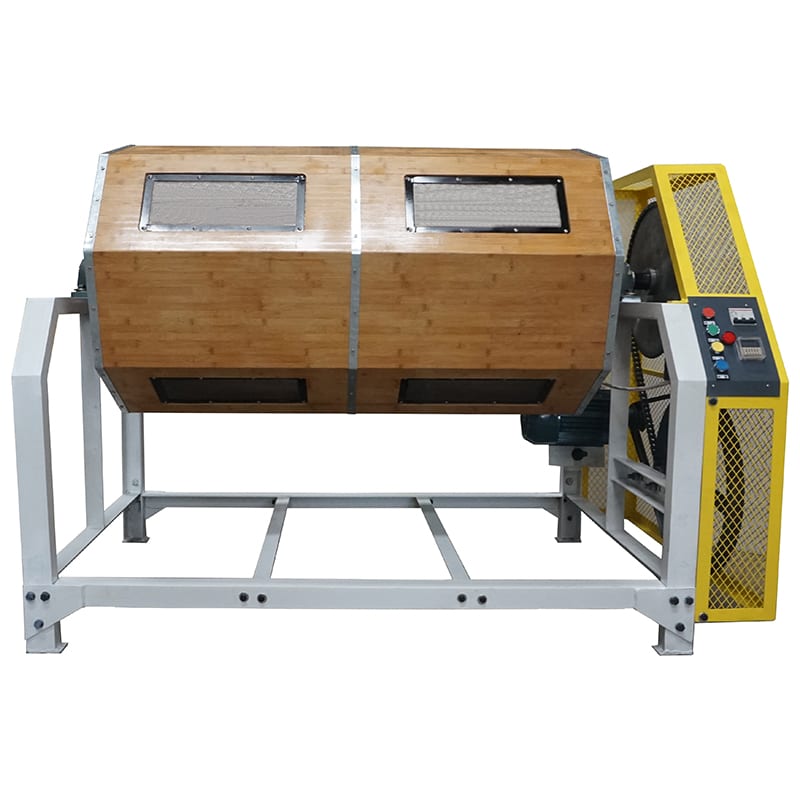
| Rotary barrel | Bench or floor, drum turning | Small to medium | Simplest, gentlest, poor on internal features |
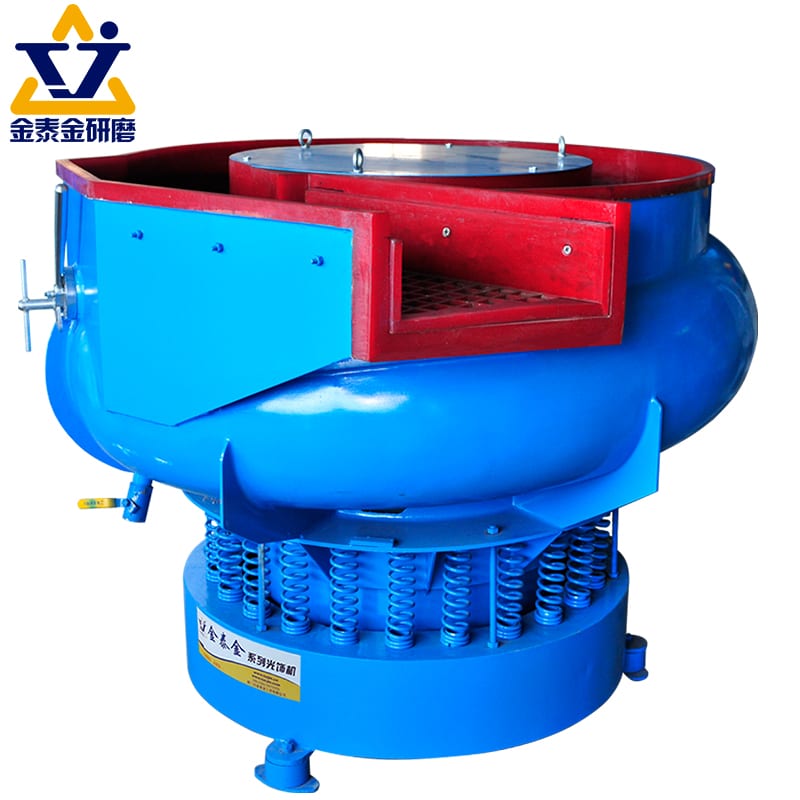
| Vibratory (bowl / tub) | Floor, bowl or channel | Medium to large | Widest coverage of mixed loads; the default family |
| Centrifugal (disc / barrel) | Floor, high energy | Medium | Short cycle, high energy, tighter tolerance |
| Magnetic | Floor, needle mass | Medium | The only family that reaches internal features |
The three models we publish for the tub form, as a scale reference — catalogue ratings, to be confirmed against your own part:
| Model | Nominal capacity (L) | Dimensions L×W×H (mm) | Power (kW) |
|---|---|---|---|
| L1300 | 1200 | 2700×1300×1400 | 5.0 × 2 |
| L1500 | 1500 | 3340×1290×1440 | 5.5 × 2 |
| L1800 | 1800 | 2800×1700×2000 | 7.5 × 2 |
And the magnetic family, which is the one that answers the "internal feature" row:
| Model | Workpiece capacity (kg) | Working area (mm) | Power (kW) | Speed (rpm) |
|---|---|---|---|---|
| OBD-30 | 30 | 1000×580 | 4.0 | 0–1800 |
| OBD-60 | 60 | 1800×580 | 6.0 | 0–1800 |
| OBD-100 | 100 | 2300×680 | 16.5 | 0–1800 |
How to read those two tables together. The tub form is measured in litres and metres — a machine that takes a tonne of parts and occupies a floor area. The magnetic form is measured in kilograms and a working area in millimetres — a machine that takes far less mass but reaches features the tub cannot. They are not alternatives at the same scale; a shop with internal-feature work usually runs a tub or bowl and a magnetic machine, not one instead of the other.
Where each form will not help
The three costs of form
Three costs follow from the form rather than from the price, and they are what a quotation tends to leave out:
1. The floor and the services. A floor machine is a permanent installation: footprint, three-phase supply, and on a wet process a drain and a rinse. A bench unit can be moved; a floor machine cannot easily be. The models above run on three-phase 380 V or 415 V at 50 Hz, and a noise band of 75 to 85 dB(A) at one metre is normal for a vibratory unit — both are building decisions.
2. The media and the compound. A machine form is also a consumable commitment. A barrel uses a charge that suits tumbling; a magnetic machine uses a specialised needle consumable that costs more per kilogram. The consumable cost per part differs by family more than the machine price does.
3. The changeover. A hand tool has no changeover. A machine has a charge change, a fixture if the part needs one, and a trial before the first production batch. On a high-mix shop this is where a machine's economics fail — not on cycle time, on changeover.
What decides it, in the order that saves money
The order that saves money
1. Is the burr accessible? If not, the answer is a family that reaches — magnetic, or a secondary operation. No amount of volume makes a bowl reach a cross-hole.
2. How consistent must the edge be? If "take the burr off" is the criterion, a hand tool may genuinely be right. If it is a boundary sample or a measured edge, the machine is justified on scrap avoidance rather than labour.
3. How many parts a shift, and how many part numbers? Volume justifies a machine; the number of part numbers decides whether the changeover kills it.
4. What is already on the floor? A shop with a bowl does not need a second machine for a job the bowl can do; it may need a magnetic unit for the features the bowl cannot reach. The equipment decision is often an addition rather than a replacement.
5. What happens downstream? A wet process needs a rinse and a dry, and on steel the rust window after the bath is real. That adds equipment and it belongs in the comparison.
What to send with an enquiry
What to send with an enquiry
- The part and the drawing, with the burr's location marked and the faces that must not change.
- The feature dimensions, especially the smallest opening if the burr is internal.
- The stock to be removed, in tenths of a millimetre.
- The volume and the mix — parts per shift and how many part numbers, because the second number decides the changeover cost.
- The acceptance criterion, and whether a boundary sample exists.
- The site: floor area, three-phase supply, drain if wet, and the noise the room tolerates.
- What is already installed, so the quotation is for what is missing rather than a duplicate.
FAQ
What counts as deburring equipment? Everything from a hand tool to a floor machine. The forms are: hand tools (file, blade, scraper, flap wheel), bench and floor machines in four families (barrel, vibratory, centrifugal, magnetic), and the media and compounds those machines run.
When is a hand tool better than a machine? When the batch is small enough that setup exceeds the work, when the part is awkward to load, when only one or two features need touching, or when the part is a one-off. The boundary moves once the acceptance criterion is a boundary sample rather than "take it off" — then the machine is justified on consistency, not on labour.
How do I deburr plastic parts? Carefully, and usually not with a blade. Plastic tears rather than chips, a blade leaves a white stress mark, and a spinning tool generates heat that changes the material. Controlled-depth scrapers, a dry loose charge, or a low-energy machine process are the usual answers. The "burr" on machined acrylic is often a thin exit film rather than a raised edge.
Do I need a machine for internal burrs? A shaped loose medium cannot enter a cross-hole, a thread root or a narrow slot — its size is the hard limit. The family that reaches is the magnetic one, and it is bought for reach rather than for speed.
Can one machine do all the deburring in a shop? Not usually. A bowl or tub covers mixed external work, a centrifugal machine covers tighter-tolerance work, and a magnetic unit covers internal features. Many shops run two, because the alternative is not finishing one class of part at all.
How much floor space does a machine need? The tub models above are up to 3340 mm long; the magnetic models up to 2500 mm. Both need three-phase supply and access for loading, and the footprint in the table is the installation requirement rather than an approximation.
Max Xu, Sales — Xiamen Jin Tai Jin Grinding Technology Co.,Ltd.
No. 31, Xinchang Road, Xinyang Industrial Zone, Haicang District, Xiamen
info@surface-polish.com
The model figures above are catalogue ratings for models in our range; they describe the machine, not the result on a specific part. A finishing process is set by the material, the stock to be removed and the finish required, so the configuration for a specific part is confirmed against a trial on that part. We manufacture finishing equipment and the media and compounds that run in it; we do not offer a job-shop finishing service.
Deburring Equipment: Matching the Form to Annual Volume
The form is decided by the part first, but volume decides whether the form you chose is the one worth owning. Three bands cover most of the range.
Below 10,000 parts a year
At this volume the capital is hard to justify on throughput alone, so the question becomes whether the form removes a bottleneck that is costing more than the machine. A barrel or a small bowl earns its place when the deburring step is what the shop queues behind; if it is not, hand tools and a borrowed machine remain rational.
10,000 to 100,000 parts a year
This is the band where a machine pays for itself, and where the choice of form starts to matter commercially rather than just technically. A bowl handles a wider mix of shapes than a barrel; a barrel is cheaper per part on simple shapes in volume. Buying the larger form "for growth" before the volume exists is the common mistake — the extra capacity is idle, and the run cost per part is worse.
Above 100,000 parts a year
At this point the constraint moves from the machine to the handling around it: how fast parts load, unload and get separated from the media. The machine is no longer the bottleneck, and a second machine may cost less per part than automating the first one — which is worth working out before the capital is committed.
When hand tools still win
Hand deburring wins in three situations, and it is worth naming them because a machine bought against them will disappoint: a single feature on an otherwise finished part; a part so large or so awkward that it cannot be charged; and a burr whose removal has to be judged by feel rather than by a sample. Those are not failures of mechanisation — they are simply outside what a loose or fixtured charge can present to the part.
 +86-592-2381506


 IPv6 network supported
