
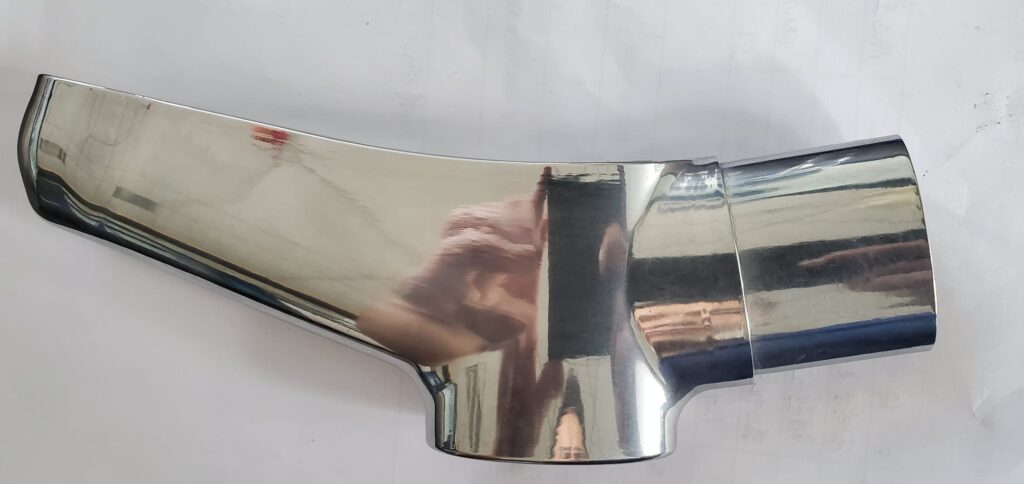
Polishing and Buffing Are Not Synonyms: Two Operations, Two Different Machines
In the trade, "polishing" and "buffing" are used as if they were two words for one thing, or as if buffing were simply the shinier second half of polishing. Both readings cause expensive mistakes, because the two operations differ in the one property that decides everything downstream: whether material and geometry are being removed.
- Polishing removes. An abrasive — loose in a charge, bonded in a wheel, or carried on a belt — cuts the surface, and cutting means the surface profile changes: scratches get shallower, edges get rounder, dimensions move by amounts measured in hundredths of a millimetre.
- Buffing brightens. A soft wheel loaded with a fine compound works the surface it is given. It raises reflectivity and colour, and it removes so little material that it cannot correct a shape or erase a scratch from a previous stage.
Put in one sentence, which is the sentence to keep: polishing changes what the surface is; buffing changes how the surface looks. A part can be buffed to a mirror over a scratch pattern that is still there, and that is exactly the part that fails on the customer's bench a week later.
Most enquiries that arrive as "polishing buffing" are really one of two questions — which of the two operations does my part need next, and which machine does that operation — and the two words get run together because the trade uses them as a pair. Separating them answers both, and it is what the rest of this page does.
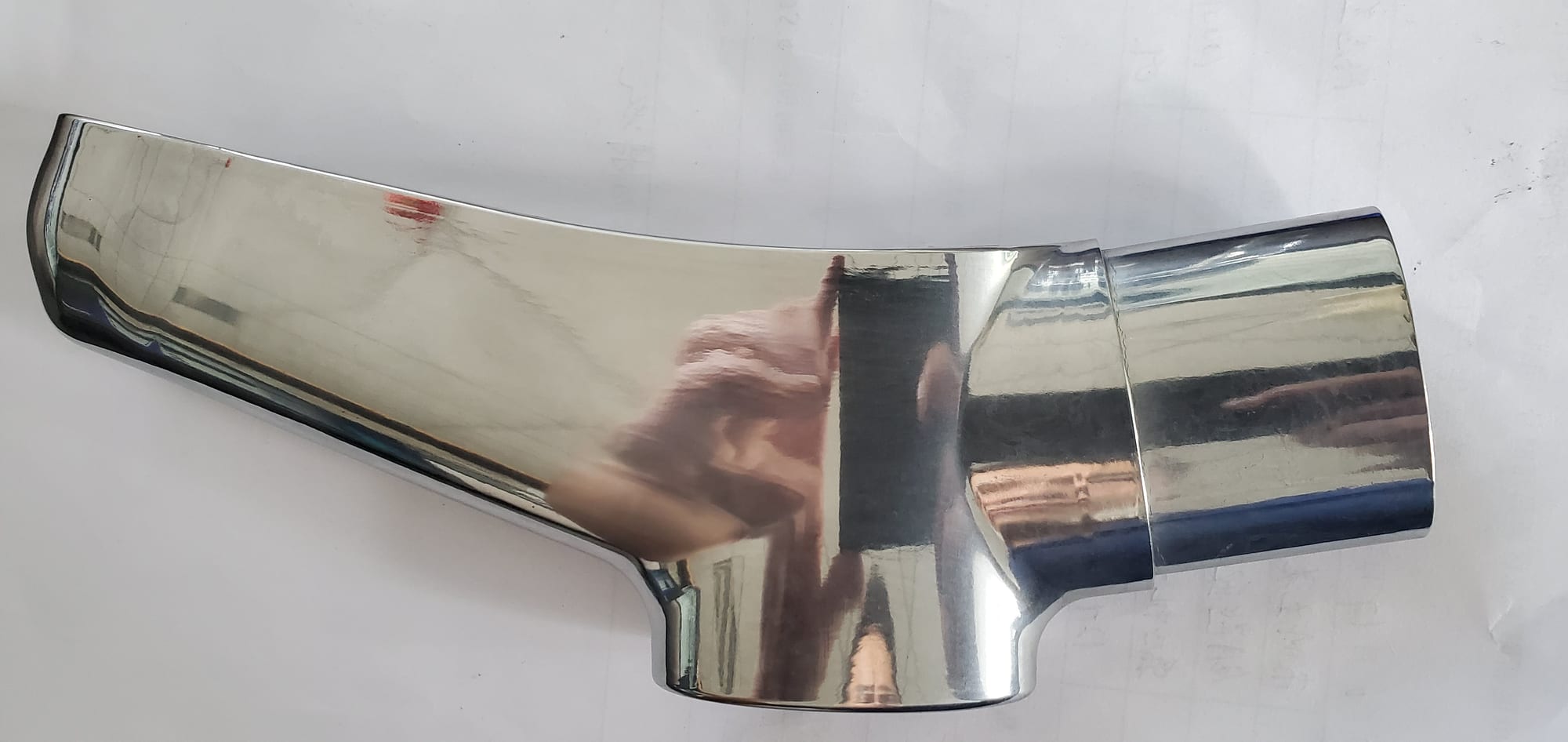
Why the two words get mixed up
Five reasons, and each one shows up in a different kind of enquiry:
1. The same machines sit in both categories. A rotary barrel or a vibratory bowl can run a cutting stage and a brightening stage, so a shop that owns one machine says it "polishes and buffs" — and it does, in sequence, with different charges. A machine with a buffing wheel, by contrast, can only buff. The equipment overlap hides the process difference.
2. Product names use both words loosely. "Buffing compound", "polishing compound", "polishing fluid", "buffing fluid" are marketing labels, not process descriptions. The physical form is the reliable clue: a solid bar belongs with a buffing wheel, a liquid belongs in a chamber. That distinction is set out in stainless steel buffing compound.
3. The finish vocabulary of the trade is brightness-based. Customers judge parts by eye, and by eye a buffed part and a polished part can look identical under good light. The difference appears later: in plating adhesion, in dimensional inspection, in the part that looks right and measures wrong.
4. Machining suppliers use "polish" for a finishing pass that is really a light cut. So a drawing can say "polish to Ra" when it means "cut to Ra", and the shop that answers it with a buffing wheel answers a different question.
5. The bonded-abrasive vocabulary sits on top of both. A "polishing wheel" can be a cutting tool and a "buffing wheel" can be a brightening tool, and they are different consumables with different specifications — the cutting side is set out in ceramic polishing wheels. Reading a product name as a process is where most of the confusion enters.
The test that tells you which stage you are looking at
Three questions, and they resolve almost every case:
1. Does the defect have a depth? A scratch, a tool mark, a weld discolouration, a burr, an orange-peel texture — each has a depth, and depth has to be cut out. Buffing cannot cut. If the defect is there before the buffing stage, it will be there after.
2. Will a dimension or an edge be checked afterwards? If the drawing holds an edge radius, a flatness or a thickness, the operation removing material is the one being controlled by that tolerance. Buffing, which removes effectively nothing, cannot move a dimension — which is good news for a finished surface and bad news for a part that needs correction.
3. What is the acceptance criterion, in writing? "Bright" is not measurable; "no visible scratches at 300 mm under a defined light" is. A buffing stage is normally accepted visually, a polishing stage normally against roughness and geometry. If the acceptance is visual only and the part still has a scratch pattern, the specification has accepted a buffed part with a hidden defect.
The general rule that follows: you cannot buff your way to a dimension, and you cannot polish your way to a directional mirror. Each operation is the wrong tool for the other's job.
What each operation implies for the equipment
This is where the language problem becomes a capital-expenditure problem.
| Polishing (cutting) | Buffing (brightening) | |
|---|---|---|
| Energy source | Loose media in a moving charge, a bonded wheel, or a belt | A soft wheel against the part, with compound |
| Presentation | The part is in the chamber, or held against the tool | The part is held by hand or in a fixture |
| Batch behaviour | The whole load at once | One part or one face at a time |
| Typical cycle | 10 to 20 minutes for a light deburr; 2 to 8 hours for a high-finish stage | Seconds to minutes per face, set by the operator |
| Machine type | Vibratory bowl, tub, barrel, centrifugal, disc | Buffing lathe, buffing head, buffing tumbler |
| Labour | Set the recipe, load, unload | Skill-intensive: pressure, speed, compound charge |
| Result | Isotropic, uniform across the load | Directional, dependent on the operator |
| Consistency | Repeatable when the process is written down | Varies with the person and the day |
Two consequences follow, and they are the ones a buyer needs:
For volume work, the cutting stage has to be a batch process. A buffing wheel works one contact point at a time; hundreds of small parts cannot economically be brought up one at a time. That is why the industrial sequence is: cut in a machine, then brighten — and why the brightening is often done in a machine as well, in a separate charge, rather than on a wheel.
For a single large or valuable part, the opposite. One fabricated frame, one cast housing, one part whose finish is judged on a defined face — contact work is competitive there, and a batch process cannot produce a directional finish in any case.
We build the batch side of that sequence: vibratory finishing and barrel machines, plus the media and the liquids that run in them. On the buffing side the site carries machines built for rotary buffing and for manual buffing work, listed on the machines page and in the catalogue. What is honest to say about the two is that they are bought for different reasons and specified against different criteria, and a single quotation that offers "polishing and buffing" without naming which stage is being bought is not a specification.
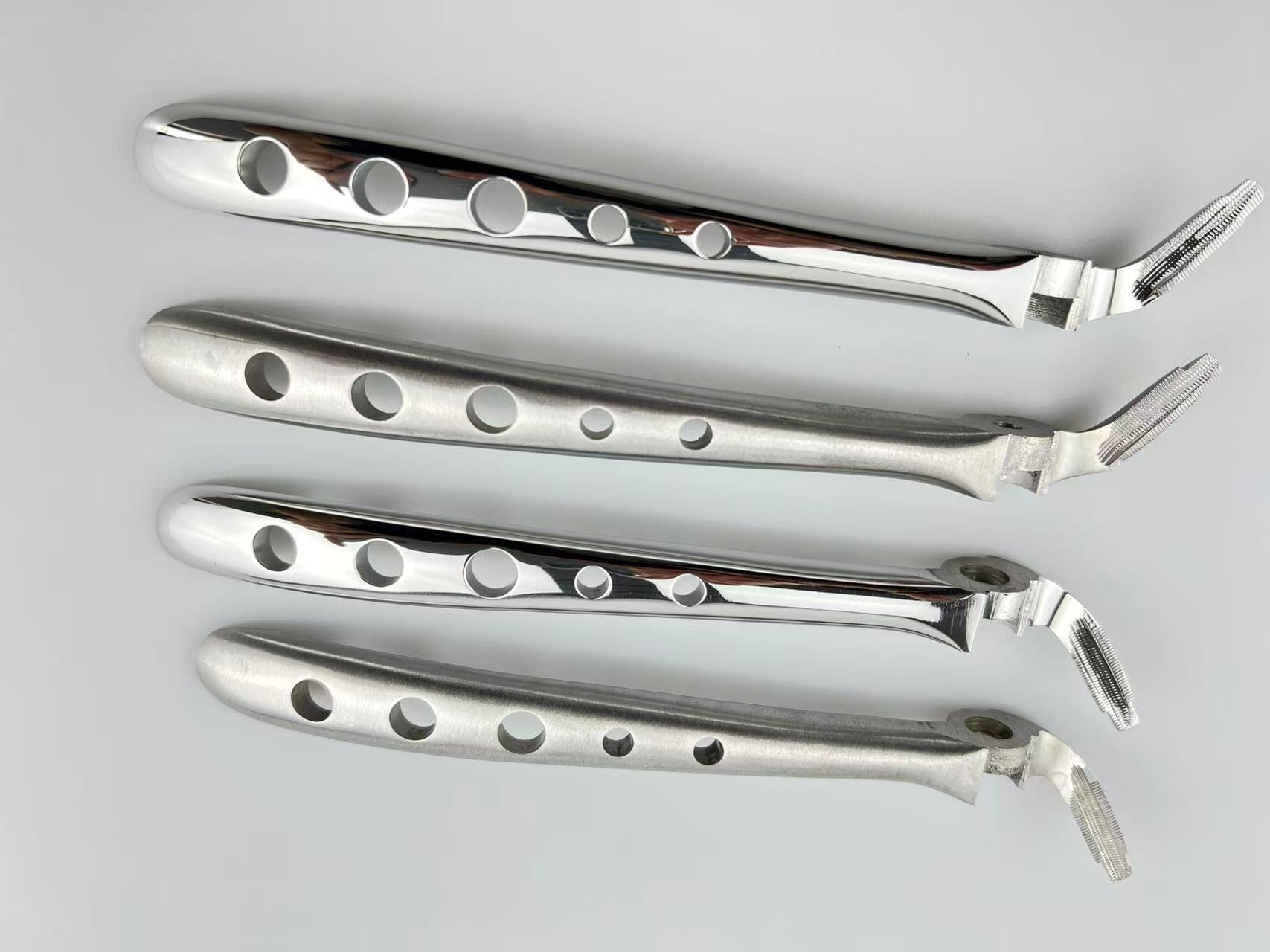
The sequence, in the order it has to run
Four stages, and the rule that governs all of them is: each stage must completely erase the marks of the stage before it. That is why the order is fixed and why the counts are what they are.
- Deburr or level. Remove the burr, the gate, the weld bead, the coarse tool mark. This is the stage that moves dimensions, so it is the stage the tolerances are written against.
- Refine. Progressively finer abrasive until the remaining scratch depth is below what the next stage can work over.
- Brighten. Raise reflectivity. In a machine, this is a fine charge plus a brightening fluid; on a wheel, it is a compound bar.
- Clean and dry. A wet process without this stage leaves a film in blind features that shows as spotting weeks later — and that failure gets blamed on the compound or the buffing.
Two numbers that decide whether the sequence is affordable: a light deburr runs 10 to 20 minutes per batch, while a brightening stage runs 2 to 8 hours. That ratio is why the cutting stage is done as efficiently as possible and why the brightening stage is where cycle time is either budgeted or resented.
And one honest caveat that belongs on every parameter: a published cycle assumes a material and a removal that may not be yours. The stage sequence is reliable; the times for your part are a trial result.
Where each one stops working
Where buffing stops:
- A scratch pattern with depth. No compound removes it. The part must go back a stage.
- Internal geometry. A wheel reaches only what it touches; a bore, a cross-hole or a deep recess is out of reach.
- A batch of hundreds of small parts. Per-part cost rises with surface area, and the labour content is the dominant term.
- A dimension or an edge tolerance. Buffing cannot correct geometry, by definition.
- A part that must be identical next month. Hand work varies with the operator; repeatability requires a written process, which is what a machine stage provides.
Where polishing stops:
- A directional mirror requirement. A batch process approaches from every direction and produces an isotropic finish; a single-direction lay is contact work.
- Selective finishing. A machine treats every face the media reaches. Masking is not a process.
- A feature smaller than the media. Media must not exceed about one third of the smallest feature; below that, no charge reaches it — magnetic finishing is the answer for a thread root or cross-hole.
- One large, few, or oversized part. A batch chamber is the wrong economics and often the wrong size.
- A dry, spot-free part off the machine. A wet process needs a rinse and a dryer; without them the surface carries a film that reads as a failed polish.
What to ask before either is quoted
- "Which stage is this quotation for — the cut or the brighten?" A supplier who cannot answer is quoting a word, not a process.
- "What is the acceptance criterion, and how is it measured?" Roughness and geometry for a cut, visual sample under defined light for a brighten. Both, if both are required.
- "What does the previous stage leave?" The incoming surface decides what the quoted stage has to remove. A quoted cycle for a part that arrives in a different condition is a guess.
- "How is the load presented?" Free in a chamber, or held in a fixture. This decides the machine family more reliably than capacity does.
- "What happens between finishing and the next operation?" Plating, passivation, assembly. A corrosion window is a compound and route decision, not a polishing one.
- "What is the consumption per batch?" Media life runs 20 to 200 operating hours, so it is measured per job; ask for kilograms per 100 hours rather than a drum price.
On the batch side, the commercial frame is straightforward: standard machines ship in 25 to 35 days from the deposit, built-to-order configurations in 45 to 60 days, media and compound adding about a week. MOQ is one machine, terms are 30% deposit with the balance against the shipping documents, and every machine runs with a charge of media before it ships. Expect 75 to 85 dB(A) at one metre and a three-phase 380 V or 415 V, 50 Hz supply — both building decisions rather than machine selections.
FAQ
Is buffing the same as polishing? No. Polishing cuts material and therefore changes geometry; buffing brightens the surface it is given and removes effectively nothing. The words are used interchangeably in the trade, which is why so many parts arrive looking right and measuring wrong.
Which comes first, polishing or buffing? Polishing, always. Buffing cannot remove a scratch left by an earlier stage — it polishes over it, and the defect stays underneath a bright surface. A buffing stage that is asked to fix a scratch pattern is a stage that will fail inspection later.
Can one machine do both? A machine with a chamber can run both as separate stages, with a clean change of charge and compound between them. A buffing wheel cannot cut at all, and a cutting machine cannot produce a directional mirror. So one machine can do both stages only if it is the batch type, and only in sequence — not in one charge.
We call our process "polishing" but we use a buffing wheel. Does it matter? It matters commercially. If the part needs material removed, a buffing wheel is the wrong tool and no amount of time changes that; if the part only needs brightening, describing it as polishing will attract quotations for cutting equipment you do not need. The stage, not the word, decides the purchase.
What is the difference between buffing and burnishing? Burnishing raises brightness by working the surface with steel or a hard medium, without cutting; buffing does the same job with a soft wheel and compound. Both are brightening operations under the definition used here, and neither can remove a scratch or hold a dimension.
Can you supply both stages? We build the batch side — vibratory and barrel machines with the media and liquids that run in them — and the site lists the rotary and manual buffing machines as well. What we will not do is quote "polishing and buffing" as one line without saying which stage your part needs, because that is the ambiguity this page exists to remove.
Max Xu, Sales — Xiamen Jin Tai Jin Grinding Technology Co.,Ltd.
No. 31, Xinchang Road, Xinyang Industrial Zone, Haicang District, Xiamen
info@surface-polish.com
This article describes the difference between a polishing stage and a buffing stage; it is not a claim about any specific part's achievable result. A finishing process is set by the material, the stock to be removed and the finish required, so the stage sequence and the parameters for a specific part are confirmed against a trial on that part. We manufacture finishing equipment and the media and compounds that run in it; we do not offer a job-shop finishing service.
 +86-592-2381506


 IPv6 network supported
