
Wheel polishing equipment is bought against throughput and integration, not against the wheel. Two shops finishing the same rim can need different machines because one has a deburring line already and the other does not - and the second shop is buying handling as much as it is buying a polishing machine. The sections below work through the selection by throughput, then through what integration into an existing line actually requires.
Wheel Polishing Equipment: The Form Decides the Throughput, Not the Spindle Power
Wheel polishing equipment is usually compared on spindle power and table size, and those two numbers decide the least about what the machine will actually produce.
What decides the output is the form: how many spindles, how the part is presented, how it is loaded and unloaded, and whether the unit stands alone or sits in a line. Two machines with the same spindle power can differ by a factor in parts per hour purely on form.
The process side — which wheel, what contact, what speed — is covered in the wheel polishing machine guide. This page is the equipment side.
The forms, and what each one is for
| Form | What it is | What it is for | What it costs |
|---|---|---|---|
| Bench unit | One spindle, manual presentation | Rework, small batches, one-off parts | Operator time is the whole cost |
| Single-spindle floor machine | One spindle, larger part capacity, foot or fixture loading | Medium parts, low-to-medium volume | Setup and changeover per part family |
| Multi-spindle (indexing) | Several spindles, part indexed between them | A family of parts needing several stages at once | Fixture cost per part number |
| Rotary / carousel | Parts loaded on a rotating table, worked continuously | Volume, one or a few part numbers | Highest capital, lowest per-part labour |
| In-line station | The unit sits in a production line, part arrives by conveyor | Integration with machining or assembly | Line design and takt matching |
The read of that table: each step up buys throughput and pays for it in changeover. A bench unit has no changeover and no throughput; a carousel has throughput and needs a steady part number to justify it. The mistake is buying two steps above the part mix.
What the form decides
1. Throughput, which is spindles times presentation
A single spindle works one contact point at a time. The only way to raise output is to reduce the time the part spends not being worked — which means either more spindles working different faces, or a presentation method that keeps the part in contact.
Two numbers set the ceiling:
- The contact time per part — driven by the area to be polished and the contact width of the wheel.
- The non-contact time per part — loading, unloading, indexing, fixture clamping.
On a single-spindle manual machine the second number usually exceeds the first, and that is why a carousel with the same spindle count can produce several times the output: it removes the non-contact time from the operator.
2. Fixturing, which is the real per-part cost
A wheel machine is quoted against a fixture, and the fixture is quoted against the part. Four consequences:
- One fixture per part family. A shop running forty part numbers needs forty fixtures.
- The fixture sets the accuracy. A fixture that lets the part move produces a result that cannot be repeated, and no wheel choice fixes it.
- Grip points matter. A fixture that grips a cosmetic face marks the part it is meant to protect.
- Changeover is a fixture change, not a wheel change. On a high-mix job this dominates.
This is why a wheel process suits low-to-medium volume, higher-value parts with a defined feature — the same economics that decide the drag finishing question.
3. Loading and unloading, which decides the labour content
| Loading method | Labour per part | Suits |
|---|---|---|
| Hand-held against the wheel | Highest | Bench rework, one-offs |
| Hand-loaded into a fixture | High | Medium parts, low volume |
| Fixture on a rotary table | Low | Volume, few part numbers |
| Conveyor / in-line | Lowest | Line production with matched takt |
The labour content is what automation buys. A machine that still needs a person to load and unload every part has automated the polishing and not the handling — and on a wheel process the handling is often the larger share of the cycle.
4. The services and the room
Wheel polishing generates heat, swarf and noise at the contact. The site requirements follow:
- Extraction or mist collection on any wet or compound process — a dry wheel produces dust, a compound wheel produces mist.
- Three-phase supply. Machines in the class we work with run on 380 V or 415 V at 50 Hz, with small models at 220 V.
- Noise. Expect the 75 to 85 dB(A) at one metre band; a bench buff is at the lower end, an indexing machine with several spindles at the upper.
- Floor and access. A floor machine is a permanent installation; the floor area and the loading envelope matter more than the table size.
5. Whether it stands alone or sits in a line
An in-line station changes the design brief completely:
- The takt has to match. If the line produces a part every N seconds, the polishing station has to finish in N seconds — or it becomes the bottleneck and the line's output is set by the slowest station.
- Buffering decides the utilisation. A station with no buffer stops when the upstream stops. That is a line-design decision, not a machine option.
- The part presentation is fixed by the line. A carousel cannot be fitted into a line that delivers parts in single file.
This is the question that most often gets skipped, and it is the one that decides whether the equipment is bought as a machine or as a station.
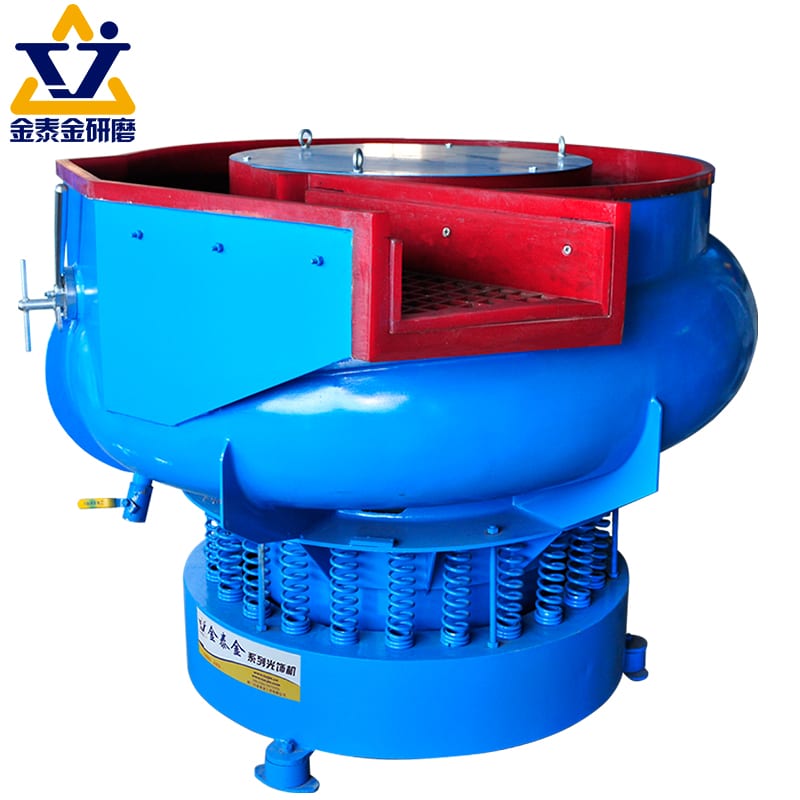
The scale of the class, for reference
We do not publish a wheel polishing model — the machine is built around a fixture and the fixture around the part, so it is quoted from a drawing and a trial rather than from a catalogue. To give a sense of the scale, published third-party figures for a comparable class of finishing machine sit in the range of a floor-standing unit roughly 1.5 to 2.5 m in its longest horizontal dimension, 600 to 900 kg net weight, and 4 to 16 kW of installed power — the same order as the machines in our own catalogue, which run to 2500 mm in length and 800 kg in the larger models.
Read that as an order of magnitude for the class, not as our specification. It tells you what floor area and what supply a wheel polishing cell implies; it does not tell you what to buy.
Where wheel polishing equipment will not help
High volume of small parts. A wheel works one contact point at a time on one part. For hundreds of small parts, a loose charge reaches every face at once at a fraction of the per-part cost. This is the most common wrong purchase.
Complex internal geometry. A wheel cannot enter a bore, a cross-hole or a deep recess. If the critical feature is internal, the process is a different family — a magnetic machine, or a secondary operation.
A part where every edge must stay sharp. Every wheel family rounds the edge it contacts. If the drawing requires sharp, a wheel is the wrong tool.
A requirement for an isotropic finish. A wheel produces a directional lay, because the contact runs in one direction. If the specification calls for no directional pattern, the process is wrong rather than the machine.
A part mix too wide for a fixture. If the shop runs many part numbers in low volume, the fixture cost and changeover exceed the labour saved. A loose charge handles variety; a wheel machine does not.
A line with a takt shorter than the polishing time. An in-line station that cannot keep up becomes the line's bottleneck. That has to be resolved in the line design, not by buying a faster spindle.
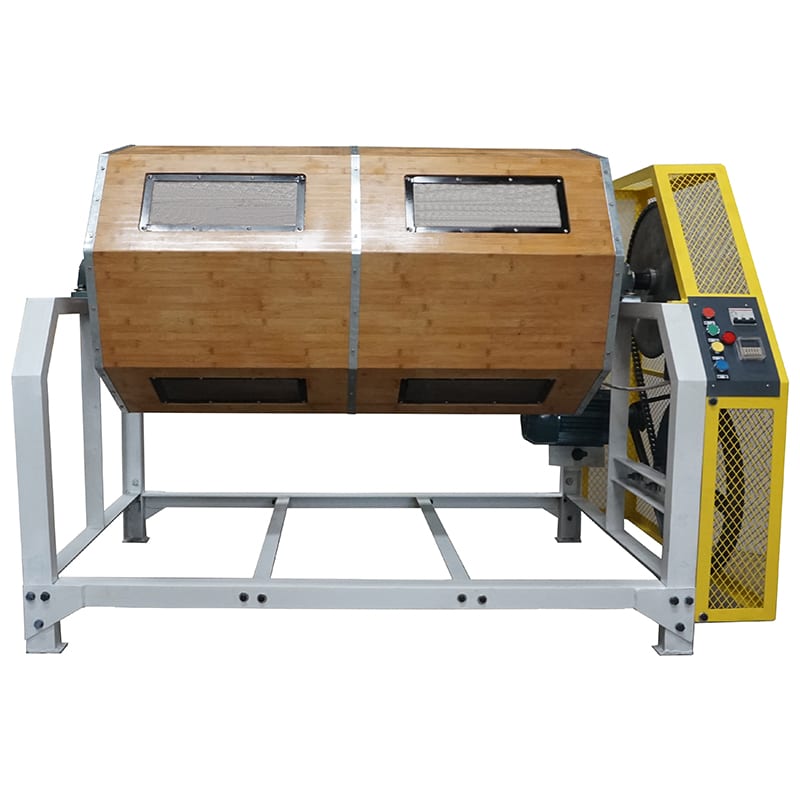
Wheel Polishing Equipment Selection by Throughput
Throughput is quoted in parts per hour, and the honest way to get that number is from the cycle, the batch and the changeover - not from a catalogue figure.
How to calculate parts per hour
Take the cycle time for one batch, add the load and unload time, add the changeover time amortised across the batch, and divide the batch by the total. The third term is the one buyers forget, and on a high-mix shop it can be the largest of the three. A machine that is fast in cycle but slow to change over is a machine that is slow.
One machine or several
One machine with a longer queue is usually cheaper than two machines idle half the time, until the queue itself becomes the constraint. The crossover is where the waiting time starts costing more than the second machine would - which is a scheduling question rather than a technical one, and worth answering before the capital is committed.
Changeover time, and why it is a specification
On a wheel cell the changeover includes the fixture, the media change and the re-validation of the first part. It belongs in the specification alongside the cycle time, because a cell that cannot be changed over quickly cannot serve a high-mix shop at all - regardless of how well it polishes.
Integration with Existing Deburring Lines
A wheel polishing cell is rarely bought into an empty building. What decides the integration cost is how the parts arrive, how they leave, and whether the two processes can share a buffer.
The questions worth settling before the order: does the deburring line discharge parts in a way the polishing cell can accept without re-racking; can a single operator serve both stations; and does the polishing cell need a dry part, which would put a dryer between the two. Each of those is a cost that does not appear on the machine offer, and each of them can change which form is the right one.
What to send with an enquiry
- The part and the drawing, with the face to be polished marked and the faces that must not be touched.
- The material and its condition, because a hardened and a soft version of the same alloy behave differently under the same wheel.
- The stock to be removed, in tenths of a millimetre, and the finish target — roughness and appearance, which on a cosmetic part are two requirements.
- The geometry the wheel must follow — flat, cylindrical, profiled, or a mix.
- How the part can be held, and where the fixture may grip.
- The volume and the part-number count — because the second number decides the fixture cost and the changeover.
- Whether it stands alone or goes into a line, and if a line, the takt it has to match.
- The site: electrical supply, extraction, noise tolerance, and the floor area against the class scale above.
FAQ
What is wheel polishing equipment used for? Bringing a defined face or simple profile to a bright finish by pressing a rotating abrasive wheel against it, with compound. It suits large, few, valuable or profiled parts and rework on a single component — not volume production of small parts.
How many spindles do I need? As many as it takes to remove the non-contact time from the cycle. On a manual single-spindle machine, loading and positioning usually take longer than the polishing, and a multi-spindle or carousel form exists to make that time productive.
Do I need a different fixture for every part? Yes, effectively. The fixture is cut to the part, so a job with four variants needs four sets. That is why a wheel process suits low-to-medium volume, higher-value work rather than a high-mix shop.
Can wheel polishing equipment go into a production line? Yes, as an in-line station — but the station has to match the line's takt, and the part presentation has to be compatible with how the line delivers parts. A carousel cannot be fitted into a line that delivers parts in single file.
What services does it need? Three-phase supply in the 380–415 V class for floor machines, extraction or mist collection on any wet or compound process, and the floor area the class scale above implies. Noise sits in the 75–85 dB(A) band at one metre.
Can you supply wheel polishing equipment? We do not publish a catalogue model for it. We build to a workpiece: from the part, the drawing, the fixture requirement and the finish target, we propose a configuration and test it on your parts before the specification is fixed. The trial is the deliverable, not the datasheet.
Max Xu, Sales — Xiamen Jin Tai Jin Grinding Technology Co.,Ltd.
No. 31, Xinchang Road, Xinyang Industrial Zone, Haicang District, Xiamen
info@surface-polish.com
The class-scale figures quoted are third-party published values given for reference only; they are not our specification and no machine is offered against them. This article describes how a wheel polishing equipment form is chosen; it is not a claim about any specific part's achievable result. A finishing process is set by the material, the stock to be removed and the finish required, so the configuration for a specific part is confirmed against a trial on that part. We manufacture finishing equipment and the media and compounds that run in it; we do not offer a job-shop finishing service.
 +86-592-2381506


 IPv6 network supported
